 Vista
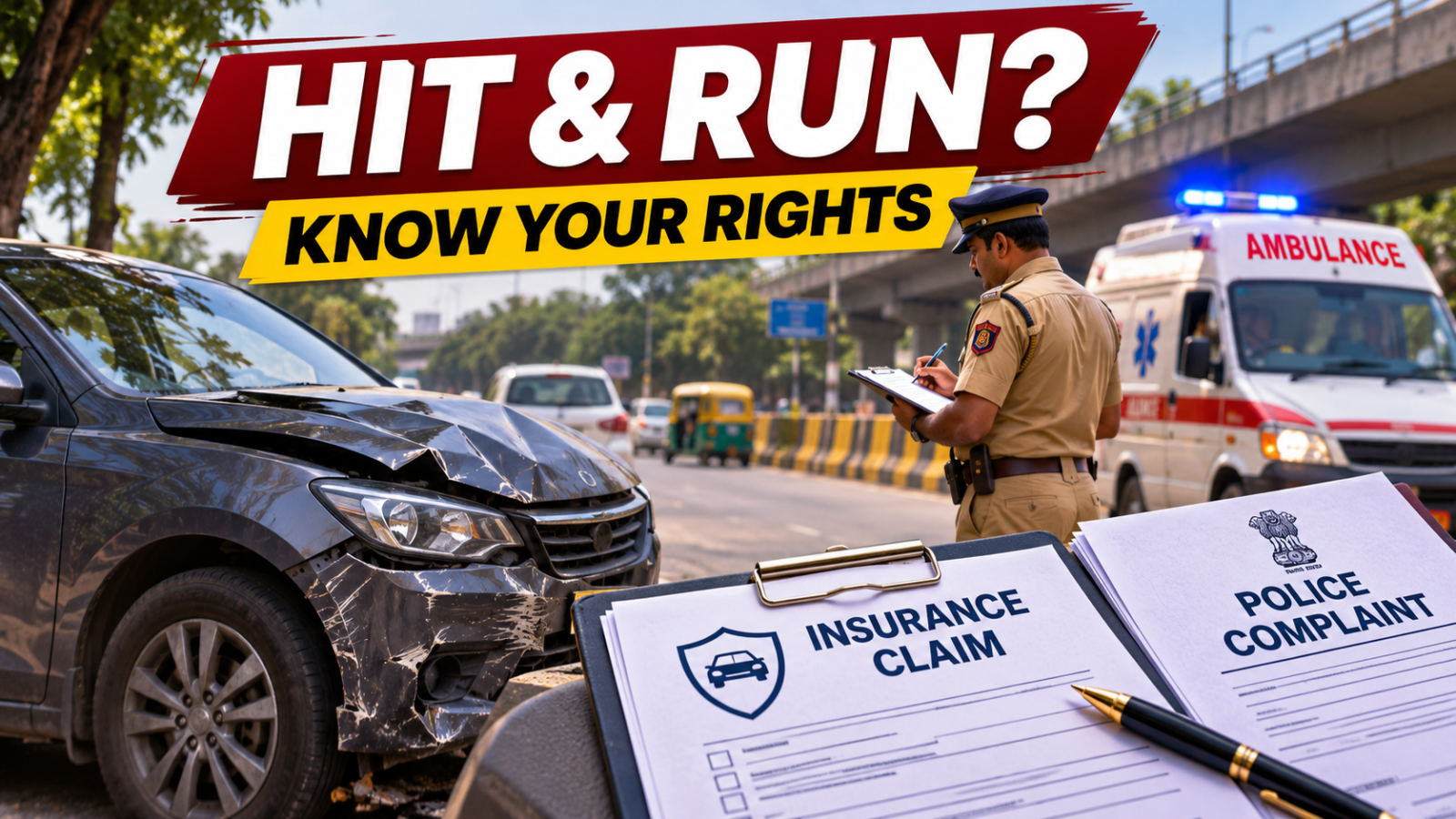
If a vehicle hits you or a family member and disappears, call 112 for emergency assistance, obtain medical care and report the accident to the police. You do not need to know the vehicle’s registration number to report what happened. In India, eligible victims of an accident involving an untraceable motor vehicle can claim fixed compensation of ₹50,000 for grievous hurt or ₹2 lakh for death. Eligible road accident victims can also access cashless medical care under PM-RAHAT. Here is how to distinguish these benefits from an ordinary motor insurance or tribunal claim.
Information reviewed: 24 November 2026 | Jurisdiction: India
1. What to do immediately after a road accident
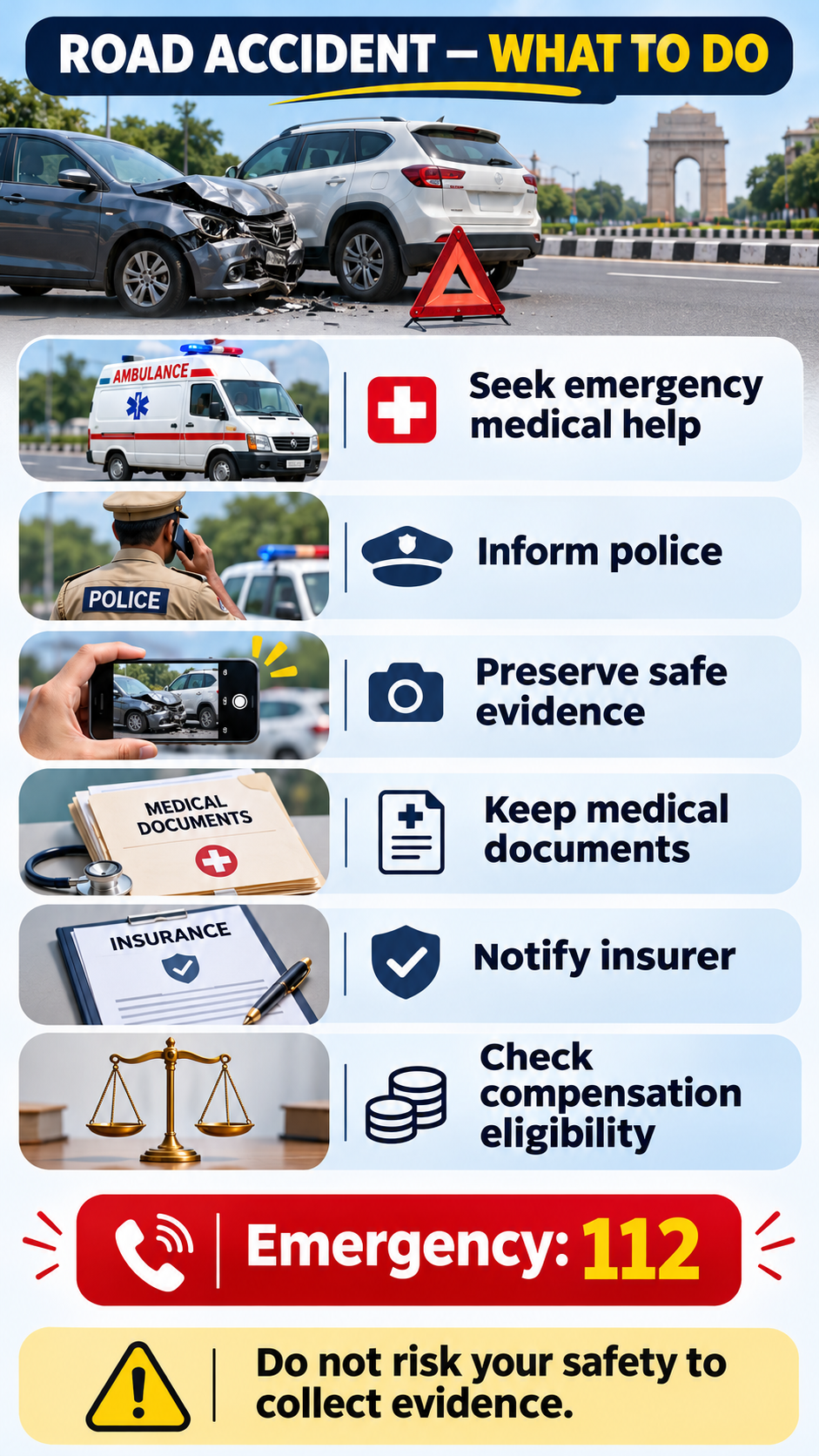
Move yourself away from moving traffic if you can do so safely. Call 112 and explain the location, number of injured people and any immediate danger. On national highways, 1033 is another assistance number. Give the nearest landmark or highway marker rather than assuming that responders already know your position. Do not chase the fleeing driver or stand in an active traffic lane to collect evidence.
Prompt medical assessment matters even if an injury initially seems minor. Loss of consciousness, breathing difficulties or suspected head and spinal injuries require urgent attention. Unless an immediate hazard makes movement necessary, avoid unnecessarily moving someone with a suspected spinal injury. Follow emergency responders’ instructions.
India’s Good Samaritan protections, including section 134A of the Motor Vehicles Act, are intended to protect people who voluntarily assist accident victims in good faith. A bystander who takes an injured person to hospital should not be forced to pay the patient’s medical bill simply because they helped. A person who voluntarily agrees to become a witness may need to follow the applicable witness procedure. Helping safely is more important than obtaining a recording of the incident.
2. How to report a hit-and-run accident and obtain an FIR
Tell the police exactly what you know: the approximate time, road, direction of travel, vehicle type, colour, registration number or partial number if observed, and the nature of the injuries. If you did not see the number, state that clearly. Avoid filling gaps with guesses or accusing someone on the basis of an unverified social media message.
Under section 173 of the Bharatiya Nagarik Suraksha Sanhita, information about a cognizable offence may be given to a police station regardless of territorial jurisdiction. This is commonly called a Zero FIR when the case must be transferred to the appropriate station. Electronic reporting is also permitted subject to the required signature within three days. Obtain the free FIR copy. If recording of cognizable information is refused, the statutory escalation route includes sending written information to the Superintendent of Police and, where necessary, approaching the competent Magistrate.
Ask the hospital for the medico-legal case reference where applicable. If emergency treatment delayed the report, explain the actual reason. Keep the police station’s contact details and the investigating officer’s reference. An FIR starts a criminal investigation; it is not itself an approval of insurance benefits or a compensation award. Follow up with the relevant claim authority separately.
3. Hit-and-run compensation amount in India in 2026
The central Compensation to Victims of Hit and Run Motor Accidents Scheme, 2022, effective from 1 April 2022, implements the fixed compensation mechanism under section 161 of the Motor Vehicles Act. Its key distinction is whether the offending motor vehicle remains unidentified despite reasonable efforts to establish its identity.
- Death attributable to the qualifying accident: ₹2,00,000 for eligible legal representatives.
- Grievous hurt: ₹50,000 for the eligible claimant.
- Minor injuries or vehicle damage alone: generally outside this fixed compensation scheme.
These figures are not the maximum value of every road accident claim in India. They apply to this particular statutory mechanism. If investigators identify the offending vehicle, even though its driver initially fled, the appropriate insurance and Motor Accident Claims Tribunal routes may be different. The classification of an injury as grievous hurt depends on the relevant legal and medical assessment, not merely on whether the person spent a night in hospital.
For example, suppose a pedestrian suffers a qualifying serious injury after being struck by an unknown vehicle. The police are unable to identify it despite reasonable efforts. The pedestrian can seek the statutory ₹50,000 benefit, subject to verification. If a later investigation identifies the vehicle, obtain advice about the available tribunal claim and statutory adjustment of compensation already received. Never assume multiple benefits can simply be added together without examining their rules.
4. How to apply for compensation: the March 2026 amendment
The Ministry of Road Transport and Highways issued amendment notification G.S.R. 153(E) dated 2 March 2026, published on 5 March 2026. Use the updated application forms rather than relying on old versions from unrelated websites.
Contact the designated Claims Enquiry Officer responsible for the sub-division or taluka where the accident occurred. The district administration or investigating police can help identify the correct office. Submit Form I, Form IV undertaking and the supporting documents; electronic submission is also contemplated by the amended scheme. Ask the local authority which submission channel it currently uses.
Prepare a copy of the FIR, injury report or post-mortem report as relevant, identity and address documents, claimant contact details, bank details and supporting account records. For a death claim, include the death certificate and evidence of the claimant’s legal relationship to the victim as required. Retain copies and obtain a dated acknowledgement with the application reference.
The Claims Settlement Commissioner reviews the enquiry report. The amended scheme aims for a sanction decision within fifteen days of receipt of that report wherever possible, rather than guaranteeing payment fifteen days after the crash. Approved cases are routed through the General Insurance Council for payment from the designated fund account. If the claim is delayed, request its status and any missing-document list in writing. The District Road Safety Committee can provide guidance. Never pay a stranger an advance fee to release compensation or share banking passwords or OTPs.
5. PM-RAHAT cashless treatment for road accident victims
Launched nationwide on 13 February 2026, PM-RAHAT provides eligible victims of motor vehicle road accidents with treatment coverage up to ₹1.5 lakh per person for up to seven days from the accident date at designated hospitals. It covers eligible accidents on different categories of roads and includes uninsured and hit-and-run cases.
Ask the emergency department whether it participates in the scheme and how the case will be recorded. If you are taken to a non-designated facility, ask about initial stabilisation and appropriate referral arrangements. Do not postpone urgent treatment while waiting for paperwork. This benefit pays eligible treatment costs through the scheme; it is not a cash grant of ₹1.5 lakh to every patient. Expenses beyond the covered period or amount may require other insurance or funding arrangements.
6. Motor insurance and MACT claims when a vehicle is identified
Where the vehicle is identified, an injured person or legal representative can investigate a claim before the Motor Accident Claims Tribunal (MACT). A fault-based application under section 166 may involve evidence about negligence, medical expenses, disability, earnings and dependency. Section 164 also provides a separate fixed no-fault mechanism. Seek advice on which route is appropriate and how different benefits interact. A tribunal award depends on the relevant facts and applicable law.
Notify your own motor insurer promptly if your vehicle was damaged. Third-party-only insurance ordinarily does not cover repairs to your own vehicle. Check the own-damage or comprehensive cover, policy exclusions and survey requirements before authorising repairs. Check personal accident, health and life policies where relevant. Obtain written reasons if a claim is rejected. Filing rules and limitation issues can depend on the accident date and applicable legal developments, so do not delay seeking professional advice.
7. Documents and evidence to preserve
Keep original photos or videos obtained safely, witness details, nearby CCTV locations, hospital records, discharge summaries, prescriptions, receipts and income records. Tell police about CCTV promptly because recordings may be overwritten. Keep a timeline of communications with the insurer, hospital and authorities. Do not post medical records or bank information publicly. Avoid signing an unexplained full-and-final settlement merely because someone promises immediate payment. Eligible applicants can seek assistance through the District Legal Services Authority.
Related: What to do if your sold vehicle’s RC has not been transferred.
Frequently asked questions
Can I claim compensation without the vehicle number?
Yes, potentially, under the fixed hit-and-run scheme if the vehicle remains unidentified despite reasonable efforts and the other eligibility requirements are met.
Does every injured victim receive ₹50,000?
No. The statutory benefit requires grievous hurt and a qualifying hit-and-run accident.
Is ₹2 lakh the maximum death compensation?
It is the fixed death benefit under the particular unknown-vehicle scheme, not a universal cap on MACT awards.
Can I report the accident at a different police station?
Information about a cognizable offence can be recorded regardless of territorial jurisdiction, subject to the applicable procedure.
Do I need a lawyer to submit Form I?
You can approach the designated officer yourself. Legal assistance is particularly valuable for contested liability, tribunal cases and rejected claims.
Is cashless treatment the same as accident compensation?
No. PM-RAHAT funds eligible treatment, while fixed compensation and tribunal awards have distinct legal purposes and requirements.
Conclusion and official references
Prioritise emergency care, report accurately, preserve the documents and choose the correct claim mechanism. Do not let uncertainty about the vehicle number prevent you from seeking medical help and reporting the accident.
- PIB: 2022 hit-and-run compensation scheme
- Gazette: 2026 amendment and revised forms
- PIB: PM-RAHAT treatment coverage
- Emergency Response Support System | India Code | NALSA
This guide provides general legal information, not individual legal advice or a guarantee of payment.
For all topics: Where to Complain in India: Police, Courts, Consumer, Banking and Government Legal Help



Share Your Opinion
Comments are closed on this post.