 Vista

Updated: 24 November 2026
There is no universal rule that a child must live with the mother or the father after divorce in India. Family courts assess the child’s welfare, including safety, education, emotional relationships, health and day-to-day care. Where the Hindu Minority and Guardianship Act applies, custody of a child who has not completed five years of age should ordinarily be with the mother, subject to the child’s welfare. Turning five does not automatically transfer custody to the father.
If either parent is being prevented from meeting the child, an application for visitation, contact or interim custody may be available. Parents do not necessarily have to wait until a divorce is finalised to seek appropriate arrangements.
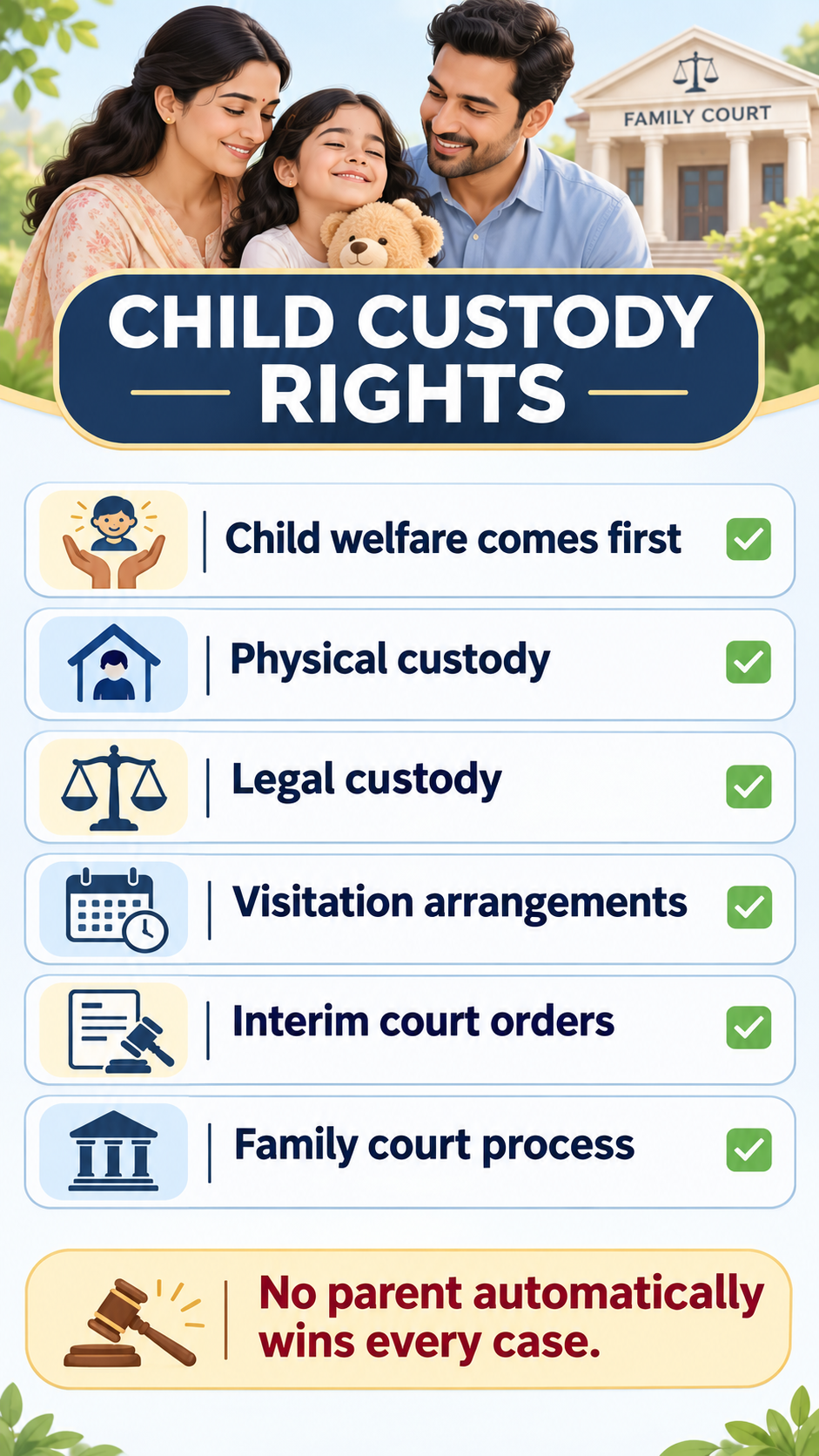
What is child custody? Physical custody, guardianship and joint parenting
Custody generally concerns where a child lives and who provides everyday care. Guardianship can involve wider legal responsibilities concerning the child’s person or property. A parent who does not have primary physical custody does not automatically lose every legal responsibility or opportunity for contact. The applicable law and particular court order matter.
| Arrangement | Practical meaning |
|---|---|
| Physical custody | The child’s living arrangements and day-to-day care. |
| Legal custody or guardianship | Authority and responsibilities concerning important decisions, including education and healthcare, under applicable law and orders. |
| Joint parenting | Sharing parenting time or responsibilities through an appropriate arrangement. |
| Visitation and contact | Personal meetings, holiday stays, telephone calls or video contact. |
| Interim custody | A temporary arrangement while proceedings remain pending. |
These are practical explanatory terms rather than identical statutory categories across every Indian personal law. Joint custody does not necessarily require the child to spend exactly half of every week with each parent. A suitable arrangement must reflect the child’s circumstances.
Which Indian laws govern child custody after divorce?
The Guardians and Wards Act, 1890 provides a general legal framework for guardianship proceedings. Section 7 concerns the court’s power to appoint or declare a guardian. Section 12 provides for production of the minor and temporary custody or protection, while section 17 identifies factors relevant to determining the child’s welfare. Under section 9, the child’s ordinary residence is generally important for jurisdiction in applications concerning guardianship of the person. A brief or temporary move does not necessarily establish ordinary residence.
Sections 6 and 13 of the Hindu Minority and Guardianship Act, 1956 address natural guardianship and the paramount importance of the minor’s welfare. Section 26 of the Hindu Marriage Act, 1955 and section 38 of the Special Marriage Act, 1954 provide for custody, maintenance and education orders in relevant matrimonial proceedings. The Divorce Act, 1869 and the Parsi Marriage and Divorce Act, 1936 contain related provisions. For Muslim families, applicable personal law and the Guardians and Wards Act must be considered together where relevant.
Section 7 of the Family Courts Act, 1984 includes proceedings concerning guardianship, custody and access to minors. Where a Family Court has been established, it ordinarily exercises the relevant jurisdiction. Elsewhere, identify the competent court under the applicable legislation.
Who gets custody of a child under five in India?
The proviso to section 6 of the Hindu Minority and Guardianship Act states that custody of a minor who has not completed five years of age should ordinarily be with the mother. In Roxann Sharma v. Arun Sharma (2015), the Supreme Court examined this principle in the context of interim custody. The ordinary preference is not an absolute guarantee: evidence showing that a different arrangement is necessary for the child’s welfare can affect the outcome.
There is no automatic transfer of custody when a child reaches five. Neither is there a universal rule awarding daughters to mothers and sons to fathers. Age, schooling, caregiving relationships, health, safety and stability all matter. Under section 17(3) of the Guardians and Wards Act, a court may consider the child’s preference when the child is sufficiently mature to form an intelligent preference. The child should not be pressured into choosing a parent, and their preference is not necessarily decisive.
Does a parent with a higher income automatically win custody?
No. Financial resources can be relevant, but a parent’s salary is not a substitute for evaluating the child’s welfare. A mother without independent earnings does not automatically lose custody. Similarly, a father who earns less than the mother is not automatically unsuitable. Courts may consider stable accommodation, availability for daily care, educational continuity, medical needs, family support and arrangements for maintenance.
In Gaurav Nagpal v. Sumedha Nagpal (2009) 1 SCC 42, the Supreme Court emphasised the child’s overall welfare over competing parental claims. For example, one parent might earn a higher salary but travel frequently, while the other has been the child’s regular caregiver. Such circumstances require a complete assessment rather than an automatic preference for either parent.
Both parents should provide accurate financial and caregiving information. Proposing a workable budget for schooling, healthcare and everyday expenses can help explain how the child’s needs would be met under the requested arrangement. Maintenance obligations can be determined separately.
What if your wife or husband does not allow you to meet the child?
Where communication is safe and no court restriction prevents it, propose a reasonable written contact arrangement that respects school schedules and the child’s routines. If an existing visitation order is being breached, retain a copy and a factual record of missed visits. Seek appropriate enforcement, clarification or modification through the competent court. If no order exists, apply for interim visitation or contact arrangements.
In Yashita Sahu v. State of Rajasthan (2020) 3 SCC 67, the Supreme Court recognised the importance of maintaining a child’s relationship with both parents, including meaningful visitation and remote contact. However, where abuse, violence or other safety risks are present, the court may impose supervised visitation, restricted communication or other protective arrangements.
A parenting plan can specify weekends, school holidays, festivals, video calls, neutral handover locations, transport responsibilities and arrangements for missed visits. These are suggestions, not mandatory schedules. Avoid forcibly taking the child, collecting them from school contrary to an order or threatening the other parent. If there is an immediate safety concern, seek urgent lawful assistance.
How to apply for child custody and interim visitation in Family Court
- Identify the competent court based on ordinary residence, applicable matrimonial legislation and any existing proceedings.
- Collect the child’s birth certificate, school and relevant medical records, details of present care and previous court orders.
- Prepare the appropriate custody or access application, seeking interim relief where necessary.
- Explain your proposed arrangements for accommodation, education, healthcare, travel and contact with the other parent.
- Participate in hearings, counselling or appropriate mediation according to court directions, with safety concerns raised where relevant.
- Follow the resulting order and seek a lawful variation if circumstances materially change.
Interim orders may be sought under section 12 of the Guardians and Wards Act or relevant matrimonial legislation. Section 21 of the Protection of Women from Domestic Violence Act, 2005 also provides for temporary custody in eligible proceedings. If a child is in immediate danger, contact emergency services on 112 or the child helpline 1098. Police assistance is not ordinarily a substitute for obtaining custody directions from a competent court.
Custody arrangements may be reconsidered when the child’s needs, health, safety or living circumstances change. No universal deadline guarantees completion of every custody proceeding.
Frequently asked questions
Can I seek custody or visitation before divorce?
Yes. Appropriate guardianship or custody proceedings may be available while parents are separated.
Does remarriage automatically disqualify a parent?
No. The effect of changed circumstances on the child’s welfare must be assessed.
Can visitation be withheld because child maintenance is unpaid?
Maintenance and access are separate issues. Seek appropriate court directions rather than unilaterally breaching an order.
Is equal parenting time guaranteed?
No. The child’s welfare determines the appropriate arrangement.
Where can I get free legal assistance?
Contact your District Legal Services Authority or NALSA’s helpline 15100 to check eligibility.
Conclusion: Focus on the child’s safety, stability and emotional needs, and seek a workable custody and contact arrangement through the appropriate court. Protect the child’s privacy and avoid involving them in parental disagreements.
Legal references: India Code — Guardians and Wards Act, Hindu Minority and Guardianship Act, Hindu Marriage Act, Special Marriage Act and Family Courts Act; Supreme Court of India; NALSA. See the linked judgments above. This is general legal information, not individual legal advice.
























Share Your Opinion
Comments are closed on this post.