 Vista

Updated: 24 November 2026
After buying agricultural land in India, check whether the revenue department has recorded the change of rights through mutation, also known as Namantaran or Dakhil Kharij. If you need to establish the physical boundary of a field or plot, apply separately for an official demarcation or land survey. A registered sale deed, a mutation entry and a boundary survey serve different purposes. Completing one does not necessarily complete the others.
This guide explains how to obtain updated land records, apply for mutation, request a government survey and follow up on delayed applications. It covers Madhya Pradesh, Uttar Pradesh, Bihar and Rajasthan. State procedures, fees and designated officers vary. Urban municipal properties, development authority plots and restricted land categories may follow separate rules.
What is the difference between registration, mutation and demarcation?
| Process | Purpose |
|---|---|
| Registration | Registers the instrument of sale or another transfer of rights |
| Mutation | Updates the relevant revenue record following acquisition of rights |
| Demarcation | Identifies the physical boundaries using authorised records and survey procedures |
| Partition | Separates the shares of joint holders through the applicable legal process |
| Record correction | Corrects an inaccurate entry under the appropriate procedure |
Suppose you buy a field from a farmer and obtain a registered sale deed. Mutation may be necessary to reflect the transaction in the revenue record. If a neighbour subsequently questions the location of the boundary, a separate demarcation application may be required. If you bought only a share in a jointly held plot, lawful partition or subdivision of the map may also be necessary before a distinct physical parcel can be identified.
In Jitendra Singh v. State of Madhya Pradesh (2021), the Supreme Court reaffirmed that mutation entries do not independently confer or extinguish ownership. A disputed title must be resolved by the competent court or statutory forum. Revenue entries are useful records, but they are not a substitute for examining the underlying legal rights.
How to apply for land mutation after registration
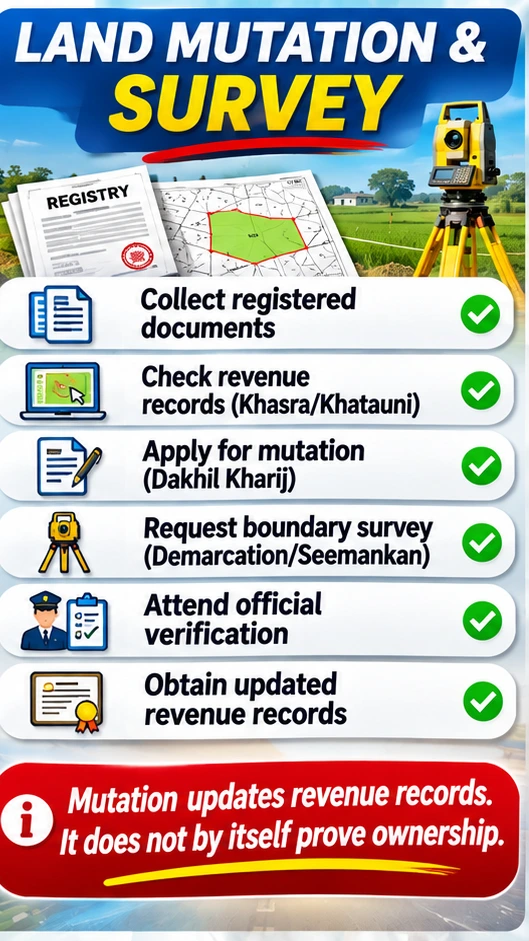
- Collect the registered sale deed and the existing record of rights, Khasra, Khatauni, Jamabandi or equivalent state record.
- Check the official revenue portal to see whether a mutation case has already been generated through the registration system.
- If a separate application is necessary, use the designated online service or competent revenue office.
- Enter the district, tehsil, village, survey or plot number, area and basis of acquisition.
- Submit the prescribed documents and official fee where applicable, and keep the acknowledgement number.
- Respond to notices and attend verification or hearings when required. Obtain the final order and check the updated certified record.
Mutation is not limited to purchases. Inheritance, a valid gift, partition and certain court orders may also require changes in revenue records. In inheritance cases, officials may request a death certificate, information about all relevant heirs and other evidence of succession. Do not omit a lawful heir merely because that person lives elsewhere.
Compare the new entry with the registered document. Check the spelling of the name, the precise parcel number, the area, the share acquired and any relevant remarks. If an entry is incorrect, obtain advice on the appropriate correction or appeal procedure. Do not treat an application acknowledgement as proof that the mutation has been approved.
How to request a government land survey or boundary demarcation
Begin by identifying the land precisely. Collect the authorised cadastral map, current revenue record, survey number, neighbouring parcel details and any available earlier survey report. Explain why the boundary needs to be identified, for example because a field boundary has become unclear or a neighbouring fence appears to cross the recorded line.
Apply to the competent authority using the official service for demarcation. The department may require a prescribed fee, documents and notice to affected landholders. An authorised surveyor or revenue official visits the site and measures the parcel using the applicable records and survey methodology. The equipment may vary depending on the local survey system. A phone GPS reading or a private measurement is not automatically equivalent to a statutory demarcation.
Attend the survey if required, make your records available and ask that genuine objections be documented. Obtain the measurement report, map and relevant order or certification. If you believe the measurement is incorrect, use the prescribed objection, review or appeal process. Do not move boundary stones or demolish a neighbouring structure yourself. Demarcation identifies boundaries; eviction or restoration of possession may require a separate lawful order.
Sample application for official land demarcation
To: The competent Revenue Officer / Tehsildar / Sub-Divisional Officer, ______ Tehsil, ______ District.
Subject: Application for official boundary measurement and demarcation of land.
Sir/Madam, I, ______, residing at ______, claim rights in land situated at Village ______, Survey/Khasra/Gata No. ______, measuring ______, as supported by the attached documents. The physical boundary is unclear / a dispute has arisen concerning the field boundary. I request an official survey after notice to the affected parties in accordance with applicable rules. Kindly provide the survey report, map and relevant order.
Attachments: current revenue record, land map, documents supporting rights, identity proof and other required records. Name, address, contact number, date and signature: ______.
This is a general covering-letter format. Use your state’s prescribed form, competent authority and fee requirements where applicable. Keep a dated acknowledgement and the application number for follow-up.
State-wise land mutation and demarcation services
Madhya Pradesh
Use MP Bhulekh to access available Khasra, B-1 and map records. The official MP e-Service directory lists revenue services including mutation through RCMS. Sections 109 and 110 of the Madhya Pradesh Land Revenue Code, 1959 concern reporting acquisition of rights and mutation, while section 129 deals with demarcation. Approach the competent revenue office or available online service for the relevant application. Confirm the case status and obtain the resulting records.
Uttar Pradesh
Check the Khatauni and Gata details through UP Bhulekh. The Revenue Court Computerised Management System (RCCMS) provides services connected with mutation under section 34 and boundary disputes or measurement under section 24 of the Uttar Pradesh Revenue Code, 2006. The competent Sub-Divisional Officer and revenue survey staff have roles in boundary proceedings. A joint parcel that has not been lawfully subdivided on the map may need additional proceedings first.
Bihar
Access online Dakhil Kharij through the Revenue and Land Reforms Department and BiharBhumi services. Have the district, Anchal, Mauza and Jamabandi details ready. For official measurement, use the separate e-Mapi service for Amin booking where applicable. Parimarjan Plus is a separate route for correcting eligible errors in digitised Jamabandi records.
Rajasthan
The official Apna Khata portal provides access to Jamabandi and mutation applications. Its Seema Gyan service is intended for boundary identification applications. Registration-linked automatic mutation may be available for eligible transactions, but verify the actual updated record rather than assuming that registration alone has completed the process.
How long does mutation take, and what if the survey is delayed?
There is no uniform national deadline or fee. For example, a Madhya Pradesh Legislative Assembly response dated 30 July 2025 stated prescribed service periods of 30 working days for uncontested mutation, five months for contested mutation and 45 working days for demarcation. Check the current state service rules when applying, including eligibility, applicable deadlines and the designated grievance authority. Objections, missing documents and complications relating to the parcel may require further proceedings.
If a Patwari or other official has not carried out the survey, send a written reminder with the application number, receipt and relevant dates to the competent revenue authority. Use the applicable public service guarantee, grievance or appeal mechanism. Ask for a written status rather than paying unofficial fees. If your Khasra or Khatauni contains an incorrect entry, request the specific record correction procedure. A substantive dispute over ownership should not be disguised as a simple clerical correction.
Frequently asked questions
Is mutation automatic after registering a sale deed?
Not everywhere. Check whether a case has already been initiated and whether the final updated entry has been issued.
Can a government survey take place if a neighbour is absent?
Applicable notice and hearing requirements must be followed. The competent official determines the effect of absence under the relevant rules.
What is the fee for official land demarcation?
Fees vary by state, service and parcel. Check the official schedule and retain your payment receipt.
Does a mutation certificate establish ownership?
No. The underlying legal rights and instruments remain important. Mutation alone is not conclusive proof of title.
Where can I complain about a delayed land survey?
Approach the competent revenue officer with your receipt and case details, then use the applicable escalation or appeal mechanism.
Conclusion: Treat mutation and demarcation as separate services. Verify your updated records, retain certified orders and obtain local legal advice when ownership or possession is seriously disputed. This guide is general legal information for India, not individual legal advice.






















Share Your Opinion
Comments are closed on this post.