 Vista
Updated: 24 November 2026
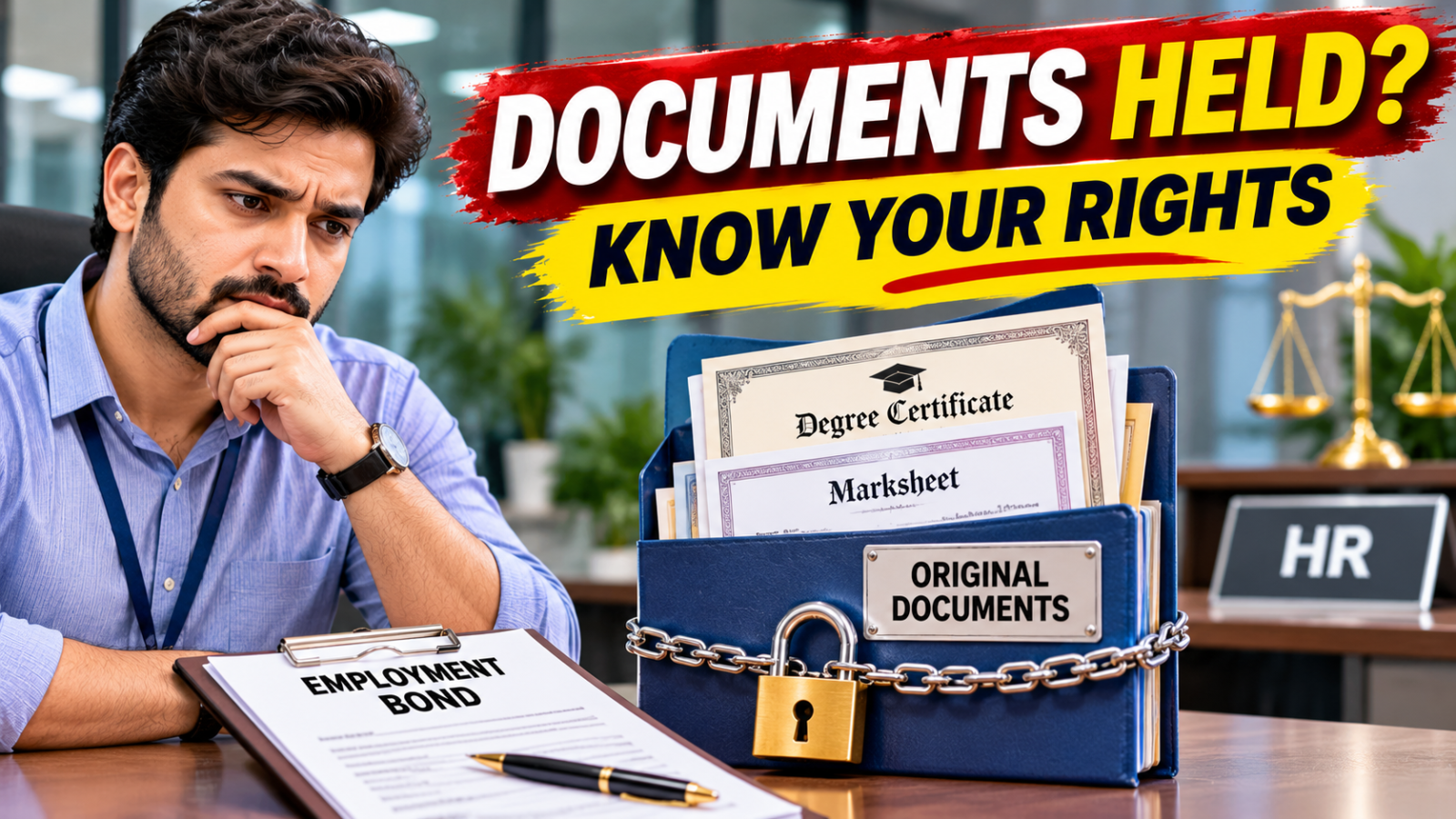
If your employer refuses to return your original marksheets, degree certificates or other personal documents in India, gather evidence of their submission and make a written request to HR. Ask the employer to identify the contractual or statutory basis for retaining them. A dispute about an employment bond and a request for the return of personal certificates are separate legal issues. Even an enforceable bond does not automatically establish an unlimited right to retain your certificates. Depending on your employment category and circumstances, labour authorities or a competent court may offer remedies.
This guide focuses on original documents, bond recovery and employment certificates, rather than the separate question of leaving a job without serving a notice period. State law, contractual terms and the nature of your work can affect the available remedies.
What to do when a company will not return original certificates
Employers may examine original educational qualifications during recruitment. Temporarily handing over a certificate for verification differs from allowing an employer to retain it as security for continued employment. Establish what was actually agreed and whether the company acknowledged receiving the documents.
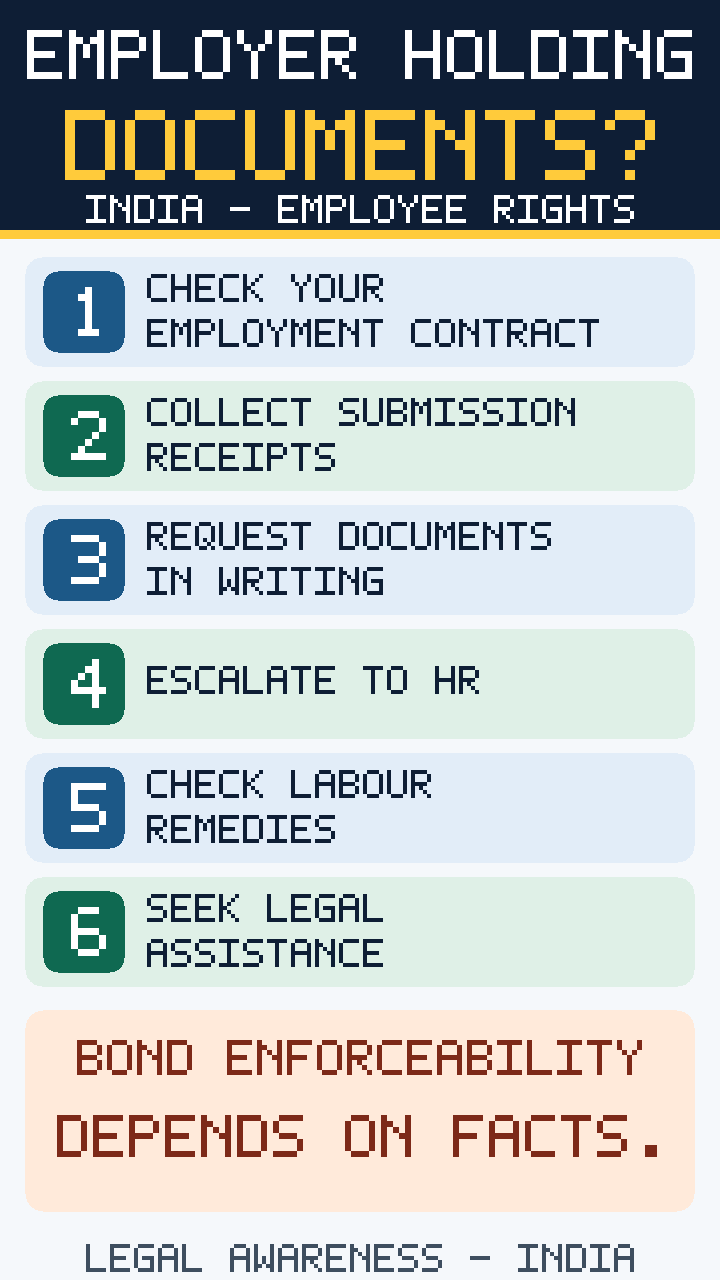
- List each original certificate, its issuing institution, year and identifying number.
- Locate the appointment letter, employment bond, training agreement, submission receipt and joining correspondence.
- Send HR a written request for the return of the documents and ask for the reason for any refusal.
- Escalate unresolved requests to senior management or the company’s designated grievance channel.
- Return company property such as laptops or identification cards through the proper handover process and obtain receipts.
- Seek advice about the appropriate labour or civil remedy if the certificates remain withheld.
If you did not receive a submission receipt, look for emails, joining checklists, witnesses and messages acknowledging that the employer holds your originals. Ask the company to confirm the inventory in writing. Do not attempt to recover the documents by forcibly entering an office or threatening staff.
Can an employer hold your degree as security for an employment bond?
Educational certificates can be essential for further studies, professional registration and recruitment. Where documents were deposited for verification or safekeeping, the circumstances may support a legal claim for their return. Sections 160 and 161 of the Indian Contract Act, 1872 address the return of bailed goods and responsibility for failure to return them at the appropriate time, where the legal requirements of bailment are met.
An employer asserting a contractual security right or lien must have its claimed legal basis assessed. Merely alleging a breach of the employment bond does not independently establish a valid right to retain personal certificates indefinitely. The employer may pursue a legitimate monetary claim through the appropriate legal procedure.
Sections 7 and 8 of the Specific Relief Act, 1963 provide remedies for recovery or delivery of specific movable property in appropriate circumstances. Section 39 concerns mandatory injunctions and may also be relevant. If withholding your documents threatens an imminent university admission or new employment opportunity, preserve the relevant deadline and offer letter. A lawyer can assess whether urgent interim relief should be sought. The precise remedy depends on the evidence and jurisdiction.
Are employment bonds legal in India? The 2025 Supreme Court judgment
An employment bond may require a minimum service period, reimbursement of specified training costs or compensation for an early departure. Indian law does not treat every bond as automatically void or automatically enforceable. Section 23 of the Indian Contract Act concerns lawful objects and public policy; section 27 concerns restraint of trade; sections 73 and 74 address compensation for contractual breach.
On 14 May 2025, the Supreme Court decided Vijaya Bank v. Prashant B Narnaware (2025 INSC 691). It upheld a clause requiring a bank employee to serve for three years or pay ₹2 lakh for leaving early, on the facts before it. The bank’s recruitment requirements, the senior employee’s position and remuneration, and the reasonableness of the clause were important considerations. The Court distinguished restrictions supporting employment during its term from restraints on future employment.
This decision is not blanket permission for private companies to impose arbitrary penalties or withhold educational documents. Review the particular agreement, the employer’s conduct, the legitimate interest protected by the clause and the basis of the amount claimed. Section 74 provides for reasonable compensation not exceeding the stipulated sum; the need to establish actual loss depends on the applicable legal principles and facts. Do not assume that signing a bond settles every question about its enforceability.
What if the company demands employment bond money?
Ask for the signed agreement, the minimum service period, details of any promised training and an itemised explanation of the amount claimed. Check whether the contract provides for a proportional reduction as you complete part of the required service. If the employer terminated your employment, failed to provide agreed training or breached another material obligation, preserve evidence of that conduct for legal review.
For example, an employee might complete eighteen months of a two-year bond and receive a demand for the entire stipulated amount. There is no universal rule that the amount must always be reduced proportionally to the six remaining months. The wording of the agreement and the applicable principles of reasonable compensation matter. Do not sign a fresh acknowledgement of liability or settlement under pressure without understanding its consequences. If an agreed payment is appropriate, obtain written settlement terms, a receipt and a clear arrangement for document return.
Sample written request for return of original documents
To: HR Manager / Authorised Officer, ______ Company.
Subject: Request for return of my original personal and educational certificates.
Dear Sir/Madam, I submitted the following original documents on ______ for recruitment or verification: ______. Please confirm their present custody and arrange their safe return by ______. If the company claims a contractual or statutory basis for retaining them, kindly provide the relevant provision and reasons in writing. My rights concerning any separate financial or employment dispute are reserved. I am available to cooperate with the appropriate collection and acknowledgement procedure.
Name: ______. Employee ID: ______. Contact: ______. Date: ______. Attachments: available submission receipt and relevant correspondence.
This is a general request, not a complete legal notice. You can propose a reasonable response period, such as seven days, but that is not a universal statutory deadline. Keep delivery evidence and any reply. If the company refuses or fails to respond, consult a lawyer about a formal notice and further remedies.
Labour complaints under India’s current labour framework
Implementation of the four labour codes began on 21 November 2025. The Ministry of Labour and Employment maintains current notifications and rules on its Labour Codes page. Under section 4 of the Industrial Relations Code, 2020, industrial establishments employing twenty or more workers must constitute a Grievance Redressal Committee for individual grievances. Eligible workers whose grievances remain unresolved may have access to conciliation through the prescribed procedure and applicable deadlines.
Not every salaried employee is a worker within the statutory definition. Managerial, administrative and certain supervisory positions may be treated differently. Actual duties matter as well as job titles. Check the relevant state Shops and Establishments legislation, applicable standing orders and employment rules. The official SAMADHAN portal and state labour departments can help identify the available complaint channels. A civil court may be the appropriate forum for a personal property claim or a contractual dispute outside the labour authority’s jurisdiction.
Experience letters, police complaints and joining a new employer
An original degree is different from an experience letter, relieving letter or employer-issued service certificate. Entitlement to a service certificate may arise from applicable standing orders, service regulations, state legislation or contractual terms. There is no universal right to a customised experience letter in every employment relationship. Request a factual certificate stating your period of employment and role.
If your next employer accepts alternative verification, provide genuine salary slips, appointment documents, resignation correspondence and available provident fund records. Eligible educational documents may also be available through DigiLocker. These alternatives can help with an urgent application without abandoning your claim to recover the originals.
Where there is evidence of dishonest misuse of entrusted property, forgery or threats, obtain advice about reporting actual criminal conduct. Section 316 of the Bharatiya Nyaya Sanhita, 2023 concerns criminal breach of trust and requires specific elements including dishonest conduct. A contractual disagreement alone does not establish a criminal offence.
Frequently asked questions
Can I go to jail for breaking an employment bond?
An ordinary contractual breach generally gives rise to civil remedies, not imprisonment. Genuine allegations of separate criminal offences require individual assessment.
Can I demand my degree without paying the bond?
Yes, you can make a separate written request for its return. Any legitimate monetary claim must be assessed on its own legal basis.
Can a company stop me from joining another employer?
Restrictions during employment differ from post-employment restraints. Obtain advice about the precise clause and your employment status.
Does the labour department handle every employee’s complaint?
No. The applicable law, worker classification and jurisdiction determine which forum can hear the dispute.
Where can I obtain affordable legal assistance?
Contact your District Legal Services Authority or NALSA’s helpline 15100 to check eligibility for free legal aid.
Conclusion: Preserve your document submission evidence, request the return of originals in writing and evaluate any bond demand separately. Use the appropriate labour or civil remedy rather than assuming every employment dispute is criminal.
Official sources: Indian Contract Act; Specific Relief Act; Industrial Relations Code; BNS; NALSA. General Indian legal information, not individual legal advice.























Share Your Opinion
Comments are closed on this post.