 Vista

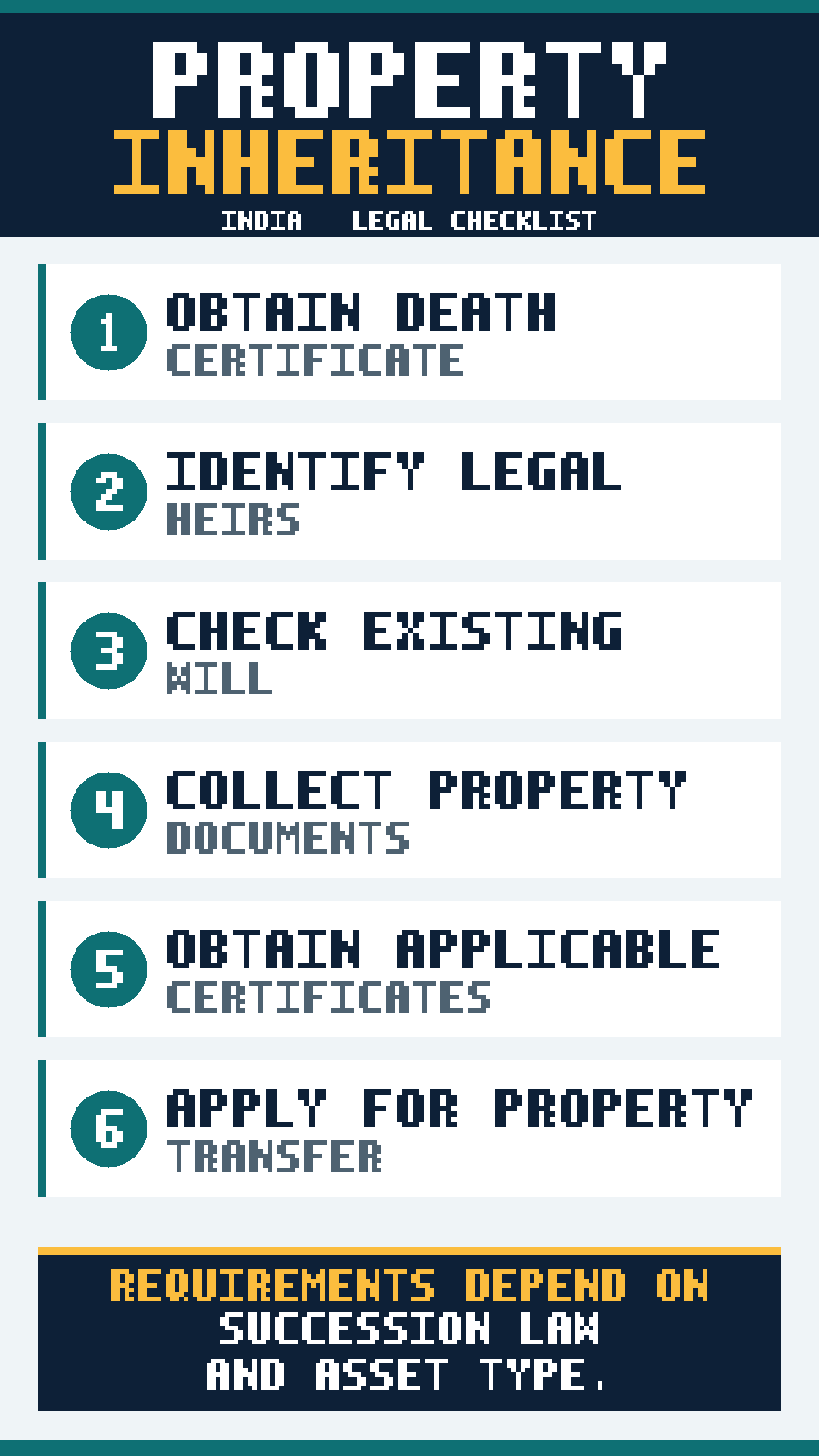
When a parent dies in India, transferring their house, land or bank deposits begins with obtaining the death certificate, identifying the rightful heirs and checking whether a valid will exists. Different assets require different procedures. Land may require inheritance mutation in revenue records, whereas bank deposits are handled through the bank’s deceased-customer claim process. A legal heir certificate, a succession certificate and probate are not interchangeable. Important changes to probate law in December 2025 and bank claim procedures applicable from April 2026 make it particularly important to check current requirements rather than rely on older advice.
Legal information reviewed: 24 November 2026 | India
1. Documents to collect after a parent dies
Obtain the official death certificate from the relevant births and deaths registration authority. Check the name, date and other identifying details against existing records. Make an inventory of the deceased person’s assets and liabilities, including agricultural land, residential property, deposits, investments, insurance policies, loans and mortgages. For jointly owned property, establish the deceased person’s actual interest before attempting to distribute the asset.
- Death certificate and identity and address documents of the claimants.
- Family details, relationship evidence and any applicable legal heir certificate.
- The original will and information about its witnesses, if one exists.
- Title deeds, land records, municipal property records and available bank statements.
- Documents concerning nominations, joint ownership, mortgages and pending disputes.
Keep originals secure and retain copies of applications and receipts. Possession of a title deed does not make someone the sole owner of the estate. Avoid operating the deceased person’s bank account using their password, debit card or PIN; use the bank’s authorised claim procedure. Check outstanding liabilities before distributing the estate, since a death does not automatically extinguish valid debts or security interests.
2. Inheritance without a will: who gets a father’s property?
Intestate succession means inheritance where there is no valid will governing the relevant property. India does not have a single inheritance formula for every family. The applicable personal or statutory law, type of property and date of death affect the result. The Hindu Succession Act, 1956 generally applies to Hindus, Buddhists, Jains and Sikhs, with statutory exceptions including specified treatment of Scheduled Tribes. Muslim personal law, applicable provisions of the Indian Succession Act and special or local legal regimes may provide different rules.
For a Hindu man dying intestate, sections 8 and 10 govern the distribution of his separately owned property among the relevant heirs. For example, suppose his only Class I heirs are his widow, his mother, one son and one daughter. In this simplified example, each receives one quarter of the estate available for distribution. Where a son or daughter died earlier leaving descendants, special branch-based distribution rules may apply. A daughter’s marriage does not itself remove her inheritance rights.
Hindu joint family coparcenary property requires a separate analysis under section 6, which recognises daughters’ coparcenary rights. Determine the deceased person’s share first, then apply the relevant succession rules to that share. Not every property inherited from an earlier generation qualifies as coparcenary property. Where a Hindu woman dies intestate, sections 15 and 16 prescribe a different order of succession, with special rules in certain cases depending on the source of inherited property. Do not automatically apply a father’s inheritance example to a mother’s estate.
3. Legal heir certificate vs succession certificate
A legal heir certificate is an administrative document used to establish family relationships or identify heirs for specified purposes. Its name, issuing authority, eligibility and application procedure vary by state. Some jurisdictions issue a family member certificate or a similarly named document. Check the relevant revenue office, district service centre or state e-district portal. Such a certificate assists with administrative claims; it does not conclusively determine disputed ownership or replace a valid transfer document.
A succession certificate is a judicial document under Part X of the Indian Succession Act, 1925. It primarily concerns debts payable to the deceased and specified securities, rather than title to a house or land. Under sections 371 and 372, an application is generally made to the District Judge with jurisdiction over the place where the deceased ordinarily resided at death. If there was no fixed residence, the location of property may determine jurisdiction. The petition identifies the deceased, relevant relatives, the claimant’s basis of entitlement and the debts or securities covered. The court follows the applicable notice, hearing and fee procedure.
Do not apply for an expensive or unnecessary certificate before asking the institution what documentation is legally required. A succession certificate facilitates collection of the covered assets but is not necessarily a final adjudication of beneficial ownership between competing heirs.
4. Wills, probate and the December 2025 legal change
A will records how a person wishes to dispose of property upon death. Where section 63 of the Indian Succession Act applies, an ordinary unprivileged will requires appropriate execution by the testator and attestation by at least two witnesses. Registration is generally optional, and a registered will can still be challenged. A testator cannot dispose of interests that they do not lawfully own. Some personal laws impose different restrictions on testamentary disposition.
The Repealing and Amending Act, 2025 (Act 37 of 2025) omitted section 213 of the Indian Succession Act with effect from 20 December 2025. That provision previously imposed a probate or administration requirement for establishing rights under certain wills in court, depending on the applicable community and territorial circumstances. The particular statutory requirement has now been removed. However, the legal mechanism for obtaining probate remains available. A disputed will, concerns about authenticity or complex estate administration may still justify or require appropriate judicial proceedings.
Probate is a court grant ordinarily issued to the executor appointed in a will. Letters of administration are a separate form of judicial authority that may be appropriate where an estate requires administration, including some cases without an executor. Consult a lawyer if there are multiple wills, allegations of undue influence or competing beneficiaries. The repeal does not validate an otherwise invalid will or settle an ownership dispute.
5. Property mutation after death: land, house and flat records
For agricultural land, apply for inheritance mutation at the competent revenue office or through the relevant state service portal. Provide the death certificate, existing land and title records, details of all heirs and the relevant testamentary or other documents. The authority may issue notices, conduct verification and consider objections. For example, Madhya Pradesh lists revenue mutation services through its state e-services portal. See also our land mutation and demarcation guide.
For urban property, approach the municipal authority, development authority or housing society as applicable to update the relevant records. Mutation is principally a revenue or administrative record update; it does not itself confer title. If several heirs inherit a property but want only one of them to become its sole owner, an appropriately executed and registered release, partition or other transfer instrument may be necessary. A simple no-objection letter does not necessarily extinguish another heir’s ownership interest. Seek adjudication from the competent court where title or inheritance is contested.
6. Bank deposits: nominee vs legal heir under 2026 RBI rules
Notify the bank and request its deceased-customer claim form. Under the relevant RBI directions applicable from 1 April 2026, qualifying nominee or survivor claims generally require the claim form, death certificate and official identity and address documentation. Subject to the prescribed conditions, the bank should not insist on a succession certificate or probate merely because the deposit is large. The nominee receives the deposit subject to the rights of the legal heirs; nomination does not automatically determine beneficial ownership.
For an uncontested claim without nomination, survivorship arrangements or a will, and without a restraining court order, the simplified documentation threshold is ₹15 lakh for banks other than cooperative banks and ₹5 lakh for cooperative banks, or a higher limit set by the bank. Documents may include an indemnity, legal heir certificate or acceptable independent declaration and disclaimers from non-claimant heirs where applicable. Even above the threshold, applicable rules may allow alternative documentation. Banks must settle deposit claims within 15 calendar days after receiving all required documents. Government savings schemes and other assets may follow separate rules.
Frequently asked questions
Does the eldest son automatically inherit everything?
No. Entitlement depends on the applicable succession law and valid testamentary arrangements.
Does a succession certificate transfer ownership of land?
No. Its main purpose concerns specified debts and securities.
Has probate been abolished in India?
No. The section 213 requirement was removed, but probate remains a judicial remedy.
Is the bank nominee always the sole beneficiary?
No. Bank nomination does not extinguish the legal heirs’ beneficial claims.
Conclusion and official references
Identify the rightful heirs and use the process appropriate to each asset. Consult the Hindu Succession Act, updated Indian Succession Act, 2025 Gazette amendment and RBI banking directions.
General legal information, not individual legal advice. Applicable personal laws and state procedures vary.
For all topics: Where to Complain in India: Police, Courts, Consumer, Banking and Government Legal Help



























Share Your Opinion
Comments are closed on this post.