 Vista
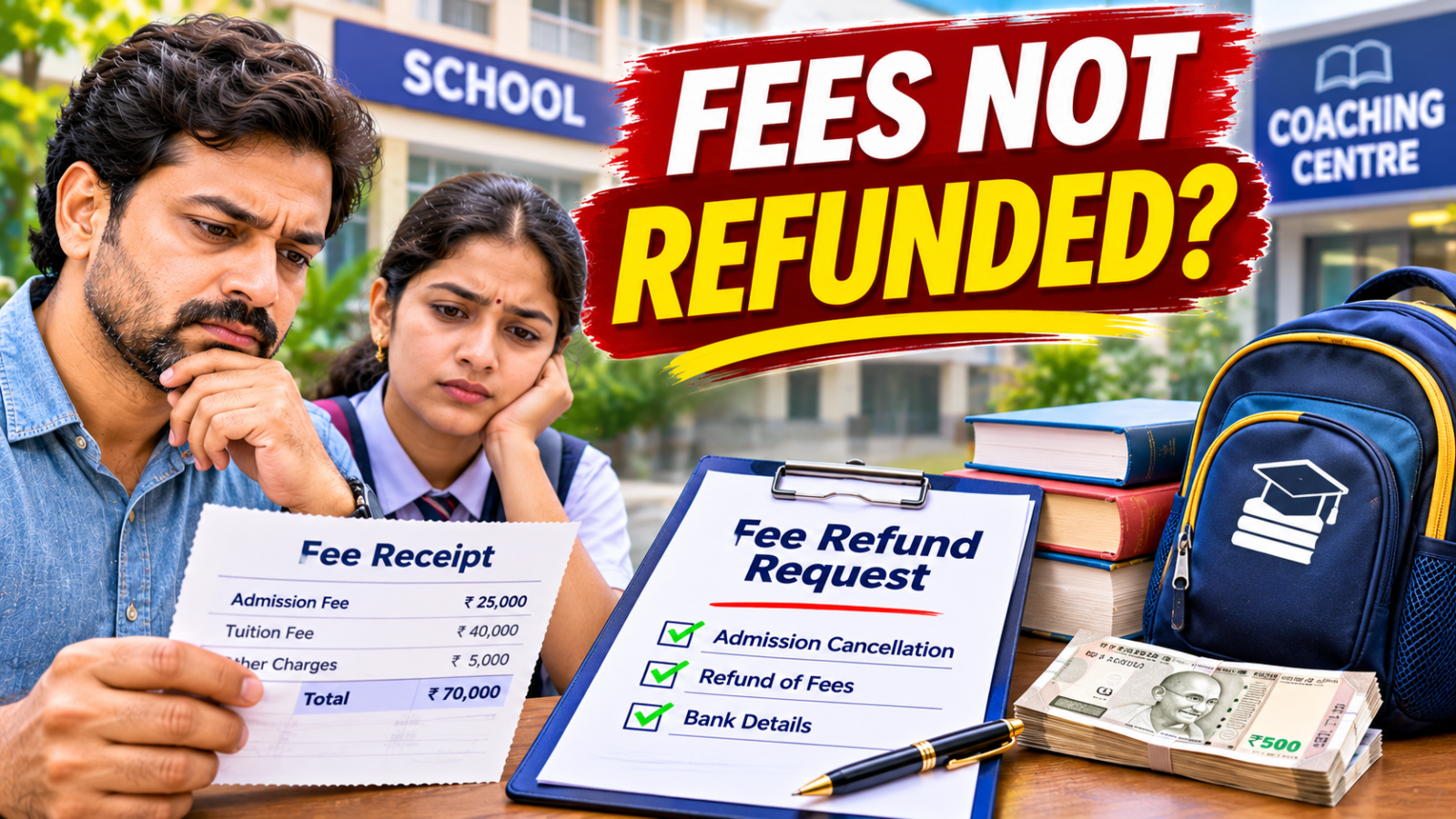
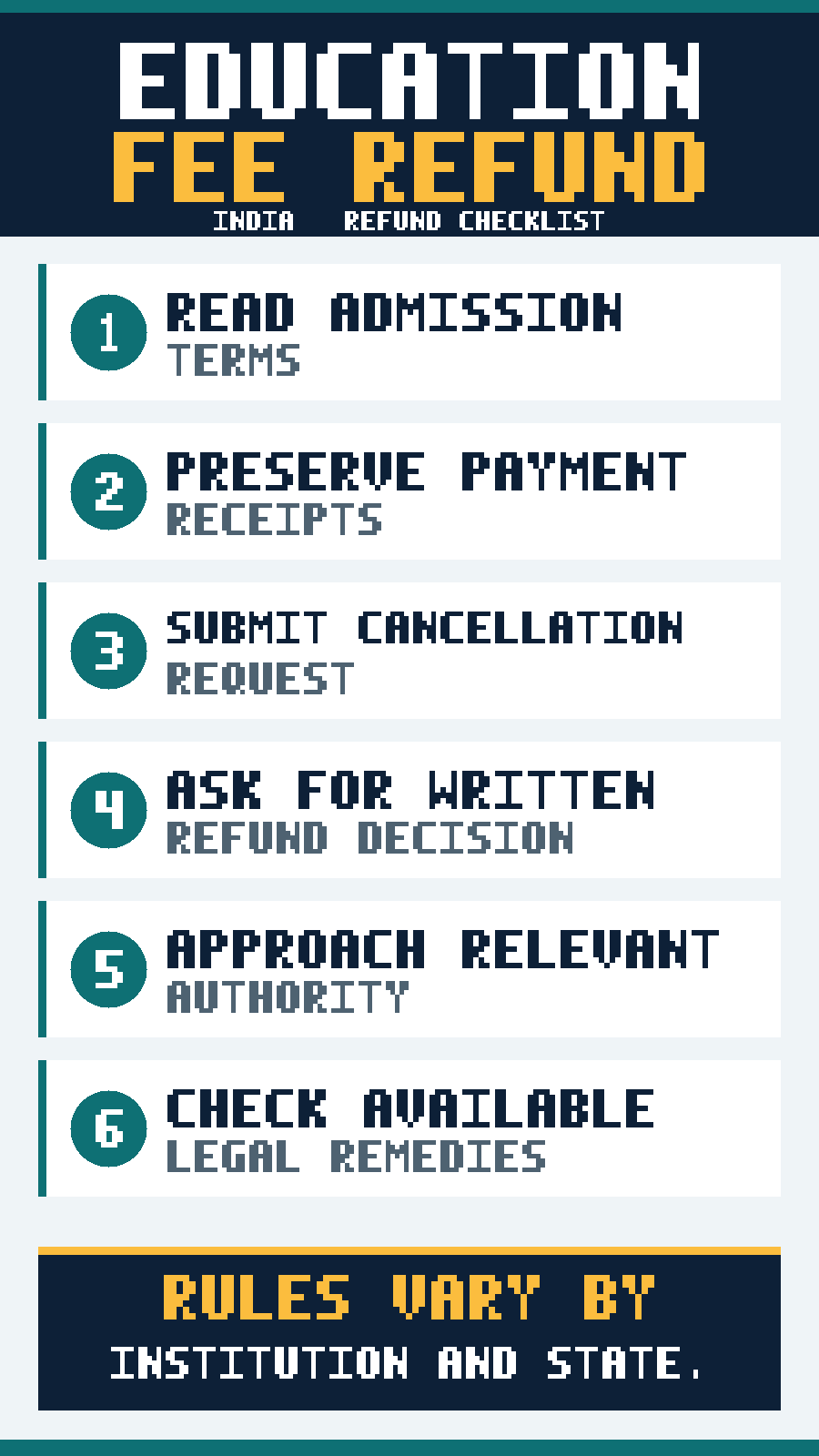
If a school or coaching centre refuses to refund fees after admission cancellation, begin by checking the admission terms, proof of payment and the rules applicable to that institution. Submit a written cancellation request and ask for an itemised refund decision. For a school, the relevant state education authority is generally the appropriate starting point. For commercial coaching services, coaching regulators and consumer grievance mechanisms may also be available. A full refund is not automatic, and school fee disputes should not be treated as identical to coaching fee disputes.
Legal and regulatory references reviewed: 24 November 2026 | India
1. When can you claim an admission fee refund?
Start with the individual components of your payment. Registration charges, admission fees, tuition, refundable security deposits, books, uniforms, transport and hostel fees may have different terms. Request a copy of the policy that applied when you enrolled, rather than relying on a policy introduced later. Keep the admission form, prospectus, advertisements, emails and receipts. If the institution promised a particular refund arrangement, preserve the exact communication.
A course cancelled by the provider is different from a course voluntarily abandoned after several months. If classes never started, a promised course was unavailable or the institution materially changed the agreed service, explain those facts in your complaint. If the student attended part of the course, identify the period actually used and the remaining period. A receipt marked non-refundable does not necessarily resolve every legal question, but neither does cancellation automatically establish an entitlement to recover the entire payment. The applicable law, contractual terms and circumstances must be considered.
2. School admission refund: where should parents complain?
School fees are governed substantially by the applicable state or Union Territory education legislation, orders and regulatory framework. CBSE affiliation does not establish a single nationwide school fee refund formula. Chapter 7 of the CBSE Affiliation Bye-Laws provides that admission fees and other charges must comply with the regulations of the appropriate government. Check the state rules that apply to the school, the relevant class and the published admission policy.
Address a written request to the principal and school management first. If the dispute remains unresolved, contact the District Education Officer (DEO), competent education directorate or designated state fee regulatory authority. The name and powers of the relevant committee differ across states. If there is an apparent breach of CBSE affiliation requirements, the board’s official channels may also be relevant. However, the affiliation authority is not automatically the forum for deciding every individual contractual refund claim.
Section 13 of the Right of Children to Free and Compulsory Education Act, 2009 prohibits capitation fees in admissions within its applicable scope. Section 32 provides a grievance mechanism concerning rights under that Act. These provisions are not a universal rule requiring a refund of all private school tuition charges. Keep the child’s continuing education separate from the dispute. If the issue is a withheld transfer certificate, consult our separate guide: School refusing to issue a transfer certificate due to pending fees.
3. Coaching fee refund rules: the January 2024 model guidelines
The Ministry of Education circulated its Guidelines for Regulation of Coaching Center to states and Union Territories on 16 January 2024. The model framework recommends clear disclosure of course fees and exit policies, reasonable charges and protection against fee increases during the agreed course. Clause 8(iv) provides for a proportional refund of the prepaid fee corresponding to the remaining course period when a student withdraws after paying the full course fee. The model specifies a ten-day period and also addresses unused hostel and mess fees where applicable.
Importantly, the central document was circulated for implementation through appropriate state or UT legal frameworks. It is not a uniform standalone statute automatically imposing an identical refund deadline on every tuition provider in India. Its definition refers to coaching centres serving more than fifty students; state definitions may differ. In its 2026 parliamentary update, the government identified several states and territories that had introduced their own coaching regulations, including Rajasthan, Assam, Haryana and Jharkhand. Verify the local provisions and their commencement dates before relying on a specific deadline.
Consider an illustrative six-month coaching programme costing ₹60,000 in tuition. If the student formally withdraws after two months and the applicable arrangement uses equal monthly proportional pricing, the unused four months correspond to ₹40,000. This is an example, not a guaranteed award. The actual calculation depends on the operative refund rules, course structure, cancellation date and any legally permissible deductions. Ask the centre to show the basis for its calculation in writing.
4. Write an admission cancellation and refund request
Include the student’s name, admission reference, class or batch, payment date, amount and effective withdrawal date. Attach copies of the relevant receipt and admission terms. Send the request through an official email address, designated portal or acknowledged physical submission. An oral promise can be difficult to prove later. Request confirmation of cancellation so there is a clear record of when the student stopped using the service.
Subject: Request for admission cancellation and fee refund. Dear Principal/Manager, I request cancellation of admission number ___ for class/course ___ with effect from ___. A fee of ₹___ was paid on ___. Please process the refund under the applicable rules and provide a written breakdown of the refundable amount, any deduction and its basis, and the expected payment date. A copy of the payment receipt is attached. Name, contact details and date.
Provide bank details only through a verified institutional channel. Never disclose your UPI PIN or OTP to receive a refund. Keep the original receipt and retain a copy of the acknowledgement. If the institution offers a partial settlement, understand whether accepting it would waive any further claim. Do not sign a full-and-final settlement without reviewing its terms.
5. Coaching centre complaint: consumer helpline and regulatory routes
Escalate an unresolved request to the centre’s head office or grievance officer. Where state coaching regulations apply, contact the notified registration or regulatory authority. For misleading marketing or service deficiencies involving commercial coaching, consumer protection mechanisms may also be relevant. The Central Consumer Protection Authority (CCPA) issued coaching-sector advertising guidelines on 13 November 2024, addressing misleading representations about matters including fees and refund policies. Its April 2025 advisory specifically identified complaints involving cancelled admissions, denied refunds and unprovided services.
Call the National Consumer Helpline at 1915 or lodge a grievance through consumerhelpline.gov.in. Explain the promised service, the amount paid, the cancellation request and the response. Attach supporting documents and retain the docket number. The helpline facilitates pre-litigation resolution; it does not itself issue a binding judicial award. If unresolved, an eligible coaching-service complaint can be considered through the consumer commission system using e-Jagriti. Section 69 of the Consumer Protection Act, 2019 normally specifies two years from the cause of action for filing, subject to condonation where sufficient cause is established. Do not assume that helpline correspondence automatically extends a statutory deadline.
6. Can you file a consumer case against a school?
Formal schooling and commercial coaching are treated differently in consumer jurisprudence. In Manu Solanki v. Vinayaka Mission University (2020), the National Consumer Disputes Redressal Commission distinguished ordinary educational institutions from coaching centres, generally excluding formal educational activities from consumer jurisdiction under the earlier statute. The broader question has also been the subject of litigation. A school admission fee refund dispute should therefore not be presented as automatically maintainable before a consumer commission.
Start with the relevant education authority and fee regulator for the school. If the dispute cannot be resolved administratively, obtain legal advice about civil recovery, mediation or another competent forum. Eligible applicants can seek assistance through the District Legal Services Authority or the NALSA helpline at 15100. Consider the cost, time and evidence required before beginning contested proceedings.
Frequently asked questions
Is a full coaching fee refund guaranteed?
No. The applicable rules, agreement, reason for cancellation and unused service period matter.
Does the ten-day refund rule apply to every coaching centre?
No. Check the state or UT’s operative regulatory framework and its scope.
Who handles private school fee complaints?
Start with school management and escalate to the competent education department or state fee authority.
Can I complain without a paper receipt?
Bank records, payment references and admission emails may help establish payment.
Do UGC college refund rules apply to school admissions?
Do not assume so. Check the policy’s institutional scope and applicable academic year.
Conclusion and official resources
Request cancellation in writing, preserve payment records and approach the authority relevant to the institution. See the Ministry of Education model guidelines, 2026 state regulatory update, CBSE Affiliation Bye-Laws, CCPA advisory and RTE Act.
General legal information, not individual legal advice. Verify the rules applicable to your institution and state.
For all topics: Where to Complain in India: Police, Courts, Consumer, Banking and Government Legal Help














Share Your Opinion
Comments are closed on this post.