 Vista

If you live in a rented home in India without a written rent agreement, the absence of paperwork does not automatically entitle your landlord to throw you out, change the locks or remove your belongings. Rent payments, messages and the circumstances in which you were given possession can help establish the arrangement. However, proving the agreed rent, duration and conditions may be more difficult without a written contract. The applicable state law and the nature of your occupancy determine the remedies available. This guide focuses on tenants facing eviction demands, sudden rent increases or lockouts without a written agreement.
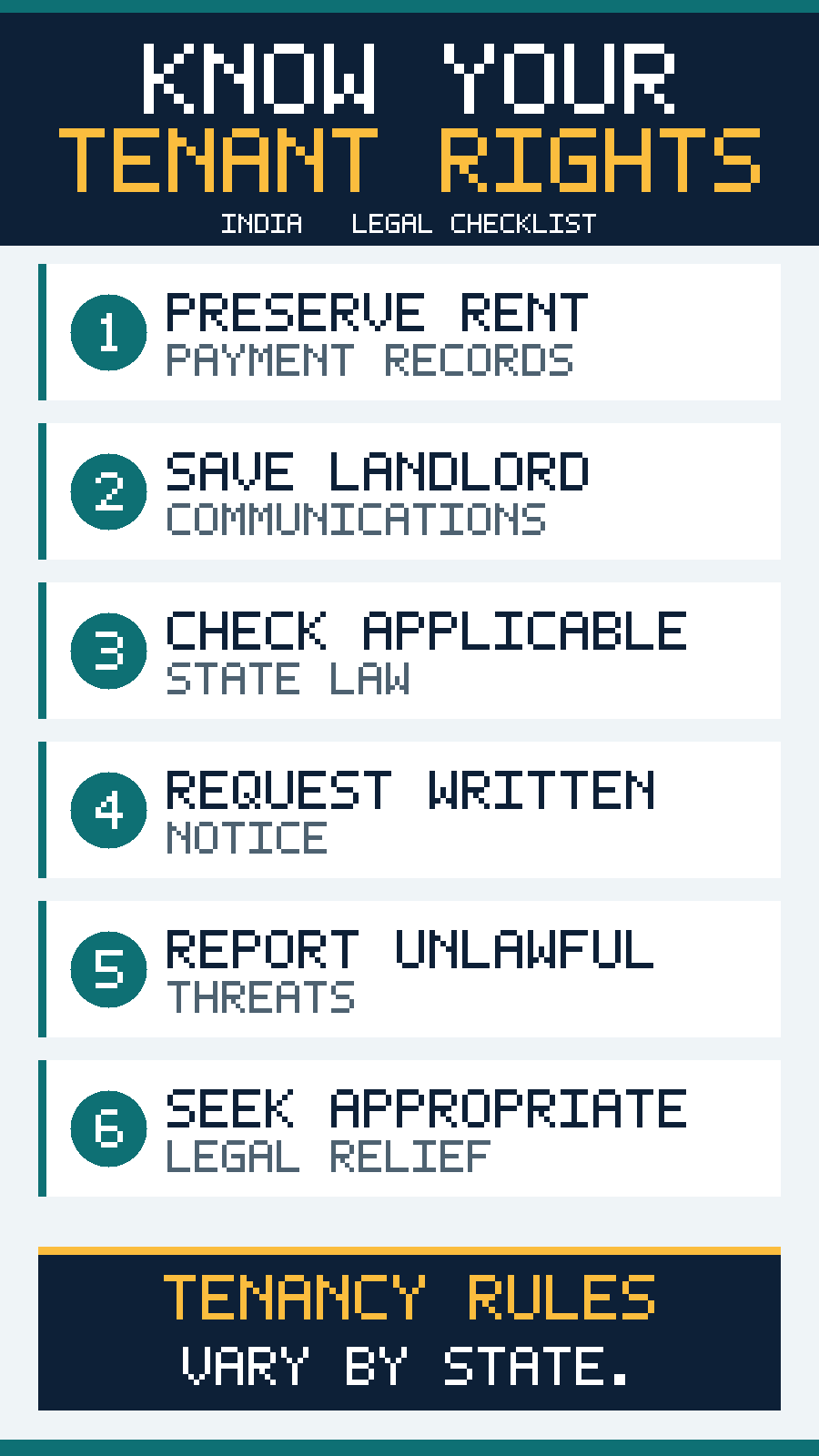
Legal information reviewed: 24 November 2026 | India
1. Is a tenancy without a written rent agreement legal in India?
Under the general framework of section 107 of the Transfer of Property Act, 1882, certain leases can be created by an oral agreement accompanied by delivery of possession. A lease from year to year, for a term exceeding one year or reserving annual rent ordinarily requires a registered instrument. Special state legislation can impose additional written-agreement or registration requirements. Consequently, an oral arrangement should not be described as universally valid or universally invalid.
If the landlord voluntarily handed over the keys, agreed to monthly rent and regularly accepted payments, these circumstances may support your claim that a tenancy existed. They do not necessarily establish a particular fixed term. A paying guest, a licensee and a tenant may occupy property under different legal arrangements. The substance of the arrangement, applicable law and available evidence matter more than simply calling yourself a tenant.
2. How to prove your tenancy without a rent agreement
Collect reliable records before a dispute escalates. Preserve original digital messages and documents rather than relying exclusively on cropped screenshots. Useful evidence may include:
- Bank or UPI payment records showing dates, amounts and the recipient.
- Signed rent receipts or messages acknowledging cash payments.
- Messages or emails recording the agreed rent, move-in date and handover of keys.
- Records of rent increases, notices and communications about the duration of occupancy.
- Deposit receipts, inventories of belongings and genuine witness information.
For example, if you have paid ₹7,000 every month for eight months and your landlord has acknowledged those payments, the records may help establish the relationship and monthly rent. They do not automatically prove that the landlord agreed to a fixed twelve-month term. An identity document showing the address can support your account of residence but is not conclusive evidence of tenancy. Never fabricate a backdated agreement or alter a receipt to strengthen a claim.
3. Can a landlord ask you to vacate immediately? The notice period
Section 106 of the Transfer of Property Act establishes a general default rule for leases where there is no contrary contract, local law or usage. Residential leases under that default framework are generally treated as month-to-month tenancies, terminable by fifteen days’ notice. The statutory period runs from receipt of the notice, and the section contains requirements for written, signed notice and service.
This does not mean that every tenant in India is subject to an identical fifteen-day eviction rule. Where rent control or other tenancy legislation applies, the landlord may have to establish a statutory ground, serve a particular demand notice or obtain an order from the competent forum. Termination of a tenancy is also distinct from physically recovering possession. An owner should not resort to forcible self-help merely because a notice period has expired.
Respond to a notice promptly. Check the address, dates, grounds and requested handover date. Ask for clarification in writing if the demand was only verbal. If a court or statutory authority issues a summons, comply with the applicable response procedure. Tenants do not have an indefinite right to remain after a lawful termination, and ignoring proceedings can worsen the situation. If you need additional time to relocate, seek a written arrangement rather than assuming that the law automatically grants it.
4. Sudden rent increase: can you refuse the new amount?
India does not have one nationwide percentage cap applicable to every residential rent increase. Examine the agreed rent, any revision clause, the applicable state law and whether the property is covered by rent regulation. Ask the landlord to specify the proposed amount, effective date and contractual or statutory basis in writing. A proposed revision may be negotiable, while certain regulated tenancies have specific statutory increases or procedures.
Continue to document payment or a lawful offer to pay the rent that is properly due. Do not assume that a dispute over an increase allows you to stop all rent payments. Arrears may create an independent ground for legal proceedings. If the landlord refuses payment, obtain advice about the prescribed deposit or tender procedure in your jurisdiction. Some state laws allow deposits with a designated authority or court under specified conditions. Simply transferring money into an unrelated account does not necessarily satisfy your obligations.
5. Illegal lockout: what if the landlord changes the locks?
If you return home and discover that the locks have been changed or your belongings have been removed, avoid a physical confrontation. Record the situation from a safe, lawful location and preserve relevant messages. Tell the landlord in writing if essential medicines, identity documents or children’s belongings remain inside. Call 112 if there is immediate danger, violence or a credible threat. Police can address suspected offences and urgent safety concerns, although they are not ordinarily the forum for adjudicating a disputed civil tenancy.
Section 6 of the Specific Relief Act, 1963 provides a potential remedy for a person dispossessed of immovable property without consent and outside lawful process. A suit under that section must be brought within six months of dispossession, subject to statutory restrictions and the applicable jurisdiction. Seek advice immediately rather than waiting for the deadline. Where a threatened lockout has not yet occurred, an appropriate injunction or interim order may be available. The outcome depends on evidence and the competent forum. For utility-related disputes, see our separate guide: Landlord cutting electricity or water.
6. State-specific examples: Madhya Pradesh, Uttar Pradesh and Maharashtra
In Madhya Pradesh, section 12 of the MP Accommodation Control Act, 1961 specifies grounds for eviction where the Act applies. Its ordinary rent-arrears ground refers to failure to pay or tender legally recoverable arrears within two months of service of the prescribed demand notice. Other grounds and special landlord categories involve different requirements.
In Uttar Pradesh, section 4 of the Regulation of Urban Premises Tenancy Act, 2021 requires a written agreement for new tenancies within its scope. The exception for residential tenancies shorter than twelve months concerns informing the Rent Authority, not the written agreement itself. Transitional rules and exclusions must also be considered.
In Maharashtra, section 55 of the Maharashtra Rent Control Act, 1999 places responsibility for registration of covered written letting or leave-and-licence agreements on the landlord. Without such documentation, the occupant’s account of the terms can prevail unless disproved. Section 11 provides for a four percent annual rent increase in applicable cases and other permitted increases under specified conditions. The central Model Tenancy Act, 2021 is a model framework, not automatically binding nationwide legislation. Check your state’s actual statute, amendments and exclusions.
7. Where to complain and how to respond in writing
Dear landlord, I have occupied the premises at ___ since ___ at an agreed monthly rent of ₹___. On ___ I received a request to vacate/a proposed rent increase. Please provide the written basis, effective date and applicable notice period. I am willing to comply with lawful payment and tenancy obligations. Please do not change the locks or restrict access to my belongings outside lawful procedure. Name, date and contact details.
Depending on jurisdiction, approach the Rent Authority, Rent Controller, designated court or civil court. Eligible applicants can seek legal assistance through the District Legal Services Authority or NALSA at 15100.
Frequently asked questions
Is every oral tenancy illegal?
No. The applicable state law and nature of the arrangement matter.
Is an eleven-month agreement always exempt from registration?
No. Special state requirements may apply.
Can a landlord evict me without a court process?
Forcible eviction is distinct from lawful termination and recovery of possession. Check the appropriate statutory procedure.
Can rent increase by ten percent every year?
There is no universal nationwide percentage rule.
Can police decide the rent amount?
Ordinary civil rent disputes generally require the appropriate tenancy or judicial forum.
Conclusion and legal references
Preserve payment evidence, request written communication and seek timely legal relief. Sources: Transfer of Property Act, Specific Relief Act, MP section 12, UP Tenancy Act, Maharashtra Rent Control Act. General legal information, not individual legal advice. Local law and occupancy arrangements may change the available remedy.
For all topics: Where to Complain in India: Police, Courts, Consumer, Banking and Government Legal Help




























Share Your Opinion
Comments are closed on this post.