 Vista

Who is the most powerful Egyptian god?
Ra is a strong candidate for the most important god across much of ancient Egyptian religious history, while Amun-Ra is a particularly convincing answer when discussing the supremacy of the state god during the New Kingdom. But the answer changes with the meaning of power. Osiris has authority over the dead, Isis is renowned for her protective magic, and Ptah is a creator in Memphite theology. It would be misleading to turn these different responsibilities into a universal combat ranking.
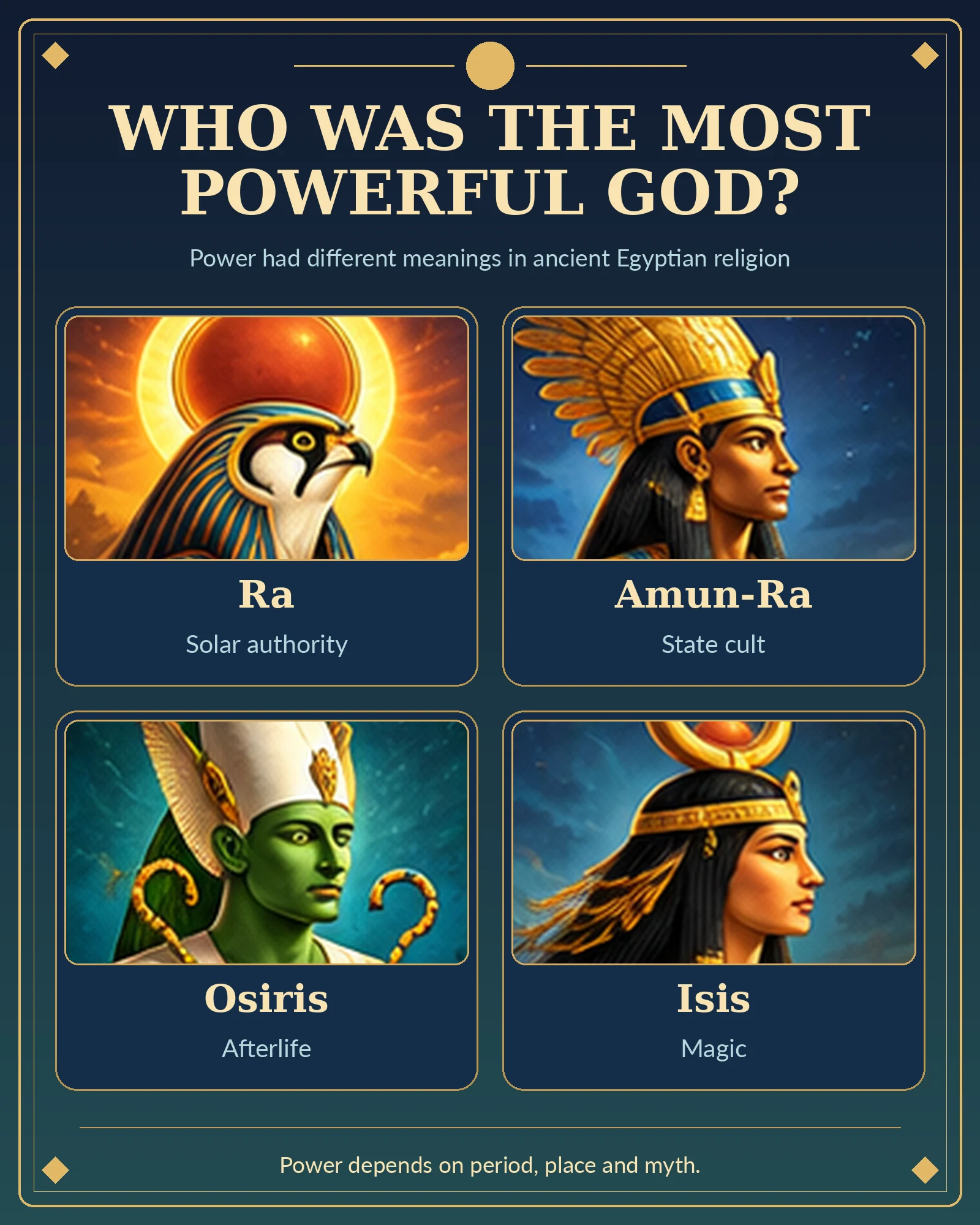
The question is more interesting than it might initially appear. Egyptian myths sometimes show a deity who seems invincible being endangered, deceived or assisted by another divine figure. The sun god requires protection during his nightly journey. A mighty goddess can become a danger to the very people she is intended to govern. The ruler of the dead derives much of his mythic significance from a story in which he is killed. Such apparent paradoxes become understandable when power is considered within the function of a story instead of as a numerical strength score.
This guide compares the most significant contenders through creation, solar renewal, state religion, magic, protection, kingship and the afterlife. Its classifications are educational, not a recovered ancient league table. The ancient Egyptians did not leave a single authoritative list arranging every god in order of strength.
| Deity | Context of power | Key distinction |
|---|---|---|
| Ra | Solar renewal | Enduring cosmic importance |
| Amun-Ra | New Kingdom state religion | Combined divine identity |
| Atum | Heliopolitan creation | Specific genealogy |
| Ptah | Memphite creation | Creative thought and expression |
| Osiris | Afterlife | Authority over the dead |
| Horus | Kingship | Legitimate rule |
| Set | Disruptive and protective force | Role varies by narrative |
| Isis | Magic and protection | Knowledge and healing |
| Sekhmet | Dangerous and protective force | Destruction and healing |
| Ma’at | Truth and order | Not a combat ranking |
What did divine power mean in ancient Egypt?
Imagine three different questions being asked in an Egyptian religious setting. A ruler asks how his reign can be legitimate. A bereaved family asks how the deceased can be protected. A household asks how a child can safely enter the world. Each question points toward a different set of religious concerns. The figure most relevant to one question need not be the most relevant to another.
Power is therefore better divided into several dimensions. Cosmological authority concerns the origin and continuation of the world. Political authority concerns the religious legitimacy of the king. Ritual authority concerns the protection and transformation of the deceased. Protective power concerns dangers encountered in daily life. Knowledge and magic concern the ability to speak, know and perform actions regarded as effective in a religious context.
The prominence of a deity in surviving monuments can also tell us something about political patronage and religious institutions. Yet the number of surviving statues cannot serve as a direct measure of how powerful every worshipper considered that deity. Archaeological preservation is uneven. The monumental evidence for an official cult differs from the smaller objects through which protective beliefs entered domestic life.
The distinction helps explain why a household deity such as Taweret is worth mentioning in an article about power, even if she is not usually described as the supreme creator. The immediate danger of childbirth mattered to ordinary families. A theological description of the first moment of creation answers a different question.
Ra: the strongest contender for enduring cosmic authority
Ra, also spelled Re, is closely connected with solar light and the recurring renewal of the world. Sunrise is an easily observable phenomenon, but in Egyptian religious imagination it could express something more: the restoration of life and the successful continuation of a cosmic cycle. The return of the sun makes the solar god relevant to both royal religion and the wider structure of existence.
The solar disk is one of the most recognizable clues associated with Ra. Yet it is not a unique logo belonging exclusively to him. Other deities can share solar imagery, and the sun god can appear in several forms. A reader comparing images should examine the inscriptions and context rather than assuming that every figure with a disk is Ra.
The nightly solar voyage also gives a useful perspective on strength. Apep threatens the journey, while other divine beings participate in its protection. If power meant complete independence from every other being, this narrative would seem to undermine Ra’s status. Within the story, however, the cooperation helps express the repeated achievement of order.
Ra’s creative importance and extensive religious associations make him a strong general answer for readers seeking one name. But his significance does not require treating the roles of all other gods as minor. Nor is it historically useful to imagine the ancient tradition as a competition in which one deity permanently eliminates the rest.
Amun-Ra vs Ra: which god was more important?
Amun was especially important in Thebes. His growing prominence became closely associated with the religious and political developments of that city. The combined name Amun-Ra brought the hidden or unseen creative aspect associated with Amun into relationship with the solar identity of Ra. The fusion is a major example of Egyptian religious flexibility.
A comparison between the two names needs to begin by recognizing this connection. Treating Amun-Ra as a completely independent opponent fighting against Ra misunderstands the theological relationship. Amun-Ra is a combined divine identity, not the offspring of Amun and Ra or an enemy who steals the solar god’s authority.
In the context of New Kingdom state religion, Amun-Ra is an especially strong candidate for supreme divine status. The great cult institutions connected with Thebes offer historical context for that importance. Earlier periods and other religious centers could organize their beliefs differently. Consequently, an answer that works for a New Kingdom royal setting cannot simply be imposed on every earlier and later community.
A modern comparison chart can make this distinction explicit: Ra for enduring solar centrality, Amun-Ra for prominent New Kingdom state theology. This is more informative than announcing a winner without defining the historical setting. It also prevents a reader from confusing a combined identity with a genealogy or a mythological battle.
Atum and Ptah: can a creator god be stronger than Ra?
Creation is another possible standard of divine greatness. In the Heliopolitan genealogy, Atum occupies the originating position, with Shu and Tefnut and later generations following. If the reader’s definition of power is being the first figure in this particular lineage, Atum becomes a natural answer.
Memphite religious thought offers a different perspective through Ptah. The notion of creation connected with thought and expression gives creative authority a different form from a simple sequence of divine births. This invites a distinction between a mythic genealogy and an account of how creative intention becomes reality.
The existence of different creator figures does not necessarily mean that ancient Egyptian religious communities were engaged in an endless argument over which one was the true winner. Their theological traditions could accommodate multiple accounts, associations and interpretations. Modern readers should resist treating religious diversity as a flaw that needs to be corrected by an invented universal story.
If a classroom chart needs a heading, use creator gods and give separate rows to the traditions associated with Atum and Ptah. A single arrow labeled strongest would hide the most interesting feature of the evidence: the different ways in which creative agency was imagined.
Osiris, Horus and Anubis: different kinds of authority
Osiris’s role is connected with the dead and the hope of renewed existence. His place in mythology does not depend on being undefeated in battle. Indeed, the loss of his earthly kingship is essential to the meaning of his narrative. The story turns a catastrophe into a different form of authority. For a discussion of the afterlife, this makes Osiris a central figure.
Horus the child, associated with Osiris and Isis, belongs to the next generation of the royal conflict. His contest with Set concerns the right to rule. In a discussion of royal legitimacy, the relationship between Horus and kingship is more important than an estimate of how much physical damage he could cause.
Anubis is often described online as the Egyptian god of death. That shorthand can obscure his particular associations with funerary preparation and safeguarding the deceased. The balance in judgment scenes helps distinguish his function from that of Osiris. Thoth may record the result, while Ma’at supplies the principle against which the deceased is assessed.
This group is a useful exercise in reading mythological roles. Who prepares and protects? Who presides over the dead? Who maintains the connection to living kingship? The answers describe several forms of religious authority without requiring them to compete for one title.
The modern popularity of Anubis in wallpapers, games and tattoos does not by itself establish greater historical importance than Ra or Osiris. A deity’s appeal in contemporary entertainment and the ancient evidence for worship are separate matters.
Is Set the strongest Egyptian warrior god?
Set’s association with storms, deserts and disruptive force makes him an obvious candidate in a discussion of formidable power. Yet the ancient mythological context complicates the image of a simple villain. His opposition to Horus and Osiris belongs to a different narrative situation from his participation in the defense of solar order.
Apep is the great opponent of the solar journey. The distinction between Set and Apep matters because readers sometimes treat all Egyptian figures associated with disorder as identical enemies. In solar protection scenes, Set’s strength can be directed toward overcoming a danger that threatens the wider cosmos. In the royal succession narrative his role is different.
The question of whether Horus or Set is stronger cannot be answered by comparing imagined statistics. Their conflict is shaped by legitimacy, judgments and narrative reversals. A successful outcome in one episode does not prove universal superiority in every religious context.
A fantasy author is free to construct a fictional tournament between the two characters. Historical education has a different task: it asks what the surviving stories express about force, conflict, kingship and order. This distinction allows readers to appreciate modern fantasy without confusing its rules with ancient Egyptian religion.
Who was the most powerful Egyptian goddess?
Isis and Sekhmet are excellent starting points, but they express very different kinds of power. Isis is associated with protective knowledge, healing, motherhood and the restoration of the Osiris family. In stories of her magic, knowledge and speech can achieve what brute force cannot. Her significance also extends far beyond being defined through her husband and child.
Sekhmet’s lioness imagery communicates formidable strength. The religious story of the solar Eye’s destructive intervention and its eventual pacification shows why such power can be both threatening and necessary to control. A deity associated with danger could also be approached for protection and healing. The combination is more meaningful than simply describing her as a goddess of violence.
Hathor is another essential figure because her domains include joy, maternal care and celestial and solar associations. The possibility of connections between Hathor and the dangerous solar Eye reminds readers that the same broad religious identity can have apparently contrasting aspects.
Ma’at represents truth and proper order. Her relevance is not based on a story in which she defeats every rival. Instead, her significance emerges from the ideal that divine and human activity should maintain a meaningful order. In this respect, asking whether she is physically stronger than a lioness goddess is a category error.
Bastet and Taweret add a household perspective. Their protective significance shows that the religious power sought by a person living in ancient Egypt might concern a specific problem rather than an abstract supreme position. A useful strongest-goddess answer therefore distinguishes magical, dangerous, protective and cosmic dimensions.
Three mythological stories that reveal the limits of power
The first example is the solar voyage. A god central to the continued existence of light is not portrayed as operating in a world without opposition. The repeated encounter with a threatening serpent makes renewal an active achievement. The story invites us to consider cooperation and continuity rather than permanent domination.
The second example is the tradition of Isis and the hidden name of Ra. In a well-known magical narrative, Isis gains access to knowledge that Ra initially withholds. The story illustrates the religious significance of knowing and speaking a name. It does not establish that Isis permanently replaces Ra as sovereign in every temple.
The third example is the myth of humanity threatened by the solar Eye. The dangerous force associated with the lioness goddess is eventually pacified through a red-colored drink in the familiar narrative. The story can be read as a reminder that destructive power is not identical to the ability to sustain a world. The continuation of life requires both force and its restraint.
Together these episodes answer a question that simple rankings cannot: a divine character may be exceptionally powerful precisely because of a particular capacity, while still depending on the actions of others in a particular story. Modern readers can use this pattern to compare mythology across cultures without assuming that their ancient authors intended the same conclusions.
Egyptian gods hierarchy versus modern power scaling
An educational hierarchy should name its criterion. A chart about New Kingdom state religion will differ from a chart about creation traditions. A family tree will differ from a chart of funerary responsibilities. Confusing these formats leads to common mistakes, such as treating a creator’s position at the top of a genealogy as proof of invincibility.
The term omnipotent is also difficult to apply without qualification. Egyptian praise of a god can use expansive language appropriate to a hymn or temple. Such praise should be read within its literary and religious context. It does not provide an experimentally measurable claim about unlimited physical strength.
The best practical method is to write the context beside the name. Amun-Ra: prominent state god. Osiris: authority over the deceased. Isis: protective magic. Horus: kingship. Then the reader can compare actual religious roles rather than fictional numbers. If the question comes from a game, distinguish the rules of that particular game from historical evidence.
Readers comparing Ra with Zeus, Odin or Surya should apply the same approach. All can be discussed through themes such as authority or the heavens, but these comparisons do not establish common origins or a universal battle outcome. Different mythologies have different narrative assumptions.
What the evidence can actually tell us
Museum objects, temple inscriptions, funerary manuscripts and scholarly studies can establish that divine names and associations were meaningful in particular places and periods. A royal sculpture provides one kind of context; a protective amulet gives another. The purpose of an object should be considered before its importance is generalized.
For example, an impressive statue of Amun-Ra may reflect the status of a royal cult. It cannot prove that all households placed that god first in every prayer. Likewise, the preservation of funerary papyri makes the afterlife especially visible to modern observers without establishing that death was the sole concern of Egyptian religion.
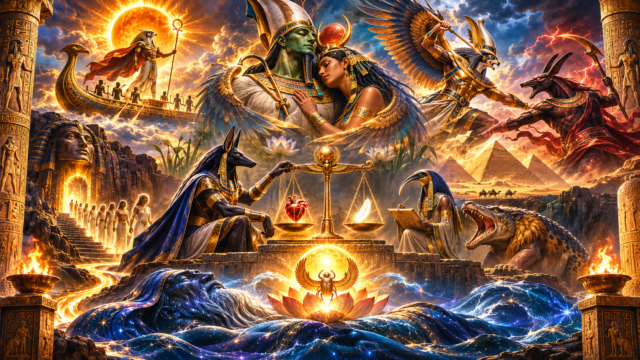
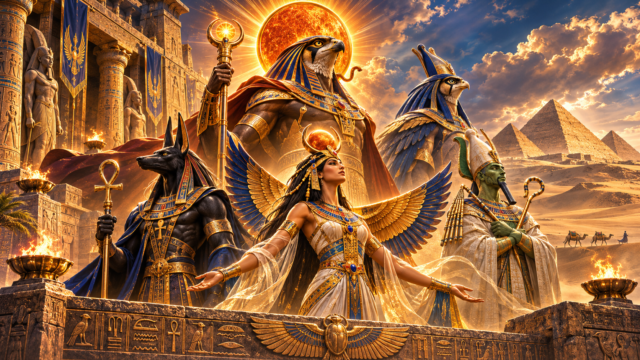
When using modern illustrations to explain these gods, label them as artwork. Do not present a newly invented crown, weapon or glowing magical ability as a feature documented on an ancient object. The study of divine power becomes much more reliable when images are linked to named roles and historical settings.
A reader can start with the source notes below, then compare the stories of individual gods and the ancient objects that preserve their images. The goal is to understand the richness of Egyptian religion, not to declare a scientifically verifiable winner among supernatural beings.
Frequently asked questions
Who is the king of the Egyptian gods?
Amun-Ra is a particularly relevant answer for New Kingdom state religion. Ra is a major solar deity across a longer period.
Is Ra stronger than Amun-Ra?
They are related divine identities, not opponents in a universal ancient tournament.
Who is the strongest Egyptian goddess?
Isis is a major figure in protective magic; Sekhmet is associated with formidable force. No universal ranking exists.
Can Anubis defeat Osiris?
Their religious responsibilities differ, and ancient sources provide no universal combat result.
Was Set stronger than Horus?
The succession stories concern legitimacy and conflict; they do not establish a universal strength scale.
Who created the Egyptian gods?
Atum begins a familiar Heliopolitan genealogy, while other traditions have other creators.
Is Apep a god of supreme power?
Apep threatens the solar journey, but his role is opposition rather than universal rule.
Is Ra the same as Surya?
Both have solar associations, but their histories and religious identities are distinct.
Is there an official Egyptian gods tier list?
No single ancient canonical power ranking survives. Contextual comparison is more accurate.
Conclusion
Ra and Amun-Ra are the most useful broad answers, depending on period and criterion. For the rest of the pantheon, compare powers by domain rather than invented battle scores.
Sources and further reading
- Smarthistory — Egyptian deities
- UCL Digital Egypt — Gods and goddesses
- UCL Digital Egypt — Creation
- Metropolitan Museum of Art — Divine Egypt
- Historical Museum — Gods and goddesses of Ancient Egypt
Related guides: Is Amun-Ra Related to Lord Rama? Claims vs Historical Evidence · Ra: Egyptian Sun God, Creation Myths, Eye of Ra and the Night Journey (Facts and Symbols)



















Share Your Opinion
Comments are closed on this post.