 Vista
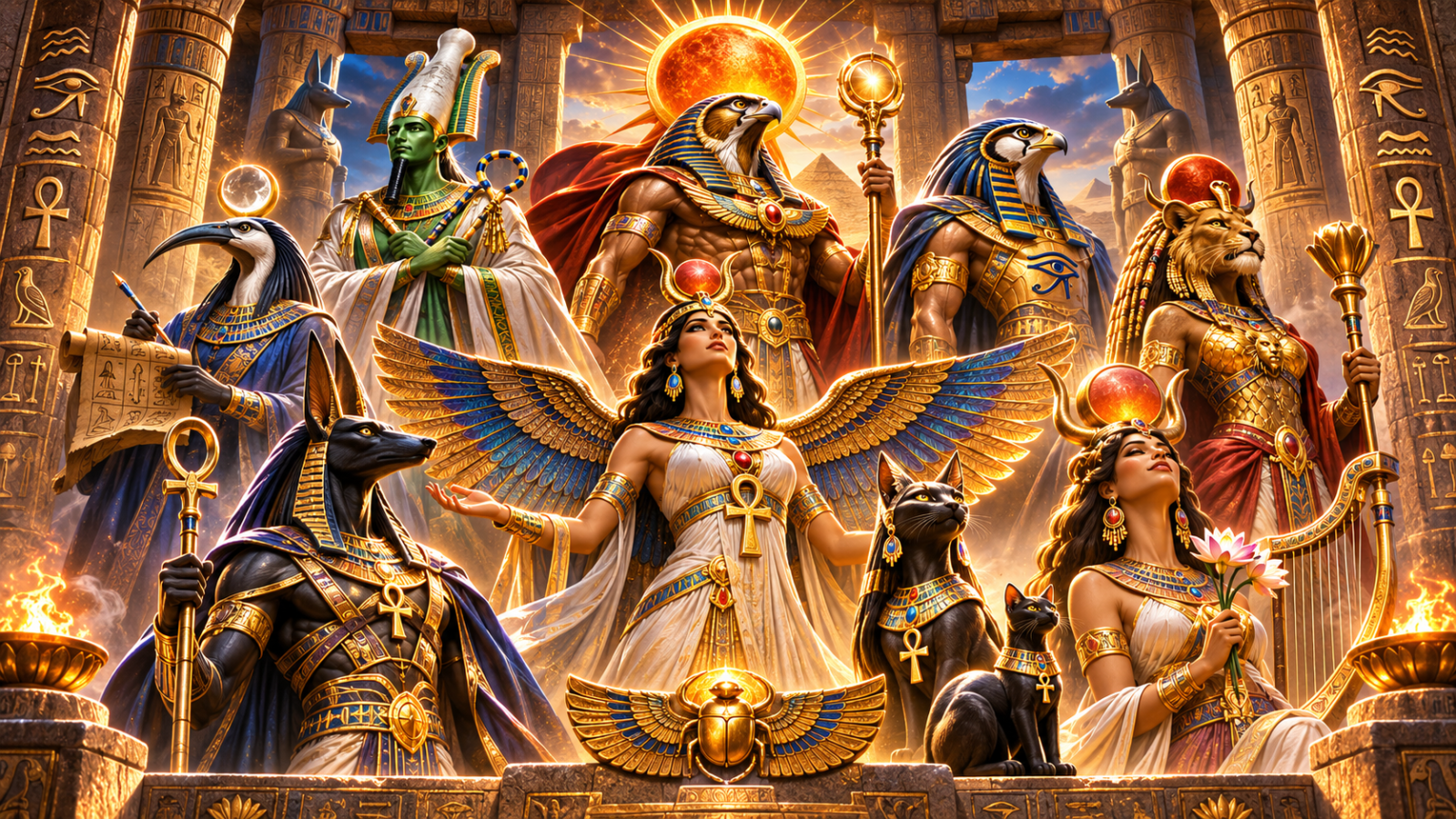
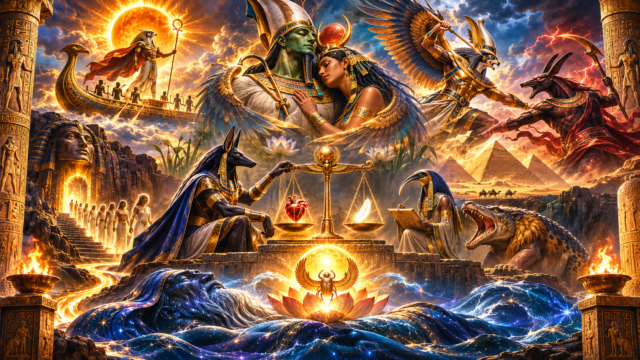
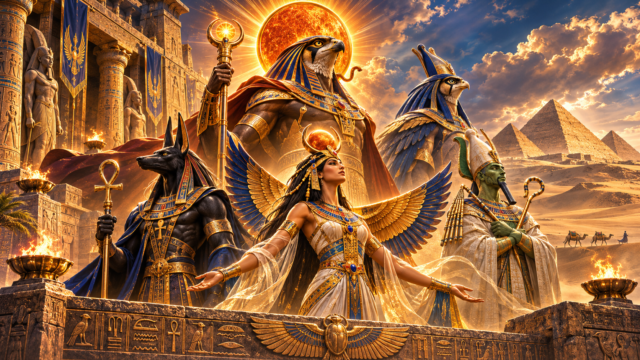
Egyptian gods and goddesses include Ra, Anubis, Osiris, Isis, Horus, Set, Thoth, Bastet and dozens of other divine figures. Their powers and symbols reflect the sun, the Nile, kingship, magic, childbirth, death and the maintenance of cosmic order. This illustrated reference identifies the major gods by name, role and visual attributes, then explains how to recognize them without mistaking modern fantasy art for historical evidence.
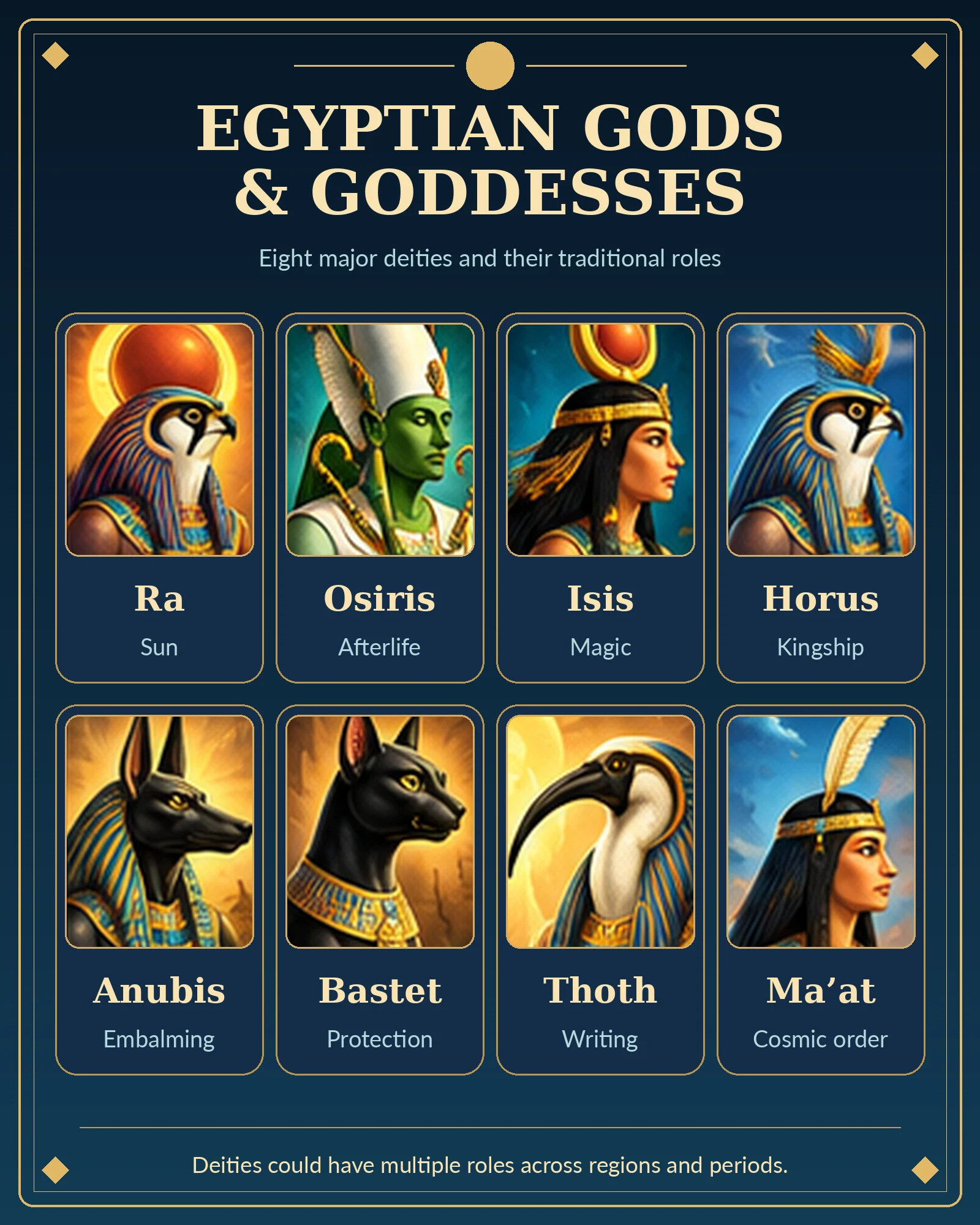
Egyptian gods and goddesses chart: names, powers and symbols
Use the table as a quick identification guide. A deity may have more than one form, and a symbol can belong to several gods. Egyptian religion lasted through many centuries, so the descriptions are common associations rather than exclusive or permanent definitions.
| God or goddess | Common roles | Visual clues |
|---|---|---|
| Ra (Re) | Sun, creation and renewal | Falcon head and solar disk in familiar forms |
| Amun (Amun-Ra) | Hidden power and creation | Tall double-plumed crown |
| Osiris | The dead, regeneration and kingship | Mummiform body, royal insignia, Atef crown |
| Isis (Aset) | Magic, motherhood and protection | Throne-shaped sign; sometimes cow horns and solar disk |
| Horus | Sky, divine kingship and protection | Falcon or falcon-headed figure |
| Set (Seth) | Desert, storms and disruptive force | Distinctive long-snouted Set animal |
| Anubis | Embalming, cemeteries and protection of the dead | Black canine or canine-headed man |
| Thoth (Djehuty) | Writing, knowledge, calculation and lunar associations | Ibis or baboon |
| Ma’at | Truth, justice and proper order | Feather |
| Bastet | Feline protection and domestic well-being | Cat or feline-headed woman |
| Sekhmet | Dangerous power, warfare and healing | Lioness head and solar disk |
| Hathor | Music, joy, motherhood and the sky | Cow horns and solar disk; cow form |
| Ptah | Creation and craftsmanship | Close-fitting cap and wrapped figure |
| Atum | Creation and completion | Human form, sometimes double crown |
| Shu and Tefnut | Air, separation and moisture | Shu supporting the sky; Tefnut often leonine |
| Geb and Nut | Earth and sky | Geb beneath an arching, star-covered Nut |
| Nephthys | Mourning and funerary protection | Name-sign headdress |
| Khonsu | Moon and associated healing traditions | Lunar disk and crescent |
| Sobek | Water, crocodiles and strength | Crocodile or crocodile-headed figure |
| Hapi | Nile inundation and abundance | Human figure with emblems of fertility |
| Khnum | Creation, shaping life and river associations | Ram head and potter’s wheel |
| Khepri | Renewal and the rising sun | Scarab beetle |
| Taweret | Protection around pregnancy and childbirth | Composite hippopotamus figure |
| Bes | Household protection, birth and music | Front-facing dwarf-like protective figure |
| Seshat | Writing, records and measurement | Distinctive emblem above the head |
| Serket (Selket) | Protection, venom and healing | Scorpion emblem |
| Wadjet and Nekhbet | Royal protection | Cobra and vulture respectively |
Major Egyptian gods and their stories
Ra (Re): Sun, creation and renewal
Identification: Falcon head and solar disk in familiar forms.
The solar journey gives Ra a role in the continuity of the cosmos. In the nighttime cycle, the solar barque encounters threats including the serpent Apep. The renewed sunrise symbolizes the continuing victory of order. Ra is linked to kingship and appears in combinations such as Ra-Horakhty and Amun-Ra. Neither combination means that Ra literally fathered the other deity. His morning, daytime and evening manifestations may be represented through different imagery.
Amun (Amun-Ra): Hidden power and creation
Identification: Tall double-plumed crown.
The rise of Thebes as a political and religious center was accompanied by Amun’s prominence. His association with Ra expressed an important solar and creative identity. The immense temple complex at Karnak gives material context to his cult. Amun’s name and the idea of hiddenness are useful starting points, but his importance was not restricted to a single abstract quality. Worship of Amun did not require the abolition of all other gods.
Osiris: The dead, regeneration and kingship
Identification: Mummiform body, royal insignia, Atef crown.
The death of Osiris through the actions of Set and the protective efforts of Isis form a central Egyptian mythic cycle. Osiris becomes associated with the dead and the possibility of continued existence. Green coloration can convey regeneration and fertility. His royal appearance and funerary role explain why he is frequently depicted in burial-related objects. The familiar modern narrative draws on several sources; individual episodes differ between early Egyptian evidence and later accounts.
Isis (Aset): Magic, motherhood and protection
Identification: Throne-shaped sign; sometimes cow horns and solar disk.
Isis’s role in the Osiris story is complemented by her protection of the child Horus. Her resourcefulness and ritual knowledge make her an important figure in healing and protective traditions. A famous narrative concerns her acquisition of Ra’s secret name. Her worship eventually spread beyond Egypt, particularly in the Mediterranean world. That later expansion is part of the history of her cult rather than evidence that all earlier depictions had the same meaning.
Horus: Sky, divine kingship and protection
Identification: Falcon or falcon-headed figure.
Horus appears in numerous forms, including the child of Osiris and Isis. In the succession myth, he disputes kingship with Set. The restored eye of Horus became a sign associated with wholeness and protection. His connections to living kingship explain the falcon imagery found in royal art. Horus the Elder and Horus the child must be distinguished when discussing parents or relationships; the same English name can conceal different theological traditions.
Set (Seth): Desert, storms and disruptive force
Identification: Distinctive long-snouted Set animal.
Set is the opponent of Osiris and Horus in familiar narratives, yet his strength may defend the solar barque against Apep in another context. This is why describing him simply as the Egyptian devil is misleading. The identity of the animal used for his head is debated; it should not be confidently named as a known species based only on a modern illustration. His cult and reputation also changed historically.
Anubis: Embalming, cemeteries and protection of the dead
Identification: Black canine or canine-headed man.
Anubis is associated with the preparation and safeguarding of the body and the balance in scenes of judgment. Osiris has a different role as lord of the dead. Anubis’s black coloring can evoke regeneration and the funerary context, rather than moral evil. A later parentage tradition connects him with Osiris and Nephthys, but the genealogy varies. His famous shrine from Tutankhamun’s burial is an example of a real object that can contextualize artistic portrayals.
Thoth (Djehuty): Writing, knowledge, calculation and lunar associations
Identification: Ibis or baboon.
Thoth’s role as a recorder makes him especially recognizable in the judgment of the dead. Writing and measurement were important to both religious practice and administration, and Thoth connects these activities with divine order. The legendary Book of Thoth in Egyptian literary traditions should not be confused with every surviving Egyptian funerary manuscript. Modern claims that it contains proven supernatural technology go beyond the evidence.
Ma’at: Truth, justice and proper order
Identification: Feather.
Ma’at is both a goddess and a concept essential to Egyptian ideas of order. A king could be represented offering Ma’at to a god, expressing an ideal relationship between rule and the cosmos. The feather associated with her is familiar from judgment scenes. The concept cannot be reduced to a magical object or one simple legal rule. It gives a framework for understanding the religious importance of justice, reliability and continuity.
Egyptian goddesses and protective deities
Bastet: Feline protection and domestic well-being
Identification: Cat or feline-headed woman.
Bastet’s iconography changed over time and included lioness associations as well as the familiar domestic cat. Bubastis was an important center of her worship. Ancient cat offerings and animal mummies need to be interpreted in their archaeological setting; the existence of such offerings does not mean every Egyptian worshipped every individual cat as a deity. Bastet’s modern aesthetic popularity should not obscure her ancient protective role.
Sekhmet: Dangerous power, warfare and healing
Identification: Lioness head and solar disk.
Sekhmet embodies formidable solar force, which may threaten or protect. In the destruction-of-humanity narrative, the solar Eye becomes dangerous to people; versions and identifications of the goddess require care. The lioness’s appearance communicates power, but a lion-headed figure cannot always be identified from that feature alone. Her association with healing shows how a deity connected to danger could also be approached for protection against it.
Hathor: Music, joy, motherhood and the sky
Identification: Cow horns and solar disk; cow form.
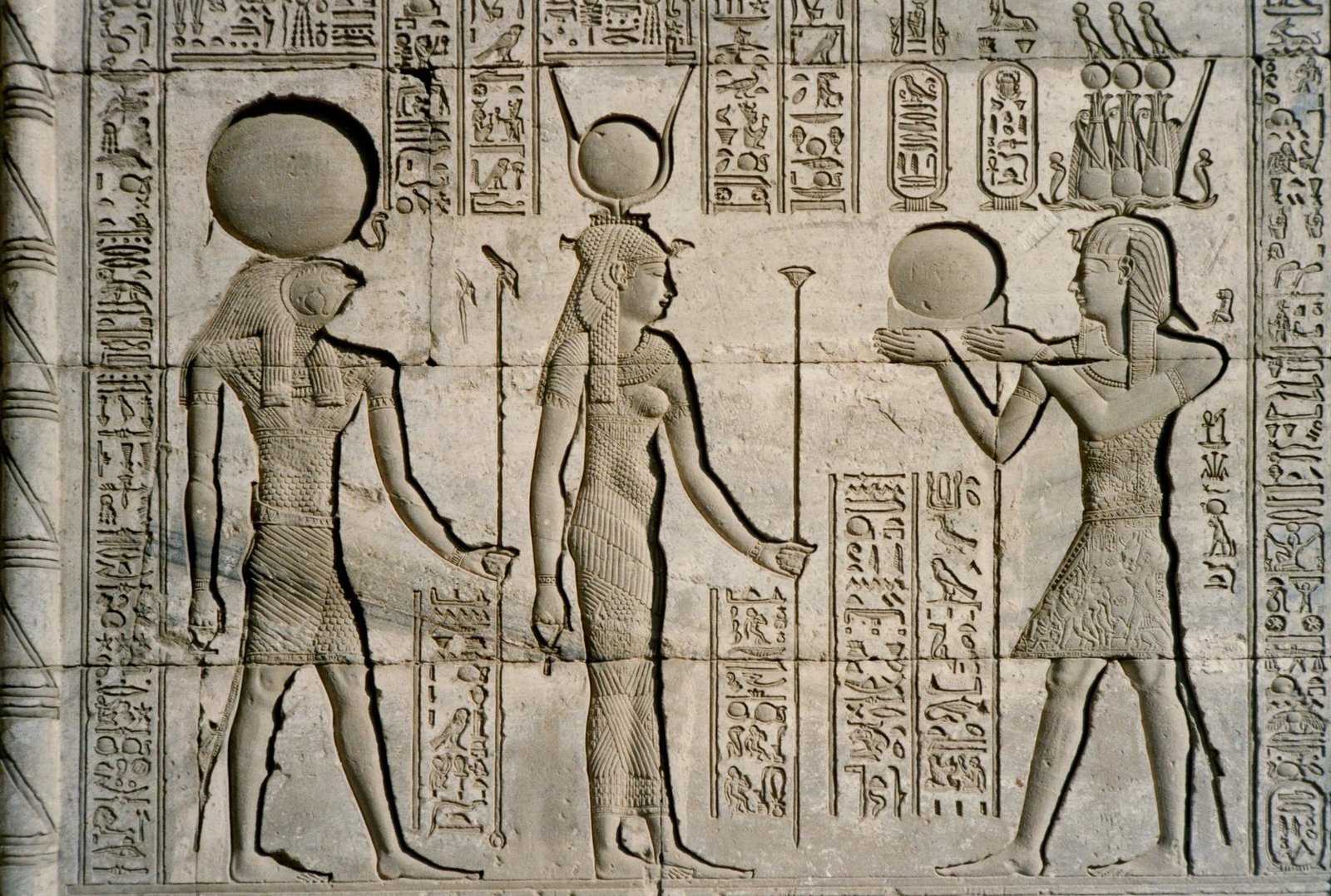
Hathor’s diverse roles include celebration and care, as well as important solar connections. The sistrum is an object often associated with her worship. The temple at Dendera is particularly important for understanding later forms of her cult. Isis can share some of her iconography, so identifying a figure requires attention to inscriptions and context rather than assuming that a horned crown belongs to only one goddess.
Creator gods, cosmic families and local gods
Ptah: Creation and craftsmanship
Identification: Close-fitting cap and wrapped figure.
Ptah was particularly important at Memphis. A notable creation tradition gives thought and utterance a central role in bringing the world into being. His patronage of craftsmanship is relevant to the work of making sacred images and other objects. His creative identity is an alternative to the familiar Heliopolitan genealogy, not an extra stage that must be forced into that family tree.
Atum: Creation and completion
Identification: Human form, sometimes double crown.
In the Heliopolitan creation account, Atum is associated with emergence from the primordial waters and the production of Shu and Tefnut. His position in that tradition makes him the first figure in a commonly taught divine genealogy. He can have solar associations, but the Heliopolitan account is not a universal explanation of every deity’s origins.
Shu and Tefnut: Air, separation and moisture
Identification: Shu supporting the sky; Tefnut often leonine.
These two form a generation in the Heliopolitan genealogy between Atum and the earth and sky deities. Shu’s role in separating Geb and Nut makes the inhabited world possible in a familiar cosmic image. Tefnut’s associations are more complex than one word, although moisture is a common introductory description. Their relationship is essential to understanding the structure of the Ennead.
Geb and Nut: Earth and sky
Identification: Geb beneath an arching, star-covered Nut.
The pairing of earth and sky is one of the most memorable Egyptian visual narratives. Nut’s role can also be related to celestial movement and solar renewal. Unlike a modern astronomy illustration, the image of Nut arching over Geb conveys sacred relationships and the maintenance of cosmic space. Their children include Osiris, Isis, Set and Nephthys in the familiar Heliopolitan account.
Nephthys: Mourning and funerary protection
Identification: Name-sign headdress.
Nephthys accompanies Isis in important funerary contexts. Their protective positions beside the deceased are meaningful in coffin and burial imagery. Nephthys’s connection with Set and the later account of Anubis’s parentage are relevant to family charts, but these relationships should not erase her independent significance as a protective goddess.
Moon, Nile, animals and household gods
Khonsu: Moon and associated healing traditions
Identification: Lunar disk and crescent.
Khonsu belongs to the Theban triad with Amun and Mut. He appears in various forms, including a youthful figure with a sidelock. A modern character named Khonshu in Marvel’s Moon Knight is inspired by this deity but has fictional powers and motivations. Ancient images and texts provide the appropriate evidence for the historical god.
Sobek: Water, crocodiles and strength
Identification: Crocodile or crocodile-headed figure.
Sobek’s crocodile form evokes a powerful animal of the Nile environment. Cult centers such as Kom Ombo and the Faiyum help explain his regional significance. His associations could include fertility, protection and royal power. A crocodile was not merely a monster to Egyptians: its dangerous qualities could be incorporated into a protective religious identity.
Hapi: Nile inundation and abundance
Identification: Human figure with emblems of fertility.
The Nile’s inundation mattered for agricultural life, and Hapi personifies its abundance. His representation with offerings and plants helps connect river processes with prosperity. Hapi should not be confused with the similarly spelled Hapy, one of the four sons of Horus. Transliteration makes that distinction particularly important in a search-based reference article.
Khnum: Creation, shaping life and river associations
Identification: Ram head and potter’s wheel.
Khnum is often associated with fashioning human beings on a potter’s wheel. The metaphor makes creation understandable through a familiar craft. Elephantine and Esna provide important settings for his worship. The ram’s horns are a useful clue, but ram-headed figures also appear in other divine contexts.
Khepri: Renewal and the rising sun
Identification: Scarab beetle.
The movement of a dung beetle and the appearance of the sun supplied visual analogies for renewal. Khepri is often connected with the morning sun, while scarab amulets acquired several religious uses. A heart scarab placed in a funerary context has a more specific purpose than a modern decorative beetle pendant.
Taweret: Protection around pregnancy and childbirth
Identification: Composite hippopotamus figure.
Taweret demonstrates how a formidable animal form could be protective rather than hostile. Small domestic and ritual objects bearing her image are evidence of religious concerns beyond royal monuments. Her composite features should not be mistaken for an illustration of a scientifically documented animal species.
Bes: Household protection, birth and music
Identification: Front-facing dwarf-like protective figure.
Bes imagery often emphasizes a frontal face and a forceful expression, which contrasts with the profile convention common in much Egyptian art. His appearances on household objects show how religious symbols could accompany daily life. The name can cover a complex group of related protective images rather than a single standardized portrait.
Seshat: Writing, records and measurement
Identification: Distinctive emblem above the head.
Seshat is associated with recording and measuring, including in scenes connected with royal building activity. Her emblem is distinctive, but its exact botanical or astronomical identification is debated. It is better to describe what appears in the image than to claim that it proves knowledge of a specific modern technology.
Serket (Selket): Protection, venom and healing
Identification: Scorpion emblem.
Serket is associated with scorpions and protective powers. In funerary contexts she can appear among goddesses protecting the deceased and burial equipment. Her presence reflects the idea that a dangerous natural force could also have a protective divine aspect. A historical explanation of her cult is not a substitute for medical treatment after a real sting.
Wadjet and Nekhbet: Royal protection
Identification: Cobra and vulture respectively.
Wadjet is strongly associated with Lower Egypt and Nekhbet with Upper Egypt. Their paired symbolism can express the protection of the united kingdom. The raised cobra on royal headgear is a familiar sign of royal authority. The two goddesses should not be confused merely because they may appear together.
How Egyptian gods are related: family tree and divine groups
In the Heliopolitan account, Atum produces Shu and Tefnut, who are followed by Geb and Nut. Their descendants include Osiris, Isis, Set and Nephthys. Horus the child is the son of Osiris and Isis in the famous succession narrative. The original nine form the Great Ennead. This is a particular theological genealogy, not a family chart containing all Egyptian gods.
The Theban grouping of Amun, Mut and Khonsu and the Memphite grouping of Ptah, Sekhmet and Nefertum are important additional models. The Hermopolitan Ogdoad expresses primordial conditions rather than the next generation of the same family. A combined form such as Amun-Ra is not a parent-child relationship. In an accurate infographic, different traditions belong in separate panels with legends.
What were the powers of Egyptian gods?
Power in Egyptian religious thought meant more than winning fights. The sun’s renewal, the protection of a child, the correctness of a written record and the fertile land could all depend on divine action in the religious imagination. Ra’s continuing solar journey and Ma’at’s proper order are complementary ideas. A god who protects a burial is no less relevant to a particular worshipper simply because the god is not the central creator in a temple’s theology.
Religious importance could also change. Amun rose with Thebes; Isis acquired an exceptionally wide following in later antiquity. Some household deities appear on everyday objects rather than monumental royal buildings. A useful comparison therefore asks which power mattered in a given historical or ritual setting, not which god would win an invented combat tournament.
How to identify Egyptian gods in pictures and statues
Look first at the inscription and the object’s catalog information, if available. Then consider the body form, crown, objects held in the hands and other figures in the scene. A solar disk by itself does not identify Ra; it may appear with Hathor, Sekhmet and other deities. A falcon can indicate Horus or a related solar form. A museum curator may identify an image more cautiously than a modern poster does.
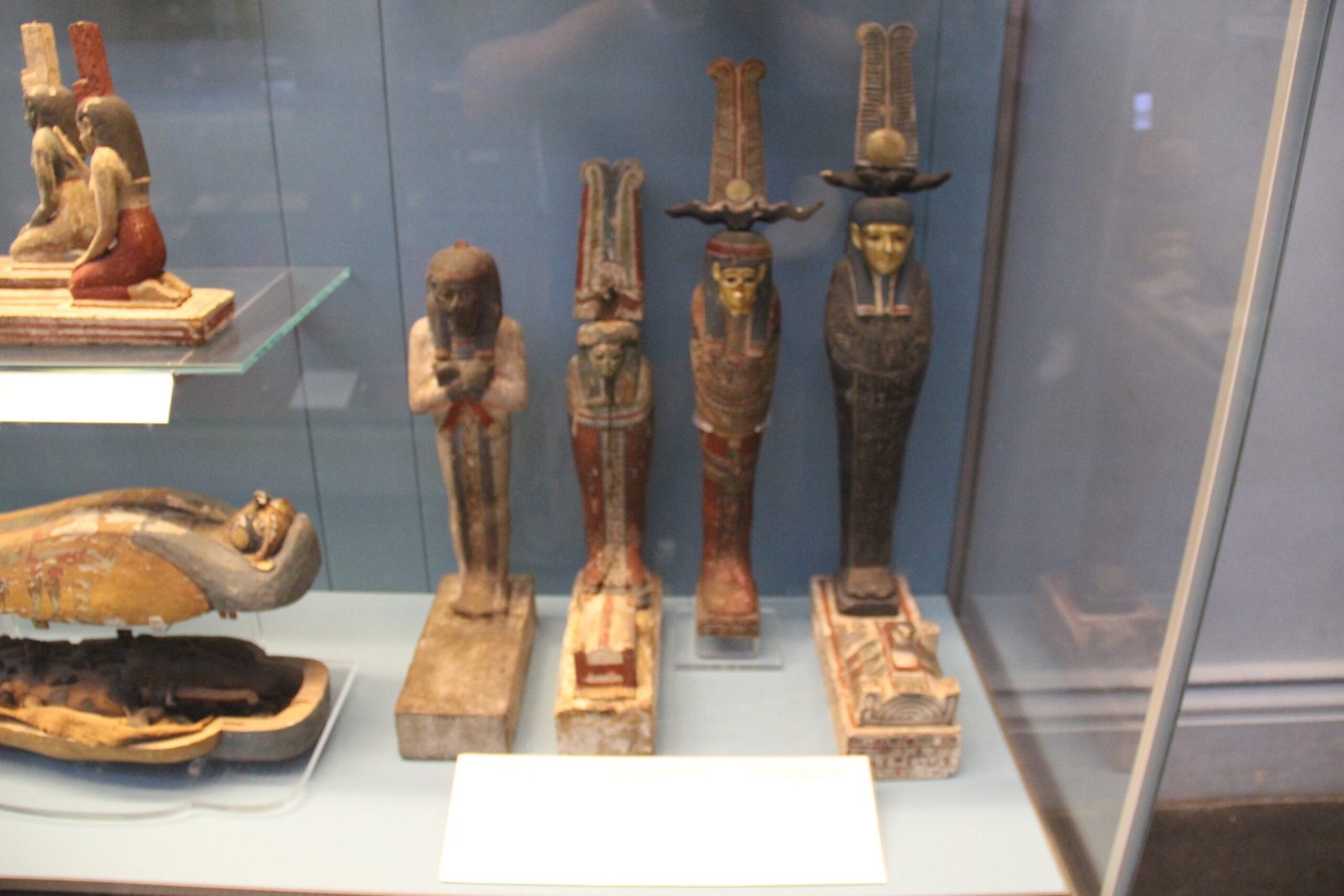
Animal forms are meaningful religious imagery. Anubis does not document the existence of canine-headed humans, and Sobek does not establish the existence of human-crocodile hybrids. A modern cinematic portrait can illustrate the imagination inspired by these gods, but should be labeled as artwork when shown alongside genuine antiquities.
Mythological beings that are not simply ordinary gods
Apep (Apophis) is the great serpent opposed to solar renewal. Ammit is the composite devourer associated with the danger of failed judgment. The Bennu bird is linked with renewal and solar themes. They are important figures in Egyptian mythology, but their functions differ from the roles of a creator god or a household protector. Not every divine or supernatural figure fits neatly into the same category.
Frequently asked questions about Egyptian gods
How many Egyptian gods were there?
There is no fixed universal total; names, local forms and combined identities make a single count misleading.
Who is the most powerful Egyptian god?
Ra and Amun-Ra were prominent in major contexts, but there is no universal ancient power ranking.
Who is the god of death, Anubis or Osiris?
Anubis is associated with funerary preparation and protection; Osiris rules the realm of the dead.
Who is the Egyptian cat goddess?
Bastet is the most familiar cat-associated goddess; Sekhmet also has a feline form, typically a lioness.
Who is the Egyptian god of wisdom?
Thoth is strongly associated with writing and knowledge; Seshat also has important record-keeping associations.
What is the Egyptian god of chaos called?
Set is associated with storms and disruptive force; Apep embodies opposition to the solar cycle. Their roles are distinct.
Are Egyptian gods related to Hindu gods?
There are thematic and visual parallels, but resemblance alone does not establish historical identity or descent.
Why do Egyptian gods have animal heads?
Animal attributes express religious identity and powers. Deities can also appear in wholly human or animal forms.
Are the gods shown in Moon Knight historically accurate?
The series uses ancient names and themes but adapts them into a fictional superhero universe.
Did every Egyptian worship all these gods?
Religious practice varied with place, period, household and personal concerns. The list is a reference, not a record of uniform practice.
Sources and further reading
Conclusion
Learning the names, powers and symbols of the Egyptian gods is a starting point for understanding a diverse religious world. Read the individual stories alongside historical objects, and keep the local traditions and alternative forms visible. This approach makes the gods easier to recognize while preserving the distinctions that make Egyptian mythology remarkable.

















Share Your Opinion
Comments are closed on this post.