 Vista
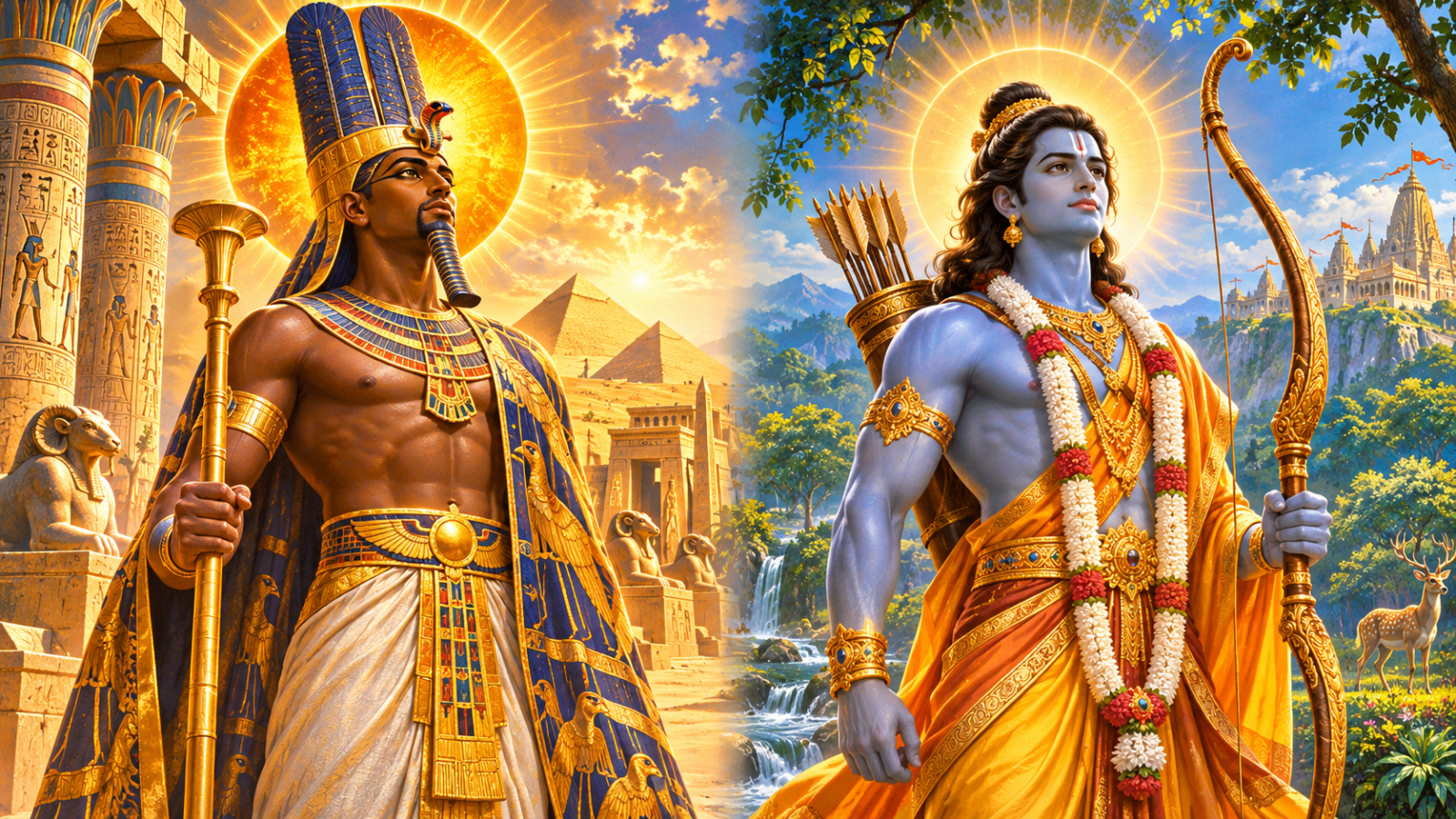
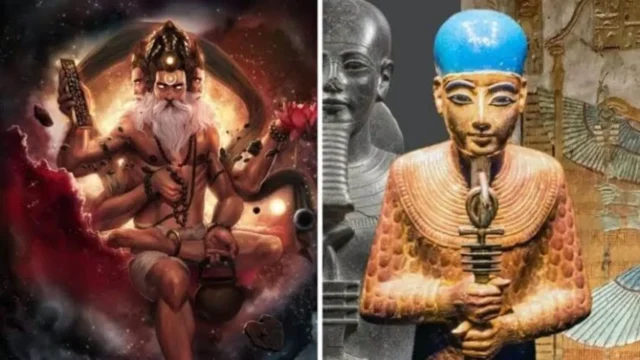
Short answer: There is no historical evidence that Amun-Ra and Lord Rama are the same figure. Amun-Ra was an Egyptian king of the gods formed by joining Amun and Ra. Rama is the hero of the Ramayana and, in Hindu belief, an avatar of Vishnu. The similarity of “Ra” and “Rama” is a coincidence of sound, not proof of connection.
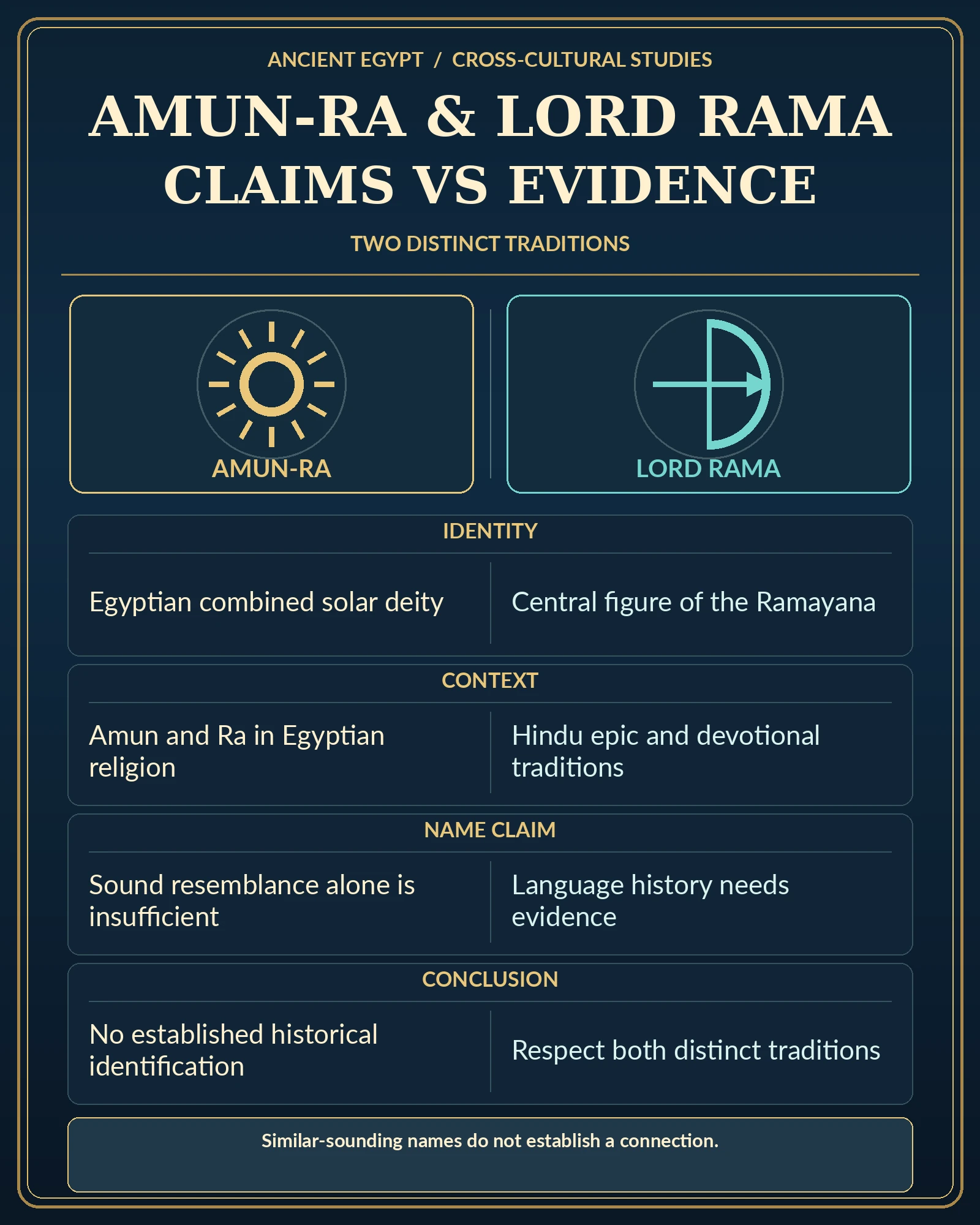
Quick Facts
| Point | Amun-Ra | Lord Rama |
|---|---|---|
| Tradition | Egyptian religion | Hindu tradition |
| Role | King of the gods, sun and hidden power | Hero of the Ramayana, avatar of Vishnu |
| Main centre | Thebes (Karnak) | Ayodhya in tradition |
| Name meaning | Amun “hidden” plus Ra “sun” | Sanskrit name, often linked to delight |
Who was Amun-Ra?
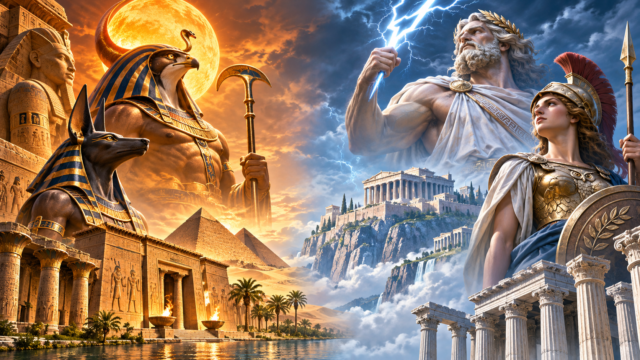
Amun was a god of Thebes. During the New Kingdom, Amun was merged with the sun god Ra to form Amun-Ra, a supreme god whose temple at Karnak became enormously powerful. In Egyptian, “ra” simply means sun.
Who is Rama?
Rama is the central figure of the Ramayana. In tradition he belongs to the Solar dynasty, which is said to descend from Surya, and Hindus revere him as an avatar of Vishnu. His name is Sanskrit and has its own meaning within that language.
Why the claim spreads
- “Ra” and “Rama” sound alike.
- Both are connected to the sun in some way.
- Sound-alike comparisons spread easily online without checking language and history.
Why linguists are not convinced
Egyptian and Sanskrit belong to different language families. Matching a short syllable like “ra” across languages is easy and proves little. Real linguistic links need regular sound patterns across many words, which are not shown here.
Story box (imagined): Two friends compare names. One is called Ravi, another is called Rafa. They sound alike at the start, but they come from different families and places. Names that start the same do not make people related.
History, Mythology and Speculation
| Category | Examples |
|---|---|
| History | Amun-Ra worship at Karnak in the New Kingdom |
| Mythology | Ramayana and its Solar dynasty tradition |
| Speculation | Amun-Ra being Rama, or Rama ruling Egypt |
Myth vs Fact
| Popular claim | Careful answer |
|---|---|
| Amun-Ra is Rama | No evidence |
| Ra and Rama share a root | Not shown by linguistics |
| Both are sun gods | Ra is, while Rama is a hero linked to the Solar dynasty, not a sun god |
Frequently Asked Questions
Is Amun-Ra the same as Rama?
No evidence supports this.
What does Ra mean?
In Egyptian, “ra” means sun and is the name of the sun god.
What does Rama mean?
It is a Sanskrit name, commonly linked to ideas of delight or pleasing.
Did Rama visit Egypt?
No historical evidence says so.
Is Rama a sun god?
No. Tradition places him in the Solar dynasty, but he is revered as an avatar of Vishnu.
Why is Amun hidden?
The name Amun is often explained as meaning hidden.
Is it wrong to compare them?
Comparing themes is fine; claiming they are the same figure is not supported.
Where can I learn more?
Read about Amun-Ra at Karnak and the Ramayana in reliable translations.
Reliable Sources
- World History Encyclopedia: Egyptian Mythology
- Egypt Exploration Society: Gods of Egypt
- The Met: Divine Egypt
Last updated: 25 November 2026. Related reading: Egyptian vs Hindu mythology, Did ancient Egypt exist during the Ramayana?
Related guides: Who Is the Most Powerful Egyptian God? Ra vs Amun-Ra and the Strongest Goddesses · Amun-Ra: King of the Egyptian Gods — Origins, Thebes, Symbols and Myths










Share Your Opinion
Comments are closed on this post.