 Vista
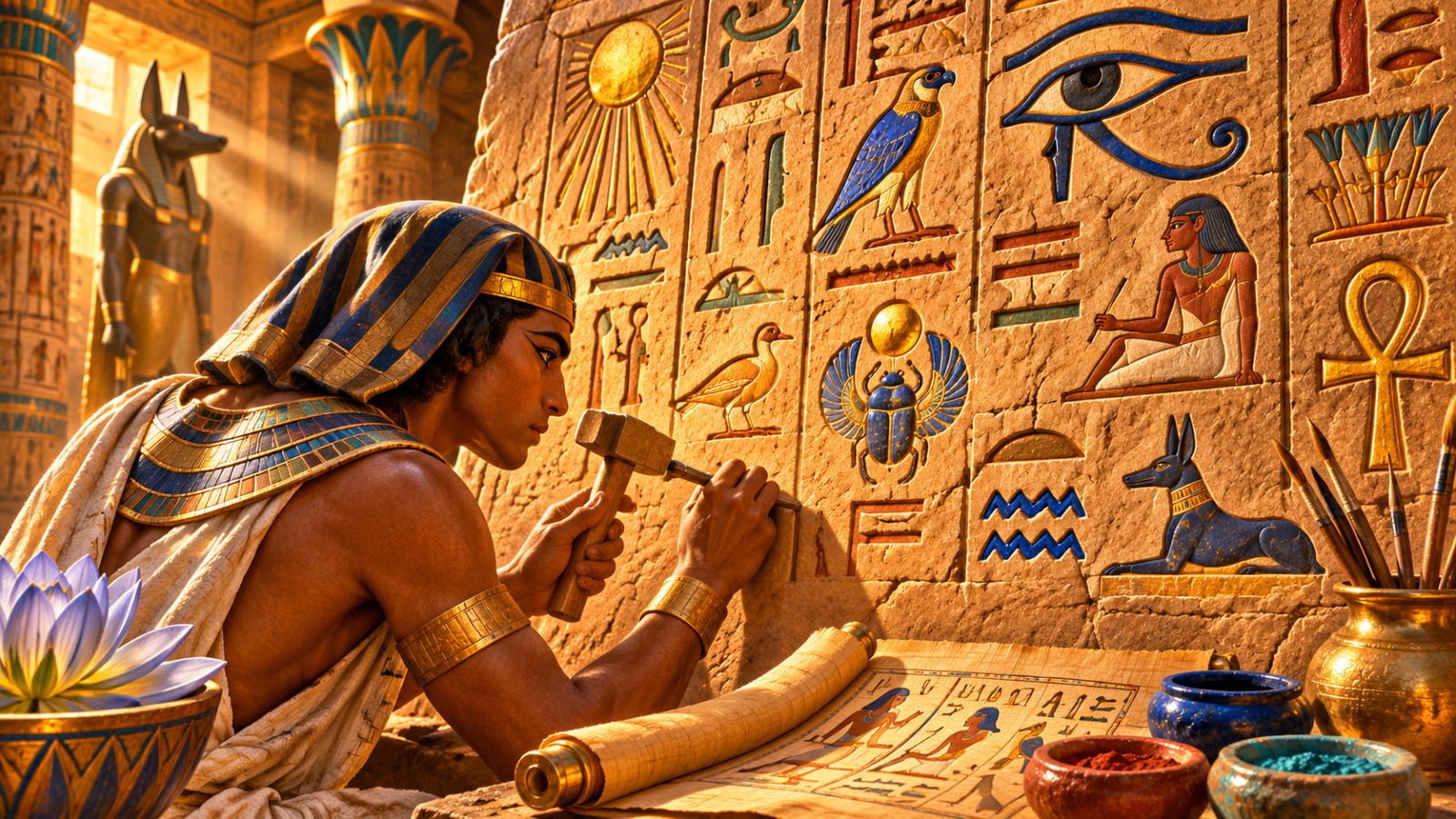
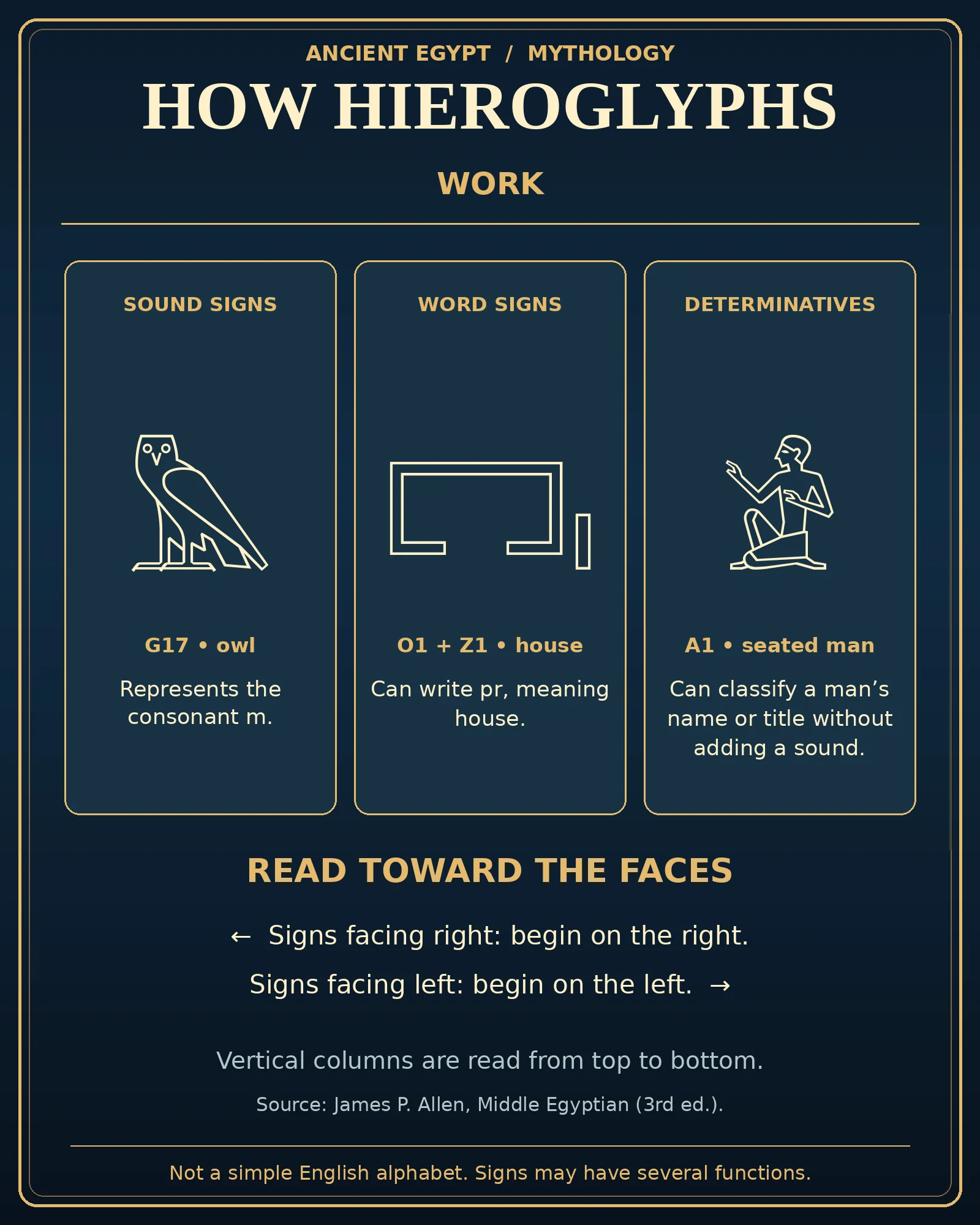
Egyptian hieroglyphs are the picture-based writing system of ancient Egypt, used for monuments, temples and religious texts for more than 3,000 years. They are not just pictures, and they are not an alphabet in the modern sense. The system mixes signs that stand for single sounds (about 24 “uniliteral” signs, often shown in “alphabet charts”), signs for two or three sounds, signs for whole words, and silent “determinative” signs that show the category of a word. Vowels were not written, so modern spellings of Egyptian names are scholars’ conventions. The script was deciphered in the 1820s, using the Rosetta Stone, mainly by Jean-François Champollion.
This guide explains how the signs work, how to read direction, what an “alphabet chart” really is, the Rosetta Stone, other Egyptian scripts, and common myths. A printable chart is handled separately by the visuals team.

Hieroglyphics Quick Facts
| Item | Detail |
|---|---|
| Name | From Greek words meaning “sacred carvings” |
| Egyptian name | “Words of the god” (medu netjer) |
| Earliest use | About 3200 BCE |
| Last known inscription | 394 CE at Philae |
| Sign types | Single-sound, multi-sound, word signs, determinatives |
| Deciphered | 1822 announcement by Champollion, building on the Rosetta Stone |
| Vowels | Not written |
How the Writing System Works
| Sign type | What it does | Example idea |
|---|---|---|
| Uniliteral (one sound) | Stands for a single consonant sound | A reed leaf, an owl, a water ripple |
| Biliteral and triliteral | Stands for two or three consonants | Signs that bring more sounds in less space |
| Logograms (word signs) | Stands for a whole word | A sun disc for “sun” or “day” |
| Determinatives | Silent signs that show a word’s category | A walking-legs sign after a verb of movement |
Because the same sign can be used for sound, meaning or category depending on the context, reading hieroglyphs takes practice. Scholars list several hundred common signs for Middle Egyptian, and many more were used in later temple inscriptions, especially in the Ptolemaic period.
The “Alphabet” Chart: What It Really Is
Websites often show a chart of hieroglyphs matched to English letters. These charts are useful for fun, such as writing your name, but they are approximate. Egyptian had sounds that English does not, and it did not write vowels. So a chart can show how to write the sounds of your name in hieroglyphs, but it is not how an ancient Egyptian would necessarily have spelled it. Treat it as a learning tool.
Reading Direction and Cartouches
Hieroglyphs can be written in rows or columns, and from right to left or left to right. The rule for reading: look at which way the animal and human signs face, and read toward their faces. Royal names were written inside an oval ring called a cartouche, which protected the name of a king. Our guides to Egyptian symbols explain several of the signs that appear in cartouches.
Story box (reconstruction of a scribe’s workshop): A young scribe sits cross-legged with a palette of red and black ink. A senior scribe taps a column of signs on a papyrus and says, “Which way do the birds look?” The student answers, “Toward the left, so I read from the left.” The older man nods. On the temple wall nearby, a carver chisels the same sign into stone, slowly, one stroke at a time. This scene is a reconstruction of scribal training, not a record of one person.
The Rosetta Stone and Champollion
The Rosetta Stone, found in 1799, carries the same decree in hieroglyphs, demotic and Greek, from 196 BCE. Because scholars could read the Greek, they could compare the texts. Thomas Young made early progress by identifying royal names in cartouches. Jean-François Champollion then showed in 1822 that hieroglyphs combine sound signs and meaning signs, which unlocked the script. The stone is in the British Museum in London.
Hieratic and Demotic
Hieroglyphs were mainly for monuments. For everyday writing on papyrus, scribes used hieratic, a cursive form, and later demotic, an even more rapid script. These were not secret codes. They were practical writing systems for the same language at different stages.
History, Mythology and Speculation
| Category | What belongs here |
|---|---|
| History | Inscriptions, papyri, the Rosetta Stone, decipherment |
| Mythology | Thoth as inventor of writing; hieroglyphs as “words of the god” |
| Speculation | Claims of hidden codes or secret messages; “pure picture” readings; claims that hieroglyphs are an alien language |
Myth vs Fact
| Popular claim | Reality |
|---|---|
| Hieroglyphs are just pictures. | They combine sound signs, word signs and category signs. |
| Hieroglyphs are an alphabet. | They include about 24 single-sound signs, but the system is more complex. |
| The script was a lost mystery until modern times. | It was deciphered in the 1820s using the Rosetta Stone and other texts. |
| Hieroglyphs always read left to right. | They can run either way, and in rows or columns. |
| Hieroglyphs hide secret codes. | No evidence supports this. |
Frequently Asked Questions About Egyptian Hieroglyphics
How many hieroglyphs are there?
Several hundred common signs, and more in later periods. Around 24 stand for single sounds.
Is there a hieroglyphic alphabet?
There are single-sound signs that scholars list like an alphabet, but the system also includes many other types of signs.
Which way do you read hieroglyphs?
Read toward the faces of the animal and human signs.
What is a cartouche?
An oval ring around a royal name.
Who deciphered hieroglyphs?
Jean-François Champollion in 1822, building on the work of others such as Thomas Young.
What is the Rosetta Stone?
A stone with the same decree in hieroglyphs, demotic and Greek, found in 1799.
Can I write my name in hieroglyphs?
You can write the sounds of your name using the sign chart, but it is an approximation.
Did Egyptians write vowels?
No. Only consonants were written, so modern vowel spellings are conventions.
Reliable Sources
- World History Encyclopedia: Egyptian Mythology
- Egypt Exploration Society: Gods of Egypt
- The Metropolitan Museum of Art: Divine Egypt
Last updated: 25 November 2026. Related reading on Vista Hub: our guides to Thoth, Seshat, Egyptian symbols and ancient Egyptian civilization.














Share Your Opinion
Comments are closed on this post.