 Vista

The Ouroboros is the ancient symbol of a serpent or dragon biting its own tail, forming a circle. It is usually read as a sign of eternity, endless cycles, and renewal through destruction and rebirth. One of its earliest well-known appearances is in ancient Egypt, in a funerary text painted on a shrine in the tomb of Tutankhamun (around 1323 BCE), where a serpent surrounds a figure with its tail in its mouth. The name “Ouroboros” is Greek, meaning “tail-devourer”, and the symbol was later used widely in Greek, Hellenistic, Gnostic and alchemical traditions.
This guide explains the Egyptian origins, the Greek and alchemical use, the meaning, comparisons with other serpent symbols, and which claims are myths or unproven.
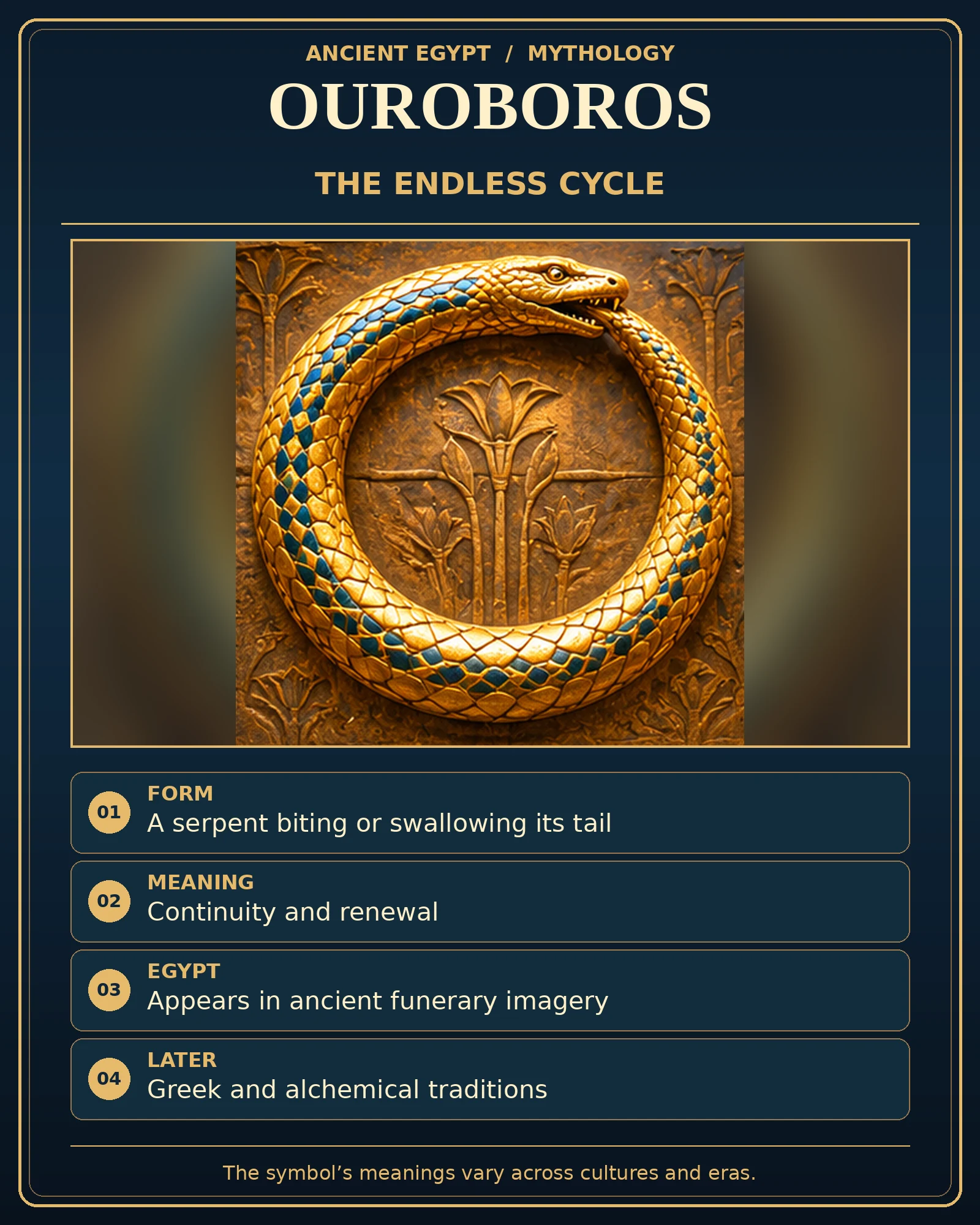
Ouroboros Quick Facts
| Item | Detail |
|---|---|
| Image | A serpent or dragon biting its tail |
| Name | Greek, “tail-devourer” |
| Early Egyptian example | Enigmatic Book of the Netherworld on a shrine of Tutankhamun |
| Later uses | Greek magical papyri, Gnostic texts, alchemy, Hermeticism |
| Main meanings | Eternity, cycles of time, renewal, unity of beginning and end |
Egyptian Origins
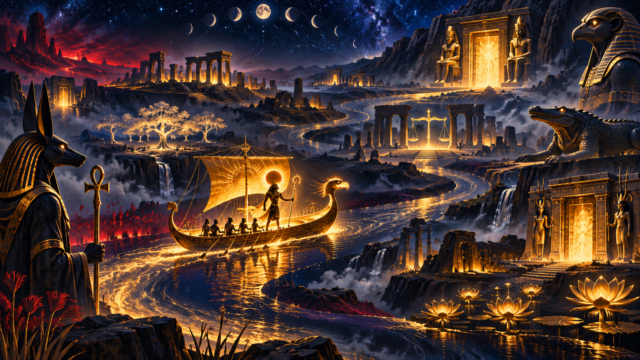
In the Egyptian underworld text called the Enigmatic Book of the Netherworld, a serpent curls around the head and feet of a figure, with its tail in its mouth. The text links this to the idea of the sun god’s regeneration in the Duat, where the darkness encloses and renews him. Egyptians also had other coiled serpents, such as Mehen, who protects Ra’s boat, and the great chaos serpent Apep. These are different beings. The tail-biting image is not a standard symbol of any particular Egyptian god, so it is best to say that the idea of a cyclic, encircling serpent is attested in Egyptian sources. See our guides to the Duat and Apep.
Greek, Gnostic and Alchemical Use
The symbol appears in Greek magical papyri and in the work of Hellenistic Egyptian alchemists. A well-known example is a drawing in a manuscript attributed to Cleopatra the Alchemist, with the Greek words commonly translated “the all is one”, inside the circle. Gnostic and Hermetic writers, and later European alchemists, used the Ouroboros to express unity, the cycle of matter and the transformation of substances. In the 20th century, the psychologist Carl Jung used it as an example of a symbol from the unconscious.
Story box (retold from tomb imagery): In the narrow gold-covered chamber, a painted figure stands inside a coiled serpent. Its tail rests in its mouth, and the circle holds the god like a protective ring. The darkness of the Duat is not empty. It is a place where life can start again. A priest, long ago, might have read this image as a promise that the sun would rise. This is an interpretation of an ancient scene, since the surviving texts are short and symbolic.
What Does It Mean?
| Reading | Explanation |
|---|---|
| Eternity | A circle has no beginning or end |
| Cycles | Day and night, seasons, life and death |
| Renewal | The serpent consumes itself and survives, like a snake shedding skin |
| Unity | The “all is one” alchemical idea |
The meaning depends on the culture and period. Many modern websites give a single universal meaning, which is a simplification.
Similar Symbols in Other Cultures
Serpents that encircle the world appear in several traditions, such as the Norse Jormungandr, who lies in the sea around Midgard and, in some retellings, bites his tail. Whether any of these are historically connected to the Egyptian image is unknown, so it is safer to say that they are similar symbols, not proof of a single origin. Hindu images of Shesha and the cycle of yugas are also sometimes compared, but those come from a separate tradition with different meanings. Our guide to Jormungandr covers the Norse figure.
History, Mythology and Speculation
| Category | What belongs here |
|---|---|
| History | Tutankhamun’s shrine image; Greek magical papyri; alchemical manuscripts |
| Mythology | The encircling serpent in the Duat; world-serpent stories elsewhere |
| Speculation | One universal ancient origin; secret-society claims; the story that a dream of an Ouroboros led Kekulé to the benzene ring, which is a popular anecdote of uncertain accuracy |
Myth vs Fact
| Popular claim | Reality |
|---|---|
| The Ouroboros is a Greek invention. | The name is Greek, but an early tail-biting serpent image appears in Egypt. |
| It always means eternity. | Meanings vary by culture and period. |
| All world-serpent myths come from one source. | This is unproven. |
| The Ouroboros is Apep. | Apep is a separate chaos serpent. The tail-biting image is not linked to him in the sources. |
| It is a secret society symbol. | No evidence supports this. It is an old symbol used in many contexts. |
Frequently Asked Questions About the Ouroboros
What is the Ouroboros?
A symbol of a serpent biting its own tail, forming a circle.
What does it mean?
Eternity, cycles and renewal, among other readings.
Where does it come from?
An early example appears in Egypt, and the Greek, Gnostic and alchemical traditions developed it further.
Is it Egyptian?
The earliest well-known example is Egyptian, but the name and much of the later meaning are Greek.
Is the Ouroboros the same as Apep?
No. Apep is a separate enemy of Ra.
What is the “all is one” phrase?
A Greek phrase found inside an Ouroboros in an alchemical manuscript, often translated “the all is one”.
Is Jormungandr an Ouroboros?
He is a similar world serpent, but the link to the Egyptian symbol is not proven.
Did the Ouroboros inspire the benzene ring?
The story is a popular anecdote about the chemist Kekulé, but its accuracy is uncertain.
Reliable Sources
- World History Encyclopedia: Egyptian Mythology
- Egypt Exploration Society: Gods of Egypt
- The Metropolitan Museum of Art: Divine Egypt
Last updated: 25 November 2026. Related reading on Vista Hub: our guides to Apep, the Duat, Jormungandr and Egyptian symbols.
Related guides: Ancient Egyptian Civilization: History, Timeline, Pharaohs and Inventions · Ankh: The Egyptian Symbol of Life and Eternity — Meaning, Origin and the "Egyptian Cross"











Share Your Opinion
Comments are closed on this post.