 Vista
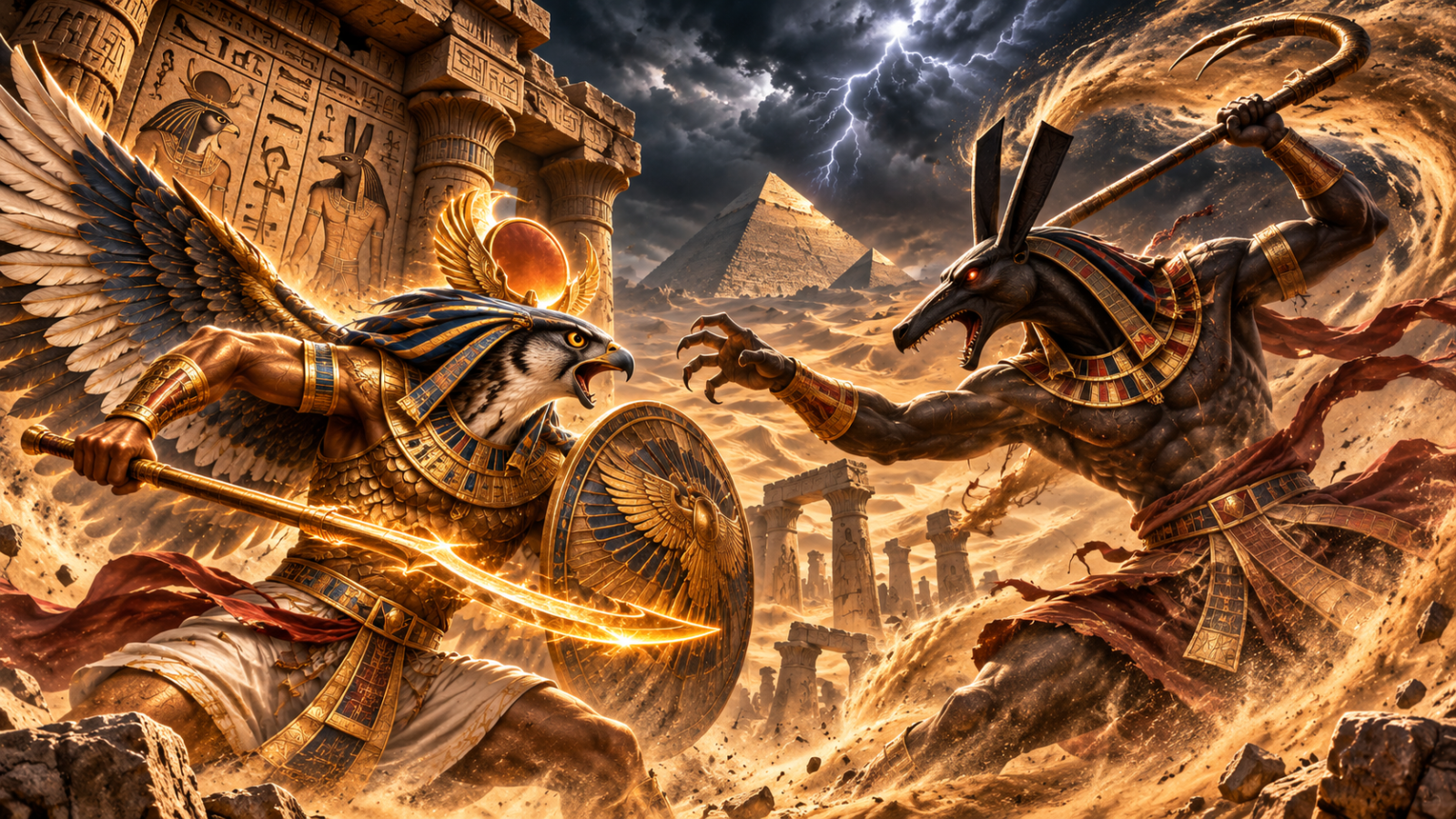
The conflict of Horus and Set is the great succession myth of ancient Egypt. After Set murdered his brother Osiris and took the throne, Osiris’s son Horus claimed the kingship as rightful heir. The two fought and argued before the council of gods for a very long time, in battles and contests where Horus lost an eye and Set was also injured. In the end, Horus was awarded the throne of Egypt, and Set was kept in a lesser, stormy role. The story explained why each living king was seen as Horus and why order won over chaos, though several versions exist and they do not agree on every detail.
This guide explains the background, the main sources, the contests, the lost eye, the outcome, and how the myth should be read.
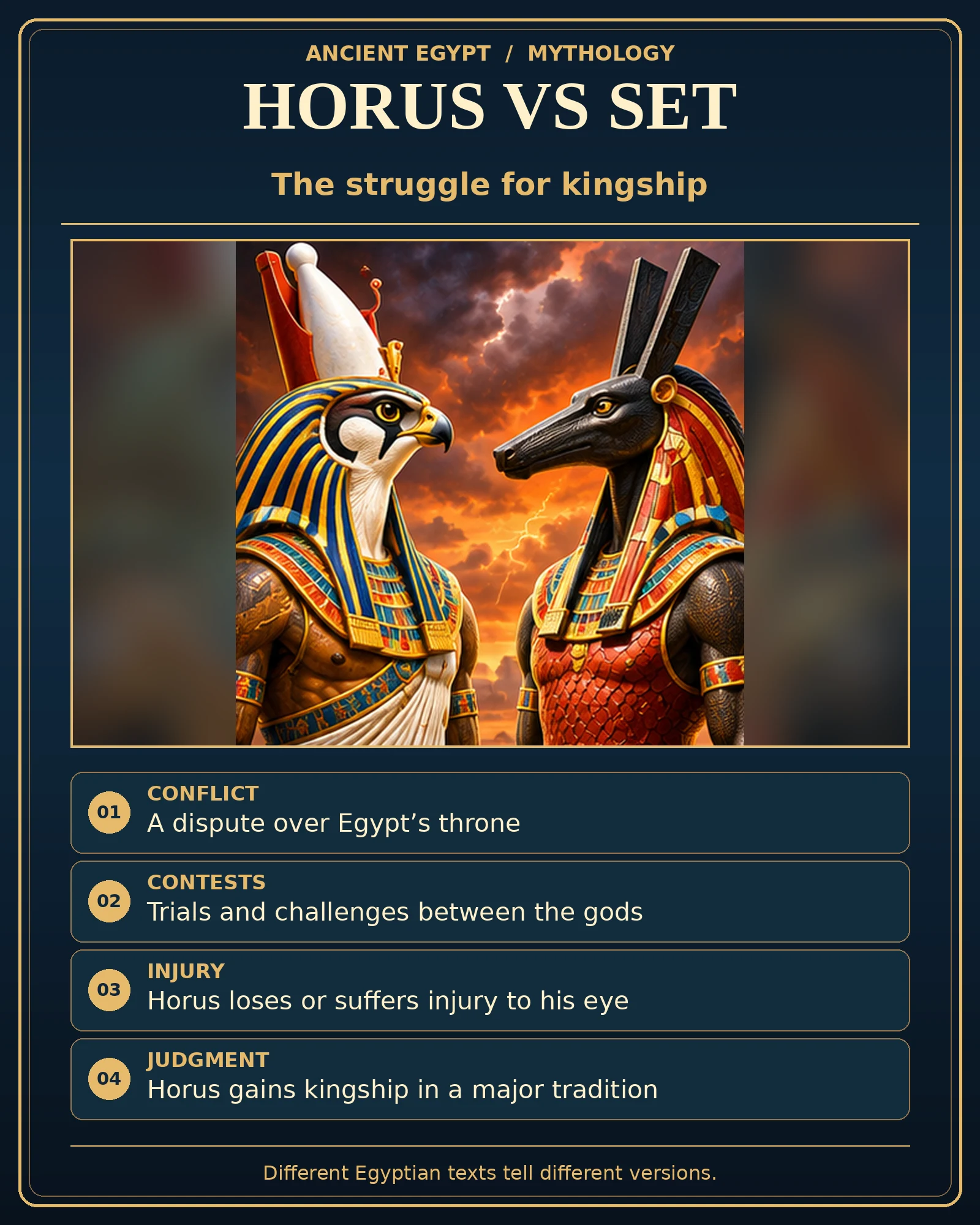
Horus vs Set Quick Facts
| Item | Detail |
|---|---|
| Conflict | Who should rule Egypt after Osiris |
| Main sources | Pyramid Texts hints; The Contendings of Horus and Set (Chester Beatty Papyrus I, Ramesside period); Plutarch’s later Greek account |
| Horus’s side | Isis, Thoth, Osiris’s claim, the council’s sense of rightful succession |
| Set’s side | Ra’s favour at times; strength and defence of Ra’s boat |
| Judges | The Ennead, led by Ra-Horakhty or Atum in different versions |
| Outcome | Horus becomes king; Set is reconciled or given a role at Ra’s side |
The Background
The conflict follows the murder of Osiris. Isis recovers his body and conceives Horus, who grows up hidden in the marshes. When he comes of age, he asks the gods to give him his father’s office. Our guides to Osiris, Isis, Horus and Set explain each figure, and this article focuses on the quarrel itself.
The Contests Before the Gods
In The Contendings of Horus and Set, the council hears the case for eighty years, according to the story. The gods are divided: some think Horus, as the son, should inherit, while others think a strong adult like Set is better able to defend Ra. Isis uses clever tricks to help her son. A series of contests follows, including a race in boats of stone, in which Set’s heavy boat sinks and Horus’s boat, which is secretly made of wood and painted to look like stone, floats. Sources describe other contests, such as a hippopotamus-shape endurance contest. The story is told with humour and with human-like quarrels among the gods, a style that differs from the solemn tone of funerary texts.
Story box (retold from the Contendings): On the riverbank, the gods watch two boats. Set’s is made of heavy stone, and Horus’s looks just as heavy. The signal is given and the boats slide into the water. Set’s boat groans and slips beneath the surface. Horus’s, lighter than it seems, moves on. Set shouts in fury and changes into a hippopotamus. The council still cannot decide, and so letters are sent to the goddess Neith and to Osiris in the underworld. This is a retelling of a literary myth, not history.
The Lost Eye
In the fighting, Set damages or removes the eye of Horus. Different texts describe the healing in different ways: in some, the god Thoth restores the eye, and in the Contendings, the goddess Hathor heals it with milk. The restored eye became the wedjat, a symbol of healing, wholeness and protection. See our guide to the Eye of Horus and the Eye of Ra for its later use as an amulet.
Who Won?
Horus wins the throne. In the story, the council agrees after a letter from Osiris warns that the land of the dead is full of demons that do not fear the gods, and that the right of the true heir must be respected. Set is not destroyed. He is taken into Ra’s service, where his storm power is used against enemies such as Apep. This ending reflects the Egyptian preference for balance: chaos is controlled, not erased. Our guide to Apep explains Set’s role as defender of the sun boat.
What the Myth Meant
For Egyptians the story supported the ideology of kingship: a living king was Horus, and his dead father became Osiris. The union of Horus and Set was also read as the union of the Two Lands (Upper and Lower Egypt). Some modern scholars read traces of early political conflict in the myth, but this is a theory, and there is no direct proof that it records a real historical war.
History, Mythology and Speculation
| Category | What belongs here |
|---|---|
| History | Texts such as the Chester Beatty papyrus; royal titles using Horus and Set |
| Mythology | The contests, the lost eye, the council’s judgment |
| Speculation | That it records a prehistoric civil war between Upper and Lower Egypt; modern “good vs evil” readings |
Myth vs Fact
| Popular claim | Reality |
|---|---|
| Set was simply evil. | He was dangerous but also a defender of Ra and a god worshipped in some periods. |
| Horus killed Set. | In most versions Set is defeated but not killed. |
| There is one standard version of the story. | Several texts differ in detail. |
| It is a record of a real war. | That is a theory; the story is religious and literary. |
| Horus lost his eye forever. | The eye was healed and became a symbol of wholeness. |
Frequently Asked Questions About Horus vs Set
Why did Horus and Set fight?
Both claimed the throne of Egypt after Osiris was murdered.
Who won?
Horus was awarded the kingship, and Set was kept in a lesser role.
How did Horus lose his eye?
Set injured it in the conflict. Texts differ on the details.
Who healed the eye?
Thoth in several texts, and Hathor in the Contendings.
What is the Contendings of Horus and Set?
A Ramesside-period story on a papyrus, describing the trial and contests before the gods.
Was Set punished?
He was defeated but then given a role at Ra’s side as a protector against Apep.
Does the myth reflect real history?
Some scholars suggest echoes of early political conflict, but this is a theory and not proven.
Why does the myth matter for pharaohs?
Each king was seen as Horus, the rightful heir, which supported the idea of legitimate succession.
Reliable Sources
- World History Encyclopedia: Egyptian Mythology
- Egypt Exploration Society: Gods of Egypt
- The Metropolitan Museum of Art: Divine Egypt
Last updated: 25 November 2026. Related reading on Vista Hub: our guides to Horus, Set, Osiris, Isis, Thoth and the Eye of Horus.
Related guides: Egyptian Mythology · Egyptian Gods and Goddesses











Share Your Opinion
Comments are closed on this post.