 Vista

Ptah was the Egyptian creator god of Memphis and the patron of craftsmen, builders and artists. In the Memphite tradition he created the world through thought and speech: he conceived things in his heart and brought them into being by naming them with his tongue. He is shown as a bearded man wrapped like a mummy, wearing a tight skullcap and holding a staff, and he was worshipped for more than two thousand years in Egypt’s first capital.
This guide explains who Ptah was, what the “creation by speech” theology says, how it is known from the Shabaka Stone, why craftsmen honoured him, and how he fits into the Memphite family of Sekhmet and Nefertem. We keep mythology, history and speculation separate, and we flag where scholars disagree.

Quick Fact Box: Ptah at a Glance
| Item | Detail |
|---|---|
| Domain | Creation, craftsmanship, architecture, artists |
| Cult centre | Memphis, the ancient capital near modern Cairo |
| Appearance | Bearded man in mummy wrappings, skullcap, holding a combined sceptre |
| Divine family | Husband of Sekhmet; father of Nefertem (the Memphite triad) |
| Creation method | Thought of the heart and command of the tongue |
| Key text | Memphite Theology on the Shabaka Stone |
| Sacred animal link | Apis bull |
| Greek equivalent | Hephaestus |
Who Was Ptah?
Ptah is one of Egypt’s oldest gods, linked to Memphis from the beginning of recorded history. Memphis was the capital of the Old Kingdom, and its main temple, the Temple of Ptah, was among the most important in the country. The Greek name for Egypt, Aigyptos, is often explained as a Greek rendering of the Egyptian name of this temple, Hut-ka-Ptah, “the house of the ka of Ptah”. If so, the name of the whole country may come from his sanctuary.
Ptah’s identity combines two ideas. He is a cosmic creator who shaped the universe, and a divine craftsman who worked metal, stone and wood. For Egyptians these were linked: the same intelligence that fashioned a statue could fashion the world.
Creation Through Speech: The Memphite Theology
The best-known Egyptian creation stories are those of Heliopolis, with the god Atum, and Hermopolis, with the Ogdoad. Memphis offered a different explanation. In its theology, Ptah is the supreme creator, and the other gods, even Atum, come from him. He conceives creation in his heart, the seat of thought in Egyptian belief, and brings it to life by speaking the names of things with his tongue.
This is one of the earliest known expressions of the idea that the world is created by a word. It also shows that priests of different cities wanted their own god to hold the highest rank, a pattern we see across Egyptian religion.
The Shabaka Stone
The Memphite Theology is preserved on the Shabaka Stone, a slab of dark stone now in the British Museum. It carries the name of King Shabaka of the 25th Dynasty, around 700 BCE, who ordered the text to be copied from an older, worm-eaten document. How much older the original is has been debated. Some scholars have argued for a very early date and others for a later composition, so the stone is best read as a theology from at least the first millennium BCE that claims ancient roots.
Story Box: A King Rescues an Old Text
The inscription on the Shabaka Stone says the king found an ancient writing eaten by worms and had it copied so it would last. Whatever the true age of the source, the stone shows an Egyptian king acting as a preserver of tradition. The slab was later reused as a millstone, and the grinding wore away parts of the text, which is why some lines are lost.
Appearance and Symbols
Ptah is shown as a man with a close-fitting skullcap, a straight false beard and tightly wrapped body, with the hands holding a staff that combines the was (power), djed (stability) and ankh (life) signs. His mummy-like dress is shared with other gods such as Osiris and Khonsu and connects him to ideas of order, permanence and rebirth. Some images show him on a base shaped like the sign of ma’at.
- Skullcap: a craftsman’s plain head covering.
- Combined staff: power, stability and life.
- Mummiform body: permanence and renewal.
- Ma’at pedestal: creation grounded in truth and order.
Patron of Craftsmen
Sculptors, metalworkers, carpenters and architects looked to Ptah as their patron. The high priest of Ptah at Memphis carried a title often translated “greatest of the directors of craftsmen”. At the workmen’s village of Deir el-Medina, where the builders of the royal tombs lived, Ptah was among the gods honoured. This gives us a view of how a creation theology also served as a working craftsman’s religion.
The Memphite Family: Sekhmet and Nefertem
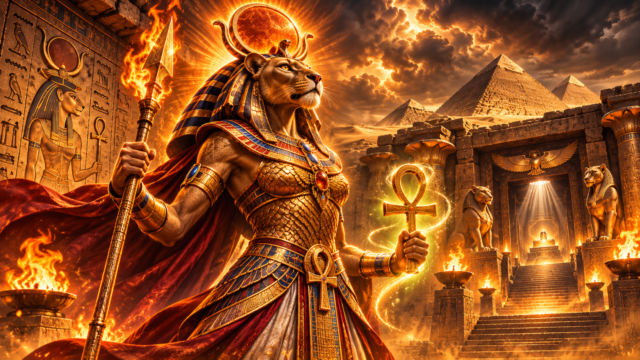
Ptah’s wife is the lioness goddess Sekhmet, whose power in war and sickness balanced his calm creativity, and their son is Nefertem, the god of the lotus and of perfume. Together they make the Memphite triad. In later periods Ptah also merged with other gods, producing combined forms such as Ptah-Sokar-Osiris, a funerary god linking creation, the necropolis and rebirth.
Ptah and the Apis Bull
The Apis bull, a living animal chosen for special markings, was kept at Memphis and regarded as a manifestation of Ptah. When it died it was mummified and buried in the Serapeum at Saqqara. This links Ptah with the sacred-animal cults described in our guide to the Apis bull and other sacred animals.
Mythology, History and Speculation
- Mythology: Ptah creates through heart and tongue; he is a divine craftsman.
- History: a god of Memphis attested from early times, with a major temple and a priesthood that lasted until the Greco-Roman era.
- Speculation: claims that Ptah is “Brahma in disguise” or that the Memphite text proves a lost ancient science of sound are not supported. Comparisons with Indian creation ideas belong to separate comparative articles.
Myth vs Fact
| Claim | Reality |
|---|---|
| Ptah was the only Egyptian creator. | Other cities had their own creators, such as Atum and Amun. |
| The Shabaka Stone is a 5,000-year-old original. | The stone dates to about 700 BCE; the original text may be older but its date is debated. |
| Ptah was a minor craft god. | He was a major creator god and patron of Memphis. |
| Ptah and Brahma are the same. | Both are creators, but they come from separate traditions. |
| Egypt’s name comes from Ptah. | It is a widely cited explanation of Aigyptos, though a theory about the word’s origin. |
Frequently Asked Questions About Ptah
Who is Ptah in Egyptian mythology?
He is the creator god of Memphis and patron of craftsmen and artists.
How did Ptah create the world?
By conceiving it in his heart and speaking it into being with his tongue.
What is the Shabaka Stone?
A stone slab of about 700 BCE, now in the British Museum, carrying the Memphite Theology.
Who are Ptah’s wife and son?
Sekhmet and Nefertem.
Why is Ptah shown as a mummy?
The wrapped form signals permanence, order and renewal and is shared with other gods such as Osiris.
What is Ptah’s connection to the Apis bull?
The Apis bull was regarded as a living manifestation of Ptah at Memphis.
Was Ptah more powerful than Ra?
It depends on the city’s theology. Memphis placed Ptah first; Heliopolis placed Atum or Ra first.
Where was Ptah worshipped?
Mainly at Memphis, with shrines across Egypt, including Thebes and the workmen’s village at Deir el-Medina.
Does Ptah’s name give Egypt its name?
A common theory says the Greek Aigyptos comes from Hut-ka-Ptah, his temple’s name, but it is an explanation, not a certainty.
Is Ptah similar to Brahma or Vishwakarma?
The parallels with Brahma (creator) and Vishwakarma (divine craftsman) are thematic. They come from different cultures and no historical link is proven.
Sources and Further Reading
- World History Encyclopedia: Egyptian Mythology
- Egypt Exploration Society: Gods of Egypt
- The Met: Divine Egypt
Last updated: 25 November 2026.
Related guides: Ra: Egyptian Sun God, Creation Myths, Eye of Ra and the Night Journey (Facts and Symbols) · Atum: Egyptian Creator God of Heliopolis — the Self-Created First God, the Ennead and the Setting Sun
















Share Your Opinion
Comments are closed on this post.