 Vista
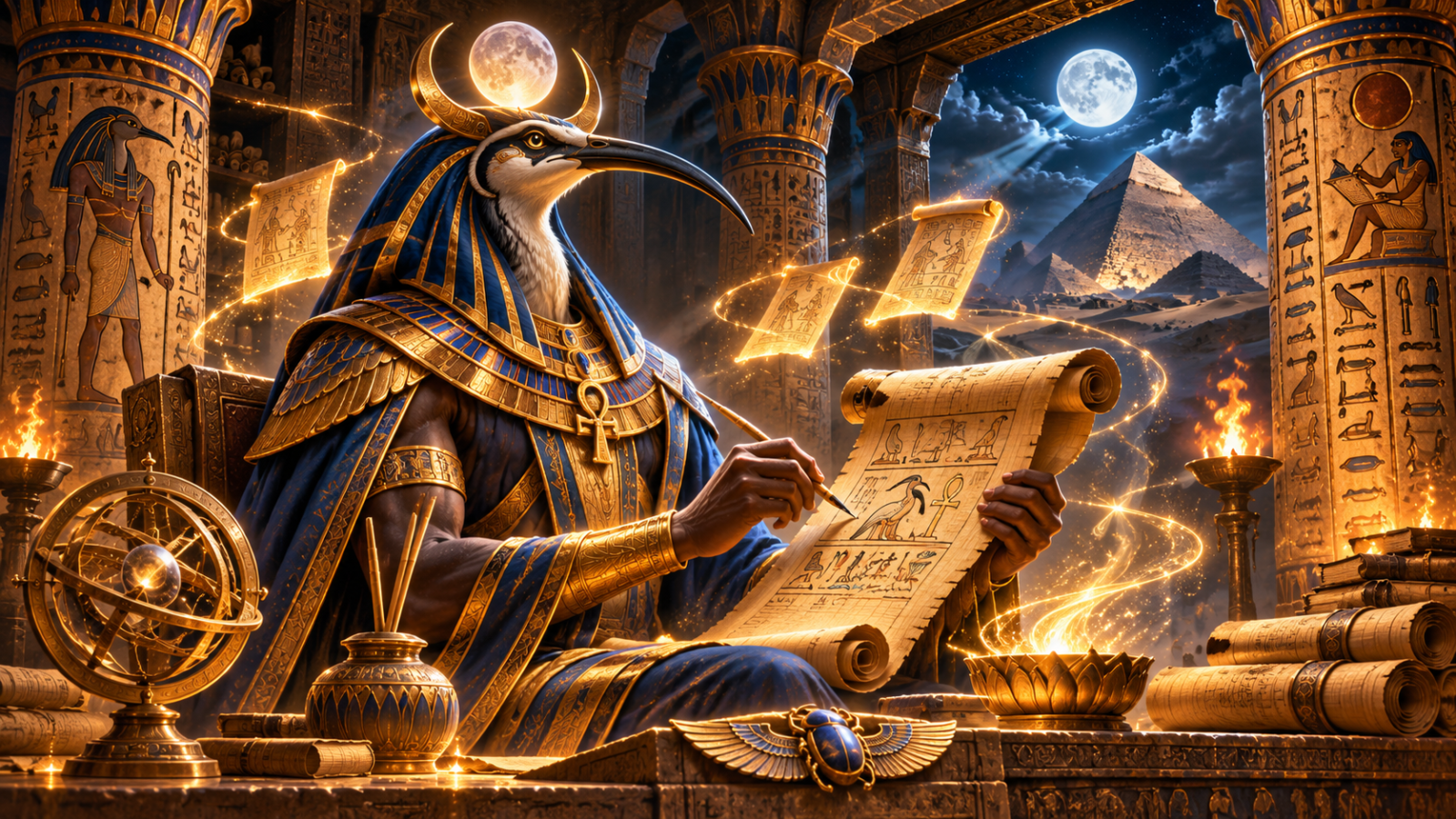
Thoth (Egyptian: Djehuty) was the ancient Egyptian god of writing, wisdom, the moon, magic and the measurement of time. He is shown as an ibis-headed man or as a baboon, and he acts as the scribe and secretary of the gods. In the judgment of the dead he records the result of the weighing of the heart, and in the myth of Horus and Set he heals the injured Eye of Horus and helps settle disputes.
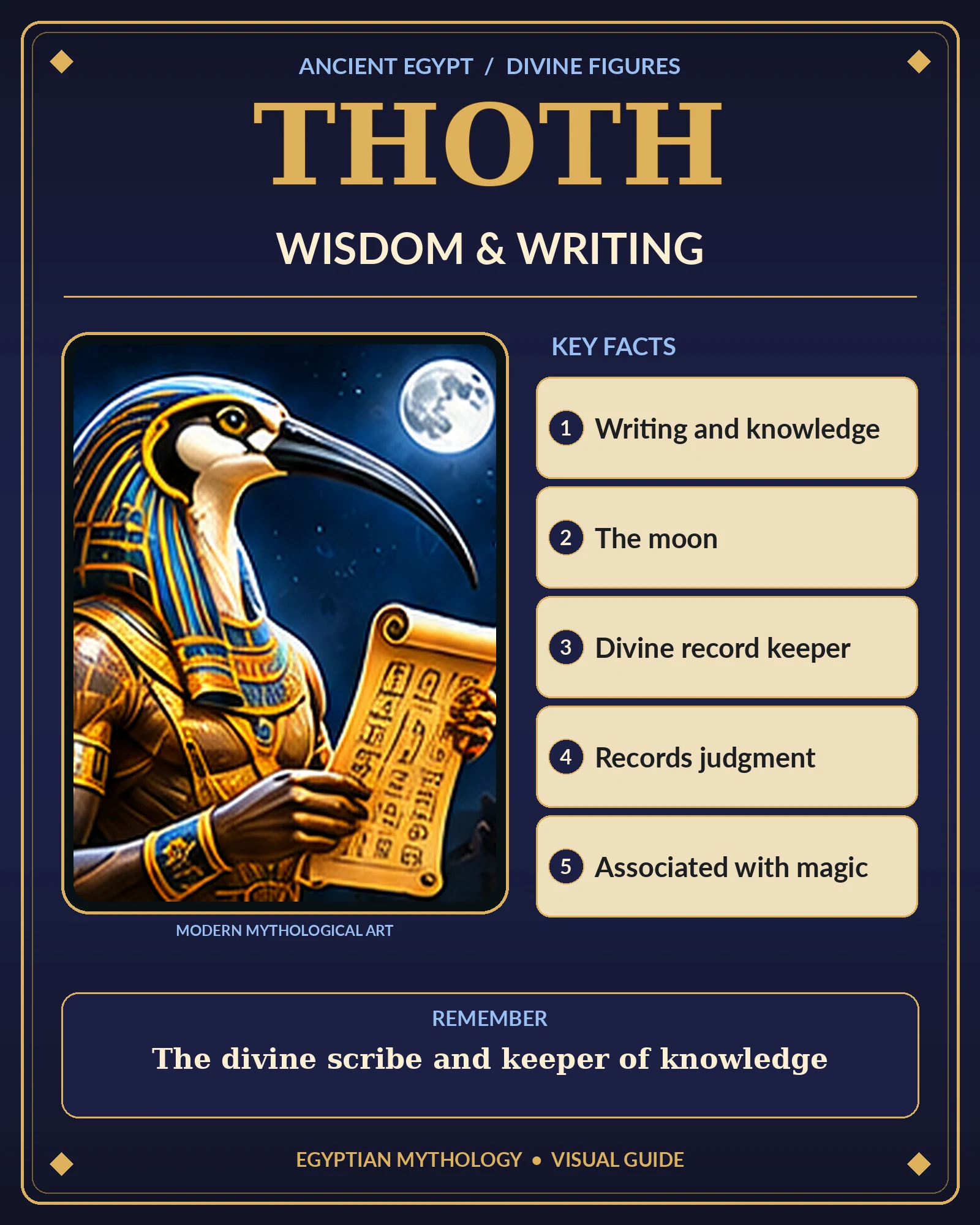
This guide separates Egyptian evidence from later Greek ideas, such as the figure of Hermes Trismegistus, and from modern claims about a “Book of Thoth”. You will find a fact box, his roles, his cult at Hermopolis, ibis mummies, the Hermetic tradition, a myth vs fact table, ten FAQs and sources.
Thoth Quick Fact Box
| Item | Answer |
|---|---|
| Egyptian name | Djehuty (Greek: Thoth; the Greeks equated him with Hermes) |
| Domain | Writing, wisdom, the moon, calendar, magic, mediation, judgment records |
| Appearance | Ibis-headed man; also a baboon; sometimes a moon disc on his head |
| Symbols | Ibis, baboon, reed pen and palette, moon, wedjat eye |
| Cult centre | Hermopolis (Khemenu, modern Ashmunein) in Middle Egypt |
| Consorts and partners | Seshat (scribal goddess) and Maat are often paired with him |
| Role in judgment | Records the verdict of the weighing of the heart |
| Role in Horus myth | Heals the Eye of Horus and acts as mediator |
| Sacred animals | Ibis and baboon, mummified in huge numbers |
| Greek and later forms | Hermes, Hermes Trismegistus, the Hermetica |
Who Is Thoth in Egyptian Mythology?
Thoth appears in the Pyramid Texts, so his cult is very old. He is associated with the moon, which the Egyptians used to measure months, and with the ibis, a wading bird common on the Nile. As god of the moon he is the “reckoner of time”, linked to calendars and festivals. As patron of scribes, he stood for the skill that ran the Egyptian state: reading, writing, accounting and record-keeping.
Egyptian tradition credited Thoth with the invention of writing, and the Egyptian word for hieroglyphs, “the god’s words” (medu netjer), shows this link. Scribes often poured out a little water or offered a prayer to Thoth before beginning their work, and his name appears in many scribal texts and school exercises.
Thoth in the Weighing of the Heart
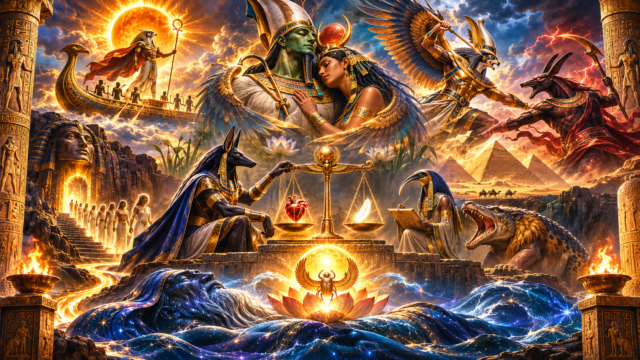
In the judgment scenes of the Book of the Dead, Thoth stands beside the scales with a palette and reed pen, writing down the result when the heart is weighed against the feather of Maat. He then announces the verdict to the tribunal presided over by Osiris. The scene is described in more detail in our Anubis guide and Osiris guide. Thoth’s neutrality, as a recorder and not a judge, makes him the trusted witness of the process.
Thoth, Horus and Set: The Healer and Mediator
In the stories of the conflict between Horus and Set, Thoth serves as an adviser and peacemaker. After Set tears out Horus’s eye, Thoth restores it, making it the “sound” eye (wedjat) used as a healing amulet. In some versions he also heals Set, showing that his role is to restore balance rather than take sides. For the full contest see our Horus guide.
Story box: the moon and the eye. The Egyptians linked the moon’s waxing and waning to the injury and healing of Horus’s eye, with Thoth guiding the cycle. This is a religious reading of the moon’s phases, not a scientific explanation, but it shows how myth, calendar and observation were woven together.
Thoth’s Other Roles: Magic, Calendar and Creation
- Magic. Thoth helped Isis with spells and was believed to hold secret knowledge; magical texts often call on him.
- Calendar. He measures time, lunar months and years, and is linked to the first month of the Egyptian civil year.
- Creation. In the Hermopolis tradition he is linked to the Ogdoad, eight primeval gods, and to the egg or lotus from which the sun emerged.
- Messenger and arbiter. He carries messages between gods and settles disputes.
Hermopolis and the Ibis Catacombs
Thoth’s main cult centre was Khemenu, “city of eight”, the Hermopolis of the Greeks, near modern Mallawi in Middle Egypt. Not much of the temple survives, but the necropolis of Tuna el-Gebel nearby contains catacombs with vast numbers of mummified ibises and baboons offered to Thoth. Similar ibis galleries exist at Saqqara. As with the dogs of Anubis and the cats of Bastet, these were votive offerings by pilgrims, so the number of animals reflects the size of the cult, not an Egyptian belief that all ibises were gods.
Thoth and Hermes Trismegistus
Greeks in Egypt identified Thoth with Hermes, the messenger and guide of souls, and the city of Khemenu became Hermopolis. Later, a group of Greek-language texts called the Hermetica were attributed to “Hermes Trismegistus”, “thrice-greatest Hermes”. These writings were produced in Roman Egypt, roughly in the first to third centuries CE, and mix Greek philosophy with Egyptian-style religious ideas. They are not ancient Egyptian scriptures, and scholars treat them as a product of the Greco-Roman world.
The “Emerald Tablet”, often said to be written by Thoth, is a medieval Arabic and Latin text with no known Egyptian source. Claims that Thoth wrote a secret “Book of Thoth” hidden in a tomb come from the Egyptian story of Setne Khamwas, a Late Period tale of fiction, not a record of a real book.
Myth vs Fact: Common Claims About Thoth
| Claim | What the evidence shows |
|---|---|
| “Thoth wrote the Emerald Tablet.” | The Emerald Tablet is medieval; there is no Egyptian original. |
| “Thoth and Hermes Trismegistus are the same.” | Greeks linked them, but the Hermetica are Greco-Roman texts. |
| “The Book of Thoth is a real hidden book.” | It appears in a Late Period story of fiction. |
| “Thoth is the judge of the dead.” | He records the verdict; Osiris and the tribunal judge. |
| “Thoth is an alien teacher.” | No evidence supports this modern claim. |
| “Thoth was only an ibis.” | He is shown as both ibis and baboon forms. |
Frequently Asked Questions About Thoth
What is Thoth the god of?
Writing, wisdom, the moon, magic and the measurement of time.
Why does Thoth have an ibis head?
The ibis’s curved beak resembles a crescent moon, and the bird was common on the Nile and linked to careful, patient hunting.
What did Thoth do in the weighing of the heart?
He recorded the result and announced it to the tribunal.
How did Thoth help Horus?
He healed Horus’s injured eye, creating the wedjat, and advised during the contest with Set.
Who is Thoth’s wife?
Commonly Seshat or Maat, depending on the tradition, but accounts vary.
Where was Thoth worshipped?
At Hermopolis in Middle Egypt, and through ibis cults across the country, especially at Tuna el-Gebel and Saqqara.
What is the Hermetica?
Greek-language religious and philosophical texts from Roman Egypt attributed to Hermes Trismegistus.
Is there a real Book of Thoth?
Not as a hidden magical book. The idea comes from a fictional story and later esoteric tradition.
Is Thoth similar to Saraswati or Ganesha in Indian tradition?
All are linked to knowledge and writing, so readers compare them, but their myths and origins are separate, and the comparison is thematic, not historical.
Is Thoth worshipped today?
The ancient cult has ended; some modern esoteric groups reference him, which is a modern reinterpretation.
Sources and Further Reading
Last updated: 25 November 2026.
- World History Encyclopedia, “Egyptian Mythology”: worldhistory.org
- Egypt Exploration Society, “Gods of Egypt”: ees.ac.uk
- The Metropolitan Museum of Art, “Divine Egypt”: metmuseum.org
- World History Encyclopedia, “Osiris”: worldhistory.org
















Share Your Opinion
Comments are closed on this post.