 Vista

Bastet (also Bast) was the ancient Egyptian goddess of the home, protection, motherhood, joy and perfume. Today she is best known as the cat goddess, shown as a woman with a cat’s head or as a seated cat, but she began as a fierce lioness protector and only later became the gentle household cat. Her main city was Bubastis in the Nile Delta.
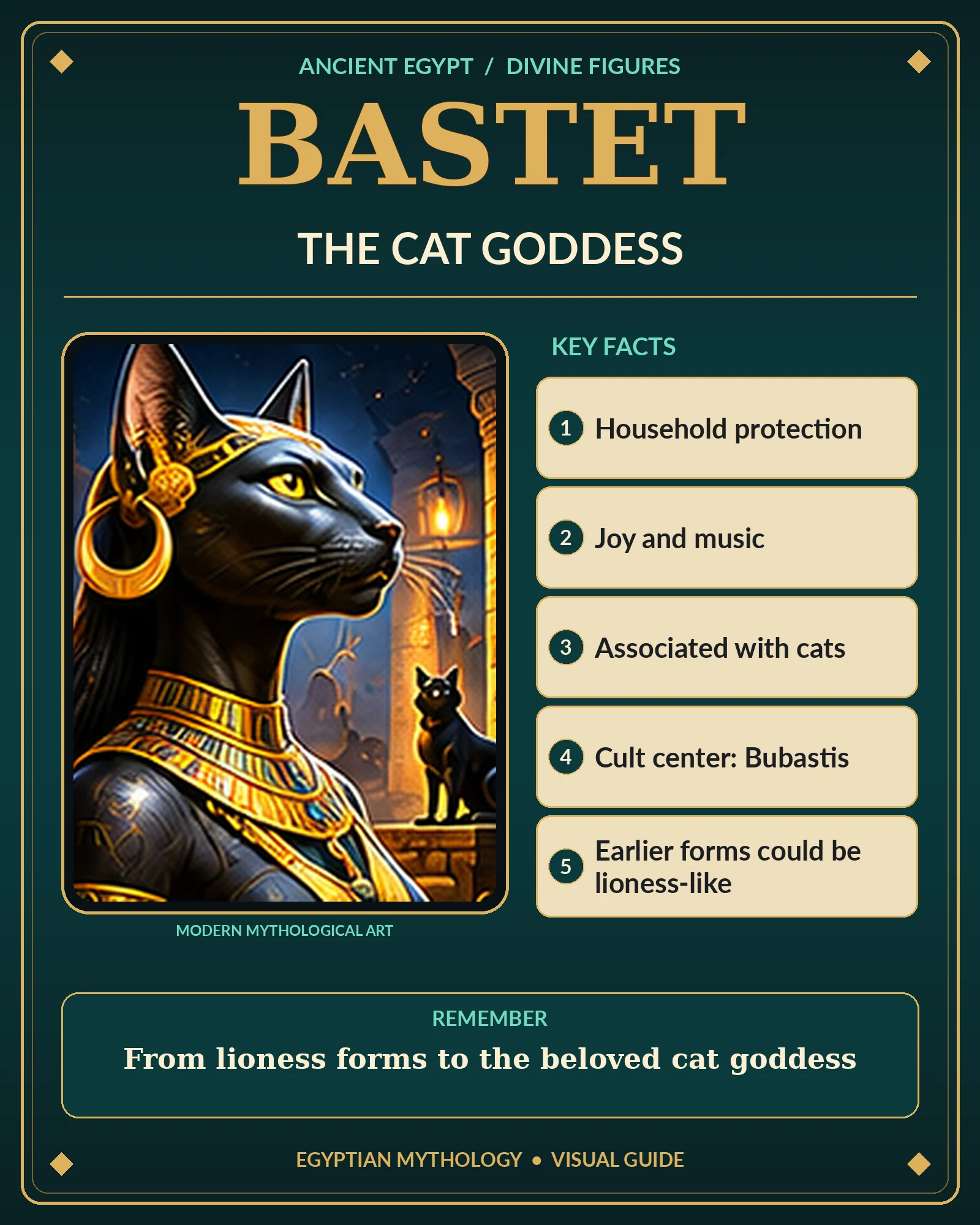
This guide separates Egyptian evidence from later retellings and modern claims. You will find a fact box, her change from lioness to cat, her roles, the festival at Bubastis, how she differs from Sekhmet, a myth vs fact table, ten FAQs and sources.
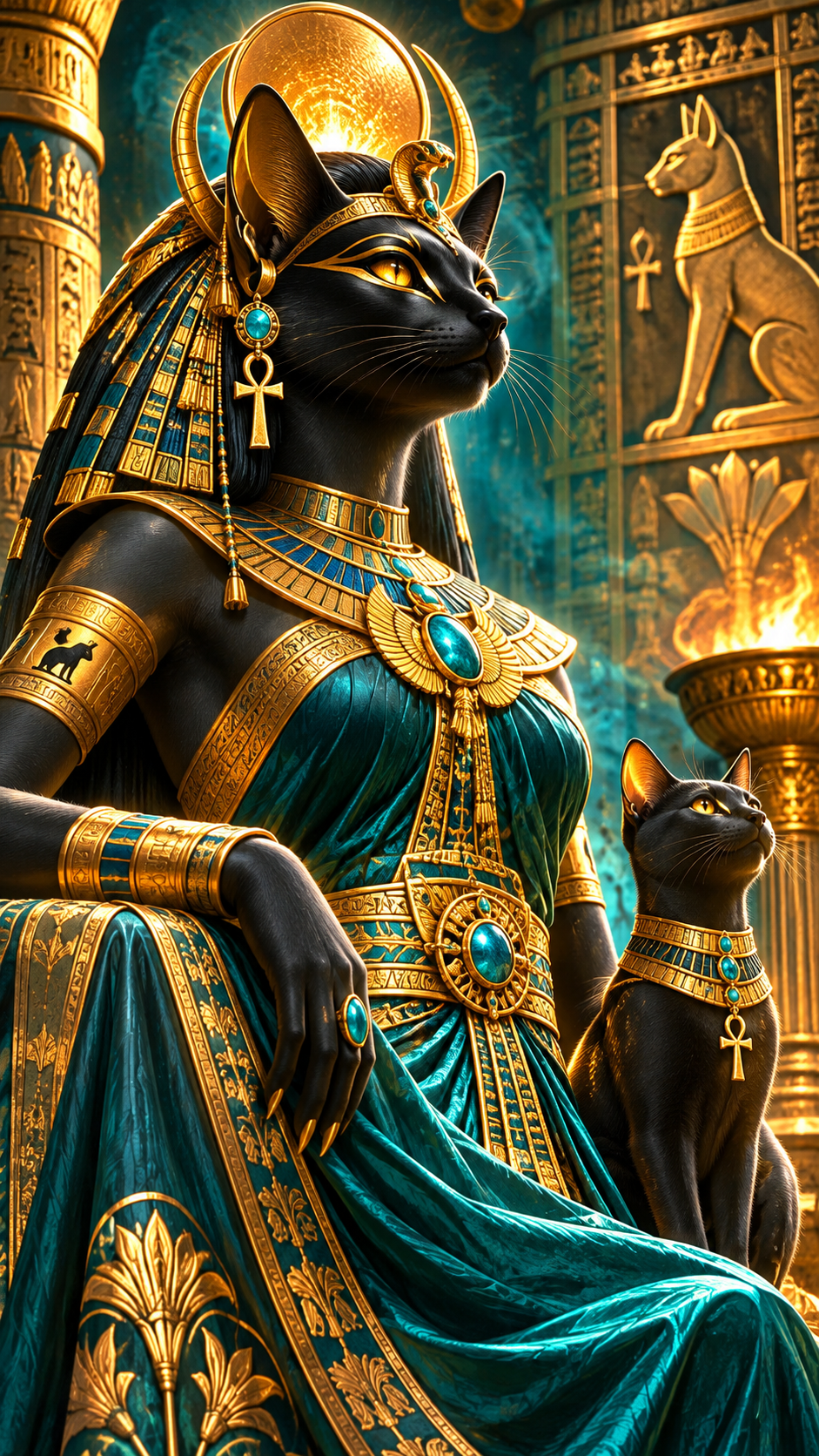
Bastet Quick Fact Box
| Item | Answer |
|---|---|
| Egyptian name | Bast or Bastet; linked to an ointment jar (the “bas” sign) |
| Domain | Home, protection, motherhood, fertility, joy, perfume and ointments |
| Appearance | Cat-headed woman, seated cat, earlier a lioness-headed woman |
| Parents | Ra (as “Eye of Ra”); mother varies |
| Symbols | Cat, sistrum, aegis (a collar-shield), ointment jar, basket |
| Cult centre | Bubastis (Per-Bast) in the Delta |
| Related goddesses | Sekhmet, Mut, Hathor, Tefnut |
| Sacred animal | The domestic cat, mummified in large numbers |
| Festival | The great celebration at Bubastis, described by Herodotus |
| Period of peak fame | First millennium BCE |
Who Is Bastet in Egyptian Mythology?
Bastet appears in early Egyptian religion, and in the Old and Middle Kingdoms she is shown mainly as a lioness goddess or a woman with a lioness head, a protector of the king and of the Delta region. Her name is written with a sign for an ointment jar, which links her to perfumes and sweet-smelling oils, as well as to ritual purity.
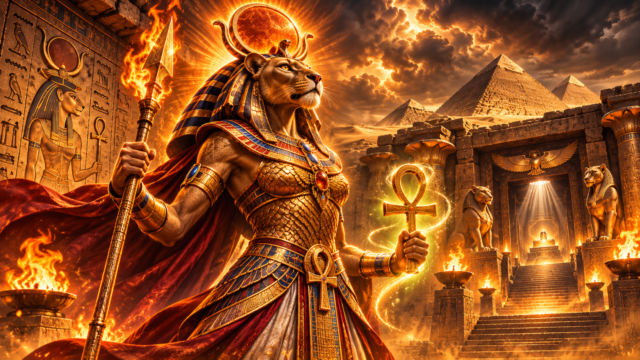
Like Sekhmet and Hathor, she belonged to the family of goddesses who acted as the “Eye of Ra”, the fierce, protective power of the sun god that defended him against enemies. In some texts Bastet is the gentler side of this energy, a protective mother, while Sekhmet is the fiercer side. For the sun god’s side of this story, see our Ra guide.
From Lioness to Cat: How Bastet Changed
Around the first millennium BCE, Bastet’s image shifted. Cats had long lived alongside Egyptians, protecting grain stores from mice and snakes, and as the household cat became a beloved animal, Bastet took on cat form. The lioness side of the divine family was increasingly attached to Sekhmet, while Bastet became the domestic, kindly side.
Story box: protector against snakes. Cats killed snakes, and Egyptian texts describe Ra, in the form of a great cat, slaying the serpent Apep beneath the sacred tree at Heliopolis. Bastet inherited some of this symbolism, which explains why a house cat could be a guardian against danger in the home and not just a pet.
What Bastet Protected: Home, Mothers and Children
- The household. Small bronze or faience cat figures, and amulets, were kept as protective charms.
- Mothers and childbirth. Cat imagery appears with kittens, which stood for motherhood and fertility.
- Health and cleanliness. Her link to ointments made her a goddess of healing creams and perfumes.
- Joy and music. The sistrum, a ritual rattle, and festival revelry link her to music and dance.
Bubastis: The City of Bastet
Bubastis (Per-Bast, “House of Bast”), now the site Tell Basta near Zagazig, was a major city in the eastern Delta. In the Twenty-second Dynasty, kings from Bubastis, including Shoshenq I, ruled Egypt and built extensively there. The temple was excavated by the Swiss Egyptologist Edouard Naville in the late 19th century, and the ruins include large granite blocks from earlier and later periods.
The Greek historian Herodotus, who visited Egypt in the 5th century BCE, described the festival of Bastet as among the largest in the land, with pilgrims arriving by boat, music, singing, clapping and heavy wine drinking. His numbers for attendance are not reliable, but archaeology confirms Bubastis as a major religious centre.
Cat Mummies and Offerings
Cats were mummified in large numbers in the Late and Ptolemaic periods and left as votive offerings, much like the dogs at Saqqara described in our Anubis guide. At Bubastis a cemetery of cat burials was found, and cat mummies and bronze cat statues appear in many museums. Scholars note that many mummies were bred and killed for the offering trade, so the practice was not simply the preservation of beloved pets.
Ancient writers such as Diodorus Siculus say that killing a cat was punished harshly. This comes from a Greek source describing Egyptian customs, and while cats were certainly protected, details of the law cannot be confirmed from Egyptian texts.
Bastet vs Sekhmet
| Feature | Bastet | Sekhmet |
|---|---|---|
| Animal | Cat (earlier lioness) | Lioness |
| Mood | Protective, gentle, joyful | Fierce, warlike, plague-bringing and healing |
| Centre | Bubastis (Delta) | Memphis |
| Associated with | Home, perfume, motherhood | War, disease, medicine |
| Relationship | Often seen as the milder face of the same divine energy | The fiercer face |
Myth vs Fact: Common Claims About Bastet
| Claim | What the evidence shows |
|---|---|
| “Egyptians worshipped all cats.” | Cats were valued and linked to Bastet, but they were not treated as gods in themselves. |
| “Bastet was always a cat.” | She was a lioness first; the cat form is later. |
| “Bastet is the same as Sekhmet.” | Related and sometimes merged, but distinct goddesses. |
| “Killing a cat meant death by law.” | Reported by Greek writers; cannot be fully confirmed from Egyptian law. |
| “Bastet is a goddess of cats only.” | Her portfolio included home, protection, perfume and joy. |
| “All cat mummies were pets.” | Many were votive offerings, bred for the purpose. |
Frequently Asked Questions About Bastet
What is Bastet the goddess of?
The home, protection, motherhood, joy and perfume.
Is Bastet a cat or a lioness?
Both, in different periods: a lioness early, a domestic cat from about the first millennium BCE.
Who are Bastet’s parents?
Commonly Ra as father, as she is an “Eye of Ra”; accounts of her mother vary.
Where was Bastet worshipped?
Mainly at Bubastis in the eastern Delta, and across Egypt in the late periods.
What is the difference between Bastet and Sekhmet?
Bastet is the gentler, domestic face; Sekhmet is the fierce, lioness side of the same divine family.
Why did Egyptians mummify cats?
Mostly as votive offerings to Bastet, left by pilgrims at temples and cemeteries.
What does the sistrum mean for Bastet?
It stands for music, joy and the ritual shaking that was thought to please and calm goddesses.
Did Egyptians really love cats?
Yes. Tomb paintings, collars, names and burials show affection for cats as pets and pest-controllers.
Is Bastet similar to Shashthi, the Indian cat-riding goddess?
Both are linked to cats and mothers, but there is no evidence of a connection, and each goddess has her own separate tradition.
Is Bastet worshipped today?
The ancient cult has ended; some modern pagan groups honour her, which is a modern reconstruction.
Sources and Further Reading
Last updated: 25 November 2026.
- World History Encyclopedia, “Egyptian Mythology”: worldhistory.org
- Egypt Exploration Society, “Gods of Egypt”: ees.ac.uk
- The Metropolitan Museum of Art, “Divine Egypt”: metmuseum.org
- National Geographic Kids, “How to make a mummy”: natgeokids.com




















Share Your Opinion
Comments are closed on this post.