 Vista
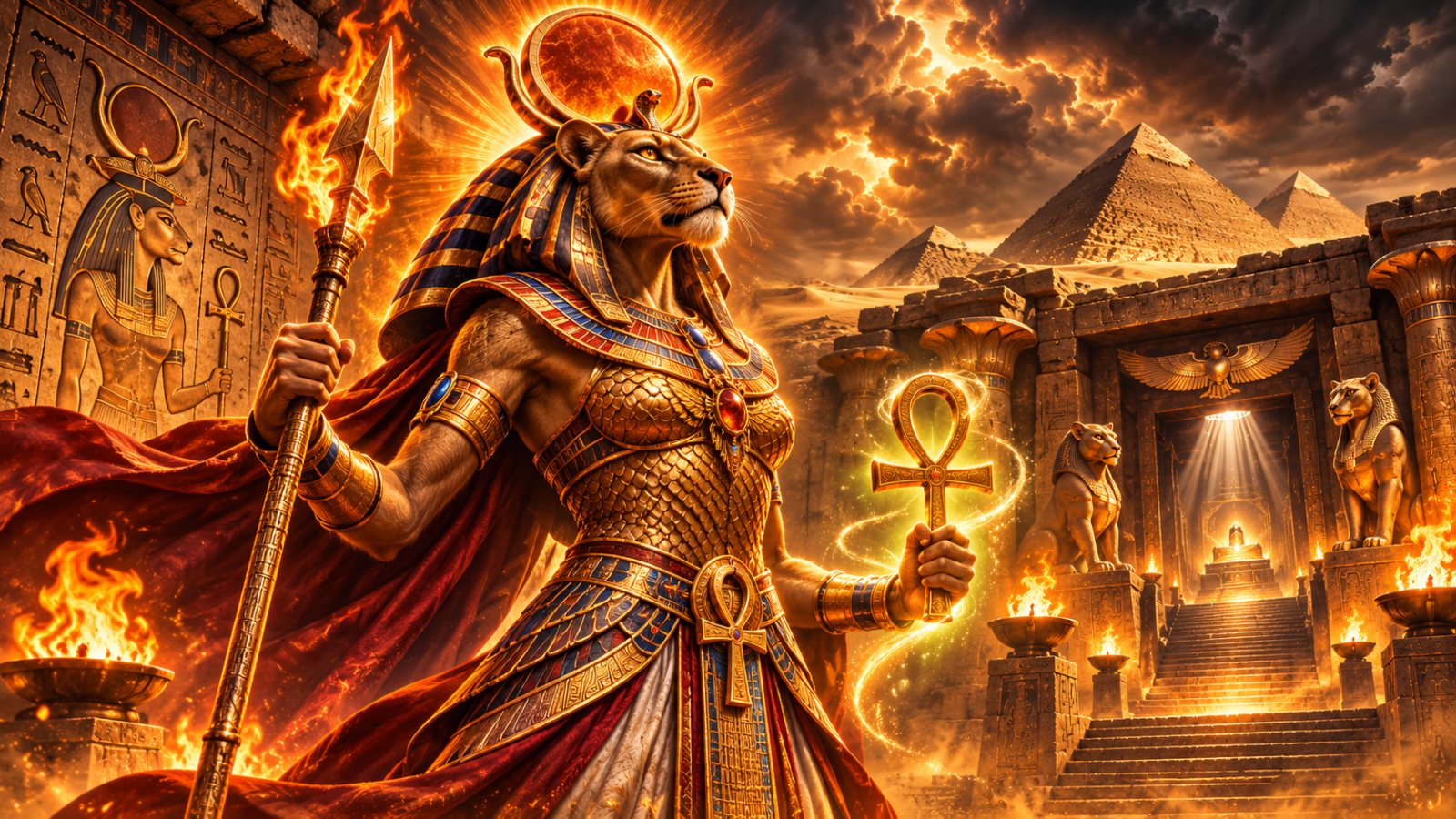
Sekhmet (“the Powerful One”) was the ancient Egyptian lioness goddess of war, plague and healing. She is shown as a woman with a lioness head crowned with a sun disc and cobra, and she was seen as the fierce “Eye of Ra”, the protective violence of the sun god. The same goddess who could send disease could also cure it, so her priests were often physicians.

This guide separates Egyptian evidence from later retellings and modern claims. You will find a fact box, the Destruction of Mankind story, her healing role, the statues of Amenhotep III, a comparison with Bastet and Hathor, a myth vs fact table, ten FAQs and sources.
Sekhmet Quick Fact Box
| Item | Answer |
|---|---|
| Egyptian name | Sekhmet, from “sekhem”, meaning power |
| Domain | War, plague, protection of the king, healing and medicine |
| Appearance | Woman with a lioness head, sun disc and uraeus, often in red |
| Parents | Ra (as his Eye) |
| Consort and child | Ptah; Nefertem (in the Memphis triad) |
| Cult centre | Memphis; widely worshipped at Thebes |
| Associated goddesses | Bastet, Hathor, Mut, Tefnut |
| Famous story | The Destruction of Mankind (Book of the Heavenly Cow) |
| Famous objects | Hundreds of statues from the time of Amenhotep III |
| Priests | Often physicians, called “wab priests of Sekhmet” |
Who Is Sekhmet in Egyptian Mythology?
Sekhmet is mentioned in the Pyramid Texts, and she was a guardian of kings, who were said to be nursed by her and to go to battle with her at their side. Her fierce breath was likened to the desert wind, and her arrows were thought to bring epidemic disease. Egyptians did not see her as a villain; she was a necessary and feared force, like a storm that needed to be calmed.
As the Eye of Ra she belongs to the family of goddesses, such as Hathor, Bastet and Tefnut, who act as the sun god’s protective daughters and sometimes as his instruments of punishment. For the sun god’s side of the story, see our Ra guide.
The Destruction of Mankind: Sekhmet and the Red Beer
The best-known story about Sekhmet is told in the Book of the Heavenly Cow, found in New Kingdom royal tombs. Ra, now old, learns that humans are plotting against him. He sends his Eye in the form of Sekhmet to punish them, and she begins to slaughter with great enthusiasm. Ra then regrets the plan and wants her to stop, but she is wild with bloodlust.
- Ra orders vast amounts of beer to be brewed and coloured red with ochre or pomegranate juice.
- Seven thousand jars are poured over the fields at night.
- At dawn Sekhmet sees the red flood, takes it for blood and drinks it.
- She becomes drunk, forgets her rage and returns peacefully; humanity survives.
Story box: the festival of drunkenness. This story was reflected in festivals in which people drank beer and wine, danced and played music to calm the goddess, often connected to the Egyptian New Year and flood season. The details of such festivals come from temple texts, and not all aspects are well documented.
Sekhmet as Healer: Priests and Physicians
Because Sekhmet could send disease, she could also remove it. Priests of Sekhmet, called wab priests, are known as some of Egypt’s early medical practitioners, treating the sick with a mix of ritual, spells and practical remedies. Medical papyri sometimes include prayers to Sekhmet. This shows that in Egyptian medicine, the line between religion and treatment was not sharp, though many remedies were practical and based on observation.
The Statues of Sekhmet at Thebes
During the reign of Amenhotep III in the 14th century BCE, a very large number of seated and standing granite statues of Sekhmet were made, said to number around 700 or more, probably for the king’s mortuary temple on the west bank of Thebes. Many were later moved, and examples are found in museums worldwide. The reason is debated: they may have been connected to a daily ritual in which a statue was presented each day, or to protecting the king’s health in his later years, but this is interpretation, not certain fact.
Sekhmet, Bastet and Hathor Compared
| Goddess | Form | Character | Centre |
|---|---|---|---|
| Sekhmet | Lioness | Fierce, war, plague, healing | Memphis |
| Bastet | Cat (earlier lioness) | Protective, home, joy | Bubastis |
| Hathor | Cow, woman with cow ears | Love, music, motherhood | Dendera |
These goddesses are linked by the Eye of Ra theme and sometimes merged in texts, which makes identification tricky. A lioness head almost always points to Sekhmet, while a cat head points to Bastet. Read our Bastet guide for the cat side of this family.
Myth vs Fact: Common Claims About Sekhmet
| Claim | What the evidence shows |
|---|---|
| “Sekhmet is only a goddess of destruction.” | She was also a healer and protector of kings. |
| “Sekhmet and Bastet are identical.” | Related but distinct; Bastet is the gentler cat form. |
| “She nearly destroyed all humanity.” | The myth says she was stopped by the red beer. |
| “The beer was blood.” | It was dyed beer that she mistook for blood. |
| “Sekhmet is a modern ‘dark goddess’ only.” | She was a major, respected goddess in royal religion. |
| “Her statues were all made for one purpose.” | Their purpose is debated. |
Frequently Asked Questions About Sekhmet
What is Sekhmet the goddess of?
War, plague and healing, and protection of the pharaoh.
What does Sekhmet’s name mean?
“The Powerful One”, from the Egyptian word for power.
Who is Sekhmet’s husband?
Ptah, the creator god of Memphis, with their child Nefertem.
How was Sekhmet stopped from killing mankind?
Ra had red-dyed beer poured out; she drank it, became drunk and calm.
Was Sekhmet a healer?
Yes. Her priests acted as physicians, and prayers to her appear in medical contexts.
How many Sekhmet statues did Amenhotep III make?
Estimates are around 700 or more, though the exact figure and original setting are debated.
What is the difference between Sekhmet and Hathor?
Both can be the Eye of Ra. Sekhmet is the fierce lioness, while Hathor is the goddess of love and joy; in the myth, a raging goddess can be calmed into Hathor.
Where was Sekhmet worshipped?
Memphis was her main centre, with strong worship at Thebes and across Egypt.
Is Sekhmet similar to Durga or Kali?
Readers compare fierce goddesses who both destroy and protect, but the myths, origins and rituals are separate, and these are thematic comparisons, not shared history.
Is Sekhmet worshipped today?
The ancient cult is gone; some modern groups honour her, which is a modern reconstruction.
Sources and Further Reading
Last updated: 25 November 2026.
- World History Encyclopedia, “Egyptian Mythology”: worldhistory.org
- Egypt Exploration Society, “Gods of Egypt”: ees.ac.uk
- The Metropolitan Museum of Art, “Divine Egypt”: metmuseum.org














Share Your Opinion
Comments are closed on this post.