 Vista
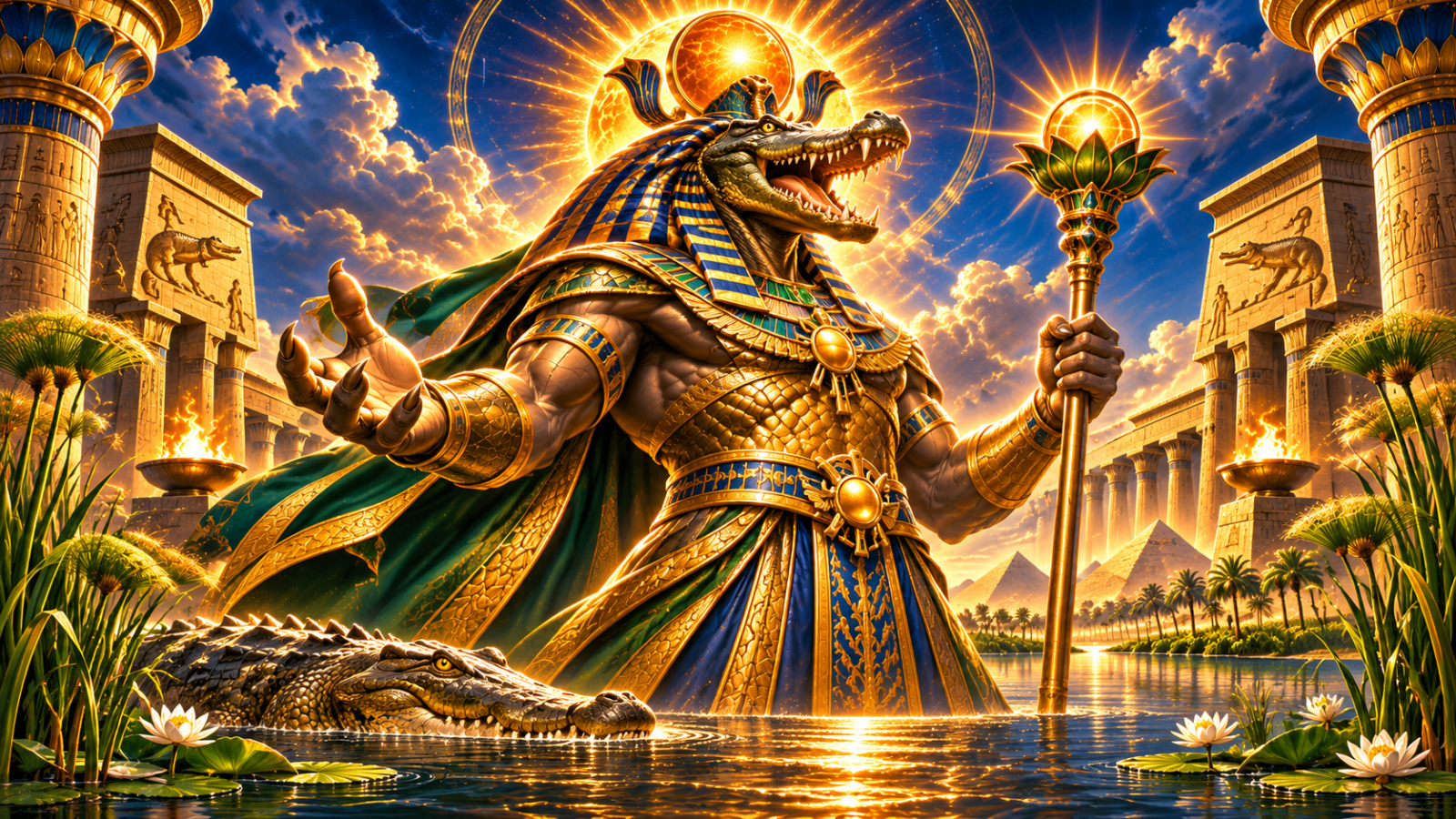
Sobek was the crocodile-headed Egyptian god of the Nile, linked to royal power, strength and fertility. Egyptians lived beside a river full of dangerous crocodiles, and they responded with both fear and reverence: Sobek was the divine force behind the animal, honoured in temples in the Faiyum region and at Kom Ombo, where visitors can still see a double temple shared with the falcon god Horus the Elder. He was sometimes merged with the sun god as Sobek-Ra.
This guide explains who Sobek was, what he did in religion and myth, why a predator became a god, and what the evidence of temples and crocodile mummies shows. We separate mythology, documented history and modern speculation, and we answer the common questions about crocodile worship in ancient Egypt.
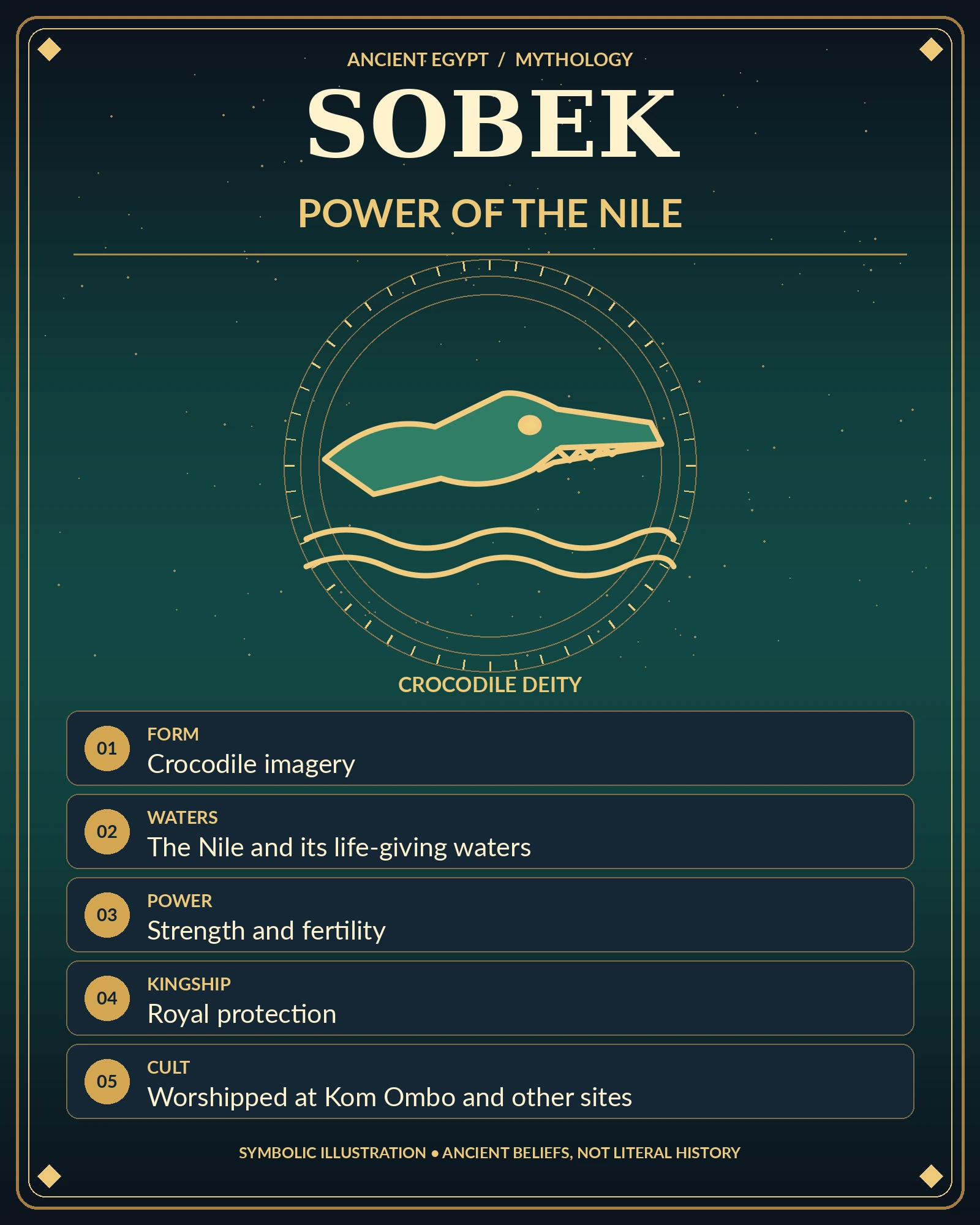
Quick Fact Box: Sobek at a Glance
| Item | Detail |
|---|---|
| Domain | Nile waters, strength, fertility, protection, kingship |
| Appearance | Crocodile, or a man with a crocodile head |
| Parents (in Pyramid Texts) | Associated with the goddess Neith |
| Main cult centres | Faiyum (Crocodilopolis/Shedet) and Kom Ombo |
| Merged forms | Sobek-Ra (with the sun god); linked with Horus at Kom Ombo |
| Sacred animal | Nile crocodile |
| Famous temple | Kom Ombo, shared with Horus the Elder (Haroeris) |
| Greek name | Souchos |
Who Was Sobek?
Sobek appears as early as the Old Kingdom Pyramid Texts, which makes him one of the older gods of Egypt. He is the lord of the waters and marshes, a creature of the river edge who can kill but can also protect. Because the crocodile is both a hunter and a mother who carries her young carefully in her mouth, Egyptians saw in it both ferocity and care. Sobek therefore combined danger with guardianship and was invoked for protection on the Nile.
Over time he gained a wider role. Texts describe him as a powerful god who helps the king, who is associated with fertility because of the Nile’s life-giving flood, and who in some later theology took part in creation. These roles show how a local river deity could grow into a major god.
Why Did Egyptians Worship the Crocodile?
The Nile crocodile is one of the largest freshwater predators in Africa, and in ancient times it was a real danger to people who fished, washed clothes and gathered water. A common explanation of crocodile worship is that people sought the protection of the dangerous animal by honouring its divine patron. Another is that the animal’s strength, speed and stillness in the water fitted ideas of royal power. Historians cannot prove a single motive, and both ideas may be partly true. What is certain is that the religion treated Sobek as a real force on the river, to be respected and appeased.
Appearance and Symbols
Sobek is shown either as a crocodile or as a man with a crocodile head, often wearing a crown of sun disk and plumes when merged with Ra. His symbols include the crocodile itself, the sun disk and horns when linked with Ra, and the ankh he sometimes holds. The crocodile was also one of the animals closely tied to the pharaoh’s protection, and several kings took names containing Sobek.
- Crocodile form: the dangerous river and the guardian.
- Human body with crocodile head: the god in cult images.
- Sun disk and plumes: sign of the merged Sobek-Ra.
- Ankh: life, often held in temple scenes.
Sobek and the Pharaohs
Sobek’s importance peaked in the Middle Kingdom, when rulers of the 12th Dynasty developed the Faiyum oasis through irrigation and land reclamation. The king Amenemhat III built extensively there, and the region became a centre of Sobek’s cult. The last ruler of that dynasty, Sobekneferu, whose name means “beauty of Sobek”, was one of the first women known to have ruled Egypt as king. The 13th Dynasty included several kings named Sobekhotep, “Sobek is satisfied”. These royal names show how closely the god was tied to kingship.
Sobek-Ra: The Crocodile and the Sun
In the New Kingdom and later, Sobek was merged with Ra as Sobek-Ra, a typical example of Egyptian syncretism, where a god takes on another’s traits. The form linked the river’s power with the sun’s, and presented Sobek as a universal ruler, not just a local deity. At Kom Ombo, he also shares a temple with Horus the Elder, where the shared worship stresses the unity of two powerful figures.
Temples: Faiyum and Kom Ombo
The Faiyum was known to the Greeks as Crocodilopolis, after its main city, where a live sacred crocodile was kept in the temple. The Greek historian Herodotus (5th century BCE) described Egyptians who kept tame crocodiles adorned with jewellery. At Kom Ombo, in the south, a temple was built in the Ptolemaic period and extended under Roman rulers. It is unusual because it is a double temple, with two parallel entrances and sanctuaries: one for Sobek and one for Haroeris, the elder Horus. A nearby museum displays mummified crocodiles, which show the care devoted to sacred animals.
Story Box: Mummified Crocodiles
Archaeologists have found large numbers of mummified crocodiles at sites in the Faiyum and at Kom Ombo, some adults and some tiny hatchlings. Many were offerings left by pilgrims, who paid priests to prepare an animal for burial as a gift to the god. This tells us that the cult was both religious and economic: temples raised animals, mummified them and sold them to worshippers. It is not evidence that all crocodiles in Egypt were sacred. People also hunted them.
Mythology, History and Speculation
- Mythology: Sobek is a strong river god who protects the king and, in some texts, helps in creation.
- History: a god attested from the Old Kingdom, prominent in the Middle Kingdom, with major temples in the Faiyum and Kom Ombo and a sacred-animal cult that continued into the Greco-Roman period.
- Speculation: claims that Sobek was a “lizard-like alien” or a real dragon do not appear in ancient sources and are modern inventions.
Myth vs Fact
| Claim | Reality |
|---|---|
| Egyptians worshipped every crocodile. | No. Certain animals were sacred at certain temples; others were hunted. |
| Sobek was an evil god. | He was dangerous but mainly protective and fertile. |
| Sobek was important only in the Faiyum. | He also had a major temple at Kom Ombo and a royal following. |
| Crocodile mummies are fake. | Genuine mummies are well documented; some modern sellers do sell fakes, so provenance matters. |
| Sobek was a minor god. | He was a significant state god in the Middle Kingdom. |
Frequently Asked Questions About Sobek
Who is Sobek in Egyptian mythology?
He is the crocodile god of the Nile, linked with strength, fertility, protection and royal power.
Why did the Egyptians worship crocodiles?
Likely to appease a dangerous predator and to honour its strength and protective qualities. Historians do not claim a single proven reason.
What does Sobek look like?
A crocodile, or a man with a crocodile head, sometimes wearing a sun disk and plumes.
Who are Sobek’s parents?
The Pyramid Texts link him to Neith. Different traditions give different versions.
What is Sobek-Ra?
The merged form of Sobek and the sun god Ra, giving the crocodile god solar authority.
Where is the Sobek temple?
The best-known is Kom Ombo near Aswan, a double temple for Sobek and Horus the Elder. The Faiyum was another major centre.
Were crocodiles really mummified?
Yes. Mummified crocodiles, from adults to hatchlings, have been found at several sites and are held in museums.
Was Sobek a god of fertility?
Yes, partly because of his link to the Nile, whose flood made the land fertile.
Was Sobek the enemy of Horus?
No. At Kom Ombo they share a temple, and they are worshipped side by side.
Is Sobek similar to an Indian deity?
The makara, a crocodile-like creature associated with the river goddess Ganga and the god Varuna, is a loose parallel because both link crocodiles with rivers. They arise from separate cultures, and no historical connection is proven.
Sources and Further Reading
- World History Encyclopedia: Egyptian Mythology
- Egypt Exploration Society: Gods of Egypt
- The Met: Divine Egypt
Last updated: 25 November 2026.
Related guides: Anubis: Egyptian God of the Dead, Embalming and the Weighing of the Heart (Facts, Myths and Symbols) · Ra: Egyptian Sun God, Creation Myths, Eye of Ra and the Night Journey (Facts and Symbols)













Share Your Opinion
Comments are closed on this post.