 Vista
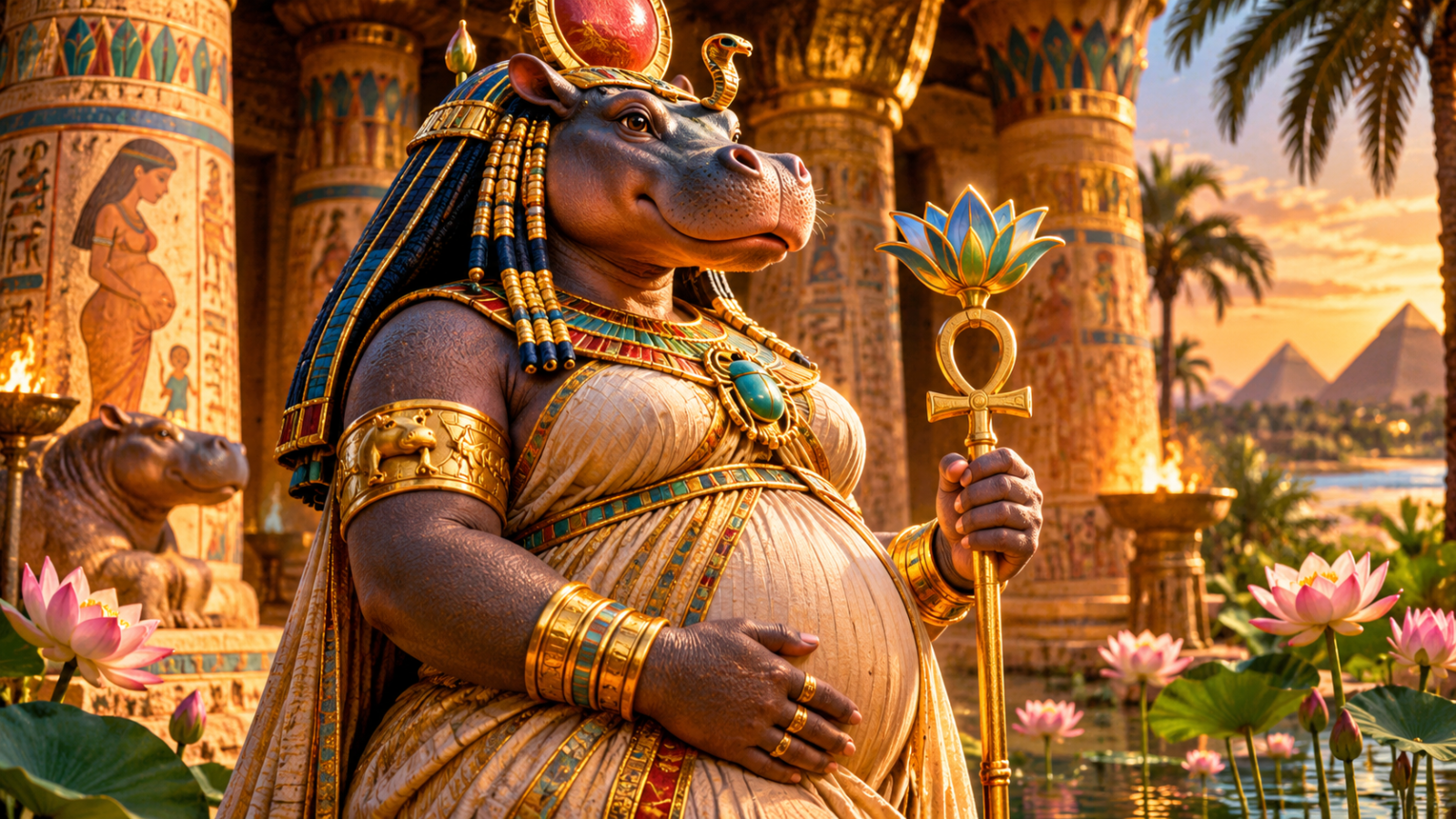
Taweret (also written Tawaret, Taweret or, in Greek, Thoeris) was the ancient Egyptian goddess who protected women in pregnancy and childbirth and watched over newborn babies. She is shown as an upright, pregnant hippopotamus with the paws of a lion, the tail of a crocodile and the breasts of a human woman. Her name is usually translated as “the Great One”. Although the wild hippo was a dangerous animal, Taweret turned its fierce motherhood into a symbol of protection, which is why she was loved in ordinary homes far more than in grand state temples.
This guide explains who Taweret was, why Egyptians chose a hippo for a birth goddess, what her body parts and symbols meant, how people used her image in daily life, and which popular claims are history, which are belief, and which are guesswork.

Taweret Quick Facts
| Item | Detail |
|---|---|
| Name | Taweret (Ta-weret), “the Great One”; Greek form Thoeris |
| Domain | Childbirth, pregnancy, fertility, protection of mothers and infants |
| Form | Pregnant hippo standing upright, lion limbs, crocodile tail, human breasts |
| Common symbol | The sa sign, a hieroglyph meaning protection |
| Closest partner | Bes, the lion-faced household protector |
| Where she appears | Amulets, ivory wands, headrests, household shrines, temple reliefs |
| Period | Hippo goddesses appear early; Taweret is best known from the Middle Kingdom through Roman times |
Who Was Taweret?
Taweret belongs to the group of protective deities that Egyptians called on in everyday life rather than in state ceremonies. Egyptian religion had two layers. The first was the grand temple religion of kings and priests, with the gods of Heliopolis, Memphis and Thebes. The second was household religion, which dealt with practical fears: a difficult birth, a sick child, a snake in the house, a bad dream. Taweret lived mainly in this second layer.
Scholars generally trace hippo-shaped goddesses back to early periods of Egyptian history, where related figures such as Ipet (Opet) appear in religious texts. The composite figure that we now call Taweret becomes especially visible in Middle Kingdom objects and then remains popular for well over a thousand years. Because Egyptian gods often merged or shared traits, it is better to think of a family of hippo goddesses than of one fixed character with one fixed biography.
Unlike gods such as Ra or Osiris, Taweret has no single famous myth in which she is the hero. Her importance comes from function. She is the guardian standing between a mother and the dangers of labour, and between a baby and the dangers of its first days.
Why a Hippo? The Logic Behind the Image
To a modern reader, a hippopotamus may seem an odd choice for a birth goddess. For Egyptians who lived beside the Nile, the choice made sense. The hippo was one of the most dangerous animals they knew. A female hippo with a calf will charge anything that comes near, including boats. Egyptians watched this fierce defence of young and turned it into a religious idea: if you want a protector for a baby, choose the animal that no one dares to approach.
The hippo also had a second meaning. The male hippo was linked with disorder and with the god Set in several texts and ritual scenes, and hunting a hippo could symbolise defeating chaos. The female hippo, by contrast, was linked with fertility and nursing. This dual character, dangerous but nurturing, helps explain why Taweret looks frightening yet is a friendly goddess. She frightens away harm, not the family she guards.
Appearance and Symbols: What Each Part Means
Taweret is easy to recognise because she combines several animals. The usual explanation is that each part contributes a protective strength. Remember that this is a modern reading of the images, not a list that Egyptians wrote down for us.
| Feature | Likely meaning |
|---|---|
| Hippo body and pregnant belly | Fertility, pregnancy and fierce motherhood |
| Lion paws and sometimes lion’s head features | Strength and guardian power |
| Crocodile tail or crocodile on her back | Water, danger and the power of the Nile |
| Human breasts | Nursing and nourishment of the newborn |
| Sa sign held in her hands | Protection |
| Knife or torch in some scenes | Driving away harmful spirits |
| Wig and sometimes a horned disc or tall crown | Divine status and links with other goddesses |
Look at the hippo’s open mouth in many images. Taweret is sometimes shown with her jaws slightly open and tongue visible, a pose that can read as a warning to unseen threats. This detail also appears with Bes, her closest companion.
Taweret in Childbirth and Household Religion
Childbirth in ancient Egypt was both a joyful and a dangerous event, as it was everywhere before modern medicine. Mothers and babies died, and families looked for every possible kind of help. Egyptian medical papyri contain practical advice, such as treatments and positions, alongside spells and amulets. The two approaches existed side by side; Egyptians did not see a sharp line between medicine and magic.
Taweret’s image appears on many small objects connected with the home:
- Amulets: small faience or stone figures that women could wear or keep at home.
- Ivory wands: curved Middle Kingdom objects, often called magic wands, decorated with Taweret, Bes, frogs, snakes and other protective figures. Archaeologists connect them with protecting mothers and children, although the exact way they were used is still discussed.
- Headrests and furniture: protective figures near the bed were meant to guard sleepers, who were thought to be vulnerable.
- Household shrines: small niches or altars in workers’ houses where families made offerings.
- Vessels and cosmetic items: jars and ointment containers showing the goddess, probably for blessing or protection of the contents.
Story box (imagined scene, not an ancient text): Picture a small house in a workers’ village. A woman is in labour, and the midwife and female relatives are with her. On a shelf sits a little figure of Taweret, and a carved wand lies near the bed. The family does not see this as “superstition” in our sense. For them, it is part of preparing the room, in the same way we prepare a hospital room today. Historians reconstruct scenes like this from objects and texts, but no single document describes exactly this moment.
Taweret and Bes: A Protective Pair
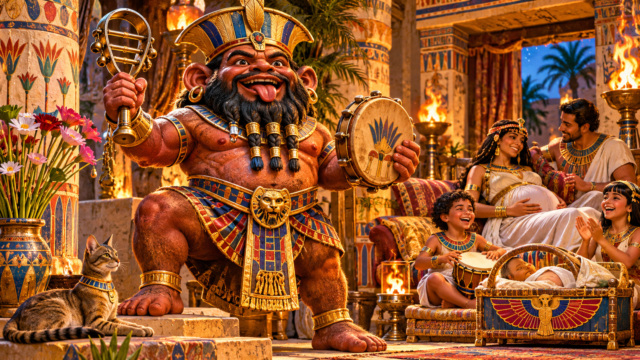
Taweret is often paired with Bes, the lion-faced dwarf-like god of the home. Their images appear together on wands and other objects. A simple way to remember the difference is that Taweret is mainly the mother-and-birth protector, while Bes is a fierce, noisy guardian who also watches over music, dance and play. Together they cover the pregnant mother, the newborn and the household around them. Our separate article on Bes explains his role in more detail.
Taweret in the Sky and in the Afterlife
Hippo figures also appear in Egyptian star depictions. On several tomb and temple ceilings, a hippo-like figure standing with a mace or chain is identified with a northern constellation, and many scholars connect it with Taweret. Because Egyptian star maps are difficult to match with modern constellations, the exact stars are debated, so treat any specific modern constellation match as a scholarly suggestion rather than a settled fact.
Protective hippo-goddesses also helped in the afterlife in a symbolic way. Birth and rebirth were closely linked in Egyptian thought: the dead person was expected to be “born again” into the next world, so goddesses of birth had a natural place in funerary imagery.
History, Mythology and Speculation: What Is Known
| Category | What belongs here |
|---|---|
| History (supported by objects) | Taweret’s image on amulets, wands, furniture and temple reliefs; her long popularity; her pairing with Bes |
| Mythology (religious belief) | Her role as divine protector of mothers and babies; her fierce but kind nature |
| Speculation (scholarly guess) | Exact ritual use of the ivory wands; exact constellation match; a single origin story for the figure |
Myth vs Fact
| Popular claim | Reality |
|---|---|
| Taweret was an evil monster. | She was a protective goddess; her frightening look was meant to scare away harm. |
| She was the goddess of all hippos. | She was mainly linked with birth and protection; hippos in general had other, sometimes negative, meanings. |
| Egyptians worshipped her in a huge national temple. | Her cult was mostly domestic and small-scale, seen in homes and on personal objects. |
| Taweret amulets could guarantee a safe birth. | Belief in this was real for ancient Egyptians, but amulets do not make childbirth safe. Modern medical care does. |
| Taweret and Bes were husband and wife. | They were often shown together as partner protectors, but this is not a marriage myth in the texts. |
Taweret Today
Today Taweret is known mainly through museum collections, books and popular culture, and replica amulets are sold in many gift shops. It is worth stating plainly, in line with our science-first approach, that these objects are cultural souvenirs. For pregnancy and childbirth, the safe path today is qualified medical care, not charms. The value of studying Taweret is historical: she shows how a society dealt with real fears using the symbols it had.
Frequently Asked Questions About Taweret
What was Taweret the goddess of?
Taweret was the goddess of childbirth, pregnancy, fertility and the protection of mothers and infants.
What does the name Taweret mean?
It is usually translated as “the Great One”. Thoeris is the Greek form of the name.
Why does Taweret look like a hippo, lion and crocodile?
The combined form gathers the strength of dangerous animals into one guardian. The pregnant hippo body stresses fertility and fierce motherhood, the lion limbs add power, and the crocodile tail adds Nile-related danger.
Is Taweret good or evil?
She is good. Her fearsome appearance is protective, aimed at harmful forces, not at the family she guards.
What is the difference between Taweret and Bes?
Taweret is a female hippo-form goddess focused on birth and mothers. Bes is a male, lion-faced, dwarf-like god who protects the home, children, music and dance. They often appear together.
Did Egyptians have a temple for Taweret?
Her worship was mainly in homes and small shrines. She appears in temple reliefs, but she was not the main god of a large national temple.
What is the sa sign that Taweret holds?
The sa is a hieroglyph that means protection. Holding it shows that she guards whoever stands under her care.
Do people still worship Taweret?
Ancient Egyptian state religion ended long ago. Some modern spiritual groups revive Egyptian deities, but Taweret is known to most people today through museums and history.
Reliable Sources
- World History Encyclopedia: Egyptian Mythology
- Egypt Exploration Society: Gods of Egypt
- The Metropolitan Museum of Art: Divine Egypt
Last updated: 25 November 2026. Related reading on Vista Hub: our guides to Egyptian gods and goddesses, Bes and the Egyptian gods family tree.
Related guides: Bastet: Egyptian Cat Goddess of Home, Protection and Joy (Myths, Symbols and Bubastis) · Isis: Egyptian Goddess of Magic, Motherhood and Healing (Myths, Symbols and Worship)














Share Your Opinion
Comments are closed on this post.