 Vista
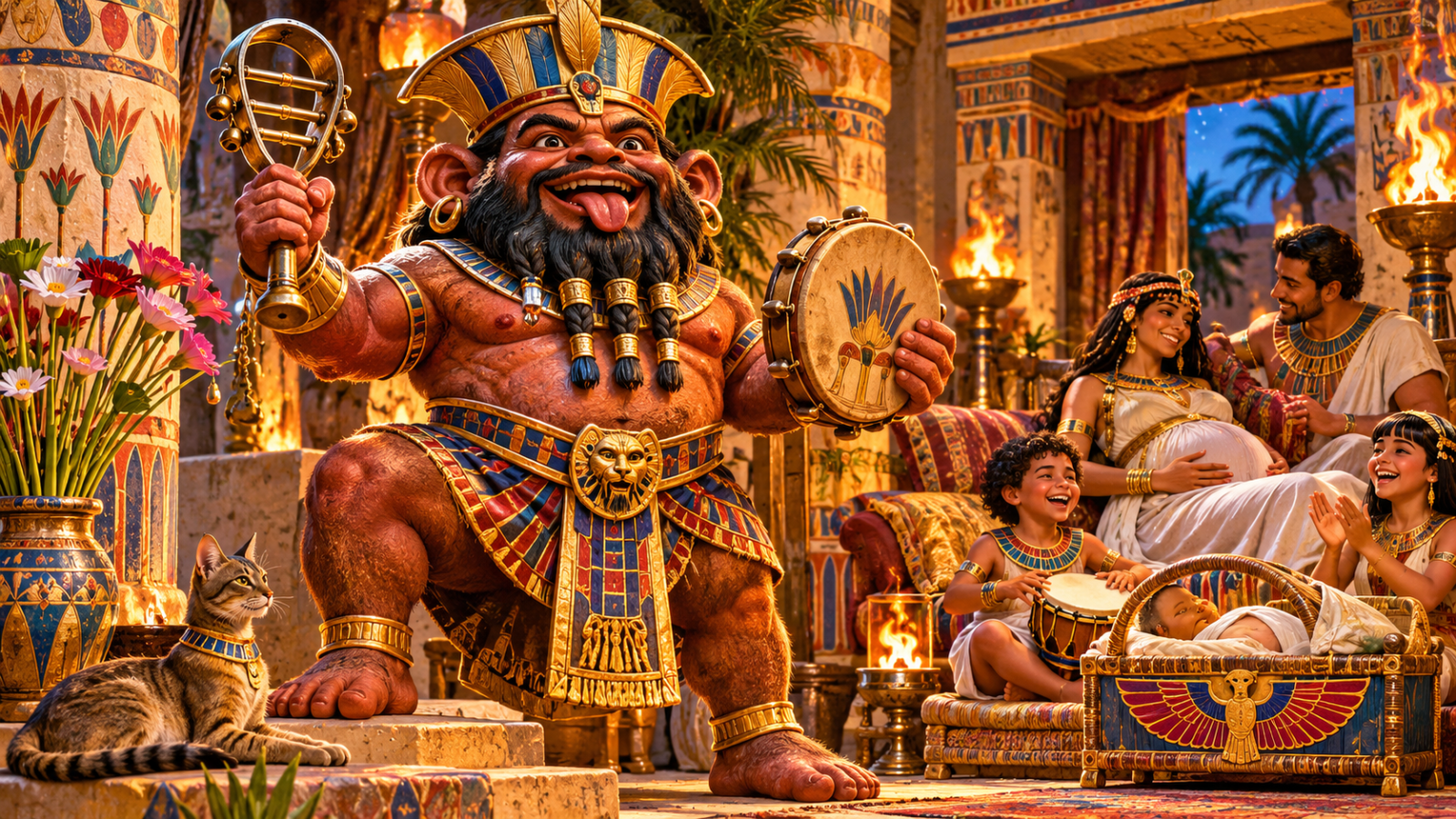
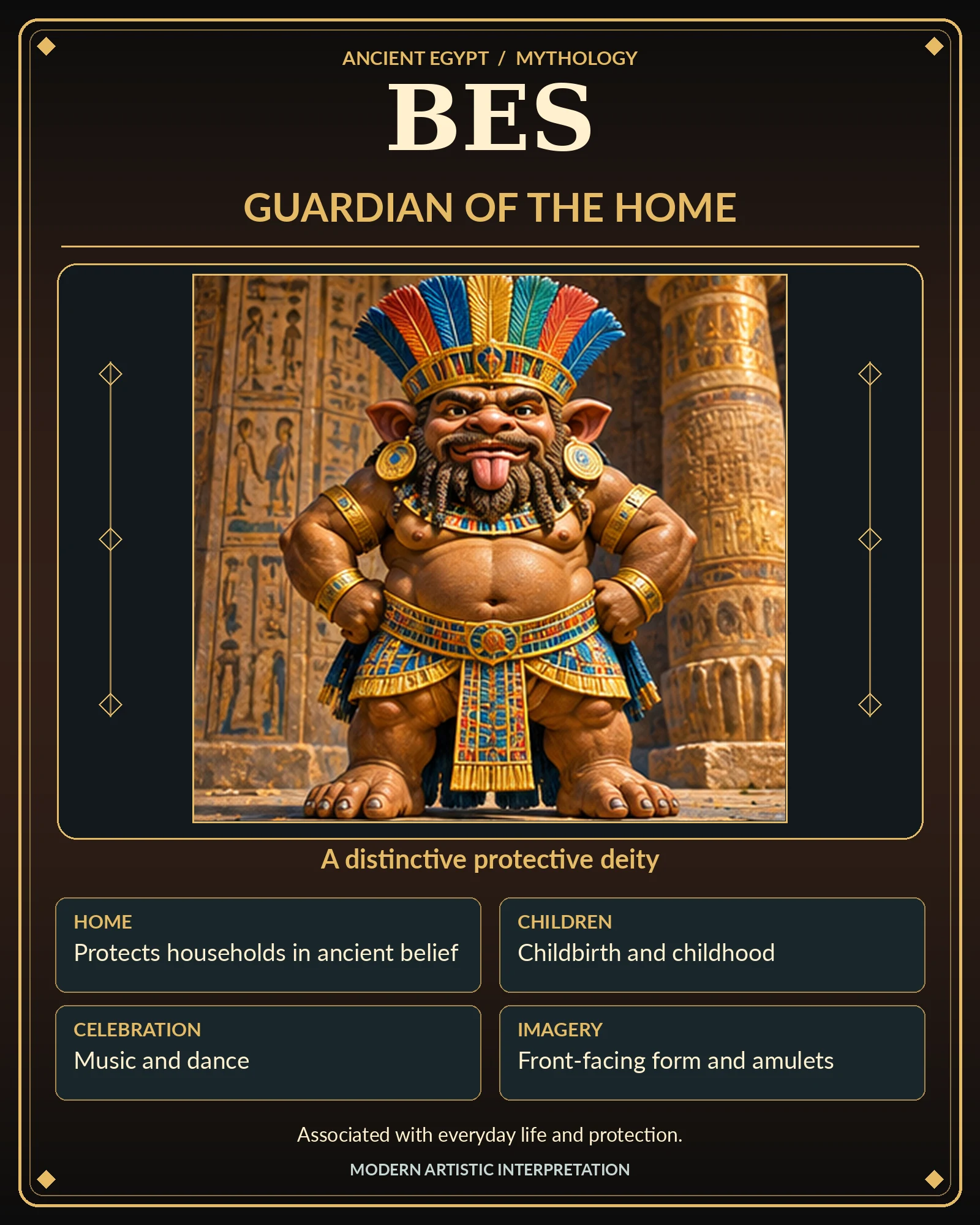
Bes was an ancient Egyptian protective god of the home, best known as the guardian of pregnant women, newborn babies and children. He is shown as a short, stocky, bearded figure with bowed legs, a lion-like face, a feathered crown and a protruding tongue, and he is one of the few Egyptian gods usually drawn facing the viewer rather than in profile. Bes was also linked with music, dance, laughter and the protection of sleepers. Where major gods like Ra or Amun belonged to temples and kings, Bes belonged to ordinary families, and that is why his image survives on so many everyday objects.
This guide covers his look and symbols, where his cult came from, how Egyptians used his image, his partnership with Taweret, and the claims about Bes that are history, belief or guesswork.
Bes Quick Facts
| Item | Detail |
|---|---|
| Domain | Household protection, childbirth, children, sleep, music, dance, humour |
| Appearance | Dwarf-like body, lion-like face, beard, feather crown, protruding tongue, often frontal view |
| Companion | Taweret, the hippo goddess of birth |
| Typical objects | Amulets, mirrors, headrests, cosmetic items, wands, house walls |
| Peak popularity | New Kingdom through Ptolemaic and Roman times |
| Spread | Images appear around the Mediterranean world beyond Egypt |
Who Was Bes?
Bes is a good example of how Egyptian religion had two layers. The temple layer concerned the cosmos, kingship and the afterlife. The household layer dealt with daily worries: safe childbirth, healthy children, sleep without nightmares, protection from snakes and scorpions. Bes was a leading figure of this second layer. He is not part of the great creation stories, and we have no long myth in which Bes is the hero. His importance comes from what people did with his image.
Because his name and form appear in many periods, scholars see Bes as a figure who grew from several older dwarf-like and lion-faced protective beings. The shape we know best belongs to the later periods, especially the New Kingdom and after. This matters when you read popular articles that claim a single “origin” for Bes: the evidence points to a gradual blending of traditions, not a single moment of creation.
Appearance and Symbols
Bes looks very different from other Egyptian gods, and that is deliberate. A face that looks grotesque or ferocious to us was meant to frighten off harmful forces.
| Feature | Likely meaning |
|---|---|
| Lion-like face and mane | Strength, guardian power and a link with lion-form protective deities |
| Protruding tongue and wide grin | A warning gesture that scares away evil; also part of his comic, playful side |
| Short, stocky body and bowed legs | A powerful, earthy figure; Egyptians also respected dwarfs as dancers and attendants |
| Tall feather crown | Divine status and links with solar or royal imagery |
| Frontal pose | Looking straight at the viewer, as if confronting threats; rare in Egyptian art |
| Knives, drums, tambourines or harps | Both defence against evil and the joy of music and dance |
The frontal pose is one of the best clues for identifying him in a museum. Most Egyptian gods are shown with head in profile and body in a set pose. Bes looks directly at you, which makes him easy to spot.
What Bes Protected
- Childbirth and babies: Bes watched over delivery and the early life of a child, usually together with Taweret.
- The home and family: He guarded doorways, bedrooms and household furniture against snakes, scorpions and harmful spirits.
- Sleep: Egyptians believed sleep was a vulnerable time, so Bes images were placed on beds and headrests.
- Music and dance: Bes is often shown with instruments, and he is linked with joyful celebration.
- Beauty and personal care: His image appears on mirrors, cosmetic spoons and ointment containers, often connected with the goddess Hathor’s world of beauty and pleasure.
Story box (imagined scene, not an ancient text): A child sleeps on a mat while the family eats in the next room. Beside the bed stands a small wooden figure of Bes with his tongue out. The parents may joke about how silly he looks, and that is part of his charm: a protector who is both frightening to danger and friendly to children. Historians reconstruct such scenes from objects and house remains, but no ancient writer describes this exact moment.
Bes and Taweret
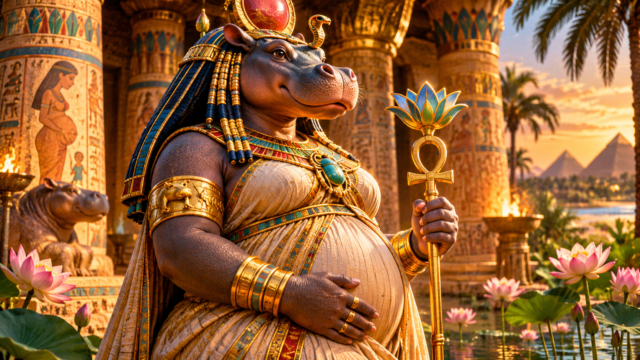
Bes and Taweret frequently appear together, especially on the curved ivory objects often called magic wands from the Middle Kingdom. Taweret represents the nursing, pregnant protector; Bes is the loud, fierce guard. Their partnership covered most of the fears connected with pregnancy and young children. They are best understood as a team of household protectors, not as a married couple in a myth. For more detail, see our separate guide to Taweret.
Where Bes Was Worshipped
Bes had few large temples of his own, and no famous national cult centre. His worship was spread across houses, workshops and small shrines. In some temples, especially those connected with birth, such as birth houses attached to Late Period and Ptolemaic temples, Bes figures decorate walls and columns, giving the idea of protection around the birth of the divine child. In daily life, a household might keep a small statue or paint his figure on a wall.
His popularity continued under Greek and Roman rule, when Egyptian household deities travelled through the Mediterranean in trade networks. Bes-like figures appear in many places outside Egypt, which shows how portable and appealing a friendly guardian could be.
History, Mythology and Speculation
| Category | What belongs here |
|---|---|
| History (supported by objects) | Bes images on amulets, furniture, wands and temple walls; his popularity in late periods; spread beyond Egypt |
| Mythology (belief) | His power to frighten evil and protect children and homes |
| Speculation (scholarly guess) | A single foreign origin for Bes; exact ritual uses of specific objects; any detailed personal biography |
Myth vs Fact
| Popular claim | Reality |
|---|---|
| Bes was a demon. | Bes was a protective god. His fierce face scared off evil forces. |
| Bes was a major state god like Ra. | He was mostly a household and personal protector without a large national cult. |
| The island of Ibiza is named after Bes. | This is a popular claim that links the Latin name Ebusus with Bes. It is often repeated, but the etymology should be treated as uncertain. |
| Bes was a foreign god who never became truly Egyptian. | Some of his traits may have mixed traditions, but he became fully integrated into Egyptian religion. |
| Bes amulets guarantee safety. | Ancient Egyptians believed in their protective power, but they are cultural objects today and do not replace medical or safety measures. |
Why Bes Still Fascinates People
Bes shows that Egyptian religion was not only about solemn gods and giant temples. It also had humour, noise and playfulness. A god who sticks out his tongue to protect a baby tells us that Egyptians understood fear and comfort as part of the same experience. For students of history, Bes is a reminder to look at small objects as carefully as at monuments, because they often reveal what ordinary people actually believed.
Frequently Asked Questions About Bes
What was Bes the god of?
Bes protected homes, pregnant women, newborns and children, and he was also associated with music, dance and joy.
Why does Bes stick out his tongue?
The tongue and grimace are usually read as a way of frightening away harmful forces. It also gives him a humorous, friendly look.
Why is Bes shown from the front?
Frontal figures were unusual in Egyptian art. Bes faces the viewer, which is read as confronting danger directly.
Was Bes a dwarf god?
He is often described as dwarf-like because of his short, stocky body. Egyptian art and texts show people with dwarfism in respected roles, and Bes’s form can be seen in that cultural context.
Is Bes male or female?
Bes is usually understood as a male god. A female counterpart, sometimes called Beset, is attested in some contexts.
What is the relationship between Bes and Taweret?
They are partner protectors who often appear together on objects linked with birth and children. They are not a married couple in a known myth.
Did Bes have temples?
He had few large independent temples. His image appears in homes, small shrines and in temple areas linked with birth.
Is Bes connected to Ibiza?
A popular claim says the island’s ancient name came from Bes, but this etymology is uncertain and should not be stated as proven.
Reliable Sources
- World History Encyclopedia: Egyptian Mythology
- Egypt Exploration Society: Gods of Egypt
- The Metropolitan Museum of Art: Divine Egypt
Last updated: 25 November 2026. Related reading on Vista Hub: our guides to Taweret, Egyptian gods and goddesses and Egyptian symbols.
Related guides: Taweret: Egyptian Hippo Goddess of Childbirth and Protection — Appearance, Symbols and Myths · Anubis: Egyptian God of the Dead, Embalming and the Weighing of the Heart (Facts, Myths and Symbols)














Share Your Opinion
Comments are closed on this post.