 Vista
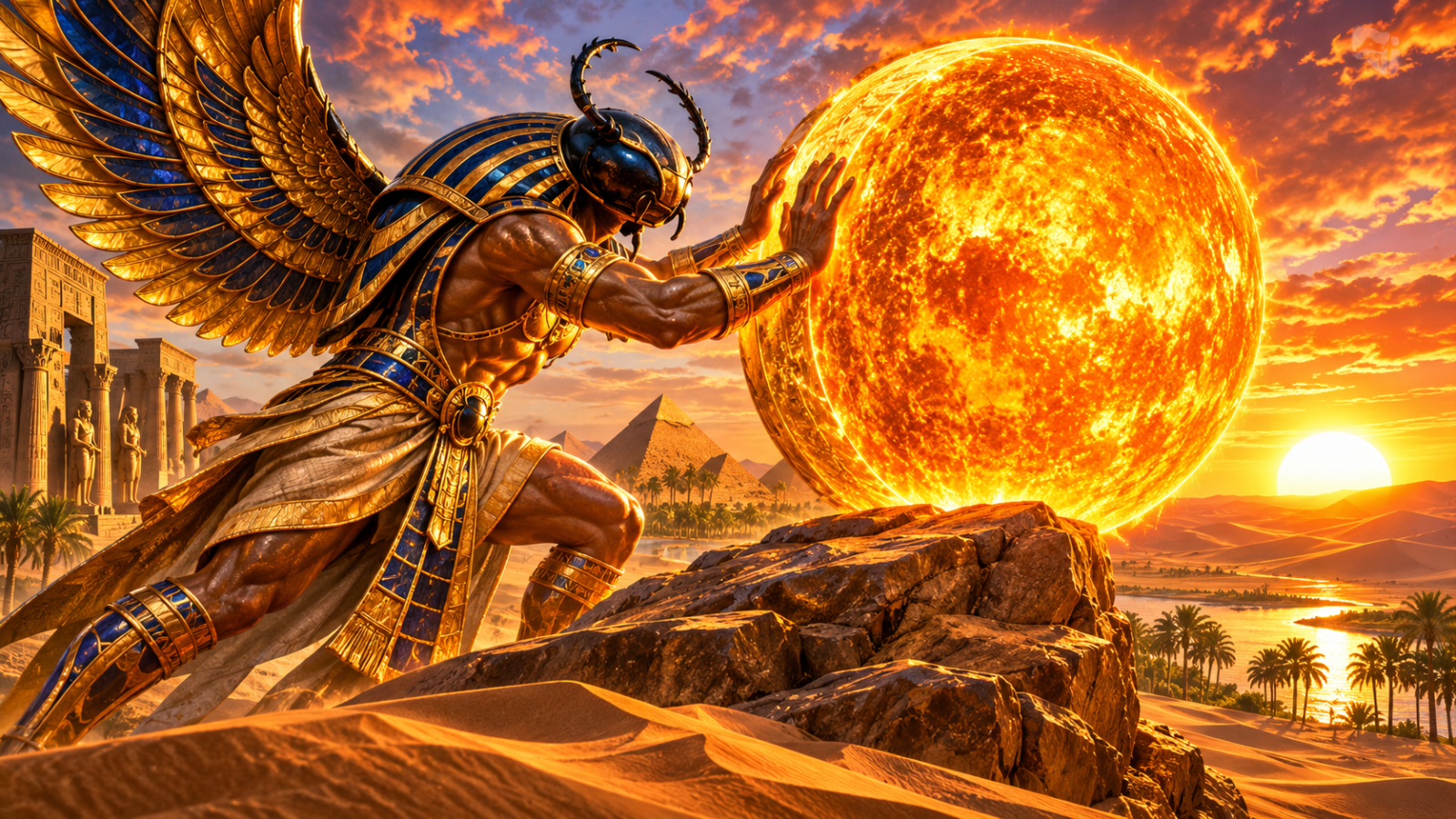
Khepri was the Egyptian god of the rising sun, shown as a scarab beetle or a man with a scarab for a head. His name comes from the verb “to come into being” or “to transform”, and he represented the sun at dawn, newly reborn after the night. The scarab beetle was his sacred animal because Egyptians watched dung beetles roll balls across the ground and saw in them an image of the sun being pushed across the sky.
This guide explains who Khepri was, how he relates to Ra and Atum, why the dung beetle became a symbol of rebirth, and how scarab amulets and heart scarabs were used. We keep the myths, the history and the modern ideas apart, and we add what science says about the real beetle, which is more interesting than the legends.
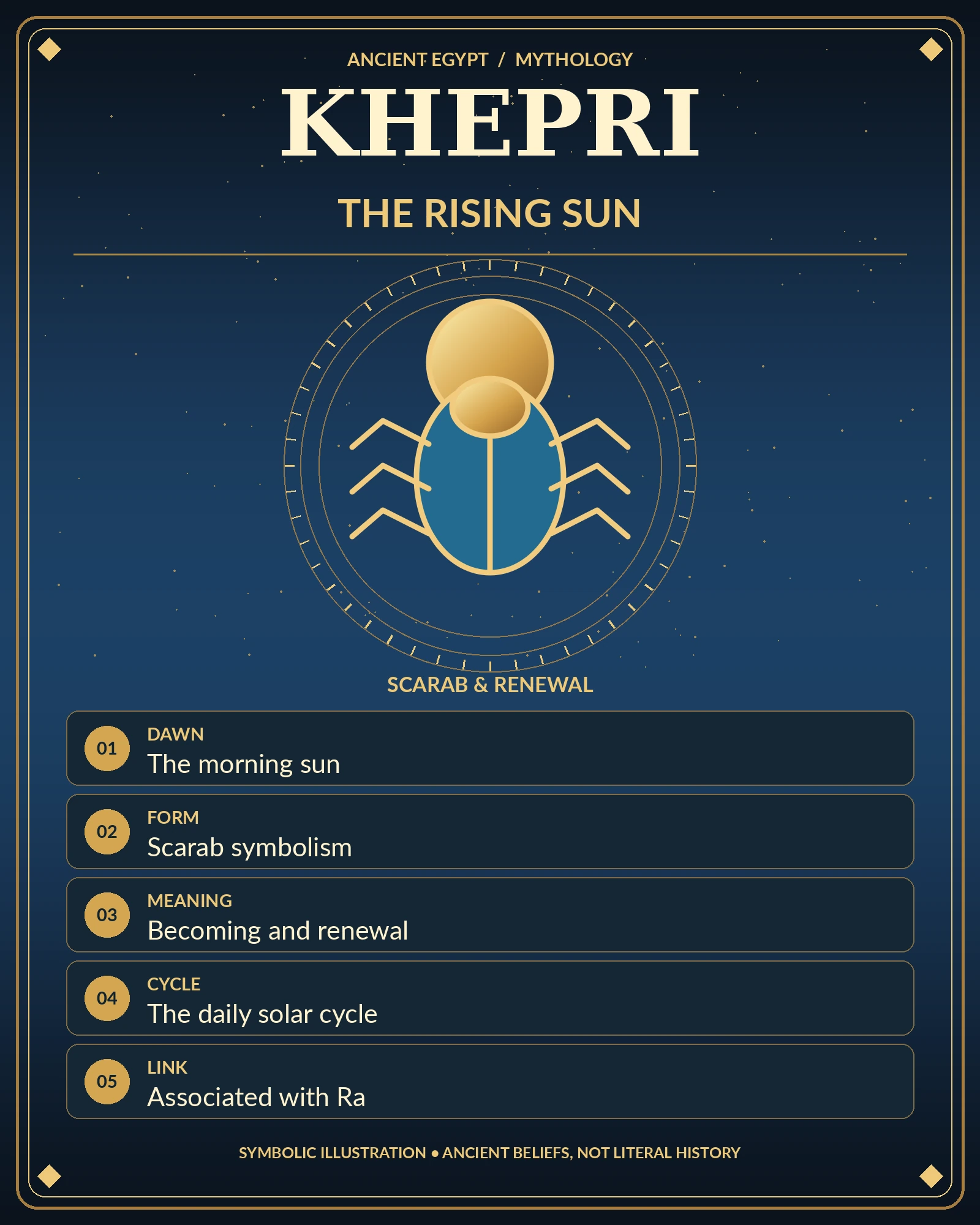
Quick Fact Box: Khepri at a Glance
| Item | Detail |
|---|---|
| Name meaning | From kheper: “to come into being, to become, to transform” |
| Domain | Dawn, the rising sun, rebirth, renewal |
| Appearance | Scarab beetle, or a man with a scarab head or beetle above his head |
| Relation to Ra | The morning form of the sun god |
| Sacred animal | Dung beetle (Scarabaeus sacer) |
| Key object | Scarab amulets and the heart scarab |
| Famous monument | Giant granite scarab at Karnak, set up by Amenhotep III |
| Related symbol | The sun disk pushed by the beetle |
Who Was Khepri?
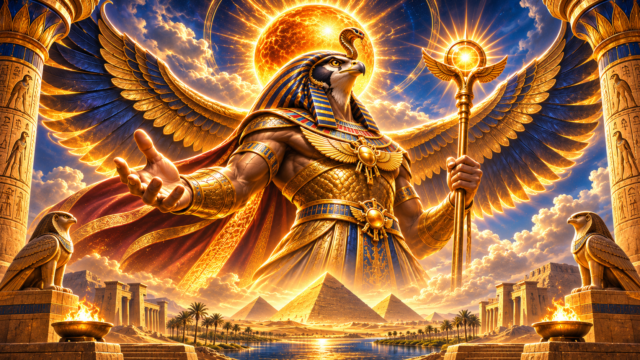
Khepri is the sun god in the form he takes at sunrise. Egyptian priests, especially those of Heliopolis, described the sun’s day as a cycle of forms: Khepri at dawn, Ra at midday, and Atum at sunset. The three were not rivals but different stages of one solar journey. Khepri is therefore the god of beginnings, the sun that has just emerged from the night and the underworld.
In underworld texts such as the Amduat, the sun god passes through the twelve hours of the night, and in the final hour he is reborn as Khepri to rise again. This is the myth of daily resurrection that gave the scarab its power as a symbol of life after death.
Why a Beetle? The Dung Beetle and the Sun
The sacred scarab is a dung beetle. It shapes a ball of animal dung and rolls it away across the ground, then buries it. The Egyptians saw an image of the sun disk being rolled across the sky by a divine beetle. They also noticed that young beetles seemed to emerge from the buried ball without a parent beetle visible. Since they did not know that the female lays eggs inside the dung, they took this as a sign of spontaneous creation, the idea that life renews itself from nothing. That is why Khepri’s name means “coming into being”.
What Science Says About the Real Beetle
The female dung beetle lays eggs in or on the dung ball, and the larvae feed on it as they grow before emerging as adults. This ordinary life cycle explains what the Egyptians saw. Modern research has also shown that dung beetles can steer straight by using the sun, the moon and even the pattern of light from the Milky Way, as reported in a 2013 study in the journal Current Biology. It is a reminder that ancient observers noticed something real about the beetle’s behaviour, even if their explanation was religious.
Khepri vs Ra vs Atum
| Form | Time of day | Meaning | Typical image |
|---|---|---|---|
| Khepri | Dawn | Rebirth and becoming | Scarab, or man with beetle head |
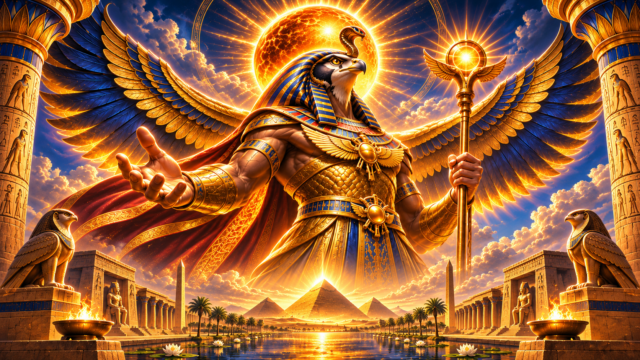
| Ra | Midday | Full light and kingship | Falcon-headed man with sun disk |
| Atum | Sunset | Completion, the old sun | Man in the double crown |
Atum also has a separate role as a creator god, as described in our guide to the primordial gods. Here he is the setting form of the sun.
Appearance and Symbols
- Scarab beetle: the main symbol, often with a sun disk held between its front legs.
- Winged scarab: the beetle with spread wings, shown on pectorals and coffins.
- Man with scarab head: an anthropomorphic form in tomb and temple scenes.
- Sun disk: the sun he raises each morning.
Scarab Amulets and the Heart Scarab
Scarab-shaped amulets are among the most common Egyptian objects. People wore them as protection and as a sign of renewal, and used them as seals, with the flat underside carved with a name, a design or a short blessing. Some royal scarabs recorded events during a king’s reign.
The heart scarab was a special type placed over the heart of a mummy. It was inscribed with Spell 30B of the Book of the Dead, which asks the heart not to speak against the dead person during the weighing of the heart. It shows how Khepri’s symbol of rebirth was tied to the hope of passing the judgment of the dead.
Story Box: The Giant Scarab of Karnak
Near the Sacred Lake at Karnak stands a large granite scarab on a pedestal, dedicated by Amenhotep III. Today many visitors walk around it, often seven times, hoping for luck or a happy marriage. This is a modern tourist custom. It does not appear in ancient texts, so it should be understood as folklore that grew around the monument, not as an Egyptian ritual.
Mythology, History and Speculation
- Mythology: Khepri rolls the sun into the sky each dawn and is the reborn sun god.
- History: the scarab appears in amulets and seals from the Old and Middle Kingdoms and was extremely popular in the New Kingdom and later.
- Speculation: modern claims that scarabs “bring wealth” or hold magical powers are market folklore. The ancient meaning was protection and rebirth, not guaranteed luck.
Myth vs Fact
| Claim | Reality |
|---|---|
| Egyptians worshipped the beetle itself. | The beetle symbolised the god Khepri; it was an image of a divine idea. |
| Khepri is a separate sun god from Ra. | He is Ra’s morning form. |
| Scarabs were born from dung without parents. | The beetle lays eggs; Egyptians did not know this. |
| Walking around the Karnak scarab is an ancient ritual. | It is a modern custom. |
| Scarab amulets guarantee luck. | Ancient meaning was protection and renewal. |
Frequently Asked Questions About Khepri
Who is Khepri in Egyptian mythology?
He is the scarab-form god of the rising sun, the dawn form of Ra.
What does Khepri mean?
It is linked to a verb meaning “to come into being” or “to transform”.
Why is the scarab beetle sacred?
Because the beetle rolling a dung ball resembled the sun being moved across the sky, and young beetles appeared to be born from the ball.
What is the difference between Khepri and Ra?
Khepri is the sun at dawn; Ra is the full midday sun. They are the same god in different forms.
What is a heart scarab?
A scarab amulet placed on a mummy, inscribed with a spell so the heart would not testify against the dead person.
What does a scarab symbolise?
Rebirth, renewal, protection and the rising sun.
How did Egyptians show Khepri?
As a scarab beetle, a winged scarab, or a man with a scarab head or beetle above the head.
Where is the giant scarab of Karnak?
Beside the Sacred Lake at the Karnak temple complex in Luxor.
Do scarab beetles really navigate by stars?
Research reported in 2013 found that dung beetles can use the Milky Way’s light pattern to keep a straight path at night.
Is Khepri similar to an Indian sun deity?
Surya, the Hindu sun god, crosses the sky in a chariot, which is a thematic parallel to the beetle rolling the sun. The two come from different cultures and no historical link is proven.
Sources and Further Reading
- World History Encyclopedia: Egyptian Mythology
- Egypt Exploration Society: Gods of Egypt
- The Met: Divine Egypt
Last updated: 25 November 2026.
Related guides: Sacred Scarab Beetle: Egyptian Symbol of Rebirth — Khepri, Amulets and the Heart Scarab · Ra: Egyptian Sun God, Creation Myths, Eye of Ra and the Night Journey (Facts and Symbols)














Share Your Opinion
Comments are closed on this post.