 Vista
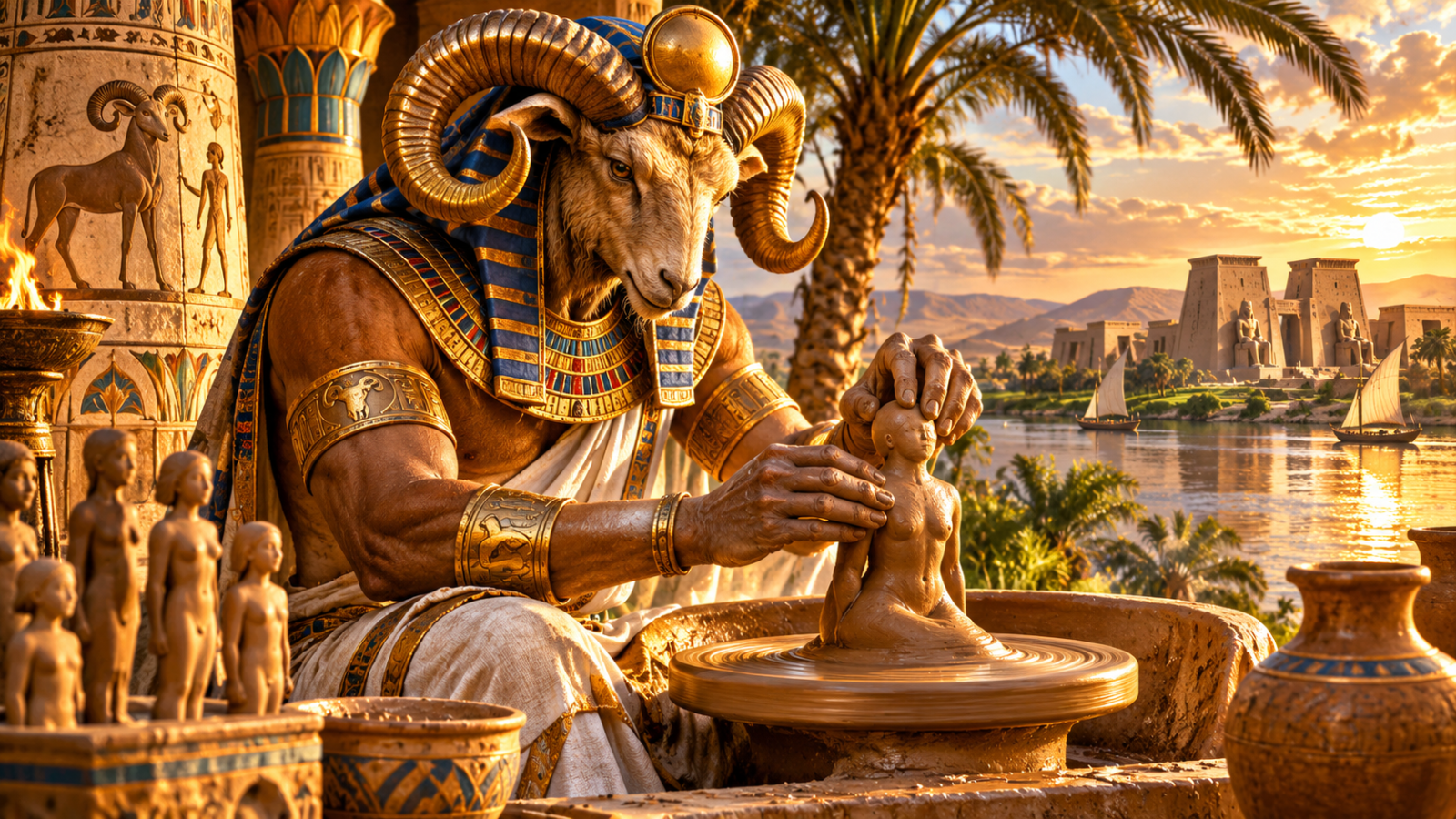
Khnum (also written Khnemu or Chnum) was an ancient Egyptian creator god, shown with the head of a ram with long, wavy horns. He was said to shape human beings, and the ka or life-force that goes with each person, on a potter’s wheel. He was also linked with the source of the Nile, which Egyptians placed near the First Cataract at Elephantine, so he controlled the river’s life-giving flood. His great temples stand at Elephantine near Aswan and at Esna in the south, where the best-preserved Khnum temple is of Greek and Roman date.
This guide explains his appearance, his creation role, his relationship to the Nile, the famous Famine Stela, his family at Elephantine, and the points where history, belief and speculation need to be kept apart.

Khnum Quick Facts
| Item | Detail |
|---|---|
| Form | Man with a ram’s head, long horizontal horns, often holding a potter’s wheel |
| Roles | Creator of humans, guardian of the Nile source and flood, giver of life |
| Main cult centres | Elephantine (Aswan area) and Esna |
| Family at Elephantine | Satet and Anuket, forming the Elephantine triad |
| Famous text | The Famine Stela on Sehel Island |
| Best-known sacred animal | The ram |
Who Was Khnum?
Khnum is one of the oldest known Egyptian gods, appearing in early religious texts, and he stayed important for thousands of years. His name is often linked to a root meaning “to join” or “to build”, but the exact meaning is debated, so it is wise to treat any single translation as a suggestion. What is clear is his job: he is a divine craftsman. Many Egyptian gods are tied to the sky or the sun, but Khnum is a god of making, forming and shaping.
The ram was an important animal in Egyptian religion because of its strength and its link with fertility. Egyptians used the ram form for several gods, including Amun, Khnum and Heryshaf. Khnum’s ram has long, nearly horizontal, twisted horns, a form of ram that is usually associated with older periods of Egyptian history. This helps scholars tell his image apart from Amun’s curved-horn ram.
The Potter God: How Khnum Made People
The most famous image of Khnum shows him at a potter’s wheel, shaping clay figures of a child and its double. In Egyptian thought, each person had a ka, a kind of life-force or spiritual double, and Khnum was said to form both the body and the ka. This idea appears in the divine birth scenes of kings, for example in reliefs that show the birth of a pharaoh such as Hatshepsut at Deir el-Bahari and Amenhotep III at Luxor. In these scenes Khnum forms the future king, and a goddess gives life to the figure.
At Esna, later temple texts go further and describe Khnum as a creator who fashions gods, humans and animals, drawing on the Nile’s clay. Because the Esna temple was built in the Ptolemaic and Roman periods, these texts show how old ideas were developed and expanded over many centuries.
Story box (based on temple reliefs, retold): In the royal birth scenes, Khnum kneels at his wheel and models two small figures, the future king and the king’s ka. A goddess stands nearby, holding the sign of life to the figures. The scene says that a king’s body and spirit were designed by the gods before birth, which supported the idea that the pharaoh was chosen. This is a religious and political statement as much as a creation story.
Khnum and the Nile
Egyptians believed the Nile’s flood came from a source under the island of Elephantine, near the First Cataract where the river’s rocky rapids begin. Khnum was the keeper of this source, and he was said to release the waters each year. The annual flood left fertile silt on the fields and made farming possible, so the god controlling it controlled the country’s food supply.
This explains why Khnum was worshipped in a region that was the southern gateway to Egypt. Elephantine was a frontier town and a trade centre. Its temples were part of a landscape of rocks, islands and river channels that looked like a place where the river could be born.
The Elephantine Triad: Khnum, Satet and Anuket
| Deity | Role |
|---|---|
| Khnum | Ram-headed creator and lord of the Nile source |
| Satet | Goddess of the southern frontier and the flood; shown with antelope horns |
| Anuket | Goddess of the cataract waters, often shown with a feather crown |
The relationships in this triad changed over time and between sites. Satet is often described as Khnum’s consort and Anuket as their daughter, but Egyptian family trees are flexible, so these links should be read as common patterns, not fixed rules. Our guide to the Egyptian gods family tree explains why.
The Famine Stela on Sehel Island
On Sehel Island near Aswan, an inscription known as the Famine Stela tells of a seven-year famine caused by low Nile floods. The text is set in the reign of King Djoser of the Third Dynasty, who is shown asking a priest about the source of the Nile. The priest describes Khnum’s temple at Elephantine and the god’s power over the river. Djoser makes offerings, Khnum appears to him in a dream and promises the return of the flood, and the king grants land and income to the temple.
Here history and tradition must be carefully separated. The stela itself is dated to the Ptolemaic period, which is more than two thousand years after Djoser. Many scholars read it as a priestly text that supports the temple’s claims by linking them to a famous ancient king. So it is valuable evidence for Ptolemaic religion, but not a reliable record of a real famine in Djoser’s reign.
The Temple of Khnum at Esna
The temple of Esna, south of Luxor, is one of the best-preserved Egyptian temples of the Greek and Roman period. Its hall has tall columns decorated with hymns and ritual texts, many of them about Khnum and the creation of the world. In recent decades, cleaning and study of the hall have drawn new attention to its texts and colours. For visitors, Esna is a good place to see how temple religion continued under foreign rulers, who built in Egyptian style and honoured Egyptian gods.
History, Mythology and Speculation
| Category | What belongs here |
|---|---|
| History | Khnum’s temples at Elephantine and Esna; royal birth reliefs; the Famine Stela as a Ptolemaic text |
| Mythology | Khnum forming humans and their ka on a wheel; his control of the Nile source |
| Speculation | The exact meaning of his name; a real seven-year famine under Djoser; modern attempts to link his story with other creation myths |
Myth vs Fact
| Popular claim | Reality |
|---|---|
| Khnum was the same god as Amun. | Both could appear as rams, but they were different gods with different roles and horn shapes. |
| The Famine Stela proves a famine under Djoser. | The stela dates to a much later period and is a temple text, so it is not direct proof. |
| Khnum was only a minor local god. | He was local in cult centres but important in creation and royal birth ideas across Egypt. |
| The Nile’s flood really came from a spring at Elephantine. | This was a religious and geographic belief. The real flood comes from rains far upstream. |
Frequently Asked Questions About Khnum
What was Khnum the god of?
Khnum was the god of creation by moulding, the Nile source and flood, and the forming of humans and their ka.
Why is Khnum a ram?
The ram symbolised strength and fertility, and several Egyptian gods used ram forms. Khnum’s long horizontal horns distinguish him.
How did Khnum create humans?
He was said to shape them from clay on a potter’s wheel, forming both the body and the ka.
Where was Khnum worshipped?
Mainly at Elephantine near Aswan and at Esna, with a presence in other southern sites.
Who were Khnum’s wife and daughter?
At Elephantine, Satet is usually called his consort and Anuket his daughter, though family links varied by site and period.
What is the Famine Stela?
It is a Ptolemaic inscription on Sehel Island that tells of a seven-year famine in the time of King Djoser and the restoration of the Nile flood by Khnum.
What is special about the Esna temple?
It is a well-preserved Greek and Roman period temple with long hymns and creation texts about Khnum.
Is Khnum related to the Nile god Hapi?
Both are linked with the Nile flood. Khnum is the creator who guards the source, while Hapi is the personified flood itself. See our guide to Hapi.
Reliable Sources
- World History Encyclopedia: Egyptian Mythology
- Egypt Exploration Society: Gods of Egypt
- The Metropolitan Museum of Art: Divine Egypt
Last updated: 25 November 2026. Related reading on Vista Hub: our guides to Hapi, Ptah, Amun-Ra and the Egyptian gods family tree.
Related guides: Egyptian Mythology · Egyptian Gods and Goddesses













Share Your Opinion
Comments are closed on this post.