 Vista
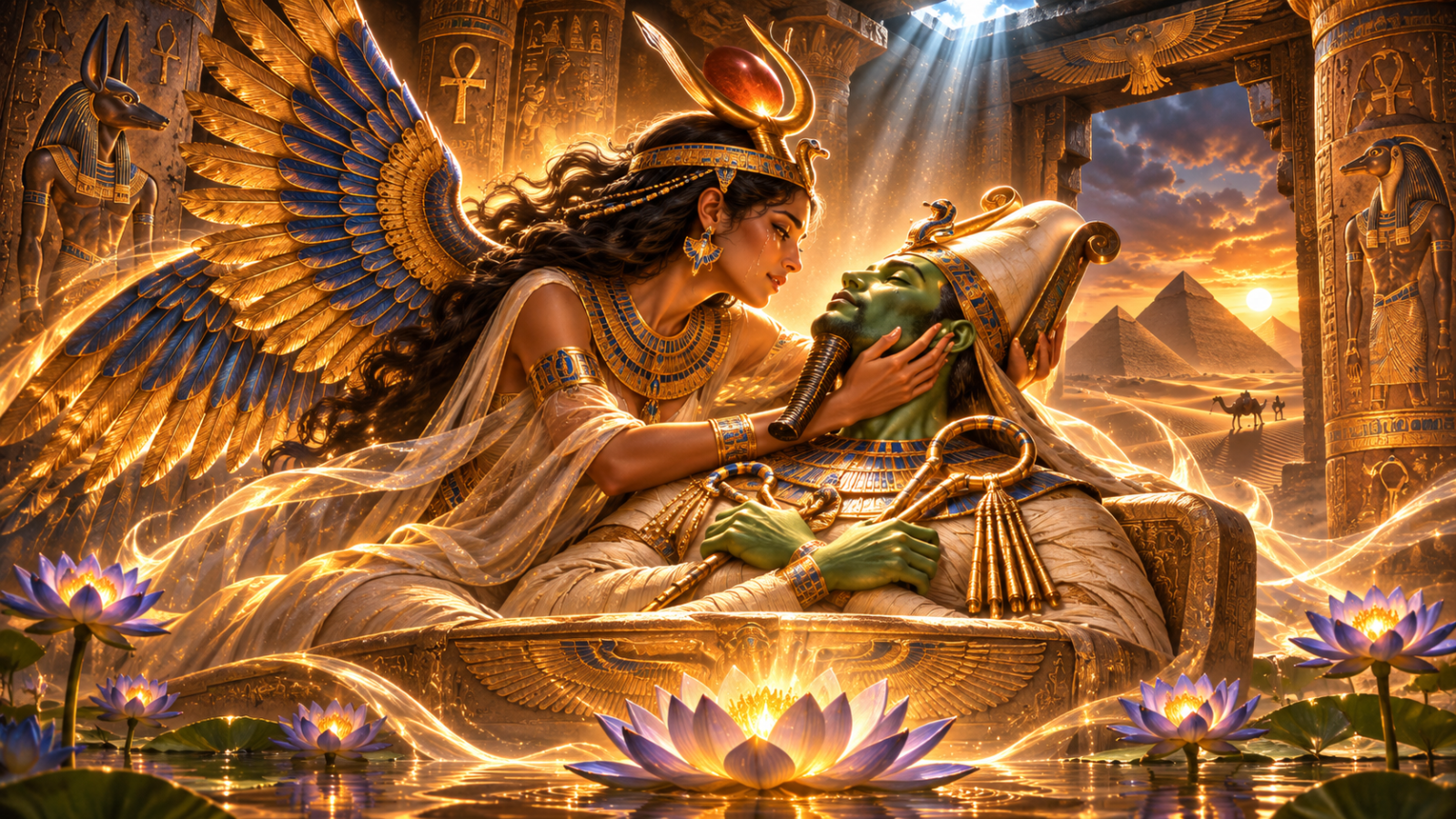
Isis (Egyptian: Aset or Est) was the ancient Egyptian goddess of magic, motherhood, healing and protection. She is best known as the wife of Osiris and mother of Horus, who searched for her murdered husband, restored him enough to conceive her son, and protected that child against Set. She is usually shown as a woman wearing a throne-shaped headdress, and later with the sun disc and cow horns she borrowed from Hathor.
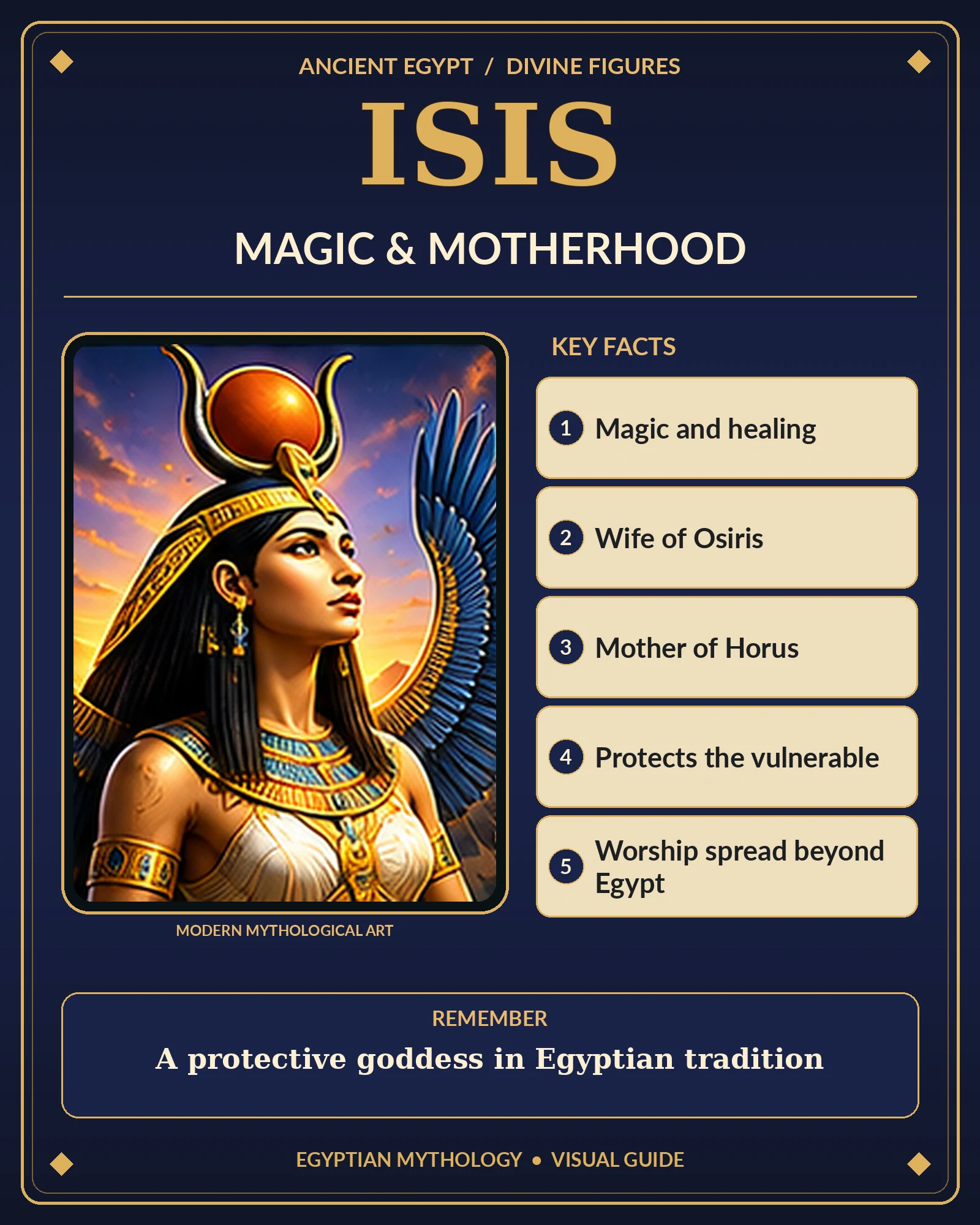
This guide keeps Egyptian evidence apart from later Greek and Roman additions and from modern claims. You will find a fact box, her myths, her symbols, the temple at Philae, her spread across the Mediterranean, a myth vs fact table, ten FAQs and sources.
Isis Quick Fact Box
| Item | Answer |
|---|---|
| Egyptian name | Aset (Greek form: Isis); the name is linked to the word for “throne” |
| Domain | Magic, motherhood, healing, protection, kingship |
| Appearance | Woman with a throne headdress; later a sun disc between cow horns; winged arms |
| Parents | Geb and Nut |
| Siblings and husband | Osiris (brother and husband), Set and Nephthys |
| Child | Horus (Harpocrates as the child form) |
| Symbols | Throne, tyet knot, wings, sistrum, kite bird |
| Main temple | Philae, in southern Egypt |
| Greek and Roman era | One of the most widely worshipped gods of the Mediterranean |
| Best-known story | Gathering the pieces of Osiris and protecting baby Horus |
Who Is Isis in Egyptian Mythology?
Isis is mentioned in the Pyramid Texts, where she and her sister Nephthys mourn and protect the dead king, so she belongs to the earliest layer of Egyptian religion. Over the centuries her importance grew until she was seen as a universal mother and magician whose words could heal, protect and even bend fate.
Her name is connected with the throne, and the hieroglyph for “throne” forms her headdress. The idea is that the king sits on Isis, as on his mother’s lap, so she legitimises his rule. Because every pharaoh was identified with Horus, Isis was the royal mother of every king.
Isis, Osiris and Horus: The Central Myth
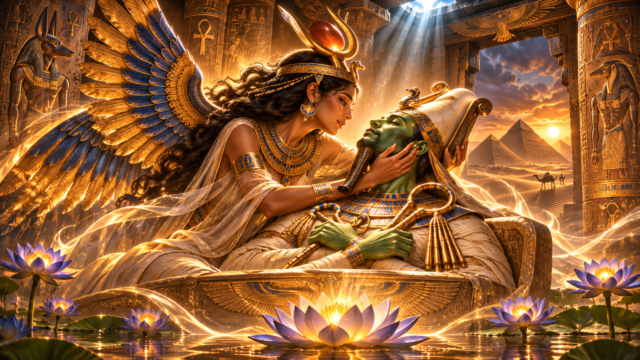
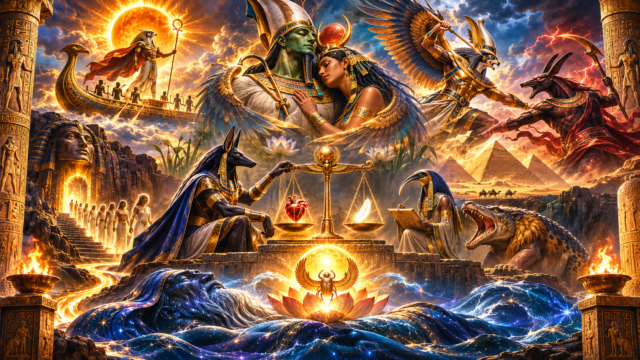
After Set kills and dismembers Osiris, Isis travels to find the pieces, helped by Nephthys. She reassembles the body, and with Anubis’s help it is embalmed. Using her magic, she revives Osiris enough to conceive Horus, then hides to give birth and raise the boy in the marshes of the Delta, protected from Set. See our full Osiris guide for the entire cycle.
Story box: the mourning kites. Isis and Nephthys are often shown as two kite birds or women with wings spread over the dead. They are the “mourners”, and their lament is part of funerary rites. Priestesses sometimes played these roles in rituals, which shows how the myth was acted out in real ceremonies.
Isis the Magician: How She Learned Ra’s Secret Name
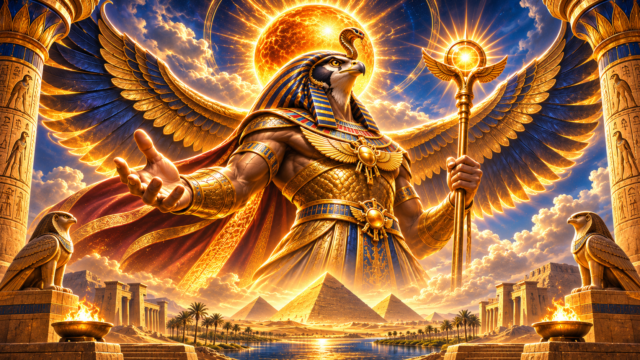
In a New Kingdom magical papyrus, Isis wants to know the hidden name of the aging sun god Ra, because knowing a god’s true name gives power over him. She gathers some of his spittle, forms a serpent from it and places it on his path. It bites him, and no god can cure the poison. Isis offers to heal him if he reveals his name; after resisting, he finally lets her search his body for it. She heals him, and gains great power.
The story explains why Isis was called “great of magic” (Weret-hekau). Egyptian “magic” (heka) was not a separate occult art but a force at the heart of religion, medicine and ritual, so spells to heal a scorpion sting or protect a child often cite Isis as their model. For the sun god’s side of the story, read our Ra guide.
Isis as Mother: Protector of Horus
In the Metternich Stela, a magical healing monument from the 4th century BCE, Isis is shown cursing and curing as she saves young Horus from a scorpion sting. She calls on Ra, who halts his sun-boat until the child recovers. Texts like this were used as healing spells, and water poured over such stelae was thought to carry their power.
Statues of Isis nursing the infant Horus are among the most familiar Egyptian images, and scholars note their similarity in form to later mother-and-child images in the Mediterranean. Claims that Christian Madonna art was copied from Isis are debated; the visual resemblance is real, but direct dependence is not established.
Symbols of Isis
| Symbol | Meaning |
|---|---|
| Throne headdress | Royal legitimacy; the king sits on her |
| Tyet (Isis knot) | Protection and life, often linked to her blood or girdle |
| Outstretched wings | Protection of the dead and of kings |
| Sistrum | A ritual rattle shared with Hathor |
| Sun disc and cow horns | Borrowed from Hathor in later periods |
| Kite | Mourning and the cry that revives Osiris |
For identification, remember that the throne on the head is Isis’s most reliable mark. The sun disc with cow horns can also indicate Hathor, so check for the throne or an inscription. Our Egyptian symbols guide covers the tyet and other amulets.
Philae: The Temple of Isis
The most famous temple of Isis is at Philae, an island in the Nile near Aswan. The surviving buildings date mainly to the Ptolemaic and Roman periods. Isis worship at Philae continued unusually late, and inscriptions suggest rites survived into the 5th century CE, after most Egyptian temples had closed. When the Aswan High Dam threatened to flood the island in the 20th century, the temples were dismantled and rebuilt on nearby Agilkia Island in an international UNESCO campaign.
Isis in the Greek and Roman World
From the Ptolemaic period, Isis became a global goddess. She was identified with Greek goddesses such as Demeter and Aphrodite, and temples to her stood in Greek and Roman cities from Pompeii to Britain’s Londinium. Her cult offered initiation, daily ritual and promises of protection and an afterlife, which appealed to people far from Egypt. The Latin writer Apuleius describes an initiation into her mysteries in “The Golden Ass”, though he writes as a novelist, so details should be treated carefully.
Myth vs Fact: Common Claims About Isis
| Claim | What the evidence shows |
|---|---|
| “Isis is the goddess of the moon.” | Not originally; the lunar link is a later, mostly Greco-Roman association. |
| “Isis and Hathor are the same.” | They are separate goddesses whose images merged in later periods. |
| “Isis was worshipped only in Egypt.” | Her cult spread across the Roman Empire. |
| “Isis was the origin of the Virgin Mary.” | Visual similarities exist, but direct derivation is not proven. |
| “Isis’s magic means witchcraft.” | Egyptian heka was a respected part of religion and medicine. |
| “Isis killed Set.” | No; Set is defeated in the contest with Horus before the gods. |
Frequently Asked Questions About Isis
What is Isis the goddess of?
Magic, motherhood, healing and protection, and she is also tied to kingship through the throne.
Who is Isis married to?
Her brother Osiris, with whom she has Horus.
Why does Isis have a throne on her head?
Her name is linked to the throne hieroglyph, and the image shows she legitimises the king who sits on it.
How did Isis save Horus?
In the myths she hides him in the marshes from Set and, in healing texts, cures him from a scorpion sting with magic.
What is the Isis knot?
The tyet, a looped amulet associated with protection and with Isis, often made in red stone or glass.
Where is the temple of Isis?
The best-preserved is at Philae, relocated to Agilkia Island near Aswan.
Was Isis worshipped outside Egypt?
Yes, widely in the Greek and Roman worlds, with temples in cities across the empire.
How did Isis get her power?
In the best-known story she learned the secret name of Ra, which gave her command over powerful magic.
Is Isis the same as the modern group name?
No. The ancient goddess has no connection to modern organisations that share the name; this is simply a name borrowed from history.
Is Isis worshipped today?
The ancient cult ended; some modern revival groups honour her, which is a modern reconstruction.
Sources and Further Reading
Last updated: 25 November 2026.
- World History Encyclopedia, “Egyptian Mythology”: worldhistory.org
- World History Encyclopedia, “Osiris”: worldhistory.org
- Egypt Exploration Society, “Gods of Egypt”: ees.ac.uk
- The Metropolitan Museum of Art, “Divine Egypt”: metmuseum.org




















Share Your Opinion
Comments are closed on this post.