 Vista
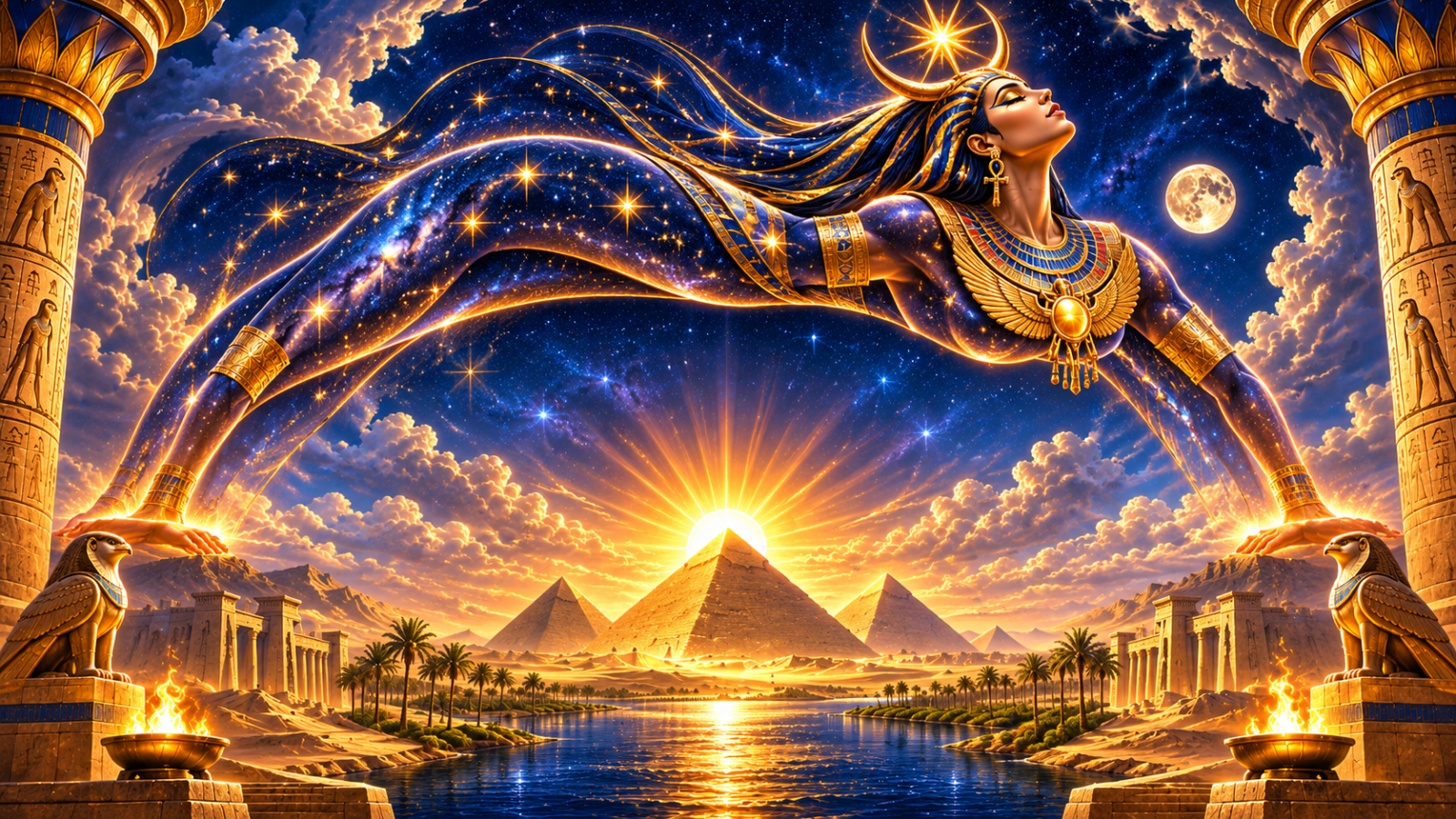
Nut was the Egyptian goddess of the sky, shown as a woman whose star-covered body arches over the earth. In myth she swallows the sun at dusk and gives birth to it again at dawn. She is the sister and wife of the earth god Geb, daughter of the air god Shu and the moisture goddess Tefnut, and the mother of Osiris, Isis, Set and Nephthys. Her image was painted inside coffin lids so that the dead would rest beneath her protection.
This guide covers who Nut was, how Egyptians pictured the sky, her family tree, the story of the five extra days of the year, and why she appears on coffins and tomb ceilings. We keep mythology, history and speculation separate, and we flag which parts of the stories come from late sources.
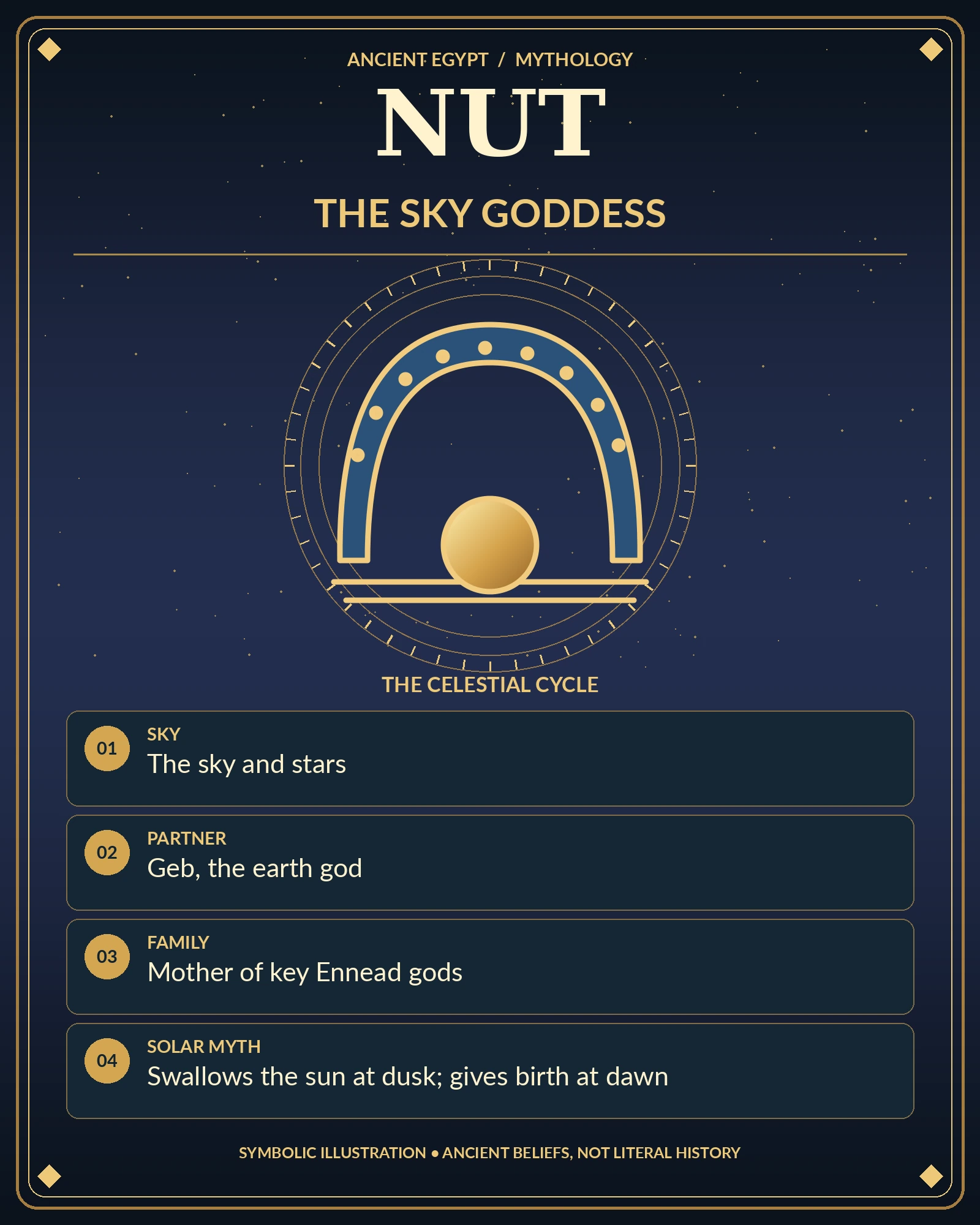
Quick Fact Box: Nut at a Glance
| Item | Detail |
|---|---|
| Domain | Sky, stars, heavens, protection of the dead |
| Parents | Shu (air) and Tefnut (moisture) |
| Husband | Geb, the earth god (also her brother) |
| Children | Osiris, Isis, Set, Nephthys (and in some traditions Horus the Elder) |
| Appearance | Woman arched over the earth, body covered in stars; sometimes a cow |
| Main tradition | Heliopolitan Ennead |
| Funerary role | Painted inside coffin lids and on tomb ceilings |
| Greek source | Plutarch tells the story of the five extra days |
Who Was Nut?
Nut is a member of the Ennead, the nine gods of Heliopolis. In that creation story, the first god Atum produces Shu and Tefnut, who give birth to Geb and Nut: the earth and the sky. Shu then raises Nut above Geb and keeps them apart, which explains why the sky is separated from the earth. The image of Nut stretched across the heavens, with her fingertips and toes touching the horizons and Shu holding her up, is among the most recognisable in Egyptian art.
Her name is written with a water-jar sign and a sign for the sky and is usually understood to mean “sky” or “heaven”. Egyptians did not see the sky as empty space. It was a body of water above the earth, across which the sun’s boat sailed, and Nut was that celestial ocean as a goddess.
Nut Swallows the Sun
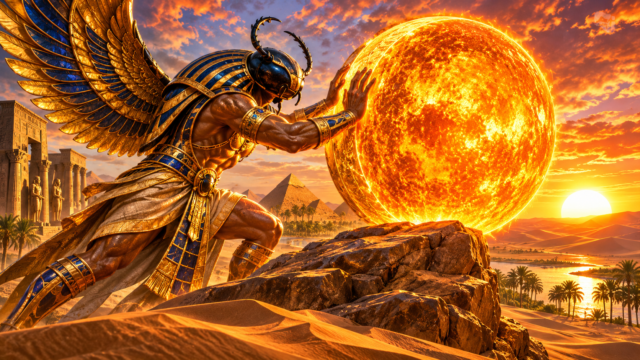
In one image, Nut swallows the sun each evening, and the sun passes through her body during the night, reborn at dawn between her thighs. This was a way to explain sunset and sunrise as part of a continuous cycle. The same image gives the sky goddess a role like a mother and a tomb, which links her with the funerary idea that the dead, like the sun, would be reborn. Some temple ceilings show this journey, with the sun disk entering her mouth and emerging again.
The Stars on Her Body
The stars are painted on Nut’s body, which also served as a map of the night sky. A text known as the Book of Nut, preserved in papyri from the Roman period, describes the movement of the sun, moon and stars across her body and discusses groups of stars called decans that were used to tell time at night. It shows that mythological imagery and practical astronomy were closely linked.
Nut and Geb: A Divine Marriage
Nut and Geb are siblings and spouses, as are many Egyptian divine couples. Their separation by Shu is one of the key moments of the Heliopolitan creation. Their children carry the central drama of Egyptian religion: Osiris becomes king and lord of the dead, Isis is the great magician and mother of Horus, Set is the god of storms and chaos, and Nephthys is the protector of mourners. Our guide to the Egyptian gods family tree explains how the relationships fit together.
Story Box: The Five Extra Days
The Greek writer Plutarch, writing centuries after the pharaohs, tells how the sun god, angry at Nut’s pregnancy, decreed she could not give birth on any day of the year. The god Thoth gambled with the moon and won a little of its light, which he turned into five extra days. Because these days were outside the normal calendar, Nut could bear her children then. The Egyptian civil calendar did have 365 days, made of twelve months of thirty days plus five additional days, and the story links them to the births of Nut’s children. Plutarch’s account is late, so it should be read as a Greco-Roman version of the tradition.
Nut on Coffins and Tomb Ceilings
Nut is often painted inside the lid of a sarcophagus, her arms spread over the body of the dead person. This represents the idea that the deceased lies in the embrace of the sky and will rise like the sun. Star-covered ceilings in tombs and temples, including the royal tombs at Thebes and the Osireion at Abydos, evoke her body. In the Pyramid Texts the dead king is said to be taken up into the sky, where Nut receives him.
Appearance and Symbols
- Arched body: the sky over the earth.
- Stars: the night sky on her skin.
- Water jar: part of the hieroglyph in her name and the celestial water.
- Cow form: in some texts the sky is a great cow, with stars on her belly.
Mythology, History and Speculation
- Mythology: Nut is the sky who swallows and rebirths the sun, mother of Osiris, Isis, Set and Nephthys.
- History: she appears in the Pyramid Texts and in funerary art from the Old Kingdom through the Roman period.
- Speculation: claims that Nut’s image shows aliens or a “cosmic being” are modern inventions; the image is a symbolic sky.
Myth vs Fact
| Claim | Reality |
|---|---|
| Nut gave birth to the sun every day literally. | It is a mythic image of sunrise and rebirth. |
| The five extra days come from a Greek invention. | The five days existed in the Egyptian calendar; Plutarch gives a late story about them. |
| Nut is the Egyptian “Mother Earth”. | She is the sky; the earth is her husband Geb. |
| Nut’s coffin art is only decoration. | It had a protective and religious purpose. |
| Nut is a minor goddess. | She is central to the Ennead and to funerary belief. |
Frequently Asked Questions About Nut
Who is Nut in Egyptian mythology?
The sky goddess, wife of Geb and mother of Osiris, Isis, Set and Nephthys.
Why is Nut covered in stars?
Her body is the night sky, and the stars decorate her skin.
How does Nut swallow the sun?
In myth the sun enters her mouth at dusk, travels through her body at night and is reborn at dawn.
Who are Nut’s parents?
Shu and Tefnut, in the Heliopolitan tradition.
Who are Nut’s children?
Osiris, Isis, Set and Nephthys, and in some traditions Horus the Elder.
Why is Nut painted on coffins?
To place the dead under her protection and link their rebirth to the daily rebirth of the sun.
What is the Book of Nut?
An astronomical text describing the movement of sun, moon and stars across Nut’s body, known from Roman-period papyri.
What are the five extra days?
The days added to the end of the Egyptian 360-day year, linked in myth to the births of Nut’s children.
Why did Shu separate Nut and Geb?
The story explains why the sky and earth are apart and creates space for life.
Is Nut similar to an Indian goddess?
Sky and earth pairs also appear in Vedic tradition, such as Dyaus and Prithvi, which is a thematic parallel. The traditions are separate and no historical link is proven.
Sources and Further Reading
- World History Encyclopedia: Egyptian Mythology
- Egypt Exploration Society: Gods of Egypt
- The Met: Divine Egypt
Last updated: 25 November 2026.
Related guides: Ra: Egyptian Sun God, Creation Myths, Eye of Ra and the Night Journey (Facts and Symbols) · Isis: Egyptian Goddess of Magic, Motherhood and Healing (Myths, Symbols and Worship)













Share Your Opinion
Comments are closed on this post.