 Vista

Amun-Ra was the king of the gods in ancient Egypt. The name joins two deities: Amun, the “hidden” god of Thebes, and Ra, the sun god of Heliopolis. The merger happened gradually, and by the New Kingdom (c. 1550–1070 BCE) Amun-Ra was the chief state god of Egypt, worshipped in the vast temple complex of Karnak and credited with creating the world, sustaining the sun and guarding the pharaoh.
This guide explains who Amun and Ra were separately, how they became one god, what “Amun vs Ra” really means, and why Amun-Ra mattered politically as well as religiously. We keep three layers apart: what the myths say, what historians can show from temples and texts, and what is modern speculation. If you are new to the subject, start with the quick fact box below.

Quick Fact Box: Amun-Ra at a Glance
| Item | Detail |
|---|---|
| Name meaning | Amun means “the hidden one”; Ra means “sun” |
| Role | King of the gods, creator, sun god, protector of the pharaoh |
| Main cult centre | Thebes (modern Luxor), especially Karnak and Luxor Temple |
| Divine family | Husband of Mut, father of Khonsu (the Theban triad) |
| Sacred animals | Ram and goose |
| Symbols | Tall double-plumed crown, ram horns, blue or dark skin in art |
| Rose to national importance | Middle Kingdom, dominant in the New Kingdom |
| Greek equivalent | Zeus (called Zeus-Ammon) |
Who Was Amun-Ra?
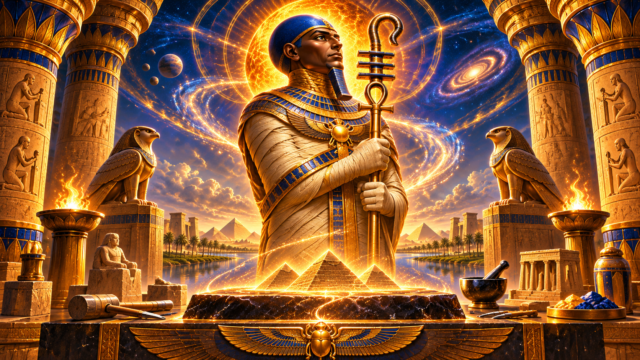
Amun-Ra is a composite god. Egyptian religion often allowed one deity to take on the traits of another without erasing either one. Scholars call this syncretism. When Amun and Ra were combined, the result carried the “hidden”, unseen power of Amun and the visible, life-giving light of the sun. In texts and temple scenes he is called the king of the gods and the lord of the thrones of the Two Lands, a title that tied him to the pharaoh’s own rule over Upper and Lower Egypt.
He was not a different god for each role. Egyptians were comfortable saying that a god had many forms and names, so Amun-Ra could be a creator, a solar king, a protector of ordinary people who prayed to him, and a divine father of the reigning king all at once.
Amun Before Ra: The Hidden God of Thebes
Amun first appears in religious texts as a minor figure. In the creation tradition of Hermopolis he belongs to the Ogdoad, a group of eight primordial deities, where he is paired with a female counterpart, Amaunet. His name suggests something concealed, a power that cannot be seen but is felt in the wind and in the breath of life. That quality made him a natural “creator behind the creator” in later theology.
His fortunes changed when Thebes became politically important. During the Middle Kingdom, kings from Thebes reunited Egypt, and some of them even placed his name inside their own, as in the name Amenemhat, often translated “Amun is foremost”. A local god of one city began to look like a national one. By the time Thebes led the war that expelled the Hyksos rulers from the north, Amun was ready to be the god of victory.
How Amun Became Amun-Ra
Ra already held the highest place in Egyptian theology. He was the sun god whose daily journey across the sky and through the underworld structured the cosmos, and the kings of the Old Kingdom called themselves his sons. If a Theban god wanted to be king of the gods, the easiest path was to share Ra’s identity. Combining the names gave Amun solar authority and gave the Theban priesthood a theology that fit the older, respected system.
The turning point came in the early 18th Dynasty. After the Theban king Ahmose I drove out the Hyksos and reunited the country, Amun-Ra was credited with the victory. Later pharaohs sent a share of war booty, land and captives to his temples. As Egypt’s empire expanded into Nubia and the Levant, the god’s wealth and influence grew with it. The pharaoh Hatshepsut, for example, presented herself in temple reliefs as the daughter of Amun-Ra, using the divine-birth story to support her claim to rule.
Amun vs Ra: What Is the Difference?
| Question | Amun | Ra |
|---|---|---|
| Main identity | Hidden creator, breath and wind | Visible sun, light and order |
| Home city | Thebes | Heliopolis |
| Earliest prominence | Rises in Middle Kingdom | Dominant in Old Kingdom |
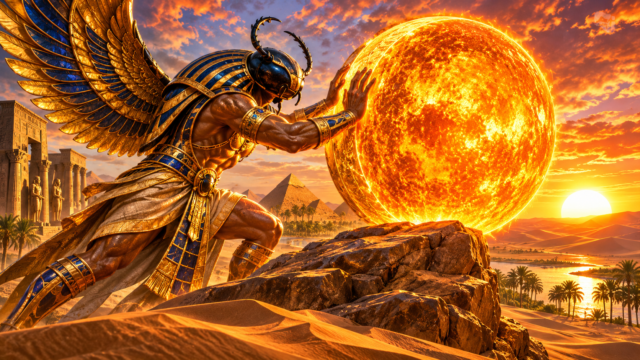
| Sacred animal | Ram, goose | Falcon, scarab (as Khepri), phoenix link (Bennu) |
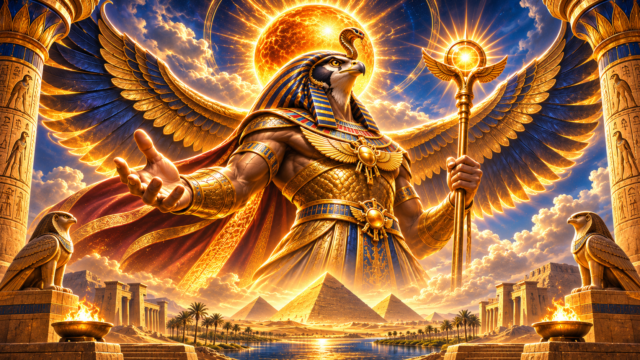
| Typical art | Man with double plumes, or ram | Falcon-headed man with sun disk |
| Combined form | Amun-Ra: hidden power plus solar kingship | |
So the question “who is stronger, Amun or Ra?” does not have a single answer. In earlier periods Ra was the greater god. In the New Kingdom the merged Amun-Ra was usually presented as the supreme one. For a full ranking debate, see our guide on the most powerful Egyptian god.
Appearance and Symbols
Amun is usually shown as a man wearing a tall crown with two straight plumes, often with blue skin, a colour linked to the sky and to the unseen. He may also appear as a ram or with a ram’s head, or as a goose. When merged with Ra he can wear a sun disk below the plumes. The ram connection explains the lines of ram-headed sphinxes that guarded the approaches to Karnak, and the Avenue of Sphinxes that once linked Karnak and Luxor Temple, restored and reopened to visitors in 2021.
- Double plumes: height and divine majesty.
- Ram: strength and fertility.
- Goose: a creator image linked to the primeval egg myths.
- Blue skin: the sky, air and the hidden or unseen.
Temples and Worship: Karnak, Luxor and the Opet Festival
Karnak is the largest ancient religious complex in Egypt, built and expanded over roughly two thousand years. Its heart is the precinct of Amun-Ra, with courts, pylons and the famous Hypostyle Hall, a forest of 134 columns. Nearby Luxor Temple was the setting for the annual Opet Festival, when statues of Amun, Mut and Khonsu travelled from Karnak to Luxor, and the king’s divine kingship was renewed.
The priesthood grew very powerful. By the end of the New Kingdom the High Priest of Amun controlled enormous estates and, in the Third Intermediate Period, effectively ruled Upper Egypt from Thebes while kings reigned in the north. This shows why historians treat Amun-Ra as a political force as much as a spiritual one. The god’s oracle at Siwa Oasis in the Western Desert was also famous in the ancient world.
Story Box: The King Who Tried to Remove Amun
Around 1350 BCE the pharaoh Akhenaten made the sun disk, the Aten, the focus of state worship and moved the capital to a new city, Akhetaten (modern Amarna). Amun’s name was chiseled off monuments and his temples lost royal support. After Akhenaten’s death, the boy king Tutankhaten changed his name to Tutankhamun, “living image of Amun”, and the old worship returned. The episode is one of the clearest examples of how closely religion and politics were tied.
Amun-Ra in Later History
Amun was also worshipped in Nubia, where kings of Kush built temples to him, notably at Jebel Barkal. In 331 BCE Alexander the Great travelled to Siwa and was greeted there as the son of Amun, which later helped his image as a divine ruler. Greeks identified the god with Zeus and called him Zeus-Ammon. As Roman rule and later Christianity spread, the cult declined, but the temples at Karnak and Luxor survived to become some of the best-known monuments in the world.
Mythology, History and Speculation: Keeping Them Separate
- Mythology: Amun-Ra is a hidden creator and sun king who sustains the cosmos.
- History: a Theban god elevated by dynasties from Thebes, merged with Ra, powerful until the Late Period and Greek-Roman era.
- Speculation: internet claims that Amun-Ra is the same as the Biblical “Amen” or a figure from Indian epics rest on similar-sounding names, not on evidence. We examine the India claims in a separate article.
Myth vs Fact
| Claim | Reality |
|---|---|
| Amun and Ra were always one god. | No. They began as separate gods and merged over centuries. |
| Amun-Ra was worshipped everywhere in Egypt equally. | No. Thebes was his centre; other cities kept their own main gods. |
| The word “Amen” comes from Amun. | Not demonstrated. Similar sound is not proof of descent; scholars explain “amen” through Hebrew roots. |
| Akhenaten destroyed Egyptian religion permanently. | His changes were reversed within a generation. |
| Amun-Ra was a “king” like a pharaoh. | His title “king of the gods” is religious; the pharaoh was his earthly son and representative. |
Frequently Asked Questions About Amun-Ra
Who is Amun-Ra in Egyptian mythology?
He is the combined form of Amun and Ra, regarded as king of the gods, a creator and the divine protector of the pharaoh.
What does the name Amun mean?
It is generally translated as “the hidden one” or “the concealed one”, pointing to an unseen creative power.
Amun vs Ra: who came first?
Ra held the higher position in the Old Kingdom. Amun rose later, and the two were joined in the Middle to New Kingdom period.
Why was Amun-Ra so important in Thebes?
Thebes was the home of the dynasties that reunited Egypt, so their city god became the state god. Temple wealth and the priesthood made him a political power.
Why is Amun linked to a ram?
The ram was a symbol of virility and strength. Amun was shown with a ram’s head or as a ram, and ram-headed sphinxes guarded his temples.
Who were Amun-Ra’s wife and son?
Mut is his consort and Khonsu, the moon god, is their son. Together they form the Theban triad.
Where was Amun-Ra worshipped?
Mainly at Karnak and Luxor in Thebes, with an important oracle at Siwa Oasis and temples in Nubia.
Why did Akhenaten reject Amun?
Historians suggest religious conviction and a desire to limit the wealth and power of Amun’s priesthood. The exact reasons are debated.
Is Amun-Ra similar to an Indian deity?
People sometimes compare him to Surya or Brahma because of the sun and creator roles. These are thematic parallels common across cultures. There is no proven historical link, and the claims are examined separately.
Is Amun-Ra still worshipped today?
The ancient state cult ended long ago. Small modern groups of reconstructionist practitioners exist, but they are not a continuation of the ancient religion.
Sources and Further Reading
- World History Encyclopedia: Egyptian Mythology
- Egypt Exploration Society: Gods of Egypt
- The Met: Divine Egypt
Last updated: 25 November 2026.
Related guides: Ra: Egyptian Sun God, Creation Myths, Eye of Ra and the Night Journey (Facts and Symbols) · Egyptian Mythology: Ancient Gods, Creation Stories, Symbols and the Afterlife
















Share Your Opinion
Comments are closed on this post.