 Vista
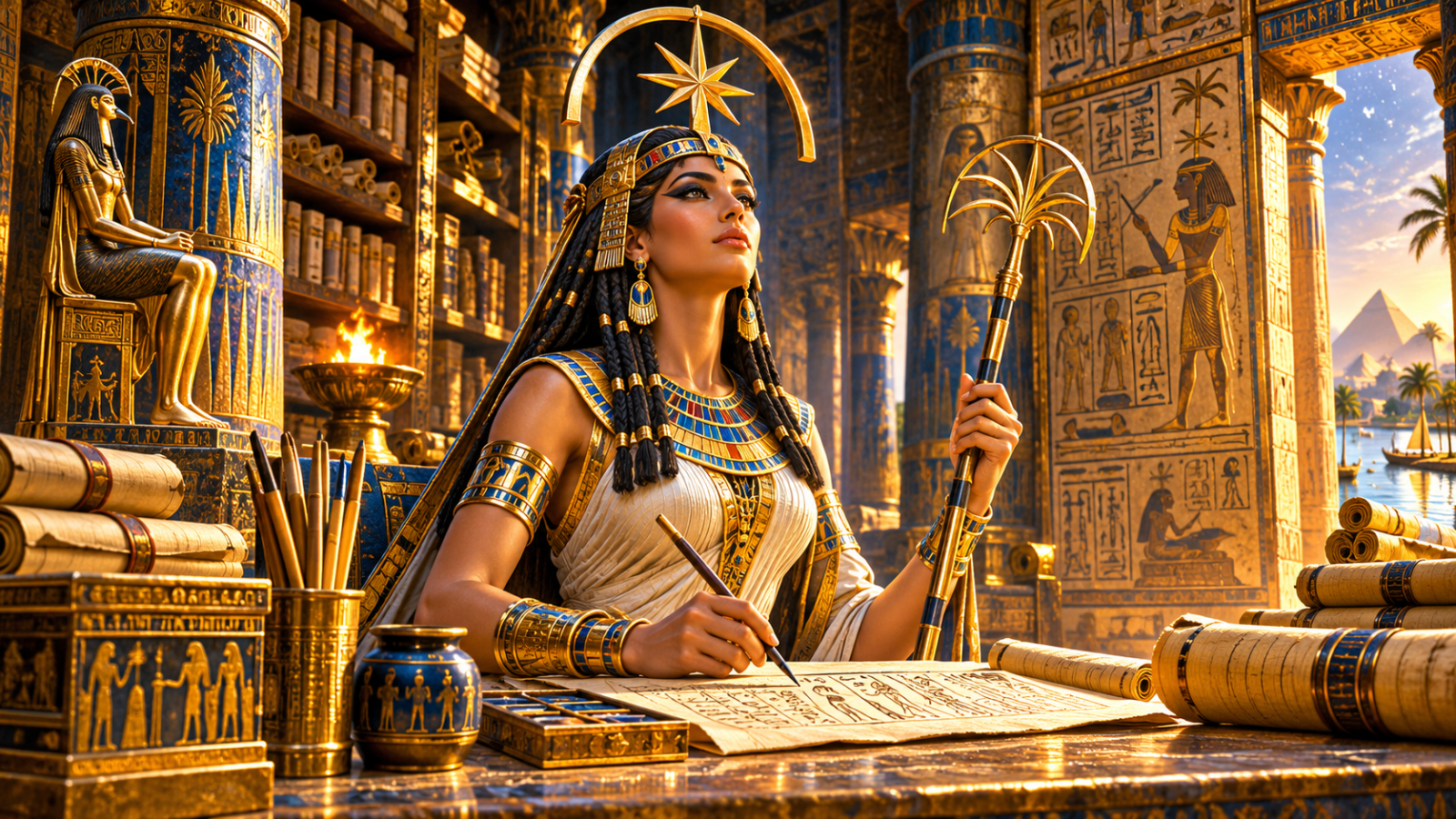
Seshat was the ancient Egyptian goddess of writing, record-keeping, measurement and architecture. She is shown as a woman in a leopard-skin dress with a distinctive emblem above her head: a star-like or flower-like rosette with seven points, topped by a curved shape that looks like a bow or a pair of horns. She is best known for helping the king with the ritual called “stretching the cord”, which marked out the ground plan of a new temple. Her name is usually understood as “female scribe”. She was close to Thoth, the god of writing, and the two are linked in many texts, but Seshat has her own role: she is the divine record-keeper of the king’s deeds and years.
This guide explains her appearance, her emblem, what stretching the cord meant, how she recorded the king’s reign, her relationship with Thoth, and what is known and unknown about her.
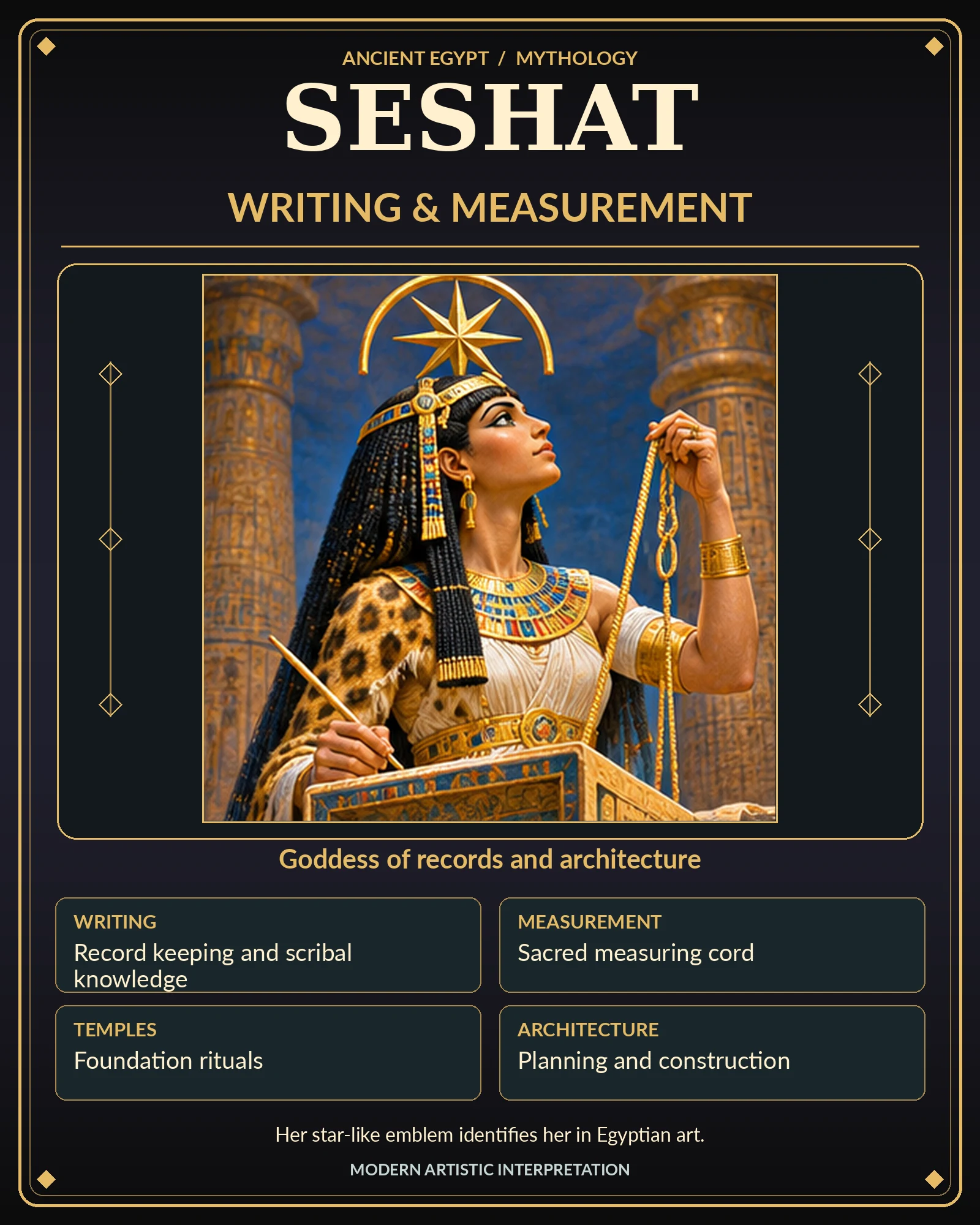
Seshat Quick Facts
| Item | Detail |
|---|---|
| Name | Seshat, often translated as “female scribe” |
| Domain | Writing, accounting, records, measurement, architecture |
| Emblem | Seven-petalled or seven-pointed rosette under a bow-like or horn-like top |
| Clothing | Leopard-skin dress, a priestly garment |
| Key ritual | Stretching the cord (pedjshes) for temple foundations |
| Tools | A palm rib with notches for counting years, a pen or stylus |
| Partner deity | Thoth, god of writing and wisdom |
Who Was Seshat?
Writing was one of the foundations of Egyptian government. Scribes recorded taxes, grain, labour, laws, letters and religious texts, and the scribal profession was respected. It is natural that writing would have its own gods. Thoth is the best known, but Seshat represents the practical, bureaucratic and measuring side of the craft. She is the patron of the librarian, accountant and surveyor as well as the writer.
Seshat appears in royal scenes from early periods, and scholars note her presence in Old Kingdom royal temple reliefs. She is often shown standing near the king, writing or counting. Because she is connected to the palace and temple, we know much less about her place in ordinary households than we do for Bes or Taweret. Her worship was a matter for the state and its scribes.
Appearance: The Star Emblem and Leopard Skin
The most unusual feature of Seshat is the emblem on her head. It has a central stem with a star or rosette of seven rays, and above it is a shape often described as a bow, a pair of horns or an upturned crescent. Egyptologists have proposed several readings, such as a flower, a star, a ceremonial tool or a symbol related to measurement, but there is no agreed explanation. This is one of those cases where it is honest to say “we do not know”.
| Feature | Possible meaning |
|---|---|
| Seven-pointed star or rosette | Unclear; suggested readings include a flower, a star or a stylised tool |
| Bow or horn shape above it | Unclear; sometimes read as a crescent or as part of the name sign |
| Leopard-skin dress | A garment of priests, linking her to temple service and ritual duty |
| Palm rib with notches | Counting years and recording reigns |
| Pen or stylus | Writing and record-keeping |
Stretching the Cord: Seshat and the Temple Foundation
When Egyptians began a new temple, a foundation ceremony called “stretching the cord” took place. The king and a priestess or priest representing Seshat drove wooden stakes into the ground and stretched a cord between them to mark the corners and axes of the building. Temple reliefs show the king and the goddess performing this act together. The ritual linked the building to the order of the cosmos, because the plan was aligned to the sky and stars, a practice connected with the idea of ma’at, the right order of things.
The scenes are religious and ceremonial. They do not mean that the king personally laid out every building. Real planning involved architects and surveyors, whom Egyptians also honoured under Seshat’s protection. Still, the ceremony shows how deeply writing, measurement and building were tied together in Egyptian thought.
Story box (imagined scene based on temple reliefs): At night the king stands on bare ground beside a priestess in a leopard-skin robe. Wooden stakes are in the ground, and a long cord stretches between them. The priestess looks up at the stars to line up the plan. When the cord is tight, the corner of the future temple is fixed. The scene combines religion, astronomy and surveying, and it is based on how reliefs show the ceremony, not on a detailed eyewitness record.
Seshat as Keeper of the King’s Years
Seshat is shown with a notched palm rib in scenes where she records the king’s years or jubilee festivals. The notches stand for years, and the idea is that the goddess writes the king’s name and length of rule on the leaves of a sacred tree. This image tells us that Egyptians felt a ruler’s fame and place in history were assigned by the gods. It also matches a real practice: Egyptians kept annals and king lists, in which years were counted by events.
Seshat also appears in scenes recording booty, tribute and captured goods, shown as lists of numbers. In this role she is the divine accountant, a reminder that Egyptian kings used written records to control wealth and show power.
Seshat and Thoth
Seshat and Thoth are the two great figures of Egyptian writing, and their relationship changes in different texts. In some sources she is described as his daughter, in others as his wife or sister. As with many Egyptian gods, family ties were flexible and depended on the local tradition. A simple way to separate them: Thoth is the god of wisdom, knowledge, the moon and the divine word, while Seshat is the goddess of the written record, counting and measuring. Our guide to Thoth explains his side of the partnership.
History, Mythology and Speculation
| Category | What belongs here |
|---|---|
| History | Seshat in royal reliefs; the stretching-the-cord ceremony; scribal culture and annals |
| Mythology | Her role as divine scribe who records the king’s years and deeds |
| Speculation | The meaning of her head emblem; claims that her star proves advanced astronomy or lost knowledge; exact family relationship with Thoth |
Myth vs Fact
| Popular claim | Reality |
|---|---|
| Her seven-pointed star is a cannabis leaf. | This internet claim is not supported by scholars. The emblem’s meaning is unknown, and a cannabis reading is a modern guess. |
| Seshat was an alien or part of a lost super-civilisation. | There is no evidence for this. She is a goddess of Egyptian scribal and building culture. |
| Seshat was only Thoth’s wife. | She was an independent goddess with her own rituals; her link to Thoth varies by text. |
| Stretching the cord was just a myth. | It was a real ceremony shown in temple scenes, though the scenes are formal and symbolic. |
Why Seshat Matters
Seshat is a useful reminder that Egyptian civilisation depended on paperwork as much as on pyramids. Without counting, measuring and recording, the great monuments could not have been planned or paid for. She also stands out as a woman in a field that, in practice, was mostly male: Egyptian scribes were usually men, yet the divine patron of the craft was a goddess. This gives a more balanced picture of how the Egyptians imagined learning and order.
Frequently Asked Questions About Seshat
What was Seshat the goddess of?
She was the goddess of writing, record-keeping, accounting, measurement and architecture.
What is the symbol on Seshat’s head?
It is a seven-rayed rosette topped by a bow-like or horn-like shape. Its exact meaning is not known.
What does “stretching the cord” mean?
It is a temple foundation ritual in which the king and a representative of Seshat marked out the building’s plan with stakes and a cord.
Was Seshat related to Thoth?
Yes, but the relationship varies. Texts call her his daughter, wife or sister depending on the tradition.
Why does Seshat wear a leopard skin?
The leopard skin was a priestly garment, linking her to ritual and temple duties.
Is Seshat’s emblem a cannabis leaf?
No credible scholarship supports this. It is a popular modern claim, and the real meaning of the emblem is unknown.
Did Seshat have her own temple?
She appears in many royal temple scenes and had priestly roles in ceremonies, but she is not known for a large independent cult centre like Amun or Ptah.
Why was a goddess the patron of writing?
Egyptians had both a god (Thoth) and a goddess (Seshat) of writing. Together they covered knowledge and the practical work of recording and measuring.
Reliable Sources
- World History Encyclopedia: Egyptian Mythology
- Egypt Exploration Society: Gods of Egypt
- The Metropolitan Museum of Art: Divine Egypt
Last updated: 25 November 2026. Related reading on Vista Hub: our guides to Thoth, Ma’at and the Egyptian gods and goddesses.
Related guides: Isis: Egyptian Goddess of Magic, Motherhood and Healing (Myths, Symbols and Worship) · Bastet: Egyptian Cat Goddess of Home, Protection and Joy (Myths, Symbols and Bubastis)














Share Your Opinion
Comments are closed on this post.