 Vista

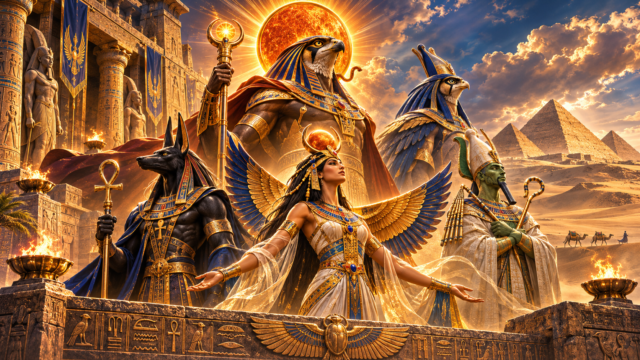
Horus (Egyptian: Heru, “the distant one” or “the one on high”) was the ancient Egyptian falcon-headed god of the sky and of kingship. He is the son of Osiris and Isis, the rival of Set, and the divine model of every living pharaoh. His eyes were thought to be the sun and the moon, and the Eye of Horus became Egypt’s best-known symbol of healing and protection.
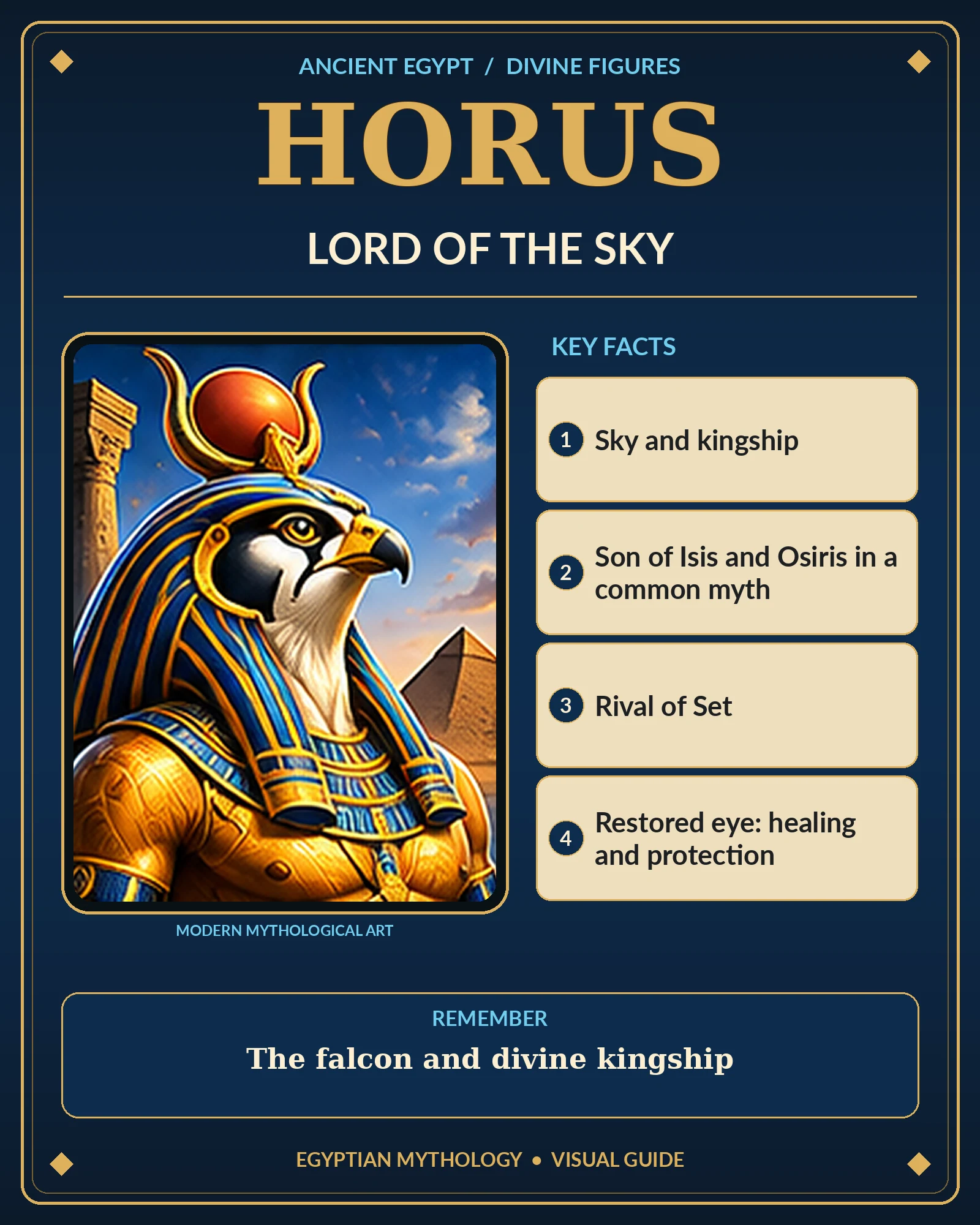
This guide separates Egyptian evidence from later retellings. You will find a fact box, the several Horus gods that Egyptians distinguished, the story of his contest with Set, the meaning of the Eye of Horus, the temple at Edfu, a myth vs fact table, ten FAQs and sources.
Horus Quick Fact Box
| Item | Answer |
|---|---|
| Egyptian name | Heru (Greek: Horos) |
| Domain | Sky, kingship, protection, war, healing (through his Eye) |
| Appearance | Falcon or falcon-headed man, often with the double crown |
| Parents | Osiris and Isis in the best-known tradition |
| Rival | Set |
| Symbols | Falcon, wedjat (Eye of Horus), double crown, sun disc with wings |
| Main temples | Edfu (Behdet), Hierakonpolis (Nekhen) |
| Royal link | Every living king was the “Horus”; each pharaoh had a Horus name |
| Merged forms | Ra-Horakhty, Harpocrates (child), Horus the Elder (Haroeris) |
| Famous story | The Contendings of Horus and Set |
Who Is Horus in Egyptian Mythology?
Horus is one of the oldest Egyptian gods. A falcon deity appears in the earliest royal imagery, and from the beginning of Egyptian history kings are linked with a falcon on a palace-façade sign called the serekh, which holds the king’s Horus name. In this sense every ruler was “Horus in the palace”.
Because Egyptian religion allowed many local traditions, there was no single Horus. Scholars distinguish several gods who share the name and falcon form, and the myths of Osiris later joined them into one narrative. Reading Horus as one fixed character is a modern simplification.
| Form | Role |
|---|---|
| Horus the Elder (Haroeris) | Sky god of older tradition, often shown as brother of Osiris |
| Horus son of Isis (Har-sa-iset) | The avenger and heir of Osiris |
| Harpocrates (Har-pa-khered) | The child Horus, shown with a finger to his mouth, a pose that Greeks read as “silence” |
| Ra-Horakhty | “Horus of the two horizons”, merged with the sun god |
| Horus of Behdet | Winged sun disc, protector of kings, worshipped at Edfu |
The Birth of Horus and His Childhood
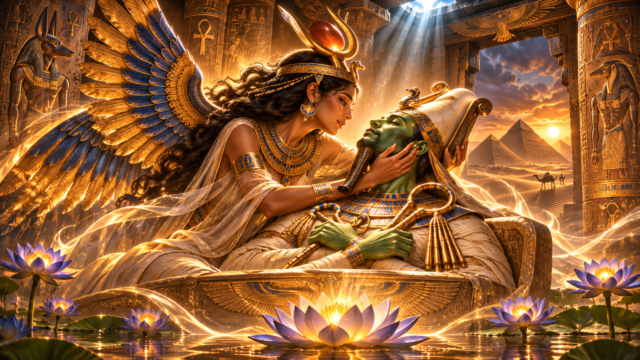
In the Osiris myth, Isis conceives Horus after reviving the dead Osiris, then hides in the Delta marshes to protect the child from Set. Horus grows up in secrecy, and healing spells recount Isis curing him of a scorpion sting. These child stories made Horus the god invoked for protecting children, and amulets and stelae with Horus on crocodiles were used as protective charms. See our guides to Isis and Osiris for the earlier part of the cycle.
The Contendings of Horus and Set
The best-preserved narrative is a Ramesside text called “The Contendings of Horus and Set”. After Osiris’s death, Horus and Set claim the throne of Egypt, and the gods meet in a tribunal. Some support Horus as the rightful heir; others favour Set as the strong adult. The case drags on for decades of myth time, with tricks, jokes and several contests.
- The boat race. The two agree to a race in stone boats. Set’s boat of stone sinks; Horus uses a boat of painted wood that looks like stone and wins.
- The hippopotamus contest. They transform into hippos and see who stays underwater longest; Isis interferes and is punished, and the contest is stopped.
- Set’s injury. In one scene Set tears out Horus’s eye and Horus injures Set; the Eye is later healed, which gives the Eye of Horus its meaning.
- The verdict. After Osiris sends a letter reminding the gods of his role, the tribunal gives the kingship to Horus, and Set is given a place as a protector of the sun-boat.
Story box: not good versus evil. Modern retellings often make Set a villain and Horus a hero. The older texts are more complex: Set is violent and disruptive but also a necessary force who defends Ra against Apep, and the text is full of humour at the gods’ expense. See our famous myths guide for more such stories.
The Eye of Horus (Wedjat): Meaning and Math
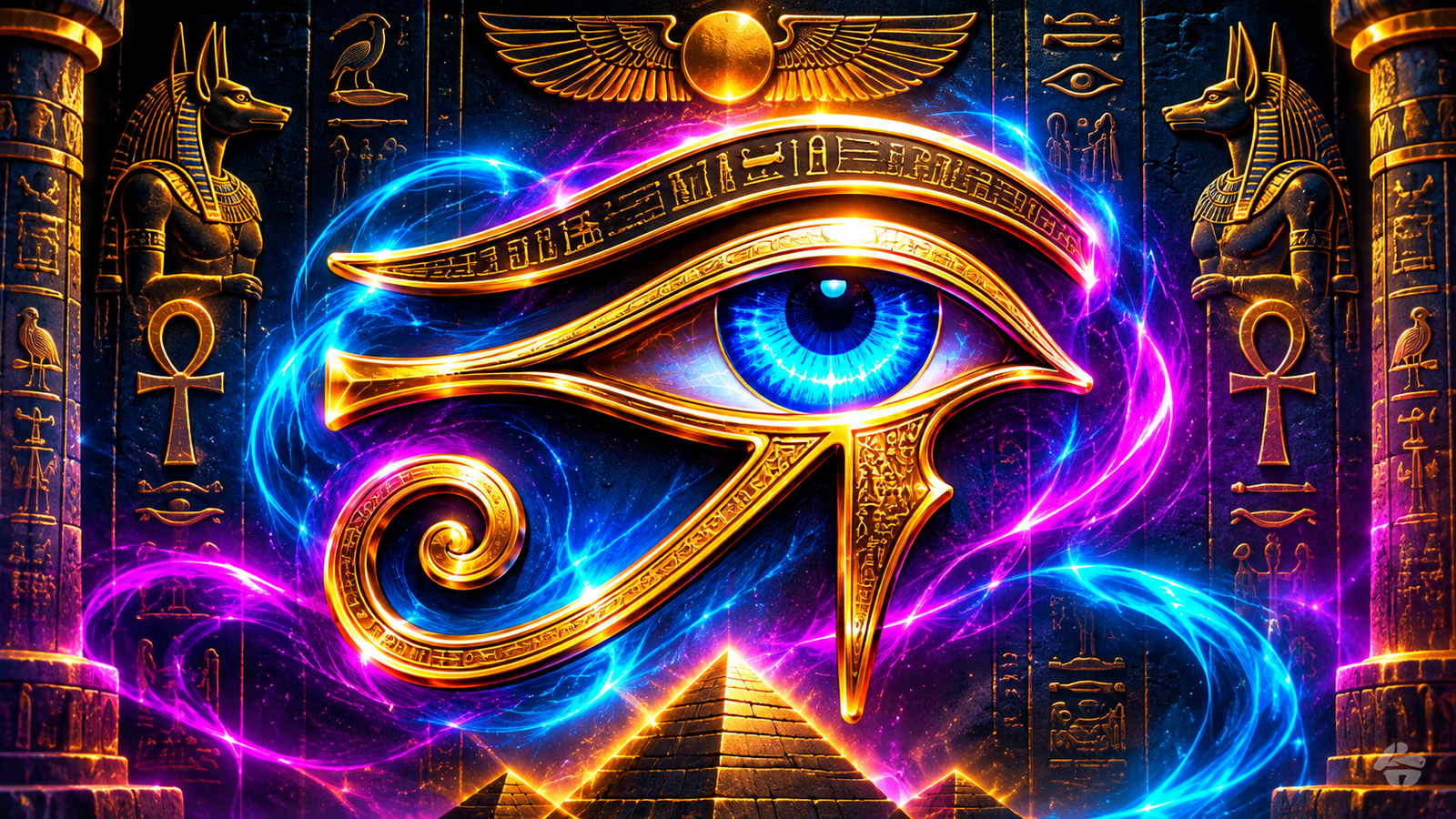
The wedjat, “the sound one”, is the restored Eye of Horus. After its injury in the conflict with Set, the eye is healed by Thoth or Hathor depending on the version, and so it came to mean wholeness, healing and protection. It was used as an amulet in life and burial, often in faience, gold or stone, and painted on coffins and ship prows.
A popular claim says each part of the eye stands for a fraction (1/2, 1/4, 1/8, 1/16, 1/32, 1/64) used in Egyptian measurement, and that the parts add up to 63/64. This association exists in scholarship, especially for grain measures, but it is not shown in all texts and the fractions were not a universal system. Treat the “math eye” as a useful teaching symbol, not a complete Egyptian numeral system. Do not confuse the Eye of Horus with the Eye of Ra, which is a separate solar symbol covered in our Ra guide.
Horus and the Pharaoh: The Living King
Each pharaoh had a five-part royal title, and the first part was the Horus name, written in a serekh with a falcon on top. When the king died he became Osiris, and his successor became Horus. This pairing of living Horus and dead Osiris was a way of describing continuity: the throne is never empty, because the son renews the father’s rule.
Edfu: The Temple of Horus
The best-preserved major temple in Egypt is the Temple of Horus at Edfu, built mostly in the Ptolemaic period, between about 237 and 57 BCE. Its walls carry long inscriptions about the myth of Horus and Set and the yearly festival of the “Beautiful Meeting”, when Horus’s statue sailed to meet Hathor of Dendera. The temple gives rare detail about ritual practice, though it reflects late-period priestly tradition rather than the earliest beliefs.
Horus in the Greek and Roman Period
Greeks identified Horus with Apollo, and the city of Edfu was called Apollinopolis Magna. The child Harpocrates became a popular household god in the Mediterranean, shown with a finger at his lips. The “silence” meaning is a Greek reading; in Egyptian art the gesture simply marks a child, who puts a finger to the mouth.
Myth vs Fact: Common Claims About Horus
| Claim | What the evidence shows |
|---|---|
| “Horus is the same as Ra.” | They are distinct gods, sometimes merged as Ra-Horakhty. |
| “Horus was a good god and Set pure evil.” | Older texts show Set as a complex figure who also protects Ra. |
| “The Eye of Horus and the Eye of Ra are the same.” | Different symbols with different meanings. |
| “Horus lost his eye forever.” | The eye was healed; that is the point of the wedjat. |
| “The Eye of Horus is an exact Egyptian fraction system.” | The fraction link is real but limited and often overstated online. |
| “Horus copied other religions’ saviour stories.” | Such claims often misrepresent the sources; Horus has his own Egyptian context. |
Frequently Asked Questions About Horus
What is Horus the god of?
The sky and kingship, with protection and healing linked to his Eye.
Who are Horus’s parents?
Osiris and Isis in the main tradition, though older traditions differ.
Why does Horus have a falcon head?
The falcon soars high above the Nile, so it symbolised the sky and a watchful ruler.
What is the Eye of Horus?
The wedjat amulet, representing the healed eye and meaning protection, health and wholeness.
Who won between Horus and Set?
Horus is given the kingship by the tribunal of gods; Set receives another role.
What is the difference between Horus and Ra-Horakhty?
Ra-Horakhty is a combined form linking Horus with the sun god Ra, “Horus of the two horizons”.
What is a Horus name?
The first of a pharaoh’s royal names, written in a serekh topped with a falcon.
Where is the Temple of Horus?
At Edfu in southern Egypt, one of the best-preserved temples in the country.
Is Horus the same as Garuda or another Indian bird deity?
No. Both are bird-linked divine figures, but their myths and roles are unrelated, and comparing them does not make them equivalent.
Is Horus worshipped today?
The ancient cult has ended; some modern revival groups honour him, which is a modern reconstruction.
Sources and Further Reading
Last updated: 25 November 2026.
- World History Encyclopedia, “Egyptian Mythology”: worldhistory.org
- World History Encyclopedia, “Osiris”: worldhistory.org
- Egypt Exploration Society, “Gods of Egypt”: ees.ac.uk
- The Metropolitan Museum of Art, “Divine Egypt”: metmuseum.org





















Share Your Opinion
Comments are closed on this post.