 Vista
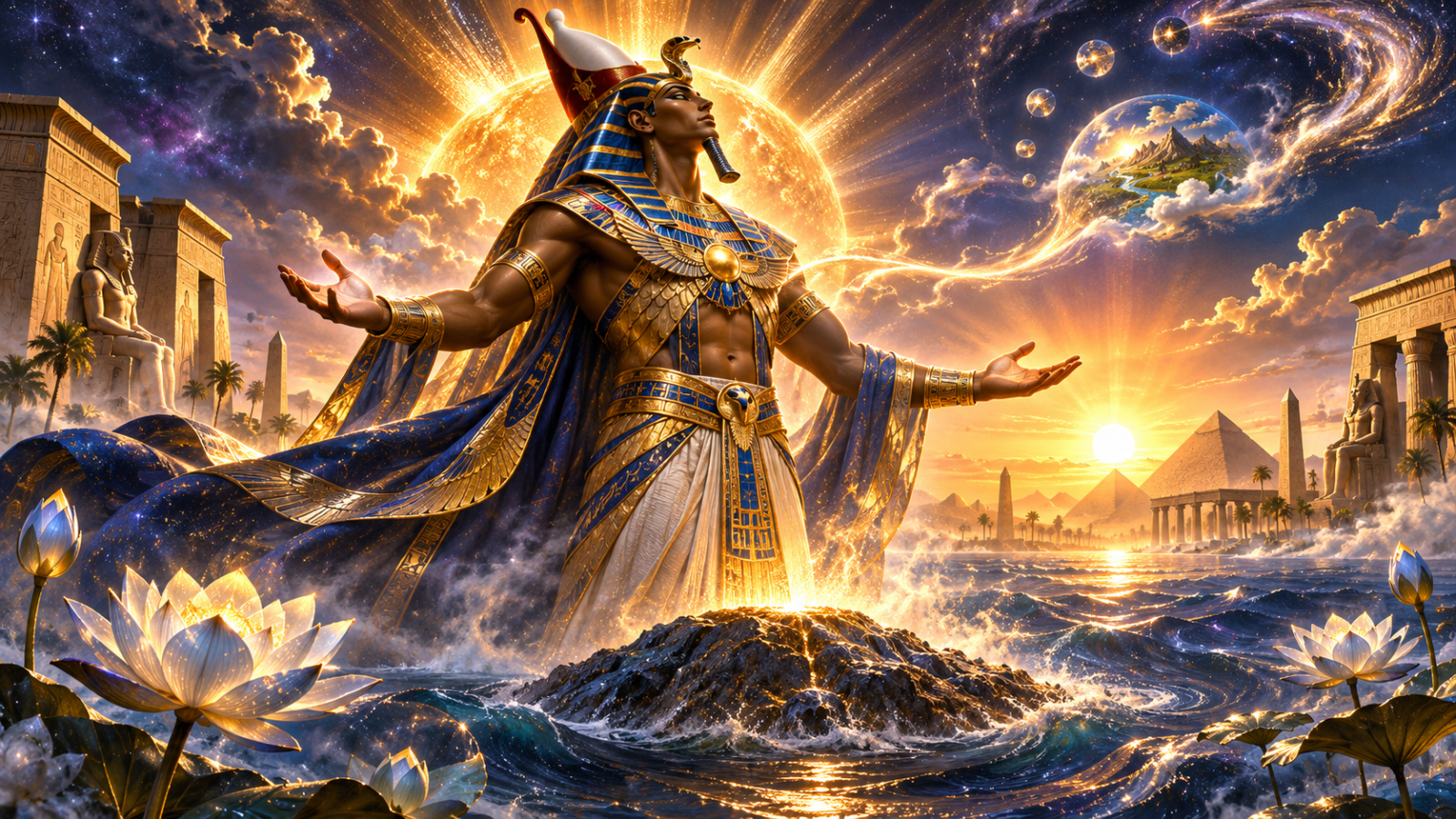
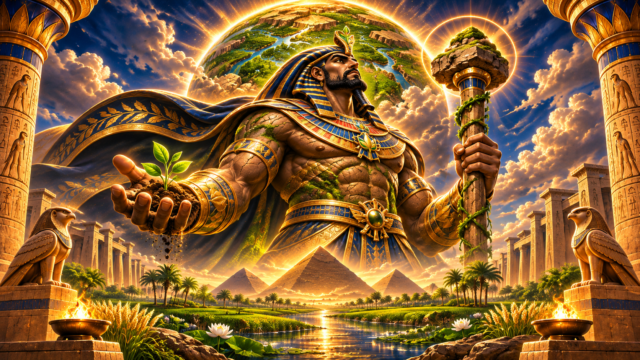
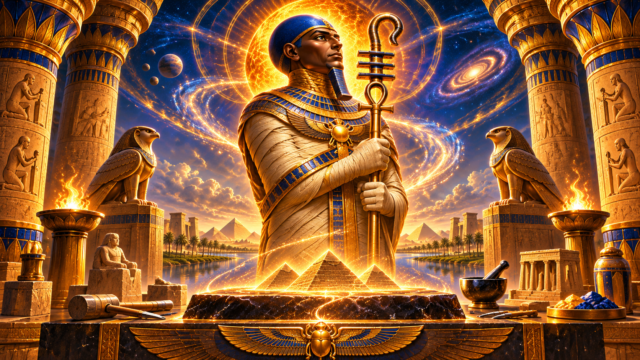
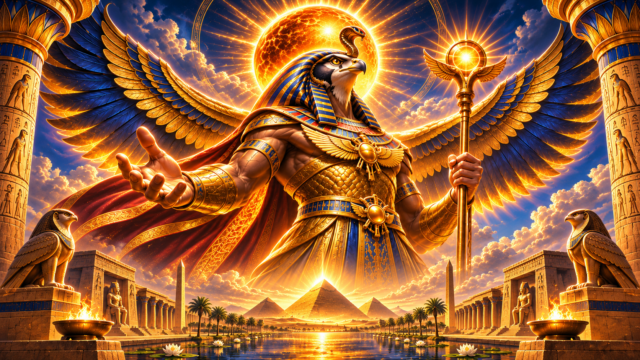
Atum (also written Atum, Atem or Tem) was the ancient Egyptian creator god of Heliopolis, said to have come into being by himself from the dark primeval waters called Nun. In the Heliopolitan creation story, he rose on the first mound of earth, then produced the first divine pair, Shu (air) and Tefnut (moisture), who in turn became the parents of Geb (earth) and Nut (sky). Atum is shown as a man wearing the double crown of Upper and Lower Egypt. He is also the god of the setting sun, the old form of the sun god who returns to the underworld at night, while Khepri is the rising sun and Ra the sun at its height.
This guide explains the meaning of his name, his role in the Heliopolitan creation story, how he relates to Ra and Khepri, the Ennead, his serpent form and the Book of the Dead’s end-of-time passage, and what is known versus guessed.

Atum Quick Facts
| Item | Detail |
|---|---|
| Name | Atum, linked with a verb meaning “to complete” or “to be whole/not to be”; the translation is debated |
| Role | Self-created creator god; setting sun; father of Shu and Tefnut |
| City | Heliopolis (Iunu), near modern Cairo |
| Appearance | Man with the double crown; sometimes a serpent, ichneumon, lion or bull |
| Partners | Iusaaset and Nebethetepet in some traditions |
| Group | The Ennead of Heliopolis, nine gods |
Who Was Atum?
Atum is among the oldest named gods of Egypt, appearing in the Pyramid Texts of the late Old Kingdom. His priests at Heliopolis developed one of Egypt’s most influential accounts of creation. In it, the world begins as an endless, dark, watery chaos called Nun. Atum comes into being on his own, creating himself, and stands on a mound of earth that rises from the water. Because nobody made him, he is the “first of all”, and everything else comes from him.
His name is often connected with an Egyptian verb that can mean “to complete” or “to be finished”, which scholars read as “the complete one” or “the one who completes”. It can also be linked with “not to be”, pointing to the state before creation. Because Egyptian words are layered with meaning, scholars do not agree on a single translation, and it is best to say that both ideas of completion and non-existence may be present.
The Heliopolitan Creation Story
The story in outline, as pieced together from the Pyramid Texts and later sources, goes like this:
- Nothing exists but the dark waters of Nun.
- Atum emerges from Nun, on the primeval mound, sometimes linked with the sacred stone called the benben at Heliopolis.
- Atum, alone, produces Shu and Tefnut. The texts describe this as an act of self-generation, with different images such as spitting or using his hand. The ancient wording is blunt and is reported by scholars in translations of the Pyramid Texts.
- Shu and Tefnut give birth to Geb and Nut. Geb is the earth and Nut the sky, and Shu holds them apart.
- Geb and Nut have four children: Osiris, Isis, Set and Nephthys.
Atum together with these eight descendants forms the Ennead, the “group of nine” gods of Heliopolis. For a visual chart of this family, see our guide to the Egyptian gods family tree.
Story box (retold from the Heliopolitan tradition): Before anything, there is only dark water without edges. Out of it rises a small hill, and on that hill stands Atum, alone, with no mother and no father. He has nothing, but he has himself, and from himself he brings forth the first pair: Shu, the breath of air, and Tefnut, the moisture. They wander away into the dark and return, and Atum weeps with joy. The tears become the first humans in one tradition. This is a religious creation story, not a historical or scientific account.
The tears-of-joy detail appears in some Egyptian texts about creation, in which humans arise from tears of a creator god, a word-play on the Egyptian words for “tears” and “people”. Because versions vary, it should be read as one tradition among several.
Atum, Ra and Khepri: One Sun, Three Forms
| Form | Time of day | Image |
|---|---|---|
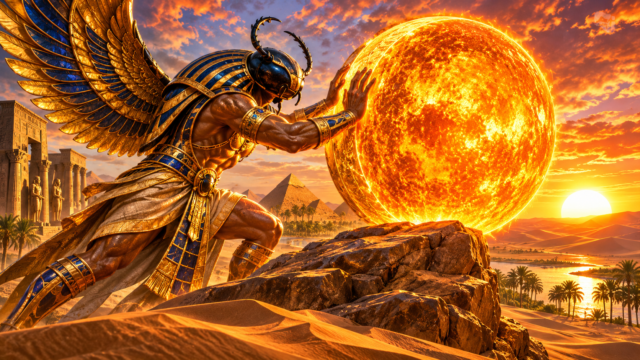
| Khepri | Sunrise | Scarab beetle pushing the sun |
| Ra | Midday | Falcon-headed man with a sun disc |
| Atum | Sunset | Old man with the double crown |
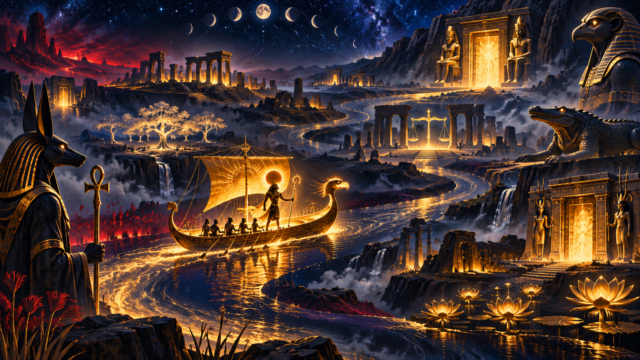
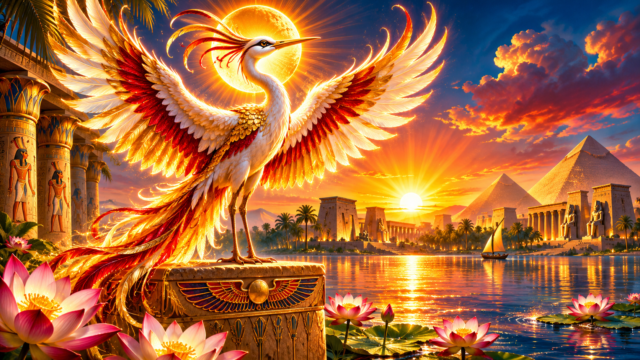
Heliopolitan priests combined Atum with the sun god Ra to create Atum-Ra (or Ra-Atum), uniting the creator with the sun. In this form Atum is the old sun at evening, ready to go through the night and be reborn at dawn. This picture helped Egyptians explain both the beginning of the world and the daily renewal of the sun. Our guides to Ra and Khepri explain the other two forms.
Atum’s Serpent Form and the End of Time
Atum can appear as a serpent, and a famous passage in the Book of the Dead (often cited as Spell 175) has him tell Osiris that he will one day destroy everything he has created and return the world to the primeval waters. At that time, only Atum and Osiris will remain, and Atum will take the form of a serpent. This is one of the few Egyptian texts that speaks about an end of the world, and it shows that the Egyptians imagined creation as something that could return to its beginning. Because the passage is brief and difficult, scholars discuss its exact meaning, so avoid describing it as a full “apocalypse myth”.
Atum and the King
In the Pyramid Texts, the dead king is expected to ascend to the sky and be received by Atum. Kings were also described as sons of the sun god, so Atum, as creator and sun, was part of the royal ideology. The Heliopolitan priesthood was powerful in the Old Kingdom, and the pyramids’ sun-linked symbolism is often connected with their influence. This is a scholarly pattern, not a single proof.
History, Mythology and Speculation
| Category | What belongs here |
|---|---|
| History | Atum in the Pyramid Texts; the Heliopolitan priesthood; Atum-Ra in later religion |
| Mythology | Self-creation on the mound; Shu and Tefnut; the Ennead; the serpent at the end of time |
| Speculation | Exact meaning of the name; modern claims linking Atum with other world creation stories; hidden-science theories about the benben |
Myth vs Fact
| Popular claim | Reality |
|---|---|
| Atum is the same as Ra in every text. | They were separate gods who were merged in some traditions, as Atum-Ra. |
| Atum was the only Egyptian creator. | Other cities had other creators, such as Ptah at Memphis, Amun at Thebes and the Ogdoad at Hermopolis. |
| The Egyptians believed the world would end in a fiery apocalypse. | The best-known passage speaks of a return to water and serpent form; it is a brief text, not a full doctrine. |
| The name Atum is the origin of the name Adam. | This is a popular guess with no scholarly support. |
Frequently Asked Questions About Atum
What was Atum the god of?
He was the self-created creator god of Heliopolis and the god of the setting sun.
Who were Atum’s children?
Shu and Tefnut, the first divine pair, and through them the grandparents of Osiris, Isis, Set and Nephthys.
What is the Ennead?
It is the group of nine gods of Heliopolis: Atum, Shu, Tefnut, Geb, Nut, Osiris, Isis, Set and Nephthys.
What is the difference between Atum and Ra?
Atum is the creator and evening sun, while Ra is the sun god at midday. Priests merged them as Atum-Ra.
What is the benben?
It is the sacred mound or stone at Heliopolis linked with the first land and the first sunrise. It is related to the shape of obelisks and pyramid capstones in some theories.
Why can Atum be a serpent?
The serpent links with the primeval waters and with the idea of beginning and end. A Book of the Dead passage says he will return to serpent form at the end of time.
Where was Atum worshipped?
His main centre was Heliopolis, near modern Cairo, though little of the ancient city remains above ground.
Is Atum connected to Adam?
No credible evidence supports a link. The similarity of sound is a coincidence.
Reliable Sources
- World History Encyclopedia: Egyptian Mythology
- Egypt Exploration Society: Gods of Egypt
- The Metropolitan Museum of Art: Divine Egypt
Last updated: 25 November 2026. Related reading on Vista Hub: our guides to Ra, Khepri, Geb, Nut and the Egyptian gods family tree.
Related guides: Ra: Egyptian Sun God, Creation Myths, Eye of Ra and the Night Journey (Facts and Symbols) · Khepri: Scarab God of the Rising Sun, Rebirth and the Sacred Dung Beetle











Share Your Opinion
Comments are closed on this post.