 Vista

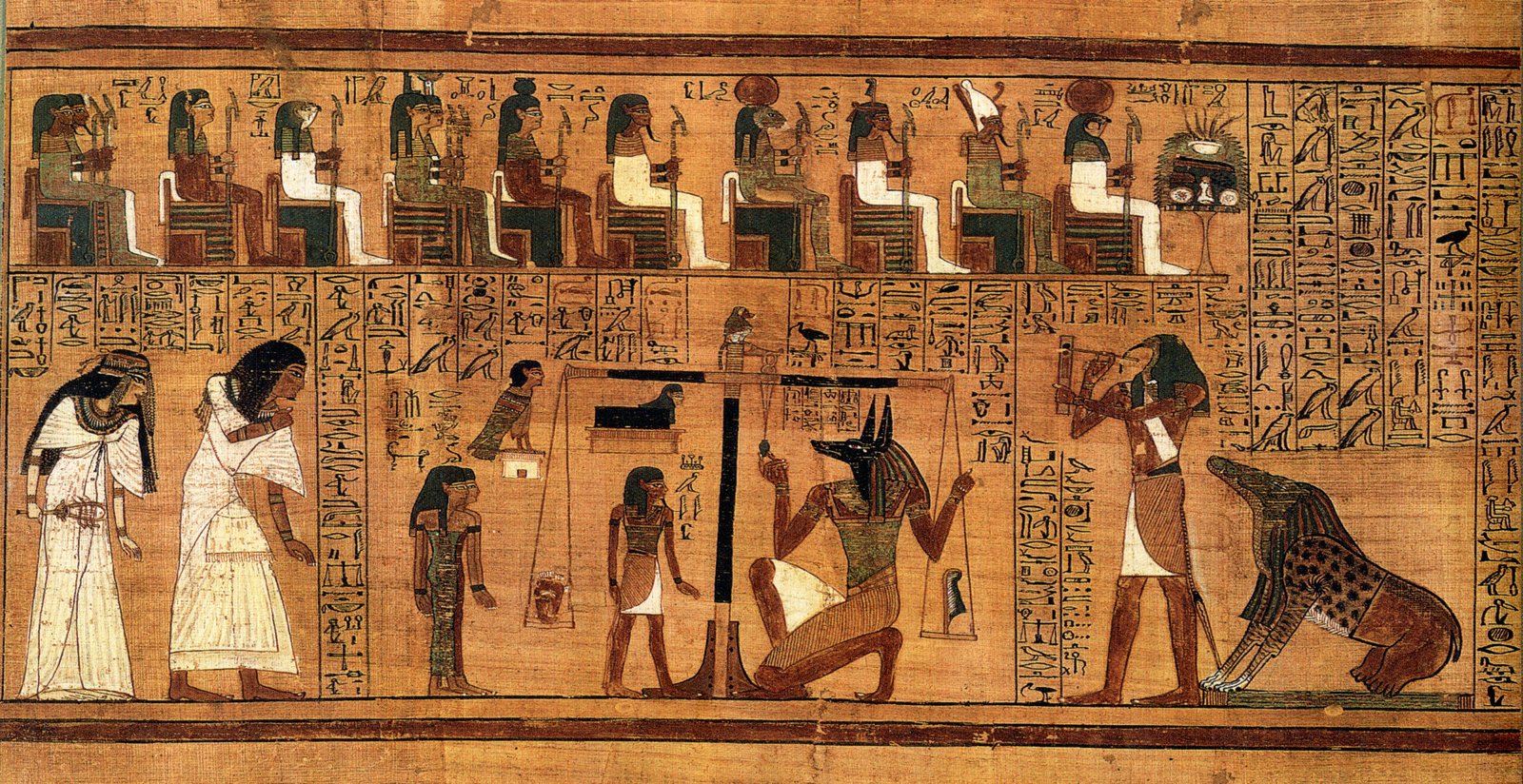
The ancient Egyptian afterlife was imagined as a continuation of life in a purified, ideal form. After death, a person’s different spiritual parts (ka, ba and others) had to be kept alive by the preserved body, tomb offerings and spells. The dead then travelled through the dangerous underworld called the Duat, faced a judgment in which the heart was weighed against the feather of Ma’at, and, if successful, joined the blessed dead in a paradise often called the Field of Reeds (Aaru). Egyptian beliefs changed over three thousand years, so there was never one single, fixed version.
This guide explains the parts of the self, the journey, the judgment, the paradise, the role of tombs and offerings, and which popular ideas are myth.
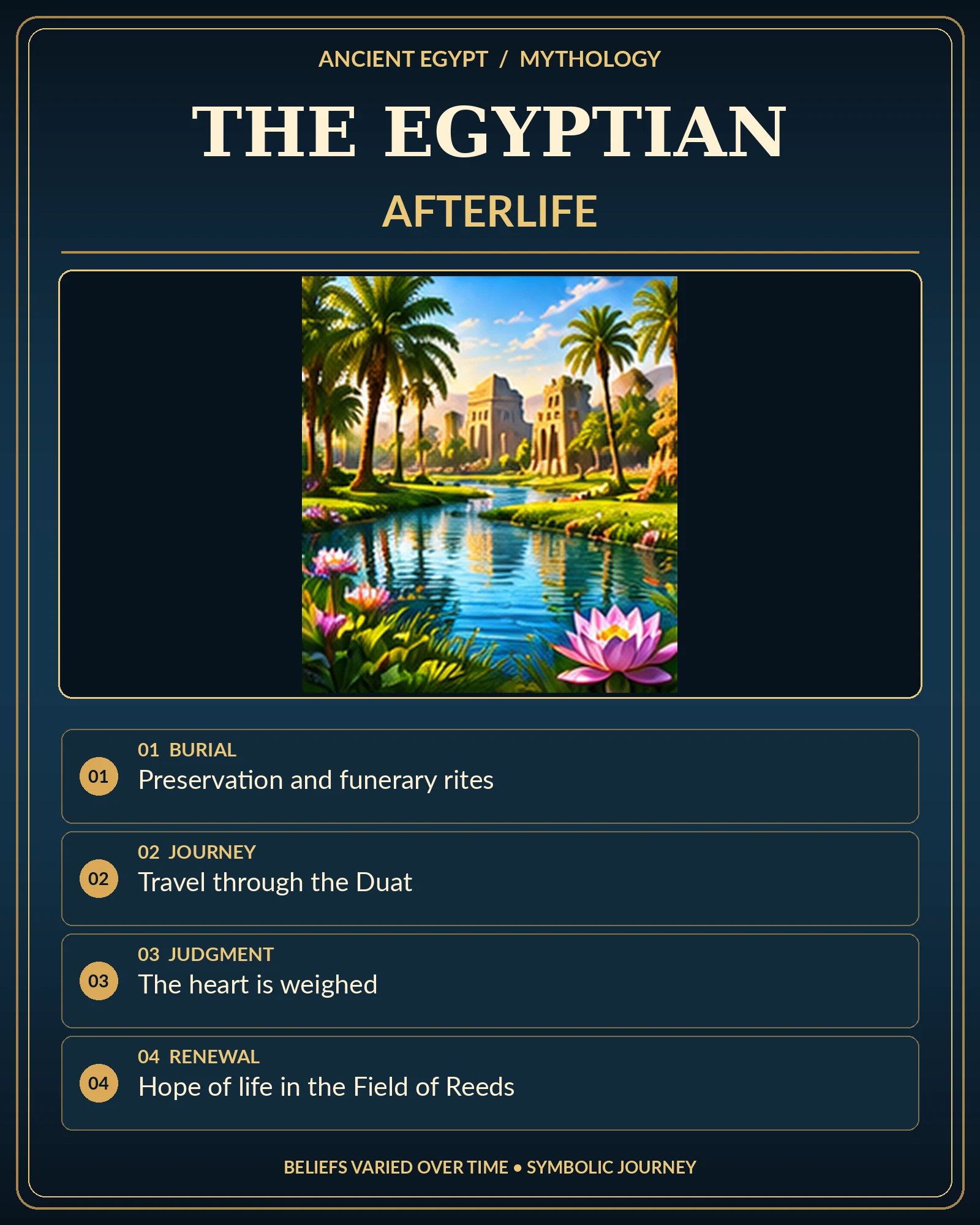

Egyptian Afterlife Quick Facts
| Item | Detail |
|---|---|
| Main idea | Life continues after death if the person is preserved, justified and remembered |
| Parts of the self | Body, name, shadow, heart, ka, ba and akh |
| Underworld | The Duat, with gates, guardians and dangers |
| Judgment | Heart weighed against the feather of Ma’at; Osiris presides |
| Paradise | The Field of Reeds (Aaru), a green, fertile land |
| Key texts | Pyramid Texts, Coffin Texts, Book of the Dead, Amduat |
The Parts of a Person
| Part | Meaning |
|---|---|
| Ka | Life force or vital double, sustained by food and drink offerings |
| Ba | Personality or soul, often drawn as a human-headed bird that can leave the tomb and return |
| Akh | The transformed, effective spirit that a justified dead person becomes |
| Ib (heart) | Seat of mind, memory and morality; the heart that is weighed |
| Ren (name) | The name, which had to be remembered to keep the person alive |
| Shut (shadow) | The shadow, treated as a part of the person |
Scholars debate the exact boundaries between these terms, and Egyptians themselves used them in flexible ways. A simple way to remember: the ka needed feeding, the ba could travel, and the akh was the successful final state.
The Journey Through the Duat
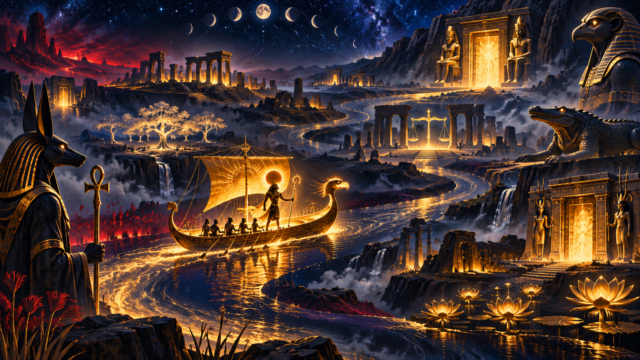
After death, the person was believed to enter the Duat, a realm of caves, rivers, gates and monsters. Funerary texts supplied spells to name guardians, pass gates and avoid dangers. Some versions link the dead person’s journey with the sun god’s night voyage: like Ra, the dead had to pass through darkness to be reborn at dawn. See our guide to the Duat for the structure of this realm.
Story box (retold from funerary texts): A woman named Nefret has died. Her body has been preserved, and her family has placed bread and beer in the tomb. Her ba flies out into the evening sky, then enters the dark gates of the Duat. At each gate she recites the name of the guardian, as her papyrus teaches. Far ahead a light glows: the Hall of Judgment. This retelling is imagined, built from how the texts describe the process.
Judgment and the Field of Reeds
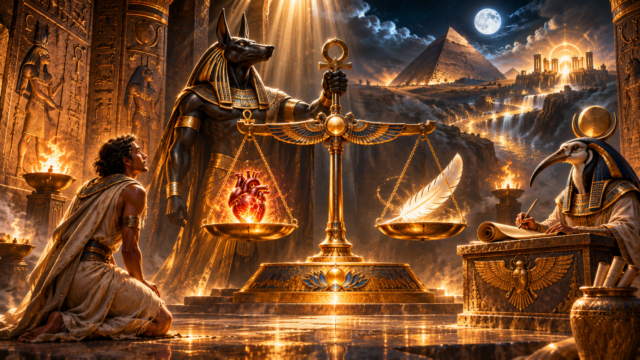
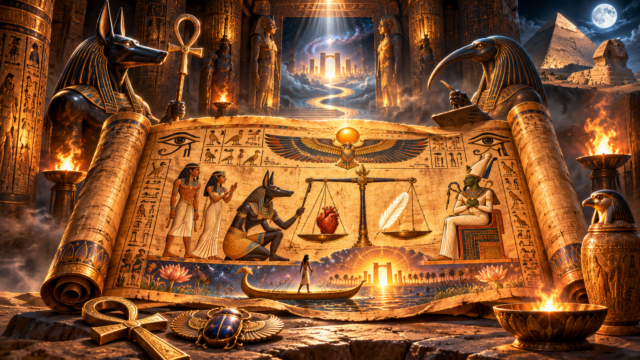
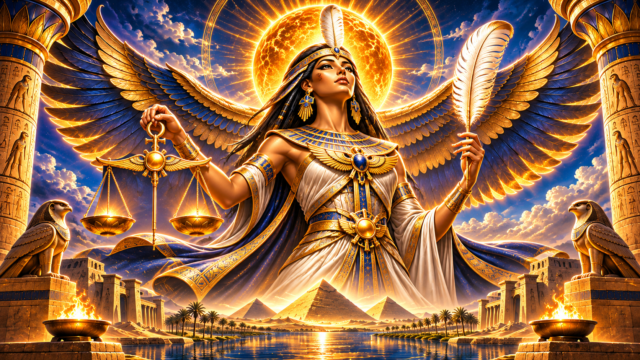
At the judgment, the heart was weighed. A balanced heart meant the person was “true of voice” (maa-kheru), and could continue. A failed heart was eaten by Ammit, which ended existence. Our separate guides describe the weighing of the heart, Ammit and Osiris in detail.
The Field of Reeds was imagined as an idealised Egypt: fields of grain, canals and a perfect harvest. The dead could farm there, but many spells and small figures (shabtis) were made so that the dead would not have to do the work themselves.
Tombs, Offerings and Memory
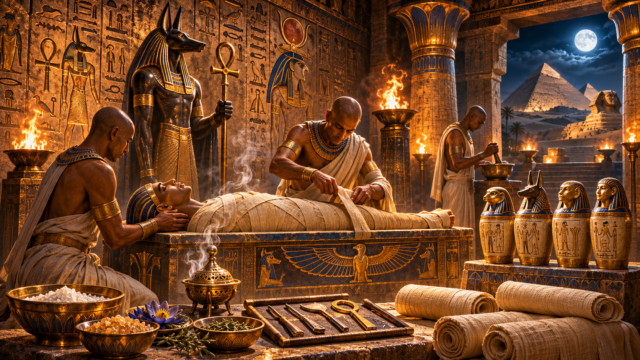
Tombs were more than burial places. They were houses for the ka and places where relatives could bring offerings. Because offerings could stop, tombs also carried painted food, offering lists and spells that would supply the dead magically. The practice of speaking the dead person’s name aloud was also believed to keep them alive. Our guides to mummification and the Book of the Dead explain related practices.
History, Mythology and Speculation
| Category | What belongs here |
|---|---|
| History | Tombs, grave goods, texts and burial practices across periods |
| Mythology | The Duat, the weighing of the heart, Osiris as judge, the Field of Reeds |
| Speculation | Exact definitions of ka, ba and akh; how literally ordinary people took these ideas; modern claims about reincarnation or “proof” of an afterlife |
Myth vs Fact
| Popular claim | Reality |
|---|---|
| Egyptians believed in reincarnation. | Mainstream Egyptology does not describe their afterlife as reincarnation in the Indian sense. It is a continued existence in the Duat and Aaru. |
| Only pharaohs had an afterlife. | Early royal texts focused on kings, but later funerary texts were used by non-royal people. |
| Egyptians had one fixed afterlife doctrine. | Beliefs changed over time and varied by text and place. |
| The afterlife was a hell for sinners. | Failure usually meant the end of existence, though some texts describe punishments for enemies. |
| Pyramids were only for souls to climb to the stars. | This is one interpretation. Pyramids were royal tombs with several religious meanings. |
Frequently Asked Questions About the Egyptian Afterlife
What did Egyptians believe happened after death?
They believed the person travelled through the Duat, was judged, and if justified, lived on in a blessed realm.
What are ka and ba?
The ka is the life force that needed offerings, and the ba is the personality that could move between tomb and world.
What is an akh?
The transformed spirit of a justified dead person, who was effective in the afterlife.
What is the Field of Reeds?
A paradise imagined as a perfect version of the Egyptian countryside.
Why did Egyptians preserve bodies?
A preserved body gave the ka and ba a place to return to and a form to recognise.
Did everyone face judgment?
Judgment scenes were part of funerary texts used by many people, though the details changed over time.
Was there a hell in ancient Egypt?
Not in the later sense. Failing the judgment meant destruction, while some texts describe punishment for the enemies of the gods.
Is there scientific proof of an afterlife?
No. The Egyptian afterlife is a religious belief system studied through texts and archaeology, not a proven scientific fact.
Reliable Sources
- World History Encyclopedia: Egyptian Mythology
- Egypt Exploration Society: Gods of Egypt
- The Metropolitan Museum of Art: Divine Egypt
Last updated: 25 November 2026. Related reading on Vista Hub: our guides to the Duat, the weighing of the heart, Osiris, Anubis, mummification and the Book of the Dead.











Share Your Opinion
Comments are closed on this post.