 Vista

The Apis bull was the most famous sacred animal of ancient Egypt, a living bull at Memphis that was believed to be a manifestation of the creator god Ptah. When an Apis bull died, it was mummified and buried with great ceremony in the Serapeum at Saqqara, and priests then searched for a new calf with the right markings. The Apis was part of a wider Egyptian practice of honouring sacred animals, including other bulls, cats, ibises, baboons, crocodiles and falcons. Egyptians did not simply “worship animals” in the sense that people sometimes imagine. They believed that a god could be present in, or act through, a particular animal.
This guide explains the Apis cult, other sacred bulls, the Serapeum, the huge number of animal mummies, how historians understand animal worship, and which popular claims need correction.

Apis Bull Quick Facts
| Item | Detail |
|---|---|
| Animal | A living bull with special markings, kept at Memphis |
| Linked god | Ptah; later also Osiris (as Osiris-Apis), and in Ptolemaic times Serapis |
| Burial | The Serapeum at Saqqara, underground galleries with large stone sarcophagi |
| Other sacred bulls | Mnevis (Heliopolis, linked with Ra) and Buchis (Armant, linked with Montu) |
| Rediscovery | The Serapeum was found by Auguste Mariette in 1851 |
What Was the Apis Bull?
Apis (in Egyptian, Hapi, which is not the Nile god of the same English spelling) was a bull that lived in a special enclosure at Memphis. It was treated as a living image of Ptah, the creator god of the city. The bull’s role grew over time. In the New Kingdom and later, a dead Apis was identified with Osiris, which gave rise to the form Osiris-Apis. In Ptolemaic times this merged into the Greek-Egyptian god Serapis, whose name comes from this combination. Our guides to Ptah and Hapi explain the related gods and name confusion.
The bull was kept in luxury, appeared in festivals, and was consulted for omens. Visitors and pilgrims came to see it. When it died, Egypt entered a period of mourning until a new bull was found.
How Was a New Apis Chosen?
Priests looked for a calf with particular markings. Classical writers such as Herodotus described a black bull with a white spot on the forehead, an eagle-like shape on the back, a beetle-like mark under the tongue and doubled hairs in the tail. The exact markings are described differently in different sources, so it is best to treat the list as a tradition reported by outsiders rather than an official Egyptian checklist. After a suitable calf was found, it was brought to Memphis with a ceremony.
Story box (reconstruction from classical and Egyptian sources): The old Apis has died, and the temple at Memphis is full of mourning. Priests set out across the country, examining young black calves for the marks they know. In a field, they find one with a white patch on the head. News travels quickly. The calf is taken south with honours and enters Memphis to cheering crowds. A new living image of Ptah has arrived. The scene is a reconstruction, based on how sources describe the ritual.
The Serapeum at Saqqara
The Serapeum is an underground burial place for Apis bulls near Memphis. French archaeologist Auguste Mariette found it in 1851. Long tunnels were cut into the rock, with side chambers holding enormous stone sarcophagi, many made from granite or other hard stone. Each sarcophagus was for one bull. The galleries were used over many centuries, which shows how long the cult lasted. Today parts of the site are open to visitors under restrictions that change over time, so check before planning a visit.
Other Sacred Animals
| Animal | Linked god | Place or role |
|---|---|---|
| Mnevis bull | Ra (and Atum) | Heliopolis |
| Buchis bull | Montu | Armant near Thebes |
| Cats | Bastet | Bubastis; many cat mummies |
| Ibises and baboons | Thoth | Saqqara and Tuna el-Gebel |
| Crocodiles | Sobek | Kom Ombo and the Faiyum |
| Falcons | Horus | Edfu and other centres |
| Rams | Khnum, Amun | Elephantine and Thebes |
Animal Mummies: Millions of Offerings
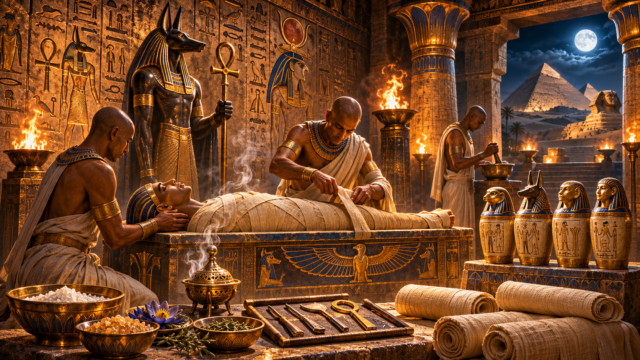
In the Late Period and Greco-Roman times, Egyptians produced enormous numbers of animal mummies. Pilgrims bought mummified ibises, cats or other animals as offerings to the gods. Some sites contain very large numbers, which suggests a thriving industry connected to temples. Researchers also distinguish several kinds of animal mummies: beloved pets, a single sacred animal like the Apis, food offerings, and votive mummies that served as gifts to a god.
Modern scans and X-rays of animal mummies have shown that not all are what they seem. Some bundles contain only a few bones, parts of an animal or even other materials. Studies have reported that a notable share of wrapped bundles contain little or no complete animal remains, though the numbers differ between sites and projects, so it is best to quote them cautiously. This does not necessarily mean fraud. The bundle may have worked as a symbolic offering, and the wrapping and ritual were the important parts.
Did Egyptians Worship Animals?
Most Egyptologists say that Egyptians honoured animals as vessels or symbols of divine power, not as gods in themselves. The bull was valued because it carried Ptah’s presence or because its qualities (strength, fertility) matched divine traits. Greek and Roman writers often mocked the practice, which gave later readers a one-sided picture. The reality was a complex religion in which gods could have animal forms, human forms or mixed forms, and in which certain animals were treated with respect because of their link to a god.
History, Mythology and Speculation
| Category | What belongs here |
|---|---|
| History | The Apis cult at Memphis; the Serapeum; animal mummy cemeteries; the work of Mariette |
| Mythology | The bull as Ptah’s manifestation and as Osiris-Apis |
| Speculation | The exact markings list; the proportion of empty animal mummies; any claim that sacrifice numbers were always enormous at a given period |
Myth vs Fact
| Popular claim | Reality |
|---|---|
| Egyptians worshipped cattle like gods. | The Apis was treated as a manifestation of a god, not as the whole god. |
| Apis and Hapi are the same. | They are different figures with similar English spellings: a sacred bull and the Nile flood god. |
| Every Egyptian animal was sacred. | Only certain animals linked with specific gods were honoured, and practice varied by place and period. |
| All animal mummies contain a whole animal. | Scans show some contain only parts or little animal material. |
| Egyptians were cruel to animals. | Evidence is mixed. Some animals were cared for, while the mass offering trade involved killing animals on a large scale. |
Frequently Asked Questions About the Apis Bull
What was the Apis bull?
A sacred living bull at Memphis, seen as a manifestation of Ptah and later linked with Osiris.
How did priests choose an Apis?
They searched for a calf with special markings, often described as a black coat with a white forehead patch and other signs.
What is the Serapeum?
The underground burial galleries for Apis bulls at Saqqara, found by Auguste Mariette in 1851.
What are Mnevis and Buchis?
Other sacred bulls: Mnevis linked with Ra at Heliopolis, and Buchis linked with Montu at Armant.
Did Egyptians worship animals?
They honoured certain animals as vessels or symbols of gods. This differs from worshipping the animal as a god in itself.
Why were so many animals mummified?
Many were votive offerings bought by pilgrims to send prayers to a god, while others were pets or sacred animals.
What is Serapis?
A Greek-Egyptian god of the Ptolemaic period whose name comes from the combination Osiris-Apis.
Can I visit the Serapeum?
Parts of the site have been open at different times. Check current information from official sources before visiting.
Reliable Sources
- World History Encyclopedia: Egyptian Mythology
- Egypt Exploration Society: Gods of Egypt
- The Metropolitan Museum of Art: Divine Egypt
Last updated: 25 November 2026. Related reading on Vista Hub: our guides to Ptah, Hapi, Bastet, Thoth, Sobek and ancient Egyptian civilization.
Related guides: Ancient Egyptian Symbols and Their Meanings: 15 Sacred Signs, Amulets and Mythology · Ancient Egypt Mysteries: What We Know and What Remains Unsolved











Share Your Opinion
Comments are closed on this post.