 Vista

The Bennu was a sacred bird of ancient Egypt, usually shown as a heron with a long beak and two long feathers on the back of its head. It was linked with the sun, creation, the god Ra and the god Osiris, and it symbolised rebirth and the first light of dawn. The Bennu is often called the Egyptian phoenix, because later Greek writers described a similar bird called the phoenix. But the two are not identical. The Egyptian Bennu is not described as burning itself and rising from ashes. That detail belongs to later Roman versions of the phoenix story.
This guide explains what the Bennu was, how it relates to creation and the sun, how Herodotus described the phoenix, why the fire-and-ashes story is a later addition, and what remains uncertain.
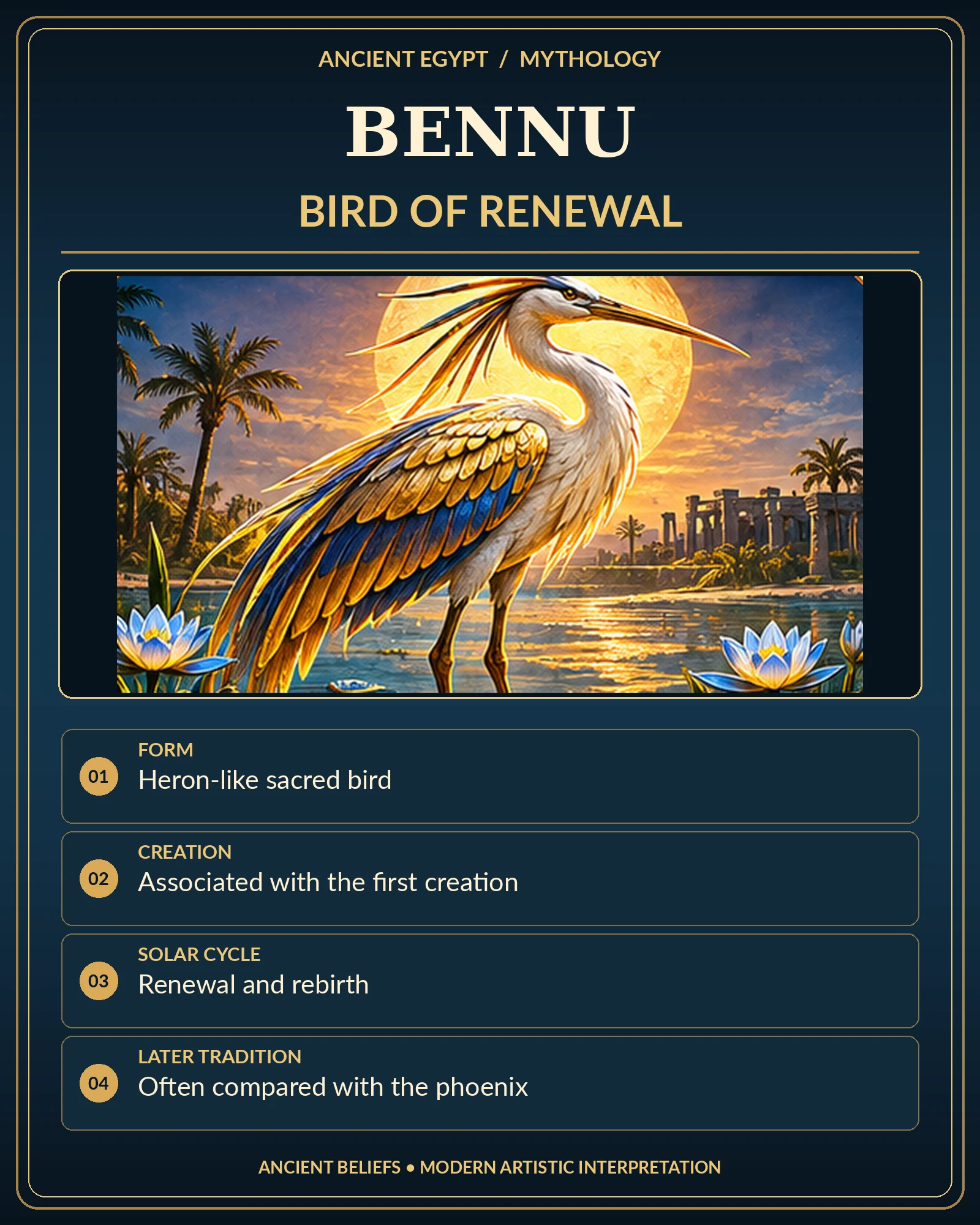
Bennu Quick Facts
| Item | Detail |
|---|---|
| Form | Heron-like bird, often with two long head plumes |
| Name | Linked with an Egyptian verb meaning “to rise” or “to shine” |
| Cult centre | Heliopolis, home of the sun cult |
| Linked gods | Atum, Ra and Osiris |
| Meaning | Creation, sunrise, renewal and the soul (ba) of Ra |
| Greek counterpart | The phoenix, described by Herodotus and later writers |
What Was the Bennu?
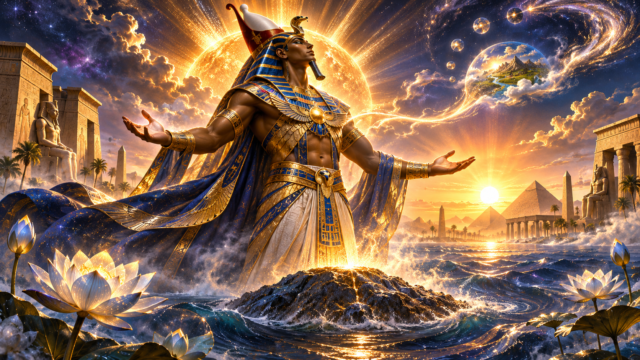
In Egyptian religion the Bennu was a bird of the first moment. In the Heliopolitan creation story, when the creator god Atum appeared on the primeval mound, the Bennu was said to have landed on the mound (or on the sacred benben stone) and let out a cry that broke the silence of the world. This gave the bird a role as a witness and symbol of creation. Our guides to Atum and the Egyptian primordial gods explain the setting.
The name Bennu is connected with the Egyptian word for rising, which links the bird to the sunrise. Egyptians saw the sun’s daily return as a small repeat of the first creation, so the Bennu became a sign of regular renewal, not of a single dramatic transformation.
The Bennu and the Soul of Ra and Osiris
Texts describe the Bennu as the ba, the soul or manifestation, of Ra, and also of Osiris. In Book of the Dead Spell 83, the dead person asks to turn into a Bennu, so that they can travel freely in the afterlife and be reborn like the sun. This is one of several transformation spells in which a person could take the form of a bird, a lotus, a falcon or a crocodile. The Bennu’s form shows that the soul of the dead hoped to share in the sun’s renewal.
Story box (retold from creation traditions): There is only dark water and silence. Then a small mound rises, and a bird with long head feathers lands on it. It opens its beak and calls. The sound is the first sound in the world, and with it, time begins. In some versions, the first light follows the Bennu’s cry. This is a religious story told by priests of Heliopolis, not a record of a real event.
Bennu and the Greek Phoenix
The Greek historian Herodotus, who visited Egypt in the fifth century BCE, wrote about a sacred bird called the phoenix that, according to the priests of Heliopolis, appeared only once every five hundred years. He wrote that it came when its father died and carried the body in an egg of myrrh to the temple of the sun. Herodotus also made it clear that he had not seen the bird himself and described only what he was told. Because the details do not match the Egyptian Bennu texts exactly, scholars are cautious, but most think that the Greek phoenix was at least partly inspired by the Bennu.
The fire-and-ashes version of the phoenix, where it burns itself and is reborn from the ashes, appears in later Roman-period writers. It does not appear in the Egyptian texts about the Bennu. So when you see a modern picture of a flaming Bennu, it is a mix of two traditions.
| Feature | Egyptian Bennu | Later phoenix |
|---|---|---|
| Appearance | Heron with long head plumes | Colourful bird, often like an eagle |
| Fire and ashes | Not described in the Egyptian sources | Common in Roman-period versions |
| Link with sun | Strong: Ra, Atum, dawn | Also linked with the sun |
| Cycle | Daily or cosmic renewal | Long cycles such as five hundred years |
Was the Bennu a Real Bird?
The Bennu is usually identified with a heron. Some modern writers have suggested a link with a larger extinct heron species known from remains in the Arabian region, but this idea is speculative and unproven. For a general reader, it is safe to say that the Egyptian art shows a heron-like bird, and that Egyptians treated it as a sacred creature of the sun cult.
History, Mythology and Speculation
| Category | What belongs here |
|---|---|
| History | Bennu images and texts; Herodotus’s report; the Heliopolitan sun cult |
| Mythology | The Bennu landing on the mound; the bird as the soul of Ra and Osiris |
| Speculation | An extinct heron as the model; any direct claim that Egyptians believed in a fire rebirth; links with modern esoteric ideas |
Myth vs Fact
| Popular claim | Reality |
|---|---|
| The Bennu burned and rose from ashes. | That is the later phoenix story, not the Egyptian Bennu. |
| The Bennu is exactly the same as the phoenix. | They are related, but they developed in different cultures and times. |
| The Bennu appeared every five hundred years in Egyptian texts. | The five-hundred-year cycle comes from Herodotus’s report, not from known Egyptian texts. |
| The Bennu was a god with a large cult. | It was a sacred bird linked to gods, mainly at Heliopolis. |
| The Bennu was a real extinct bird. | This is a speculation, not a proven fact. |
Why the Bennu Still Matters
The Bennu shows how an old idea can travel and change. An Egyptian bird of dawn and creation became a Greek wonder and later a Roman symbol of the eternal empire and of Christian resurrection imagery. When you see the phoenix in books, games and logos, you are looking at a distant descendant of a heron on the mound at Heliopolis.
Frequently Asked Questions About the Bennu
What is the Bennu bird?
It is a sacred heron-like bird of ancient Egypt, linked with creation, the sun and rebirth.
Is the Bennu the same as the phoenix?
They are related, and the Greek phoenix was probably inspired in part by the Bennu, but the fire-and-ashes story is later.
What does the Bennu symbolise?
Creation, sunrise, renewal and the soul of gods such as Ra and Osiris.
Where was the Bennu worshipped?
Mainly at Heliopolis, the centre of the sun cult.
What did Herodotus say about the phoenix?
He reported what Heliopolis priests told him about a bird that appears every five hundred years, and he said he had not seen it himself.
Could a person become a Bennu?
In the Book of the Dead, Spell 83 is a spell for the dead to transform into a Bennu in the afterlife.
What does the Bennu look like in art?
A heron-like bird, sometimes with two long head feathers, standing on a mound or branch.
Was the Bennu a real bird?
It is usually identified with a heron. A link to an extinct species is a speculation.
Reliable Sources
- World History Encyclopedia: Egyptian Mythology
- Egypt Exploration Society: Gods of Egypt
- The Metropolitan Museum of Art: Divine Egypt
Last updated: 25 November 2026. Related reading on Vista Hub: our guides to Atum, Ra, Osiris, Egyptian symbols and Egyptian monsters and creatures.
Related guides: Egyptian vs Greek Mythology: Ra vs Zeus, Osiris vs Hades and the Two Sphinxes · Who Is the Most Powerful Egyptian God? Ra vs Amun-Ra and the Strongest Goddesses










Share Your Opinion
Comments are closed on this post.