 Vista

Apep (also called Apophis in Greek) was the giant serpent of ancient Egyptian mythology, the great enemy of the sun god Ra and a symbol of chaos, darkness and the threat to cosmic order. Every night, as Ra’s boat travels through the underworld called the Duat, Apep attacks and tries to stop the sun from rising. Gods such as Set, Isis, Thoth and the serpent Mehen defend the boat, and the sun is reborn at dawn. Apep can never be finally killed, which means the battle is eternal. For Egyptians, this story explained why order must be actively protected every day.
This guide explains Apep’s nature, the nightly battle, the role of Set as Ra’s defender, the “Great Cat” scene, the rituals used to symbolically destroy Apep, and what is history, belief or guesswork.
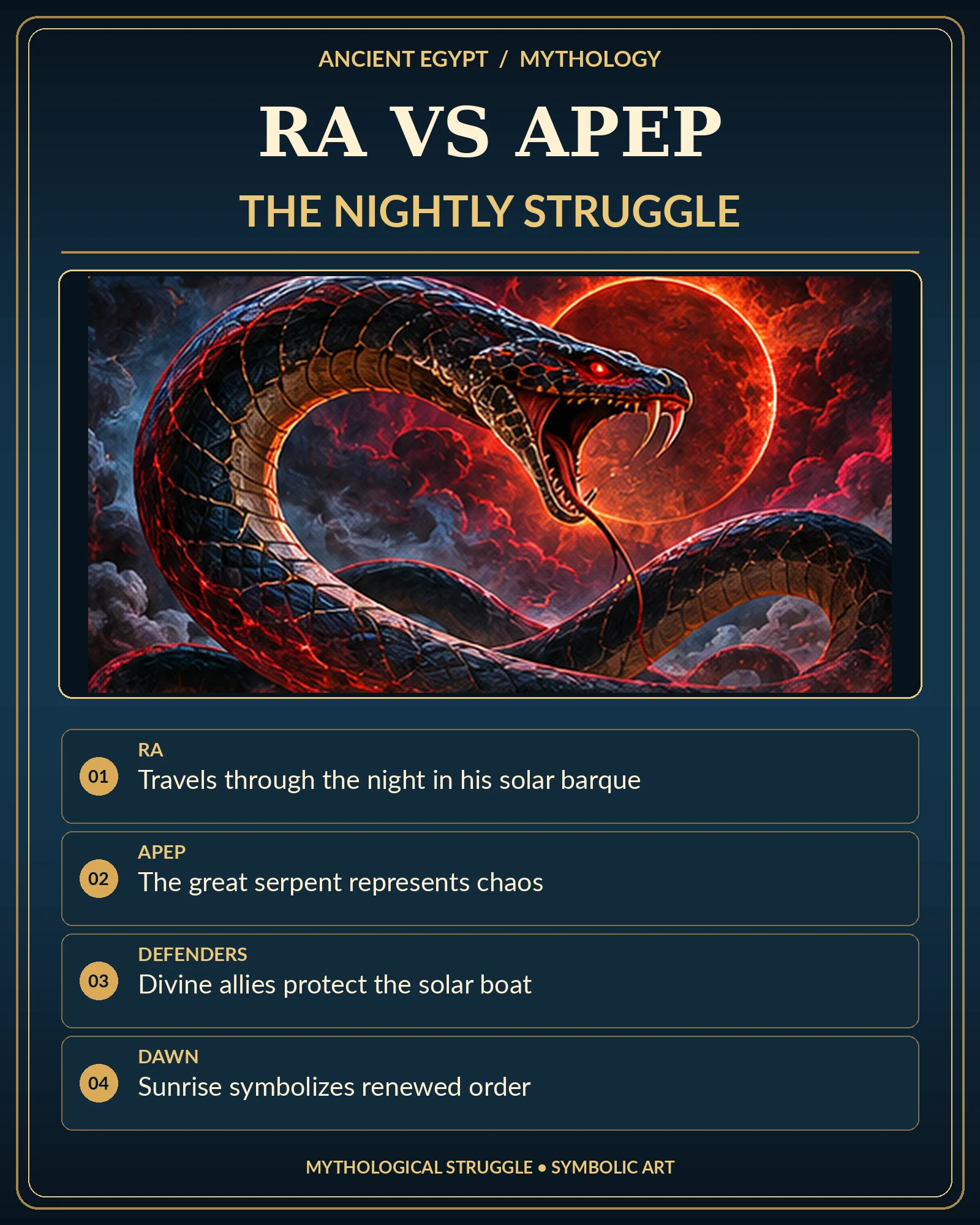
Apep Quick Facts
| Item | Detail |
|---|---|
| Names | Apep (Egyptian), Apophis (Greek) |
| Form | Giant serpent, sometimes shown with knives pinning its coils |
| Represents | Chaos (isfet), darkness, the enemy of order |
| Enemy | Ra, the sun god, on his night journey |
| Defenders of Ra | Set, Isis, Thoth, Serket, Mehen and others |
| Key ritual text | The Book of Overthrowing Apep (late period papyrus) |
Who Was Apep?
Egyptian thought saw the world as a balance between ma’at (order, truth, justice) and isfet (disorder, falsehood, chaos). Isfet was not just “evil” in a moral sense; it was the natural tendency of the universe to fall apart. Apep is isfet made into a creature. He is described as a gigantic snake living in the dark waters of the Duat or in the sky’s edge, hostile to the sun and light.
Apep is attested from at least the Middle Kingdom, and he remains a major enemy in New Kingdom royal underworld books and later ritual texts. Unlike Set, who could be both dangerous and useful, Apep has no positive side. He is never a protector, never a partner, and never worshipped.
The Nightly Battle
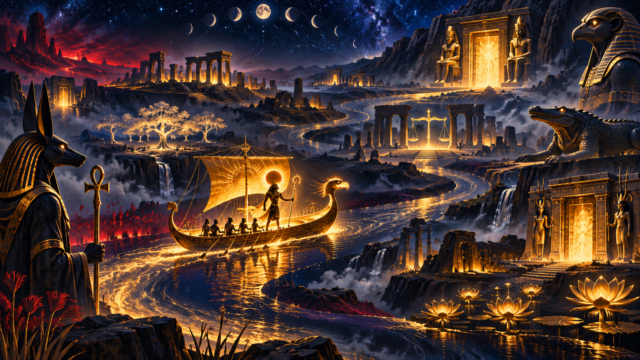
According to underworld books such as the Amduat, Ra sails through twelve hours of night in a solar boat. In some versions the sun god is accompanied by protective deities. In the seventh hour, the boat reaches a dangerous stretch where Apep lies in wait on a sandbank or in the river. He tries to swallow the boat, to drink up the water, or to hypnotise the crew with his gaze. The gods spear him, bind him with magic or cut him with knives, and the boat moves on. At dawn, the sun rises again.
| Defender | Role in the battle |
|---|---|
| Set | Stands at the prow and spears Apep; his strength is used against chaos |
| Isis and Serket | Use magic to bind Apep and neutralise his power |
| Thoth | Uses words of power and knowledge |
| Mehen | A coiled serpent who shields Ra’s shrine on the boat |
| Ra as the Great Cat | In one tradition, Ra takes the form of a cat and cuts Apep’s head |
Story box (retold from underworld books): The river of the Duat is dark and silent. The sun god’s boat glides forward, with a few gods guarding it. Ahead, the water seems to ripple. A huge coil rises and a pair of eyes catches the light. It is Apep. For a moment the boat stops, and the crew feels the pull of his gaze. At the prow Set raises his spear and shouts, while Isis and Serket speak their spells. The coils are pinned, the boat slips free, and a thin grey line of dawn appears. This is a mythological story from religious texts, not a historical event.
Set as Ra’s Defender
It may surprise readers that Set, the god who murders Osiris in other myths, protects Ra from Apep. Egyptian religion allowed gods to have more than one role. Set’s raw, stormy strength was seen as a way to fight chaos, even though he was chaotic himself. In later periods, when Set became more strongly demonised, he was sometimes removed from this role and replaced by other gods. Our guide to Set explains this change.
The Great Cat and the Persea Tree
In Spell 17 of the Book of the Dead, a passage describes the “Great Cat” beside the persea tree at Heliopolis, who cuts down the serpent. The text explains that the cat is Ra himself, and the serpent is Apep. This is one of the few scenes where Ra personally defeats Apep, and it is the origin of the cat as a solar symbol in Egyptian art. It also connects with the cult of cat goddesses like Bastet.
Rituals Against Apep
Egyptians did not leave the battle to the gods alone. Temples performed rituals to help the sun by destroying Apep symbolically. A late papyrus often called the Book of Overthrowing Apep (in the Bremner-Rhind Papyrus, from the Ptolemaic period) contains spells to be recited while making figures of the serpent, spitting on them, binding them, stabbing them with knives and burning them. The ritual could be performed daily to keep chaos away. The idea was simple: the world’s order was not automatic. People had to keep supporting it, in the same way the king acted to uphold ma’at.
Apep and Eclipses: What Is Claimed
Popular articles often say that Egyptians blamed solar eclipses or storms on Apep attacking Ra. This idea is repeated widely, but the evidence is less clear than many websites suggest. The ancient texts describe Apep’s attack mainly in the context of the night journey, and I would treat any direct link between Apep and a particular eclipse as an interpretation, not a documented belief. If you see a claim with a specific date, check for a primary source.
History, Mythology and Speculation
| Category | What belongs here |
|---|---|
| History | Underworld books, the Book of Overthrowing Apep, ritual practice in temples |
| Mythology | The nightly battle, the Great Cat, the binding and spearing of Apep |
| Speculation | Eclipse explanations; modern claims about Apep as a “real” cosmic entity; supposed links with other world serpents |
Myth vs Fact
| Popular claim | Reality |
|---|---|
| Apep is the Egyptian Satan. | Apep stands for cosmic chaos, not for a tempter figure. The comparison is loose and can mislead. |
| Set was Ra’s enemy in the Apep story. | In the best-known version Set defends Ra against Apep. |
| Apep was killed once and for all. | He is defeated every night; the battle is continuous. |
| Egyptians worshipped Apep out of fear. | There was no cult of Apep. Rituals aimed to destroy him. |
| Apep caused real eclipses in Egyptian belief. | This is a popular claim, not clearly supported by the surviving texts. |
Frequently Asked Questions About Apep
Who is Apep in Egyptian mythology?
Apep is the giant serpent who represents chaos and who attacks Ra’s boat every night in the underworld.
Is Apep the same as Apophis?
Yes. Apophis is the Greek form of the name.
Who defeats Apep?
Different gods help, including Set, Isis, Serket, Thoth and Mehen, and in one tradition Ra himself as the Great Cat.
Why does Set protect Ra from Apep?
Set’s strength was seen as a weapon against chaos, so he serves as Ra’s guardian at the prow of the boat.
Can Apep ever be destroyed forever?
No. Apep returns each night, which shows that order needs constant protection.
What was the Book of Overthrowing Apep?
It is a late ritual text with spells recited while symbolically destroying wax or ink images of the serpent.
Is Apep evil?
He is the enemy of order and light. Egyptians treated him as the opposite of ma’at, but their idea of chaos differs from modern ideas of evil.
Did Egyptians blame Apep for eclipses?
This is often claimed, but the evidence is unclear, so it should be treated as a possible interpretation.
Reliable Sources
- World History Encyclopedia: Egyptian Mythology
- Egypt Exploration Society: Gods of Egypt
- The Metropolitan Museum of Art: Divine Egypt
Last updated: 25 November 2026. Related reading on Vista Hub: our guides to Ra, Set, the Duat, Bastet and Egyptian monsters and creatures.
Related guides: Horus vs Set: The Battle for Egypt's Throne — The Contendings, the Lost Eye and Who Won · Who Is the Most Powerful Egyptian God? Ra vs Amun-Ra and the Strongest Goddesses












Share Your Opinion
Comments are closed on this post.