 Vista

The Duat (also written Duat or Tuat) was the ancient Egyptian underworld, a mysterious realm of night where the dead travelled, the sun god Ra passed through the twelve hours of darkness, and Osiris ruled as lord of the dead. It was not simply “below the ground”. Egyptian texts place it beneath the earth, beyond the western horizon and also in the sky, and describe it as a landscape of rivers, caves, fiery lakes, gates and guardians. Funerary books such as the Amduat and the Book of Gates map its regions so that the dead could pass safely.
This guide explains what the Duat was, how its twelve hours work, who lived there, how it differs from the later idea of hell, and where speculation begins.
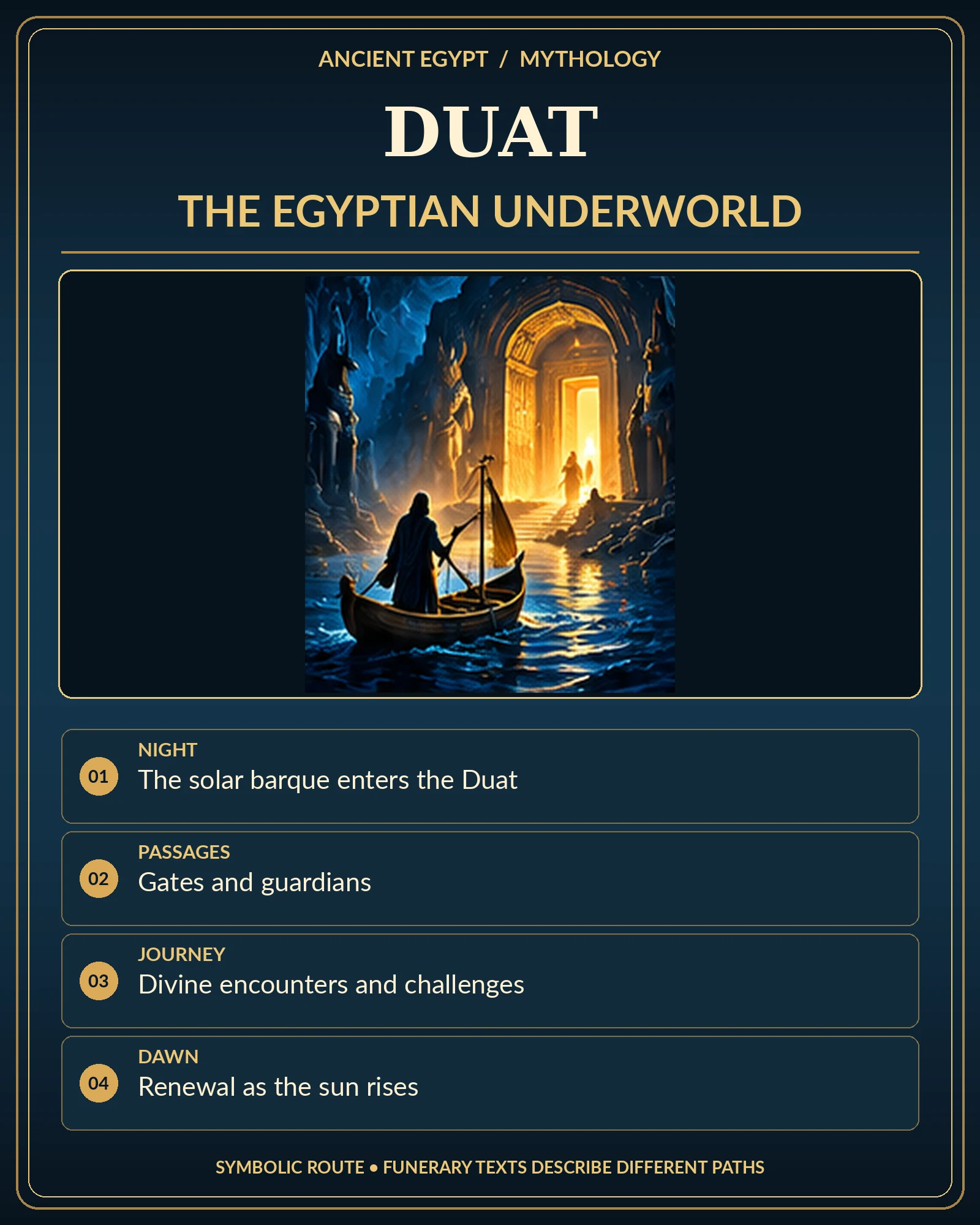
Duat Quick Facts
| Item | Detail |
|---|---|
| Meaning | The realm of the dead and of the night sun |
| Structure | Twelve hours or divisions, each with gates and guardians |
| Ruler | Osiris, lord of the dead |
| Visitors | The dead, and Ra on his night journey |
| Main texts | Amduat, Book of Gates, Book of Caverns, Book of the Dead |
| Danger | Apep, fiery lakes, hostile guardians, the risk of the second death |
What Was the Duat?
The Duat was both a place and a state. It could mean the underworld, the night sky or the space just before dawn. Its exact geography is not consistent, because the texts were religious guides and not maps in a modern sense. What stays constant is the idea of a hidden realm where death and rebirth meet. For the sun, the Duat is where it sets, renews and rises again. For the dead, it is the path to judgment and the afterlife. See our guide to the Egyptian afterlife for the wider picture.
The Twelve Hours of Night
The Amduat (“That Which Is in the Underworld”) divides the night into twelve hours. In each hour Ra’s boat enters a new region, speaks to its inhabitants and brings them light and life. The dead rejoice as he passes, then fall into darkness again when he leaves. In the middle hours, Ra meets Osiris, and in the seventh hour he must overcome Apep. By the twelfth hour, Ra is renewed as Khepri, the rising sun.
| Stage | What happens (simplified) |
|---|---|
| Early hours | Ra enters the Duat and is welcomed by the dead |
| Middle hours | The deepest darkness; meeting with Osiris; transformation |
| Seventh hour | Battle against the serpent Apep |
| Final hours | Ra is renewed and prepares to rise as Khepri |
Story box (retold from the Amduat): The sun god’s boat slips between two mountains and the sky goes dark. In the first hour, the dead stand along the banks and call his name. Ra speaks a few words to each region and gives them light. The boat moves on and the banks fall dark again. In the deepest hour, the god joins with Osiris, and from that union comes new life for the dawn. This is a religious narrative, not a geographical description.
Gates, Guardians and Spells
The Book of Gates and the Book of the Dead describe many gates, each with a guardian whose name must be known. The dead person had to speak the right words to pass. This is why funerary papyri and coffin texts were filled with long spells. A knowledgeable dead person could survive the journey, while an unprepared one risked being trapped or destroyed.
Is the Duat Hell?
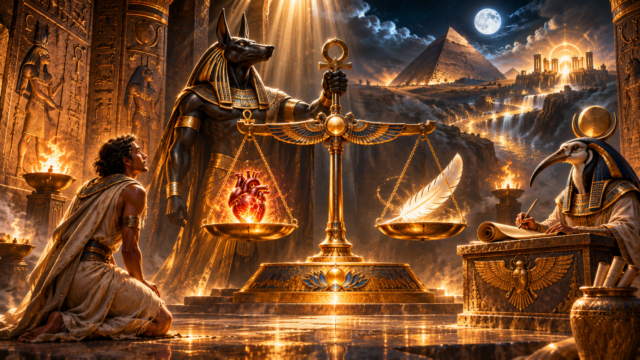
Not exactly. The Duat contains dangers and, in some texts, places of punishment for the enemies of the gods. But it is also the place of rebirth and of Osiris’s kingdom. It is closer to a transitional world than to the later idea of a hell for all sinners. Failure at judgment meant the end of existence, not eternal torture in most standard descriptions.
History, Mythology and Speculation
| Category | What belongs here |
|---|---|
| History | Royal tomb decoration in the Valley of the Kings; surviving underworld books |
| Mythology | The twelve hours, the gates, Ra and Osiris’s meeting, Apep’s attack |
| Speculation | Attempts to map the Duat on a modern geography; claims that it describes real astronomy or hidden chambers |
Myth vs Fact
| Popular claim | Reality |
|---|---|
| The Duat was Egyptian hell. | It was a complex realm of death and renewal, not a simple hell. |
| The Duat is a real underground map. | It is a religious and symbolic landscape. |
| Only Ra travelled through the Duat. | The dead also travelled through it. |
| The Duat is the same as the Greek Hades. | There are similarities, but the Egyptian idea differs in structure and in its link to the sun. |
| Hidden chambers match the Duat. | This is a claim made in popular media, not an established fact. |
Frequently Asked Questions About the Duat
What is the Duat?
It is the Egyptian underworld and night realm, travelled by the dead and by the sun god.
Who rules the Duat?
Osiris is the lord of the dead in the Duat.
What is the Amduat?
A royal funerary book describing Ra’s journey through the twelve hours of night.
What is the Book of Gates?
A New Kingdom text that describes the gates of the Duat and the guardians at each.
Why is Apep in the Duat?
He attacks Ra’s boat as the embodiment of chaos, especially in the seventh hour.
Is the Duat in the sky or underground?
Texts describe it in several ways, including below the earth and in the night sky.
Could the living visit the Duat?
In religious texts, it is a realm for the dead and the gods. Modern claims of physical access are not supported by evidence.
Is the Duat the same as Aaru?
No. Aaru, the Field of Reeds, is the paradise reached after passing through the Duat and the judgment.
Reliable Sources
- World History Encyclopedia: Egyptian Mythology
- Egypt Exploration Society: Gods of Egypt
- The Metropolitan Museum of Art: Divine Egypt
Last updated: 25 November 2026. Related reading on Vista Hub: our guides to Ra, Osiris, Apep, the Egyptian afterlife and the Book of the Dead.
Related guides: Egyptian Gods Family Tree: Relationships, Parents, Children and Divine Families Explained · Egyptian Gods and Goddesses: Names, Pictures, Powers and Symbols Explained












Share Your Opinion
Comments are closed on this post.