 Vista
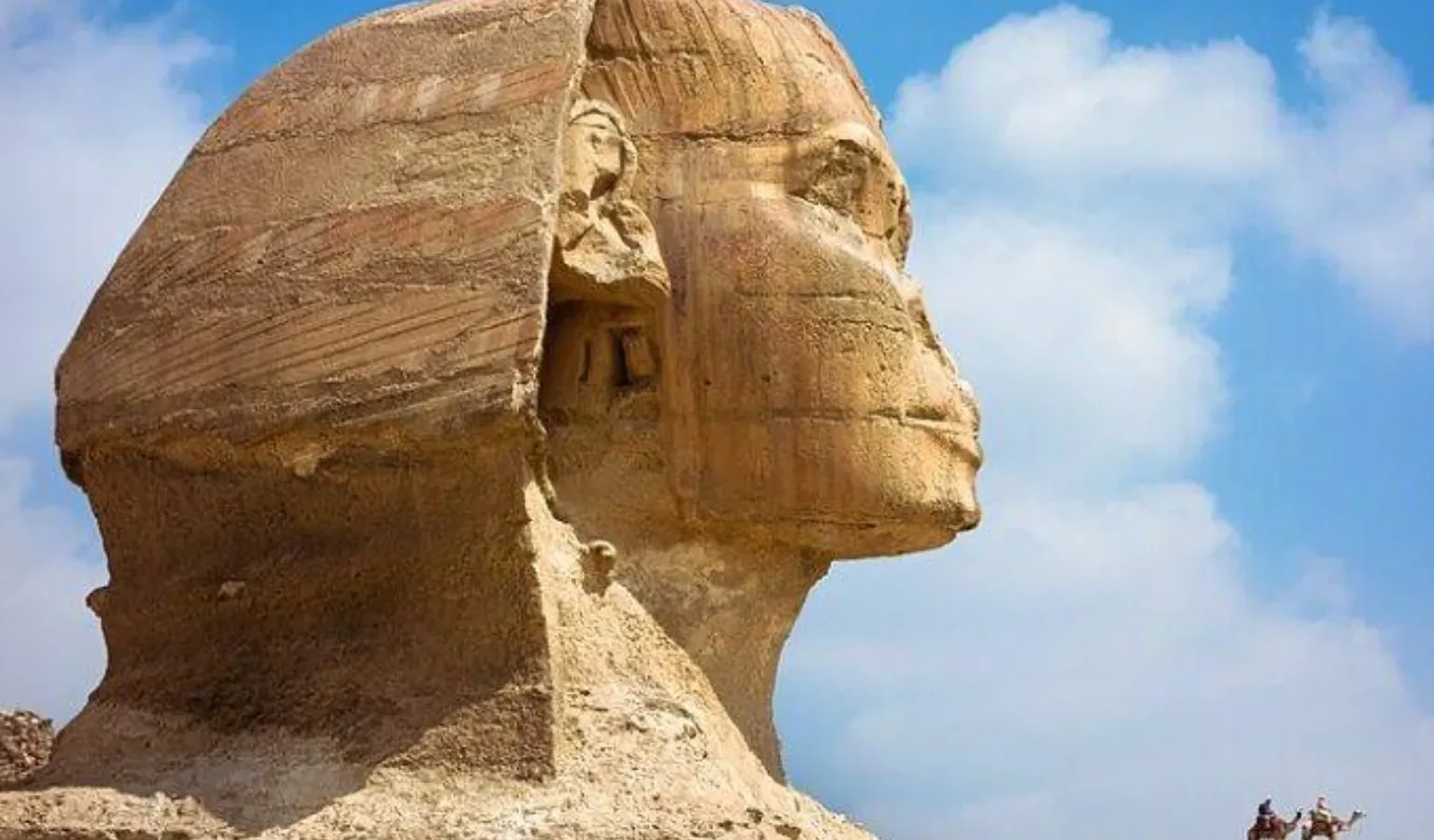
The Great Sphinx of Giza is a huge limestone statue of a lion’s body with a human head, carved from the bedrock of the Giza plateau. Most Egyptologists date it to the reign of King Khafre, around 2500 BCE, although some details are debated. Its nose was not shot off by Napoleon’s army; the damage is older, and the exact cause is not known with certainty. No hidden “Hall of Records” or secret chamber beneath it has been found, and claims of a cover-up have no evidence behind them.
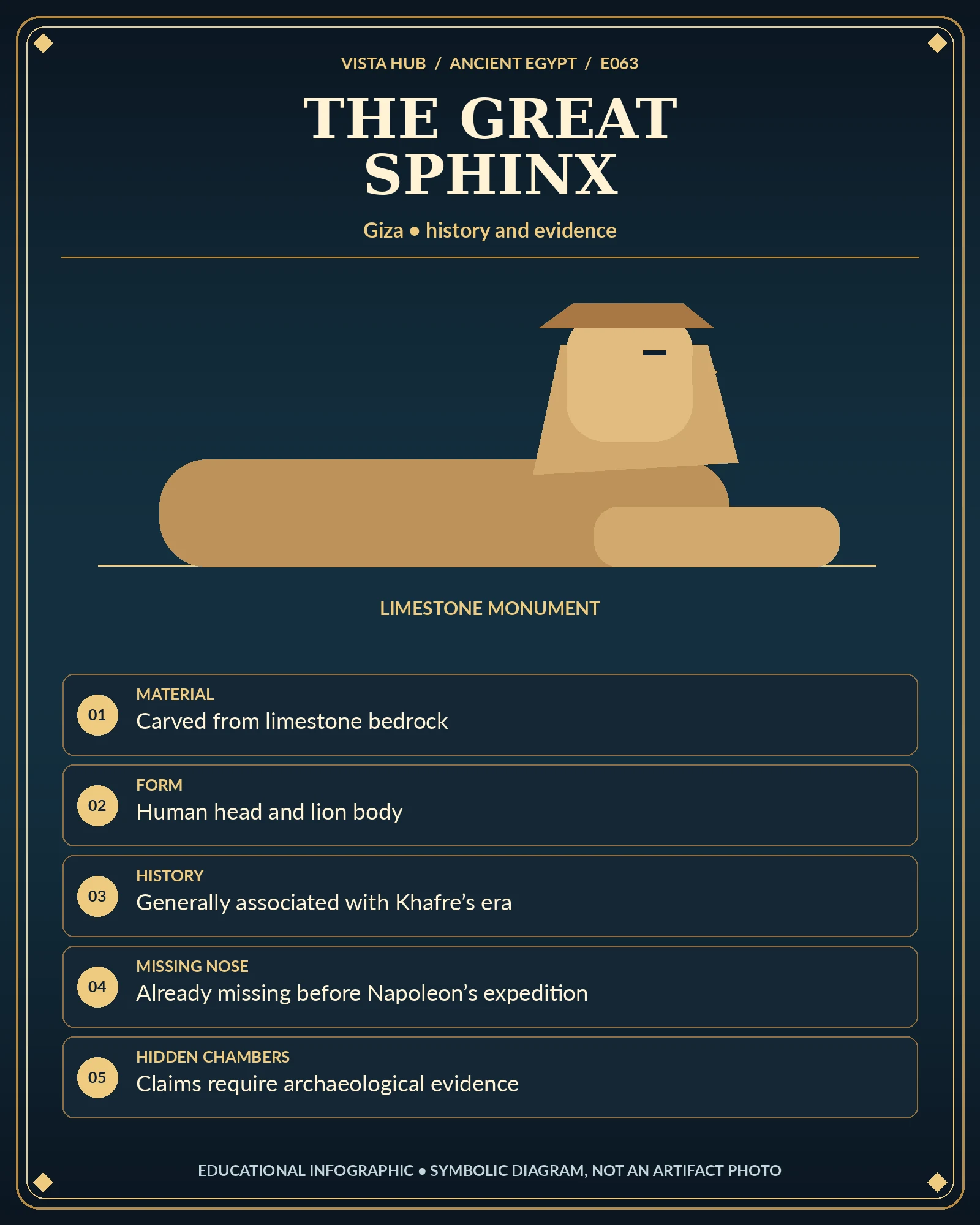
Sphinx Quick Facts
| Item | Detail |
|---|---|
| Length and height | About 73 metres long and 20 metres high |
| Material | Limestone bedrock of the Giza plateau |
| Usual attribution | King Khafre, c. 2500 BCE |
| Face | Probably a royal portrait |
| Egyptian name | Not certain; later called “Horemakhet” (Horus in the Horizon) in New Kingdom texts |
Who Built It and Why?
The Sphinx sits beside Khafre’s valley temple and causeway, and the layout suggests it was part of his pyramid complex. The statue was probably carved from a quarry hollow left after stone was removed for nearby monuments. Its purpose is not stated in any surviving ancient text of that time, so explanations such as a royal guardian are interpretations. In later centuries the figure was worshipped, and Thutmose IV recorded a dream on the “Dream Stela” between its paws.
The Missing Nose
A popular story blames Napoleon’s cannons, but drawings made before his 1798 campaign already show the nose missing. A medieval Arabic writer, al-Maqrizi, described a Sufi who damaged the Sphinx in the 14th century, which is one reason some historians link the nose to deliberate defacing. Chisel marks suggest it was removed with tools. Treat any single cause as likely rather than proven.
Story box (reconstruction): A young prince falls asleep in the shade of the great head, half buried in sand. In a dream, the figure asks him to clear the sand away and promises kingship. This follows the idea recorded on the Dream Stela, retold here as a reconstruction rather than a quotation.
Hidden Chambers and the “Hall of Records”
The idea of a hidden Hall of Records beneath the Sphinx became popular through the claims of the American psychic Edgar Cayce and later books. Geophysical surveys have found some small passages and shafts in and around the monument, but no lost library or secret chamber has been confirmed. Statements that “the government is hiding it” are conspiracy claims without evidence. Egyptian excavation and conservation work around the Sphinx is regularly published.
The Water Erosion Debate
A minority hypothesis argues that rain erosion on the enclosure walls shows the Sphinx is far older than Khafre. Most geologists and Egyptologists reject this and explain the weathering by the type of limestone layers, wind, salt and humidity. There is no archaeological evidence of a civilisation at Giza before the Old Kingdom.
The Sphinx in the wider Giza landscape
The Egyptian Ministry of Tourism and Antiquities connects the monument with the reign of Khafre, the ruler associated with the second Giza pyramid. Its setting matters: the Sphinx is not an isolated sculpture whose date must be inferred solely from the appearance of its head. Archaeologists compare the nearby monuments, stone-cutting activity and the overall architectural complex.
Weathering, repairs and the damage visible today occurred across different periods. Consequently, a modern photograph does not show the statue exactly as its makers left it. The archaeological question is how the surviving evidence fits the history of the plateau, rather than whether a striking feature can be matched to a speculative story.
Original references: Source 1
History, Mythology and Speculation
| Category | What belongs here |
|---|---|
| History | Khafre complex, Dream Stela, repairs, excavation by modern teams |
| Mythology | Sphinx as sun-god guardian, Horemakhet |
| Speculation | Hall of Records, ancient lost civilisation, tunnels to the pyramids |
Myth vs Fact
| Popular claim | Reality |
|---|---|
| Napoleon shot off the nose. | Earlier drawings show it already missing. |
| A secret chamber holds ancient records. | No evidence has been found. |
| It is 10,000+ years old. | Mainstream archaeology dates it to the Old Kingdom. |
| It is a lion with Khafre’s exact face. | The face is probably royal, but the identification is debated. |
Frequently Asked Questions About the Great Sphinx
Who built the Sphinx?
Most scholars attribute it to Khafre’s reign.
When was it built?
Around 2500 BCE.
Why is the nose missing?
It was damaged long before Napoleon; the exact cause is not certain.
Is there a hidden chamber?
None has been confirmed.
What is the Hall of Records?
A claimed lost library, popularised by psychic Edgar Cayce and later writers; there is no archaeological evidence.
What is the Dream Stela?
A granite slab placed by Thutmose IV between the Sphinx’s paws telling of a dream.
Does the Sphinx have a beard?
Pieces of a royal beard were found and are now in museums; it was added later than the original carving, according to some studies.
How does it relate to the Sphinx of Greek myth?
The Greek Sphinx is a different, riddling female monster that borrowed the name and general shape.
Reliable Sources
- World History Encyclopedia: Egyptian Mythology
- Egypt Exploration Society: Gods of Egypt
- The Metropolitan Museum of Art: Divine Egypt
Last updated: 25 November 2026. Related reading on Vista Hub: inside the Great Pyramid, Egyptian pyramids, Horus.
Related guides: Inside the Great Pyramid of Giza: Chambers, Hidden Voids and What Scanners Have Found · Ancient Egyptian Civilization: History, Timeline, Pharaohs and Inventions













Share Your Opinion
Comments are closed on this post.