 Vista

Short answer: Tutankhamun’s golden mask is a funerary mask about 54 cm tall that weighs a little over 10 kilograms. Howard Carter’s team opened the innermost coffin and revealed it on 28 October 1925. Real photographs come from museum collections and the Griffith Institute’s excavation archive, and each has its own licence, so always check who owns the image before reusing it.
AUTHENTIC MUSEUM OBJECTS
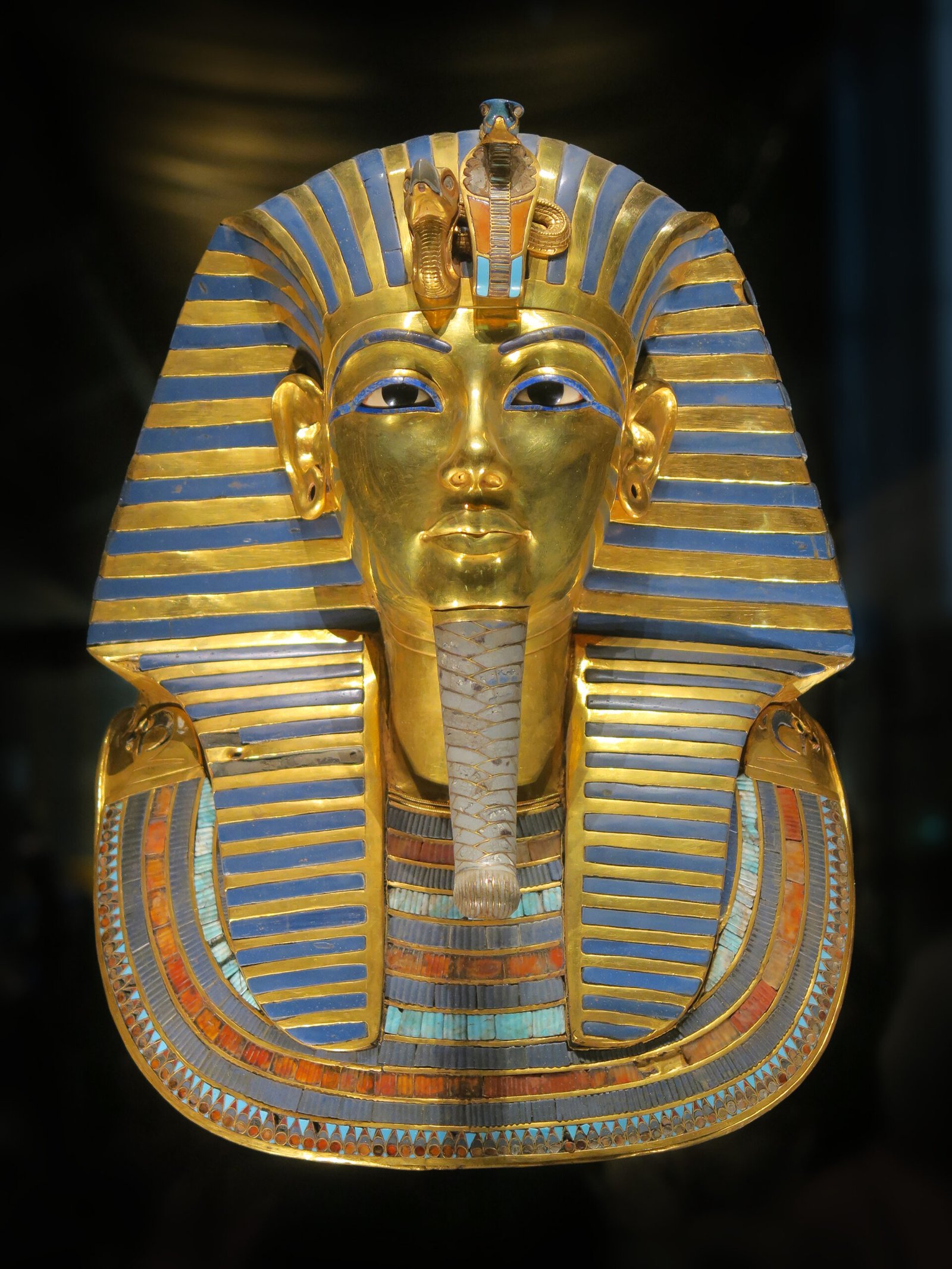

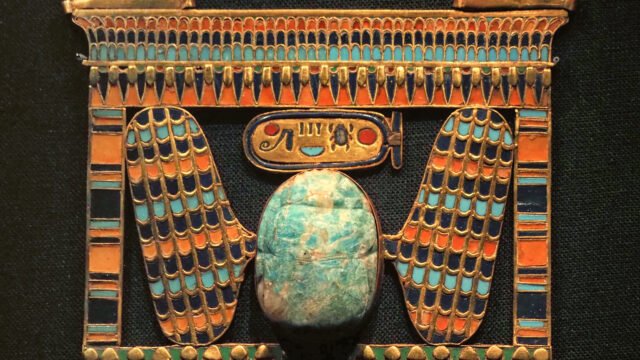
- Golden funerary mask and pectoral jewelry.
- These objects belong to Tutankhamun’s funerary assemblage.
- Each photograph retains its individual source and credit.
Quick Facts
| Point | Detail |
|---|---|
| Object | Gold funerary mask of Tutankhamun, tomb KV62, Valley of the Kings |
| Size | About 54 cm tall, 39.3 cm wide, 49 cm deep |
| Weight | Over 10 kg (often given as about 10.2 kg) |
| Materials | Gold with lapis lazuli, carnelian, obsidian, turquoise and glass paste |
| Revealed | 28 October 1925, inside the innermost of three coffins |
| Beard | The 2.5 kg gold beard had come off by 1925 and was reattached with a wooden dowel in 1944 |
| Where now | Cairo’s Egyptian Museum for a long time; recent sources say the Grand Egyptian Museum |
The mask in detail
The mask shows the young king with the royal headcloth and the likeness of the god Osiris. The eyes are outlined with lapis lazuli, which makes the face look as if it wears makeup, and the headcloth has blue stripes made with inlay. The gold is thin, mostly a few millimetres, yet the mask is heavy because gold is very dense. Analysis has found two types of gold in the mask, according to published descriptions.
The date of making is given as around 1323 BCE. The mask sat on the shoulders of the mummy and nearly covered its face. In the 20th century it became a symbol of ancient Egypt around the world. For the wider story of the tomb’s treasure, see our guide Tutankhamun’s Golden Treasure.
Other tomb artifacts people search for
- The golden throne: a royal chair decorated with gold and inlay.
- Daggers: including a gold-bladed dagger found on the king’s body.
- Gilded shrines and the Anubis shrine: a jackal figure on a shrine-shaped chest was among the objects in the treasury.
- Chariots, jewellery and furniture: everyday and ceremonial goods for the afterlife.
Most of the tomb’s objects are now displayed in the Grand Egyptian Museum at Giza, while the king’s mummy remains in the Valley of the Kings.
Where real photos come from
The best-known excavation photographs were taken by Harry Burton, who did most of the photography for the tomb. The Griffith Institute at Oxford holds Howard Carter’s archive, including Burton’s negatives and prints. The Institute says the original copyright has expired, but it owns the reproduction rights in its digital scans, and it sells prints. This means “old photo” does not automatically mean “free photo”.
Modern photographs of the mask usually come from museums, agencies or photographers who license them. Some images on Wikimedia Commons are shared under Creative Commons licences, but each file has its own terms.
Story box (retold from Carter’s diary): After the pins were removed and the lid was raised, the team saw the golden face for the first time in about 3,250 years. The moment shows why the mask became a symbol: it combined royal power, religion and craftsmanship in one object.
History, Mythology and Speculation
| Category | Examples |
|---|---|
| History | Carter’s 1925 opening of the coffin, museum display, the Burton archive |
| Mythology | The king as Osiris after death, the mask as a divine face |
| Speculation | Curses, “alien” gold, secret hidden rooms |
Myth vs Fact
| Popular claim | Careful answer |
|---|---|
| The mask is solid gold, 25 kg | Sources give about 10 kg |
| It was found in 1922 | The tomb was found in 1922; the mask was revealed in 1925 |
| The mask is cursed | No evidence; see our curse fact-check |
| All photos of it are free | Licences vary |
Read the fact-check Tutankhamun’s Curse: The Truth for more.
Frequently Asked Questions
How heavy is Tutankhamun’s mask?
A little over 10 kg, according to most sources. Some older sources give a higher figure, so treat weights as approximate.
When was the mask found?
The coffin was opened and the mask revealed on 28 October 1925.
Who took the excavation photos?
Mainly Harry Burton, the expedition photographer.
Where is the mask now?
It was in Cairo’s Egyptian Museum for decades, and recent sources report it at the Grand Egyptian Museum. Check the museum’s website before visiting.
What is the mask made of?
Gold, lapis lazuli, carnelian, obsidian, turquoise and glass paste.
Was the beard damaged?
It was detached when found and reattached in 1944 with a wooden dowel, according to museum records.
Can I reuse photos of the mask?
Only with the right licence. Old Burton photographs are still managed by the Griffith Institute for reproduction.
Is the mask in Tutankhamun’s tomb?
No. The mummy remains in the tomb, but the mask and most objects are in a museum.
Reliable Sources
- Wikipedia: Mask of Tutankhamun
- Smarthistory: Tutankhamun’s innermost coffin and death mask
- Griffith Institute: Image rights and fees
- Thames and Hudson: Unlocking Tutankhamun’s tomb
Last updated: 26 November 2026.










Share Your Opinion
Comments are closed on this post.