 Vista
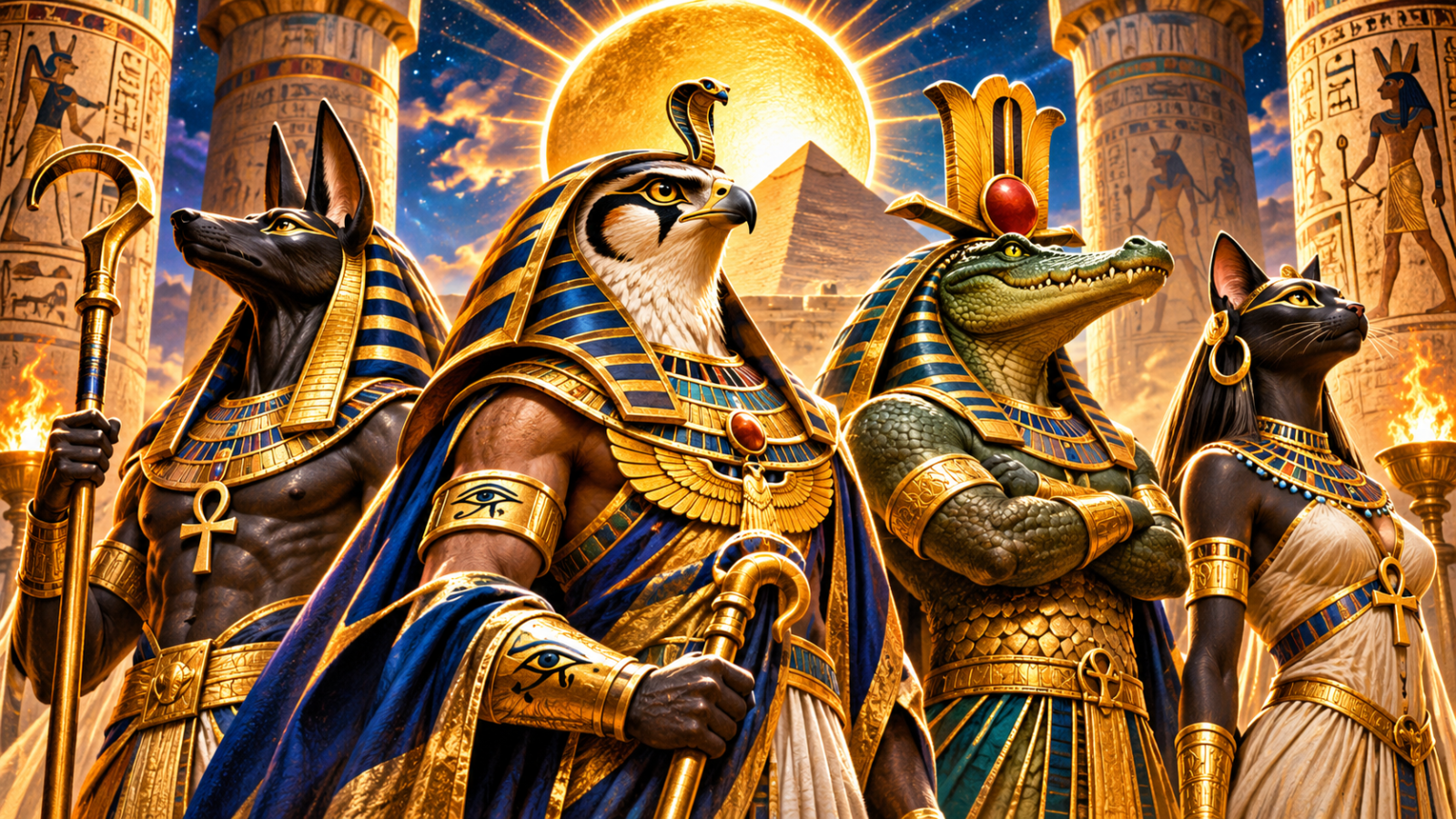
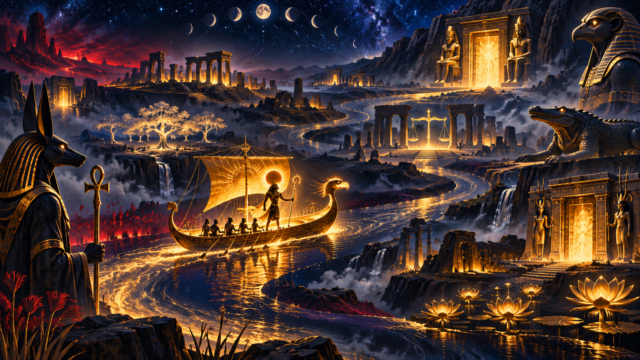
Ancient Egyptian gods were often shown with human bodies and animal heads because the animal’s qualities were used as a visual way to express the god’s nature. A falcon head suggests the sky and sharp vision, a jackal head links to cemeteries and protection of the dead, a crocodile head to power and the Nile, and a lioness head to fierce protection. Egyptians did not believe that their gods literally looked like this. The images were a kind of symbolic language, and one god could be shown in several forms. Scholars do not agree on the exact origin of the habit, and any single explanation is a theory.
This guide explains the main animal forms, why they were chosen, the main theories, how gods could have several forms, and how this compares with ideas in Hindu art.
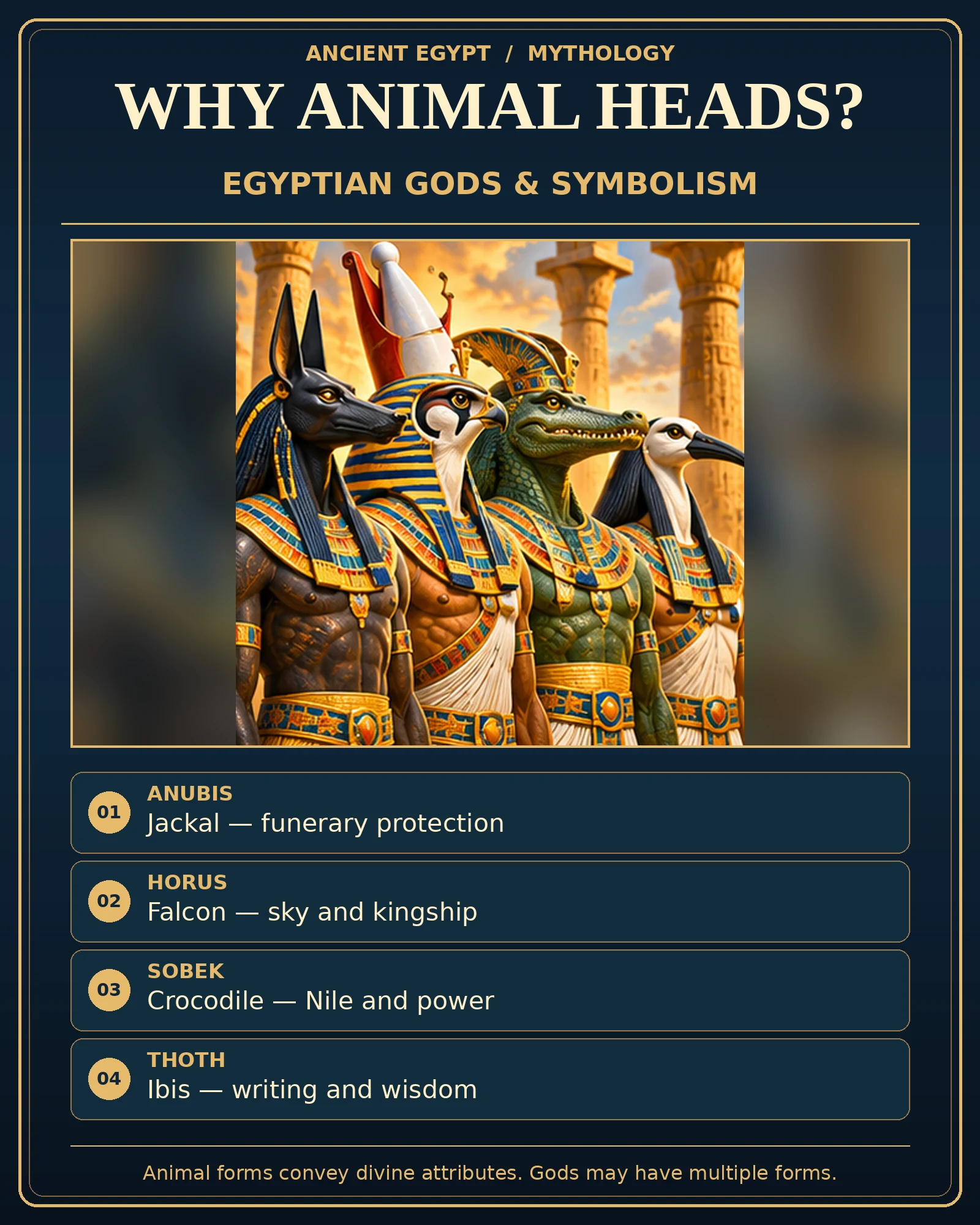
Animal-Headed Gods: Quick Facts
| God | Animal | Symbolic idea |
|---|---|---|
| Anubis | Jackal | Cemetery guardian and guide of the dead |
| Horus, Ra | Falcon | Sky, sun, kingship and far sight |
| Sobek | Crocodile | Nile power, fertility and fear |
| Thoth | Ibis or baboon | Writing and wisdom |
| Sekhmet, Bastet | Lioness, cat | Protection, war and home guardianship |
| Khnum, Amun | Ram | Creation, fertility and hidden power |
What the Animal Forms Meant
Egyptians watched animals closely and linked behaviour to divine power. Jackals roamed the desert edge near tombs, so a jackal god could be a protector of the dead rather than a threat, as shown in our guide to Anubis. The falcon, soaring high and seeing far, fitted a sky god such as Horus. The crocodile is a powerful river predator, which suited Sobek. The ibis, a careful wading bird, was linked with Thoth the scribe, and the lioness’s strength suited fierce goddesses such as Sekhmet. These links are interpretations by scholars, but they are supported by how the animals are used in texts and art.
Several Forms for One God
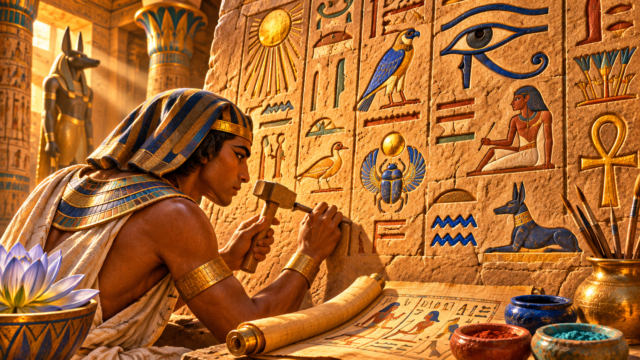
Egyptian gods did not have a single fixed look. Horus can be a falcon, a man with a falcon head, or a child. Thoth can be an ibis, a baboon or a man with an ibis head. Hathor can be a cow, a woman with cow ears or a woman with a horned crown. Different forms highlight different aspects of the same god. Hieroglyphic writing of a god’s name also often ends with a picture of the animal or the seated god, as a label.
Story box (reconstruction of a temple visit): A child visits a temple with her father. On the wall she sees a man with the head of a jackal and asks, “Is he half a dog?” Her father smiles. “No. That is Anubis. The jackal tells us what he does: he watches over the dead, as jackals watch the edge of the desert.” She looks again, and the picture seems less strange. This is a reconstruction of how symbolism could be explained, not a historical record.
Theories of Origin
| Theory | Idea | Status |
|---|---|---|
| Symbolic expression | Animal traits express divine traits | Widely accepted as the main reading of the art |
| Prehistoric animal cults | Early local animal gods merged into later human-animal forms | A long-standing idea, but evidence is incomplete |
| Hieroglyph-like labels | The head works like a written sign for the god | Plausible, supported by how names are written |
| Literal belief | Gods really looked like this | Not supported; Egyptian texts treat the forms as images |
A Careful Comparison with Hindu Deities
Readers in India often compare Egyptian gods with Ganesha (elephant head), Hanuman (a vanara), Narasimha (man-lion) or the vahanas, the animals that accompany deities. There are real surface similarities: in both traditions, the animal form can express a divine quality. But the comparison should not be pushed too far. Hindu images have their own scriptures, stories and meanings, such as Ganesha’s origin in the Puranas, and they belong to a living faith with its own interpretations. Egyptian religion is known mainly from ancient texts and art and has no living practice. So it is fair to say “similar idea of symbolic animal form”, but not “the same thing” or “one came from the other”.
History, Mythology and Speculation
| Category | What belongs here |
|---|---|
| History | Temple and tomb art; animal cults; hieroglyphic god names |
| Mythology | Gods with several forms; animal aspects of divine power |
| Speculation | Prehistoric totem origin; claims of hybrid beings; claims of a shared origin with Indian gods |
Myth vs Fact
| Popular claim | Reality |
|---|---|
| Egyptians worshipped animals as animals. | They honoured certain animals as symbols or vessels of gods. |
| Egyptian gods were half-animal creatures. | They were symbolic images, not literal descriptions. |
| The animal heads prove ancient hybrids existed. | No evidence supports this. |
| Egyptian and Hindu gods have the same origin. | No evidence supports this. The similarity is in a general idea. |
| Every god had only one fixed form. | Many gods had several forms. |
Frequently Asked Questions About Animal-Headed Egyptian Gods
Why did Egyptian gods have animal heads?
The animal’s traits symbolised the god’s nature and role.
Why does Anubis have a jackal head?
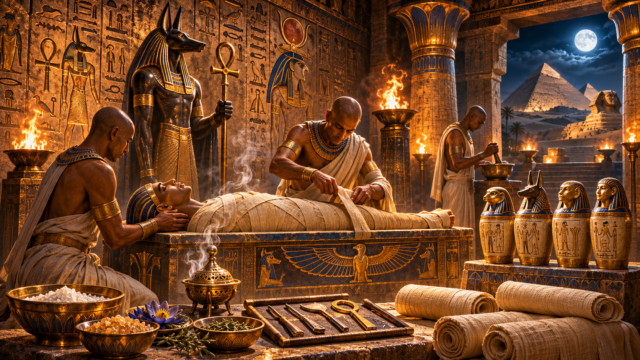
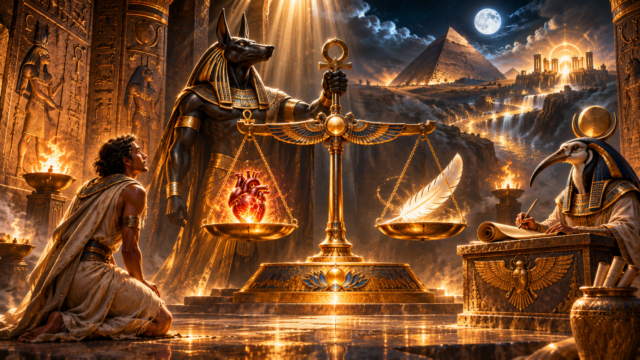
Jackals were seen near cemeteries, so the animal became a symbol of protection for the dead.
Why does Horus have a falcon head?
The falcon’s high flight and sharp sight fit a sky god and king.
Did Egyptians think gods looked like this?
No. The forms were symbolic images.
Could a god have more than one form?
Yes. Many gods appear as animals, humans and mixed forms.
Is this like Ganesha’s elephant head?
Both use animal forms to express divine qualities, but the traditions, stories and meanings are different.
Did Egyptians worship animals?
They honoured certain animals as manifestations of gods. See our guide to the Apis bull and sacred animals.
Where did the idea come from?
Scholars do not know for certain. Symbolic expression is the most widely accepted reading.
Reliable Sources
- World History Encyclopedia: Egyptian Mythology
- Egypt Exploration Society: Gods of Egypt
- The Metropolitan Museum of Art: Divine Egypt
Last updated: 25 November 2026. Related reading on Vista Hub: our guides to Anubis, Horus, Thoth, Sobek, Sekhmet and the Apis bull.
Related guides: Egyptian Pharaohs: Why Were Kings Treated as Divine, and What Powers Did They Really Have? · Dendera Light: Did Ancient Egyptians Have Electricity?












Share Your Opinion
Comments are closed on this post.