 Vista
Short answer: Egyptian and Hindu mythology share several similar ideas, such as sun gods, fierce goddesses, gods of the dead and creator deities, but there is no proven evidence that one tradition copied the other. Similar themes appear in many cultures because people everywhere watch the same sun, fear the same death and tell stories about the same forces. This guide compares the most popular pairs and clearly separates what is a comparison, what is history and what is speculation.
Quick Facts
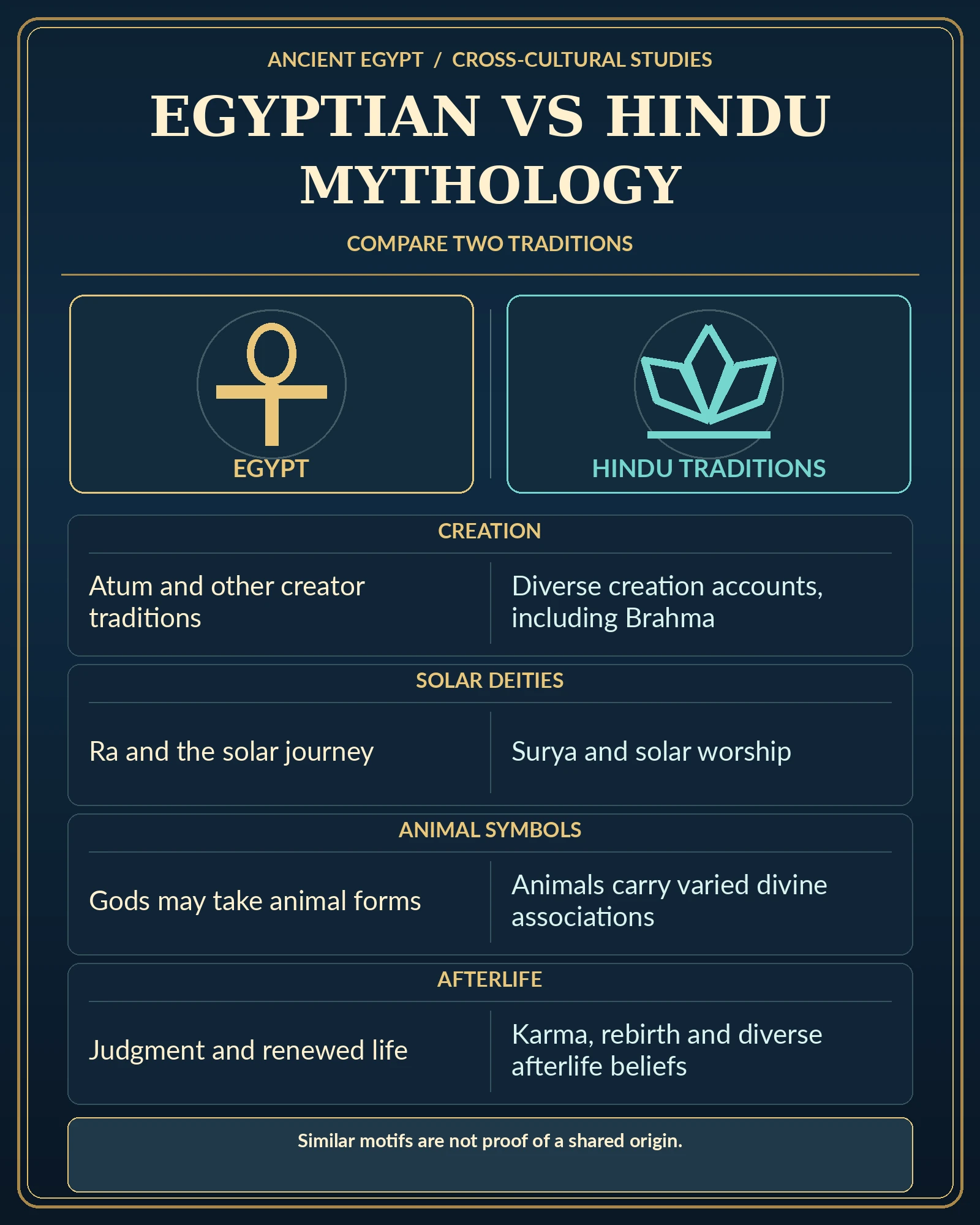
| Point | Egyptian tradition | Hindu tradition |
|---|---|---|
| Region and period | Nile Valley, c. 3000 BCE to the Roman era | Indian subcontinent, Vedic period onward, still living |
| Nature | Ancient religion, no longer practised | Living religion with many schools |
| Gods | Many gods, often with animal heads | Many deities, often seen as forms of one reality |
| Main idea of death | Judgment, then life in the afterlife | Karma, rebirth and the goal of moksha |
Why people compare the two
Both traditions are ancient, both have gods linked to the sun, rivers and death, and both use symbols such as the lotus and the serpent. Social media often turns these resemblances into claims that Egypt “copied” India or the reverse. Scholars are more careful: a resemblance is a reason to compare, not proof of contact.
Six popular pairs compared
| Egyptian | Hindu | Similar idea | Key difference |
|---|---|---|---|
| Anubis | Yama | Both are tied to the dead | Anubis guides and embalms; Yama rules and judges |
| Ra | Surya | Both are sun gods | Ra is also a king and creator; Surya is one of many deities |
| Sekhmet | Durga | Both are fierce protective goddesses | Sekhmet is a lioness of plague and war; Durga defeats a demon |
| Thoth | Saraswati | Both are linked to writing and knowledge | Thoth is male and a moon and scribe god; Saraswati is a goddess of learning and speech |
| Apis bull | Nandi | Both involve a sacred bull | Apis was a living bull worshipped at Memphis; Nandi is the bull mount of Shiva |
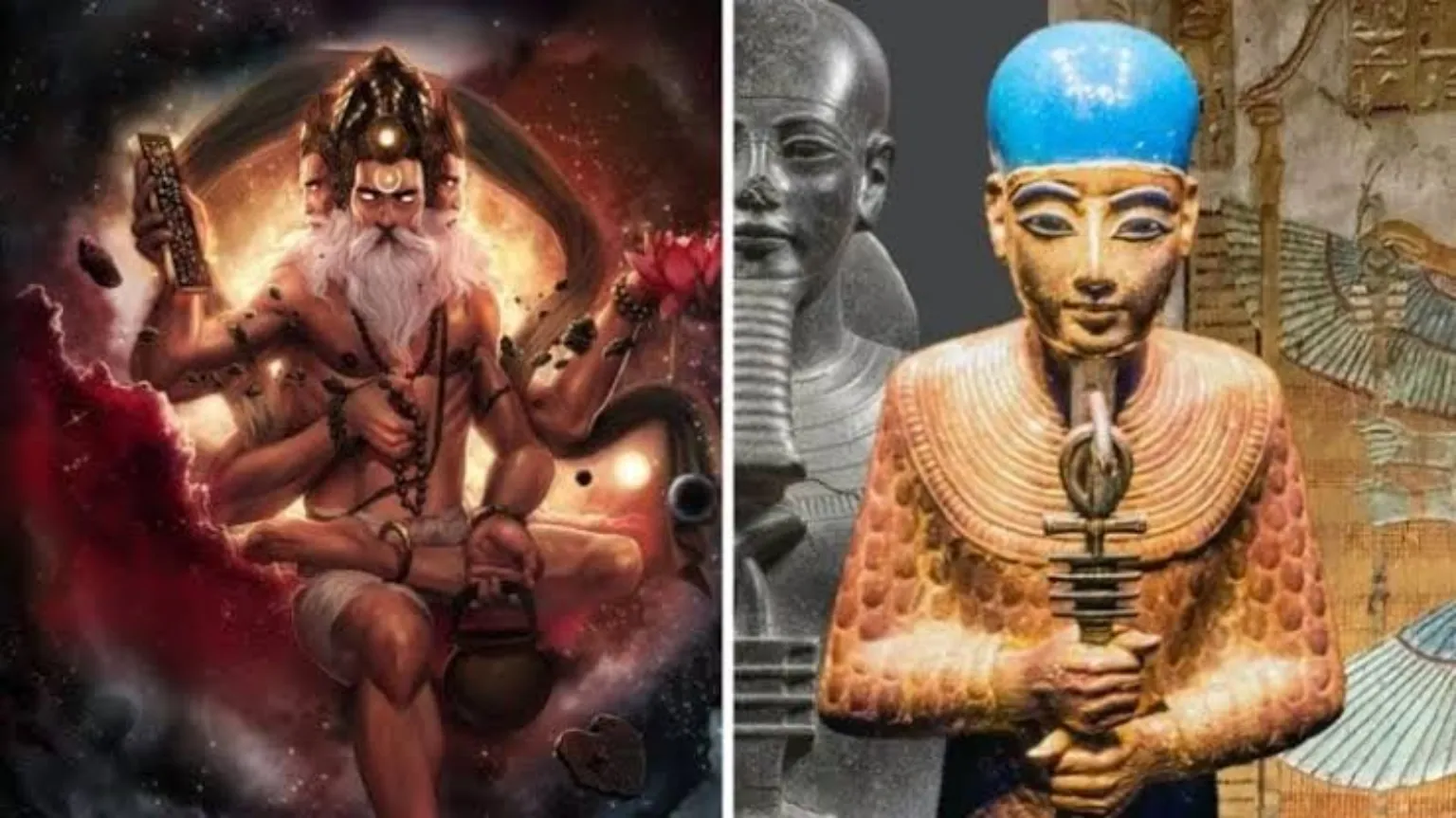
| Ptah | Brahma | Both are creator figures | Ptah creates through thought and word and is a patron of craftsmen; Brahma is the creator in the Hindu trinity |
Anubis and Yama
Anubis is the jackal-headed god of embalming who helps the dead reach judgment. Yama is the lord of the dead in Hindu tradition and is often described as the first mortal to die. Both deal with death, but their roles differ, and Hindu thought adds rebirth, which Egyptian religion does not emphasise in the same way.
Ra and Surya
Both are sun deities who cross the sky daily. Egyptian texts picture Ra sailing in a boat through the sky and the underworld. Surya is pictured in a chariot drawn by horses. The shared idea is natural; the imagery is different.
Sekhmet and Durga
Sekhmet, a lioness goddess, is the fierce Eye of Ra in Egyptian myth. Durga is a warrior goddess who rides a lion or tiger in Hindu tradition. A lion and a fierce goddess appear in both, yet the stories are separate: one is about a nearly destructive goddess calmed by the gods, the other about a goddess defeating the demon Mahishasura.
Thoth and Saraswati, Apis and Nandi, Ptah and Brahma
Thoth is the Egyptian god of writing and wisdom, while Saraswati is the Hindu goddess of knowledge and the arts. The Apis bull was a real, chosen animal at Memphis, tied to Ptah, whereas Nandi is a divine bull and devotee of Shiva. Ptah creates the world by thought and speech, and Brahma creates in the Hindu tradition. In each case the role matches, but gender, story and worship differ.
Story box (retold, not historical): Imagine a traveller standing by the Nile at dawn and another by the Ganga at dawn. Each sees the sun rise and each tells a story to explain it. One says a god sails a boat, the other says a god drives a chariot. The stories look alike because the sunrise is the same, not because one borrowed from the other.
History, Mythology and Speculation
| Category | What belongs here |
|---|---|
| History | Egyptian and Indian civilisations existed; some trade is documented in the Roman period |
| Mythology | The stories of Ra, Anubis, Surya, Yama and others in their own texts |
| Speculation | Claims that Egyptian gods are Hindu gods under other names, or that one religion produced the other |
Myth vs Fact
| Popular claim | Careful answer |
|---|---|
| Egyptian gods are Hindu gods with new names | No. Similar roles do not prove the same origin |
| Egypt got its religion from India | No accepted evidence; Egyptian religion developed locally |
| Hinduism got its ideas from Egypt | No accepted evidence either |
| Comparing them is pointless | Comparison is useful when it stays honest about differences |
Frequently Asked Questions
Is Egyptian mythology the same as Hindu mythology?
No. They share some themes but have different gods, stories and beliefs.
Is Anubis the same as Yama?
No. Both relate to death, but Anubis guides the dead and Yama rules and judges them.
Is Ra the same as Surya?
They are both sun deities, but they come from different religions and have different myths.
Is Sekhmet the same as Durga?
No. Both are fierce goddesses with lion links, but their stories differ.
Did Egypt and India ever meet?
Trade between the two regions is documented in the Roman period. Earlier direct contact is not well proven.
Which is older?
Both are ancient. Dates for Vedic texts are debated, so a simple “older” answer is not reliable.
Why do the symbols look similar?
Lotus, serpent and sun are natural symbols that many cultures use.
Is it disrespectful to compare them?
Not when the comparison is respectful and does not claim that one faith is a copy of another.
Reliable Sources
- World History Encyclopedia: Egyptian Mythology
- Egypt Exploration Society: Gods of Egypt
- The Met: Divine Egypt
Last updated: 25 November 2026. Related reading: Egyptian gods family tree, Greek vs Hindu mythology on Vista Hub.
Related guides: Eye of Horus vs Eye of Ra: Meaning, Differences, Left vs Right Eye and Tattoo Symbolism · Is Amun-Ra Related to Lord Rama? Claims vs Historical Evidence












Share Your Opinion
Comments are closed on this post.