 Vista

Short answer: No. There is no evidence that aliens built the Egyptian pyramids. Archaeologists have excavated the town where the builders lived and worked, found their bakeries, tools and tombs, and read the logbook of a man who carried stone to the Great Pyramid during Khufu’s reign. The alien idea became popular in the 20th century, but it skips over everything the Egyptians actually left behind.


Quick Facts
| Point | Detail |
|---|---|
| Great Pyramid | Built for King Khufu, around 2600 BCE (Fourth Dynasty), roughly 4,500 years ago |
| Builders | Egyptian workers and specialists organised by the state, not visitors from space |
| Evidence of builders | A planned town at Giza (Heit el-Ghurab), bakeries, cemeteries, tools, quarries and the Merer papyri |
| Oldest inscribed papyri | Found in 2013 at Wadi al-Jarf on the Red Sea coast; they include Merer’s logbook |
| Original name of the Great Pyramid | Akhet-Khufu, “Horizon of Khufu”, named in the logbook |
| Alien claim popularised | Mainly by ancient-astronaut writers such as Erich von Daniken from 1968 |
Who built the pyramids?
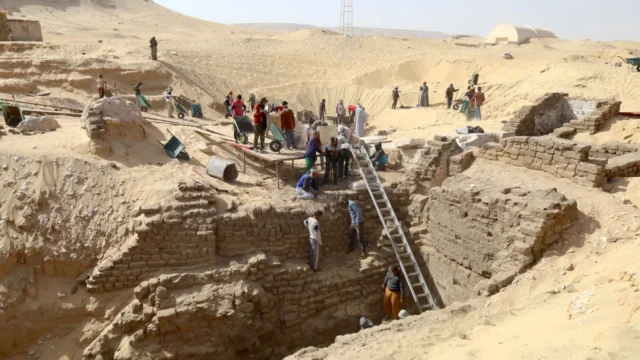
Egyptologists conclude that organised teams of Egyptian workers built the pyramids under royal officials. This is not a guess from one object. It comes from several independent kinds of evidence that point the same way: a settlement, written records, tools and quarries, and the burials of the people themselves.
The word “builders” also needs care. A pyramid complex needed stone cutters and haulers, but also boat crews, surveyors, scribes, cooks, bakers, brewers, potters, carpenters and copper workers. When we say “the Egyptians built it”, we mean a whole society that fed, housed and paid this workforce for years.
The town where the builders lived
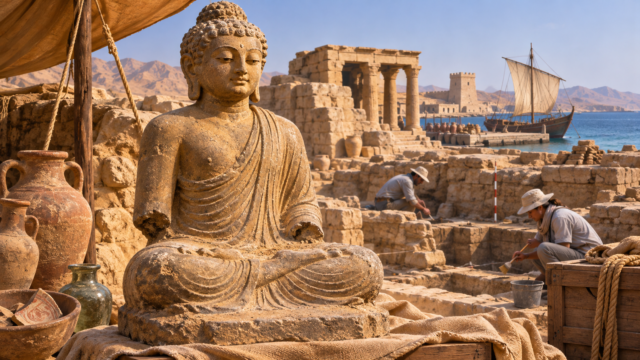
For a long time nobody knew where the Giza workforce lived. At other Egyptian monuments archaeologists had found nearby settlements, but not at Giza. Mark Lehner began asking where the “construction site trailer” and workshops were. In December 1988 his team started excavating a previously unknown site about 400 metres south of the Sphinx, near a huge stone barrier called Heit el-Ghurab, the “Wall of the Crow”. The project (Ancient Egypt Research Associates, AERA) describes it as a vast town that housed the people who built the pyramid complexes and also those who sustained the town and its workforce.
The site is often called the “Lost City of the Pyramids”. Lehner has described a division of labour inside it: accountants and administrators in one part, and bakers and other food producers in another, with copper tools for workers being weighed out and weighed back in. That is the kind of detail a bureaucracy leaves behind, and a visiting alien crew would not need a bakery or a copper accounting system.
Later work refined the picture. Lehner reported that much of the wood and pottery from a labourers’ area came from the Levant, which led him to suggest that Heit el-Ghurab was also a busy river port linked to trade routes bringing timber and other goods. In other words, the pyramid builders were part of a wider economy, not a secret project.
Merer’s logbook: a builder speaks
In 2013 a French team led by Pierre Tallet found about 30 papyri hidden in man-made limestone caves at Wadi al-Jarf on the Red Sea coast. They are the oldest inscribed papyri known. The best preserved, often called the Diary of Merer or the “Red Sea Scrolls”, were written by an inspector named Merer, who led a crew of around forty men. Reports describe them as dating to the late years of Khufu’s reign (the exact regnal year is given as 26 or 27 in different publications).
The logbook is not dramatic. Merer records, in half-day units, loading white limestone at the Tura quarries across the Nile, spending nights at the quarry, and sailing the cargo to Giza. Because Tura limestone was used for the smooth outer casing of pyramids, Tallet believes the stones were most likely intended for the casing of the Great Pyramid. The text even uses the name Akhet-Khufu, “Horizon of Khufu”, for the pyramid.
This matters for the alien debate. A logbook from the time of construction names the king, the pyramid, the quarry, the boat route and the crew’s daily work. Nothing in it hints at anything outside normal Egyptian logistics.
The strongest evidence at a glance
- Workers’ town at Giza: houses, bakeries, workshops and food waste at Heit el-Ghurab, excavated since 1988.
- Merer’s logbook: papyri from Wadi al-Jarf record a crew carrying Tura limestone to Giza in Khufu’s reign.
- Quarries and tools: copper tools, stone pounders and unfinished blocks show how stone was cut.
- Builders’ tombs: workers and officials were buried near the pyramids with simple offerings.
- Harbour and trade traces: Red Sea and Nile port installations that supported the project.
How could they do it?
Methods debated by scholars include sledges on prepared tracks, ramps, levers and large teams, with boats moving stone along the Nile and, in the Giza area, via harbour basins. Exactly how every block was raised is still discussed, and several ramp designs have been proposed. Scholars disagree on details, but a debate about method is not evidence for aliens. It is the normal work of archaeology: we also debate how Roman concrete was mixed and how Stonehenge stones were moved.
It also helps to remember the timeline. The Great Pyramid was not Egypt’s first attempt. Earlier pyramids show the learning curve, including changes of angle in some structures. Skills grew over generations of royal building projects, which is what we expect from human engineers and not from a ready-made foreign technology.
Story box (imagined, based on the logbook type of evidence): A crew leader writes down how many days his team spent hauling stone by boat. He records the trip, the cargo and the delivery. It is a boring work diary, and that is exactly the point: real builders leave boring records.
Why does the alien idea spread?
The pyramids are huge and old, and it is easy to feel that ancient people could not have done it. That feeling underestimates human skill, and it also quietly denies the achievement of the Egyptians. Popular books and TV shows from the late 1960s onward turned the idea into entertainment, and the claim spreads easily because it is simple, dramatic and needs no evidence.
A science-first approach asks a different question: what would we expect to find if aliens had built the pyramids, and what do we actually find? We would expect foreign materials, unexplained technology and no human workers. We find local limestone and granite, copper tools, human bakeries and human graves. Read our broader guide on Egyptian pyramid mysteries, and our look inside the pyramid in Inside the Great Pyramid, for more.
History, Mythology and Speculation
| Category | Examples |
|---|---|
| History | Khufu’s pyramid, the workers’ town, Merer’s logbook, Tura quarries |
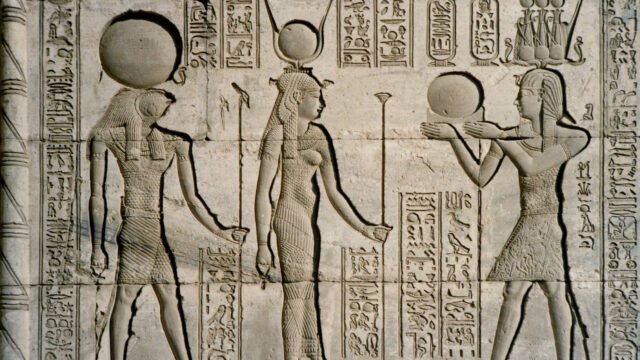
| Mythology | Egyptian myths of sky gods and creation, not building records |
| Speculation | Aliens, lost advanced civilisations, secret machines |
Myth vs Fact
| Popular claim | Careful answer |
|---|---|
| Ancient Egyptians could not build pyramids | Evidence shows they could and did |
| No tools survive | Copper tools and stone pounders were found |
| Slaves built them | Evidence points to organised workers with food and burials |
| No one knows how | Several methods are well supported, details still debated |
| There are no records | The Merer papyri are records from Khufu’s own time |
Frequently Asked Questions
Did aliens help build the pyramids?
No evidence supports this. Every major line of evidence, from the workers’ town to the logbook, points to Egyptians.
Who built the Great Pyramid?
Egyptian workers under royal officials, for King Khufu.
What is Merer’s logbook?
A set of papyri describing a crew that carried limestone from Tura to Giza in Khufu’s reign. It is among the oldest inscribed papyri found.
Were the workers slaves?
Evidence suggests fed, organised workers who were buried near the pyramids. The old slave-labour picture is not supported by the Giza excavations.
What tools did they use?
Copper tools, stone pounders, wooden sledges and levers.
How were the blocks lifted?
Ramps and levers are proposed; the exact method is still debated.
Who started the alien theory?
It was popularised in the 20th century by ancient-astronaut writers.
Why do people still believe it?
The scale is amazing and the idea makes a good story.
Reliable Sources
- AERA: The Lost City of the Pyramids (Heit el-Ghurab)
- PBS NOVA: Excavating the Lost City (interview with Mark Lehner)
- Smithsonian Magazine: The world’s oldest papyrus and the Great Pyramid
- National Geographic: This ancient diary reveals how Egyptians built the Great Pyramid
- Archaeology magazine: Port of the Pyramids
Last updated: 25 November 2026. Related reading: Were Egyptian gods aliens? Great Pyramid stargate claims.












Share Your Opinion
Comments are closed on this post.