 Vista
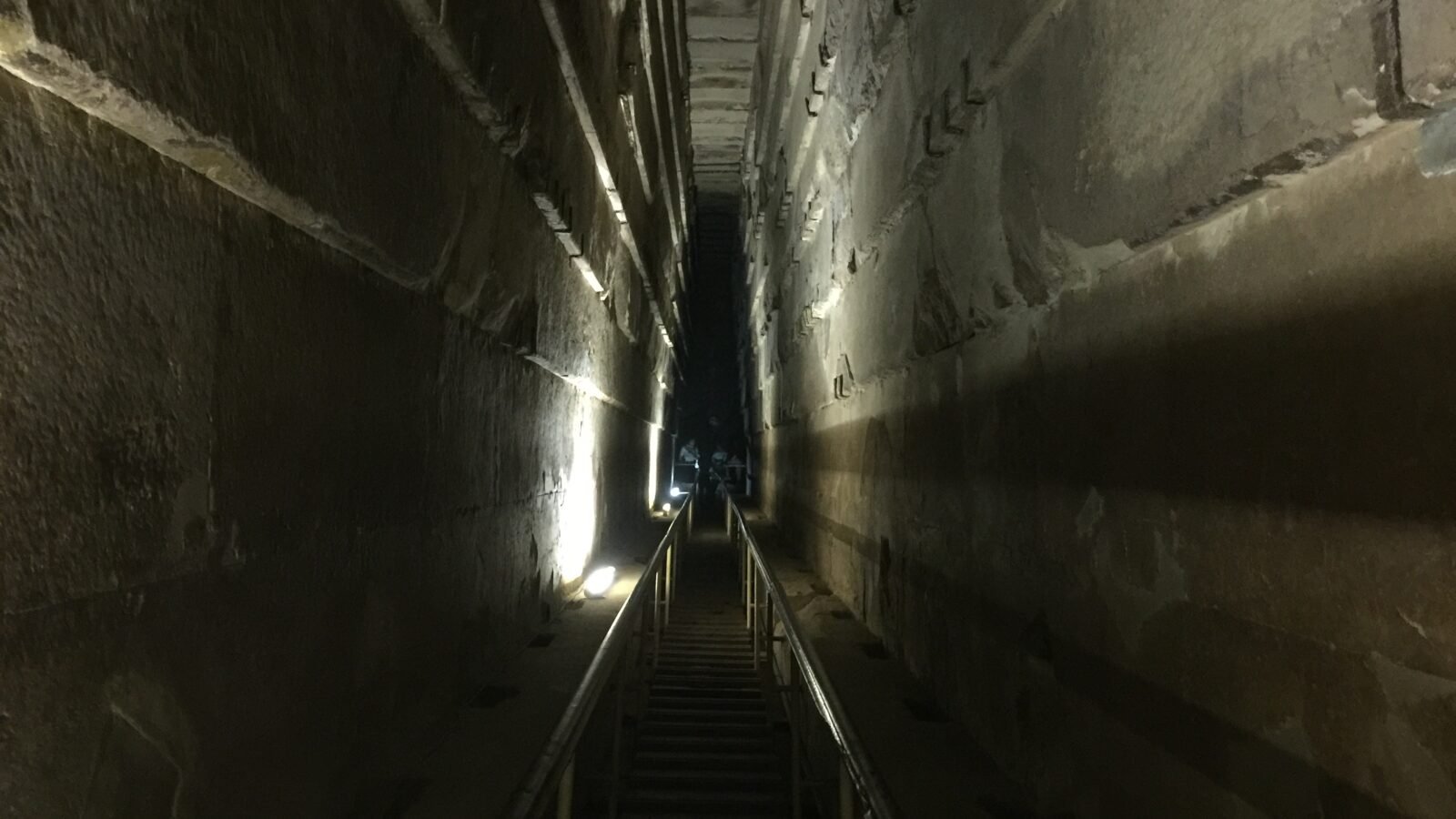
Inside the Great Pyramid of Giza there are three main known chambers and a set of passages: the King’s Chamber with an empty granite sarcophagus, the so-called Queen’s Chamber, an unfinished underground chamber cut into the bedrock, and the soaring Grand Gallery that connects the upper levels. The pyramid was built for King Khufu around 2560 BCE. Modern muon scanning has also detected a large hidden void above the Grand Gallery (reported in 2017) and a small corridor behind the entrance chevrons (reported in 2023). What these spaces are for is still being studied, and no secret treasure room has been confirmed.

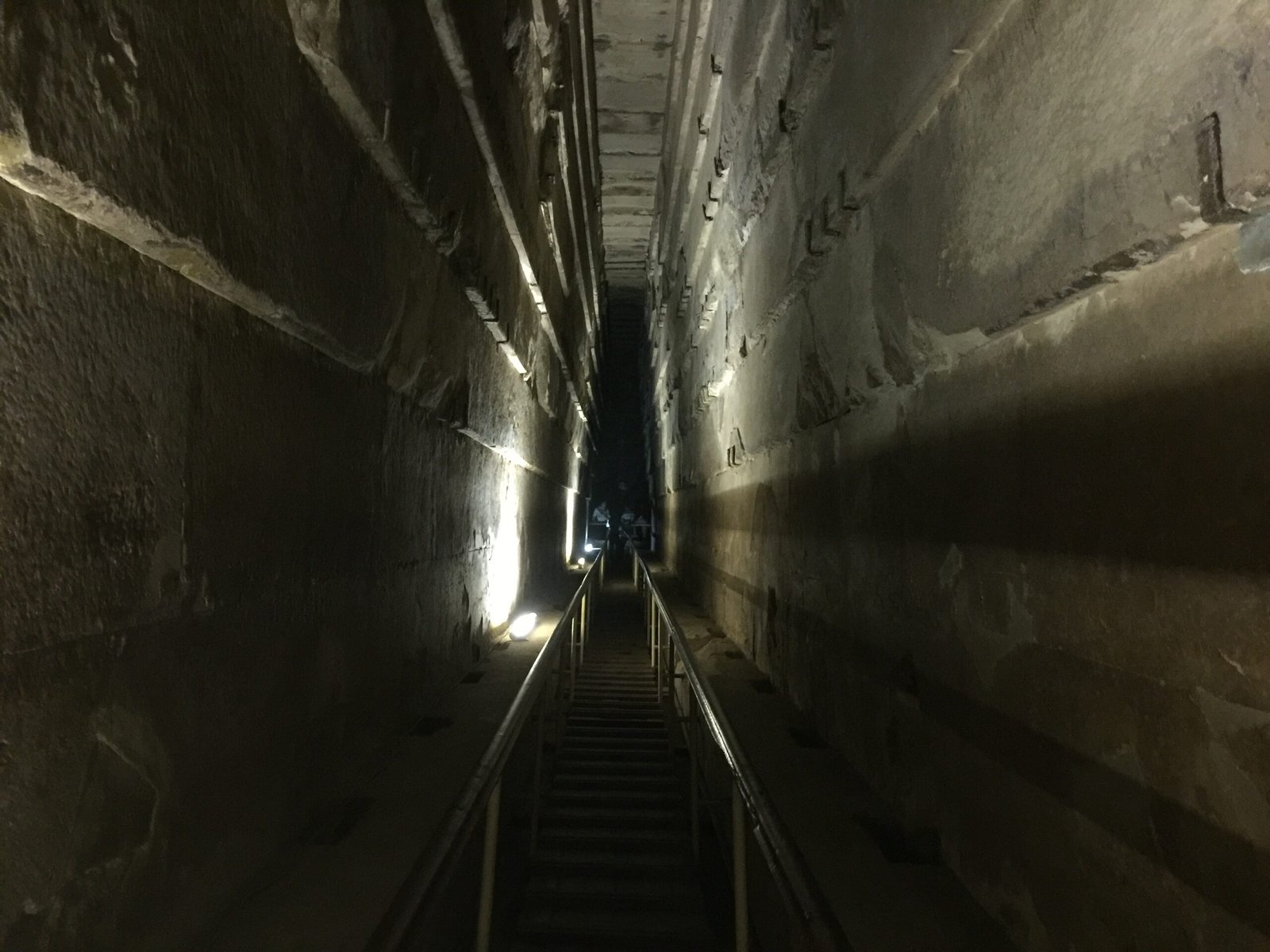
Grand Gallery photograph: Keith Adler, Wikimedia Commons, original source, CC BY-SA 4.0. No intentional edits.

Great Pyramid Quick Facts
| Item | Detail |
|---|---|
| Built for | King Khufu (Fourth Dynasty), c. 2600–2500 BCE |
| Original height | About 146 metres (today a few metres less) |
| Known chambers | King’s, Queen’s, subterranean |
| Sarcophagus | Granite, found empty; no body has been found inside |
| Recent scanning | ScanPyramids project, using muon imaging and other non-invasive methods |
The Main Chambers and Passages
| Space | What it is | Note |
|---|---|---|
| Descending passage and subterranean chamber | Passage leading down into the bedrock | Left unfinished |
| Ascending passage | Branches upward from the descending passage | Blocked by granite plugs, bypassed by a tunnel |
| Grand Gallery | Tall corbelled hall | An engineering showpiece |
| King’s Chamber | Granite room with a sarcophagus | Above it are stress-relieving chambers |
| “Queen’s Chamber” | Smaller limestone room | The name is a modern label, not an ancient one |
Above the King’s Chamber are five low “relieving” compartments that were built to spread the weight of the masonry. Workers’ graffiti found in them includes Khufu’s name, which supports the dating. Claims that this graffiti was forged have been examined and are rejected by Egyptologists.
Hidden Voids Found by Scanners
The ScanPyramids team used muon detectors, which register cosmic-ray particles passing through stone, to look for low-density regions. In 2017 they reported a “Big Void” of at least about 30 metres in length above the Grand Gallery, and in 2023 reported a roughly nine-metre corridor behind the north-face entrance chevrons. Researchers describe these as spaces whose purpose is not yet known; ideas include construction features that help hold up the weight of the structure. These are results from scanning, not entered rooms, so avoid claims of “hidden tombs” or “secret treasure” without evidence.
Story box (reconstruction): A physicist sits in a dim passage beside a plate of detectors left in place for weeks. Particles from space pass through the stone and leave faint marks. On a screen, a pale shape appears where solid rock should be. “There is something there,” she says quietly. This scene is a reconstruction of the process, not a record of one person.
How Was It Built?
Evidence for how it was built includes quarries at Giza, a workers’ town, and papyrus logbooks found at Wadi al-Jarf (reported in 2013) that record the shipping of limestone to Giza during Khufu’s reign. Details such as the exact ramp systems are still debated. For the wider picture, see our guide to Egyptian pyramids and our overview of ancient Egypt’s mysteries.
How to interpret the two ScanPyramids discoveries
The 2017 study identified the Big Void above the Grand Gallery using three independent muon detection techniques. Its minimum length was estimated at 30 metres. A separate 2023 paper characterized the corridor behind the north-face chevron. These are distinct structures, and their appearance in headlines does not mean a new decorated burial chamber has been entered.
Muon radiography estimates differences in density: fewer particles pass through thick stone than through an equivalent path containing empty space. That can reveal the size and approximate position of a cavity, but not establish its original purpose or contents. A useful distinction is between a detection, a measured structure and a physically inspected space. They represent different levels of archaeological knowledge.
Original references: Source 1 · Source 2
History, Mythology and Speculation
| Category | What belongs here |
|---|---|
| History | Khufu’s reign, chambers, workers’ graffiti, logbooks, quarries |
| Mythology | Royal afterlife beliefs, the king’s journey to the sky |
| Speculation | Secret treasure chambers, ancient machines, lost technology, “Hall of Records” |
Myth vs Fact
| Popular claim | Reality |
|---|---|
| The pyramid is full of secret rooms. | A few voids have been detected; their purpose is unknown. |
| The sarcophagus held Khufu’s mummy. | It was found empty; the king’s body has not been found. |
| The Queen’s Chamber was for a queen. | This is a modern name; its real purpose is uncertain. |
| Aliens or lost technology built it. | No evidence; the archaeology points to Egyptian workers. |
Frequently Asked Questions About the Inside of the Great Pyramid
What is inside the Great Pyramid?
Passages, the Grand Gallery, the King’s and Queen’s Chambers and an unfinished underground chamber.
Was Khufu’s mummy found?
No. The sarcophagus was empty when explorers entered in modern times.
What is the Big Void?
A large empty space detected above the Grand Gallery by muon imaging, reported in 2017.
Can tourists enter it?
Usually the King’s Chamber and the Grand Gallery are open with a separate ticket, but access rules change, so check official Egyptian sources before travel. The passages are narrow and steep.
Is there treasure inside?
No treasure room has been confirmed. The pyramid was robbed in antiquity.
How are the voids scanned without damage?
By muon detectors and other non-invasive tools such as thermography.
Why is it called the Great Pyramid?
It is the largest of the Giza pyramids and was the tallest human-made structure for thousands of years.
Are there curses inside?
No. See our fact check on the Tutankhamun curse.
Reliable Sources
- World History Encyclopedia: Egyptian Mythology
- Egypt Exploration Society: Gods of Egypt
- The Metropolitan Museum of Art: Divine Egypt
Last updated: 25 November 2026. Related reading on Vista Hub: Egyptian pyramids guide, the Great Sphinx, ancient Egypt’s mysteries.













Share Your Opinion
Comments are closed on this post.