Some places refuse to become ordinary. Egypt’s pyramids are one of them. People still ask how stone piles that old can look so exact, why kings were sealed inside them, and whether modern machines could copy the same shape. This article walks through egyptian pyramid mysteries facts as they are commonly told, then separates documented history from belief, folklore, modern claim and rumor.
The Hindi source behind this English rewrite treats the pyramids as both royal tombs and unfinished puzzles. That double reading is useful — if you keep the labels honest. A tomb can be real and still leave open questions. A popular number can be widely repeated and still need a caution tag. What follows uses the same names, measurements and claims from that source, then explains what kind of statement each one is.
Why Egyptian pyramids still sit between history and mystery
The source opens with a simple observation: the world still holds puzzles that people have not fully closed. Egypt’s pyramids sit high on that list. It is commonly said that they were built about 4,000 years ago. That round figure is a popular time-mark, not a laboratory timestamp printed on every stone. It places the monuments in a deep past, far enough that no living memory can explain the work site.
From that distance, two feelings collide. One is historical: these are buildings made by an old civilization whose remains still speak. The other is mystery-minded: if the job looks hard now, how did it happen then? The source leans into that second feeling. It says that even if people tried to rebuild a pyramid “like Egypt’s” with today’s technology, the task would be impossible — and that this is why scientists remain astonished and keep researching how the originals were made.
That last point needs a clear label. Documented fact: pyramids are still studied. Surveys, chamber mapping and conservation work continue because the monuments are large, old and incomplete in the written record. Modern claim / popular mystery line: “today’s technology cannot build one.” That sentence is a rhetorical shock, not an engineering certificate. Modern industry can cut, lift and stack stone. What is harder is copying the same political will, labor system, quarry chain and religious purpose that made a king’s tomb the center of a whole landscape.
So the real tension is not “aliens versus engineers.” It is “what we can document” versus “what viral posts treat as unsolved magic.” Keep that split in mind. Mystery language is allowed when a detail is genuinely incomplete. It becomes rumor when a gap is filled with a story no evidence supports.
Tombs, mummies and what burial custom actually meant
The source’s core historical claim is straightforward: Egyptian pyramids are understood as a kind of grave in which kings were buried. Bodies placed in that tradition are called mummies. In the largest pyramid, it is said, the ruling “emperor Pharaoh” of that time was laid to rest. “Pharaoh” here is a title for the king, not a personal name supplied by the source. The article does not name a specific monarch, so this rewrite does not invent one.
Documented historical frame: royal burial architecture, body preservation, and grave goods belong to ancient Egyptian afterlife belief. A king was not only hidden. He was provisioned. The source lists food and drink, clothes, jewelry, vessels, weapons and animals as items arranged with the dead so the body would remain “safe” in that other life. That is religious belief expressed in material form, not a modern inventory of every chamber.
One darker line also appears: sometimes servants and attendants were buried alive with the king. Treat this as traditional / source belief, not as a proven rule for every pyramid in Egypt. Early royal funerary violence is discussed in Egyptology, but the source gives no dated case, no named tomb and no count. A responsible reading is: retainer burial is part of the older story people tell about these tombs; it should not be copied onto every later pyramid as if it were a standing law.
Mummification itself is easy to sensationalize. In the source it is simply the name for bodies prepared and placed inside the pyramid system. The point of the custom, as the same text frames it, was protection plus provision. Jewelry and weapons were not random treasure. Food was not a picnic leftover. In the religious picture, the dead king still needed a world that looked like life. That is why pyramids feel like more than stone triangles. They were machines for a belief: that royal identity should survive death in a prepared house.
More than 130 pyramids — and why Giza’s Great Pyramid stands apart
Ancient Egypt is described in the source as a very old civilization. Pyramids and recovered remains are treated as the story of that civilization written in stone and objects. The same passage says Egypt is believed to have more than 130 pyramids. That number is a popular total in the source, not a live excavation log. Counts change with what researchers include: complete monuments, ruined cores, or disputed mounds. Use “more than 130” as the source’s working figure, not as a census you can audit from this page.
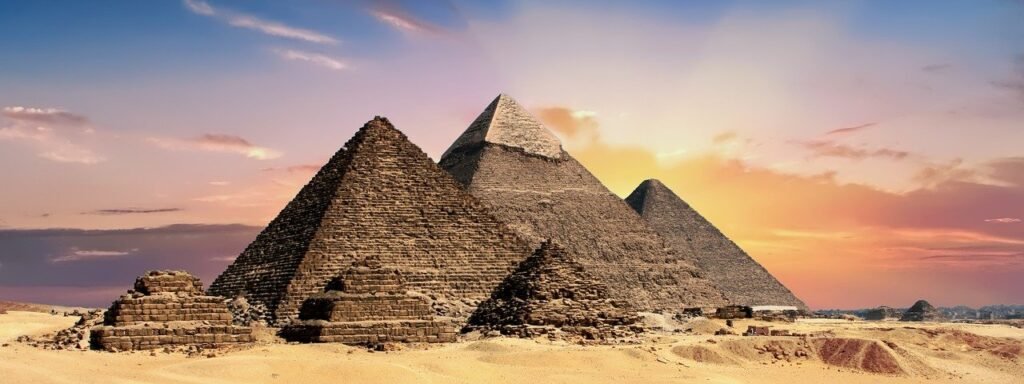
Among those structures, the largest is the pyramid at Giza, called the Great Pyramid. The source places it on the list of the Seven Wonders of the World and notes that it has stood for thousands of years in recognizable form. That combination — size, fame, survival — is why Giza swallowed the public imagination. Other pyramids exist. Many are smaller, damaged, or less photographed. Giza became the face of the whole tradition.
Two labels help here. Documented / widely accepted: Giza’s Great Pyramid is the standout monument in the popular and historical list used by the source; it is the one tied to the Seven Wonders tradition and to the idea of a king’s supreme tomb. Incomplete detail: the source does not map every other pyramid field, name each builder, or explain how the 130-plus count was compiled. Filling those blanks with extra dates or dynasty charts would be invention.
What the remains do show, even in this limited telling, is scale plus continuity. A civilization that can raise a wonder and leave goods, bodies and surrounding statues is not a blank. It is a society organized enough to quarry stone, plan a burial house and keep a royal story visible on the desert edge. Mystery begins after that fact, not instead of it.
Egyptian pyramid mysteries facts on height, blocks and weight
This is the section where the source gets specific — and where readers should watch units. According to that list, the Great Pyramid of Egypt is about 450 feet high. Its base is said to spread over 13 acres. Construction used 2.3 million stone blocks (23 lakh in the original wording). The combined weight of those blocks is given as about 5 arab 21 crore kilograms — that is, about 5.21 billion kilograms as written in the Hindi article. The stones named are limestone and granite.
A second cluster of weights follows. Blocks are said to range from 2 tons to 30 tons. Some stones are put at up to 45,000 kilograms. Then comes the shock comparison: in “today’s time,” the maximum weight that can be lifted is given as 20,000 kilograms, so how were 30-ton blocks raised thousands of years ago?
Label that comparison carefully. The 450-foot height, 13-acre base, 2.3 million blocks, limestone-and-granite mix, and the wide tonnage range are source measurements — popular figures attached to the Great Pyramid in that article. They are not independently re-measured here. The “20,000 kg maximum lift today” line is a popular claim inside the source, not a global rule of modern engineering. Heavy-lift machines in the present can move far larger loads than 20 tons. The sentence works as folk astonishment, not as a certified crane limit. If you repeat it, repeat the label.
FACT BOX
Figures as given in the source article, not as new lab results: Great Pyramid height about 450 feet; base about 13 acres; about 2.3 million stone blocks; combined weight about 5.21 billion kilograms; limestone and granite; individual blocks from 2 tons to 30 tons, with some cited at 45,000 kg; Egypt commonly said to have more than 130 pyramids; Giza’s Great Pyramid listed among the Seven Wonders and still standing after thousands of years.
What these numbers do establish, even with caution tags, is mass. A building that large is not a hut with a pointed roof. It is a planned mountain of cut stone. That is enough to explain why construction method became a public mystery. It is not enough to prove that the work was supernatural. Size creates wonder. Wonder is not the same thing as a missing civilization.
Chambers, missing mummies and the “always 20°C” claim
The source is unusually honest about rooms. It says there is no confirmed, final count of how many chambers the Giza pyramid contains. Research reported there has found three underground rooms / vaults, taken to be the king’s and queen’s chambers. The surprise attached to that finding is this: the mummies of the king and queen have not been found in those pyramids so far.
That gap is a real source claim and a useful brake on treasure-hunt stories. A tomb design does not guarantee that the original body is still inside, waiting for a camera. Burial chambers can be planned, used, emptied, reused, or never occupied in the way later visitors expect. “King and queen chambers” is an interpretation of spaces that were found. “Mummies missing” is the source’s report of what those searches have not produced. Neither sentence should be stretched into a secret-living-pharaoh rumor.
A separate cluster of claims describes climate and strength. The pyramids are said to be built so that inner temperature stays controlled. Outside heat or cold may change; inside, the temperature is described as remaining around 20 degrees Celsius. The same passage says the monuments work like an air conditioner and can also withstand earthquake shocks.
Treat the 20°C and “AC” lines as popular reported claims, not as a published year-round weather log from every chamber. Thick stone can buffer daily heat. That is a general physical tendency of mass masonry, not a magical thermostat proven by this article. Earthquake resistance is likewise a source assertion about durability. The Great Pyramid’s survival for thousands of years is the supporting image the text offers. It does not supply a seismic study, a magnitude table, or a modern stress test. Durability is visible. A full engineering certificate is not in the source.
The Great Sphinx: one stone, many unanswered questions
Outside the pyramids, the source describes a statue that looks half animal and half human. The head, it says, appears like that of a woman. The name given is the Great Sphinx. The text calls it the most astonishing statue in the world and adds that no information has yet been found about why it was made. Its special feature, in the same list, is that it was cut from a single stone.
Split the sentence. Documented monument in the source: a colossal mixed-form statue stands with the Giza pyramids and is known as the Great Sphinx; it is presented as carved from one stone. Descriptive detail from the source: the head is said to look female. Other public descriptions often read the face as a king’s, but this rewrite keeps the source’s wording and does not “correct” it with an unsourced portrait identification. Open question / source mystery line: purpose not settled in the account — “why it was made” remains unanswered there.
That last gap is where folklore grows. A guardian of the plateau, a royal portrait, a solar symbol, a forgotten cult image — those are later stories people attach to a statue that does not explain itself in a caption. The honest position is narrower. The Sphinx is part of the same Giza setting as the Great Pyramid. It is carved at a scale that still stops visitors. Its exact brief — who ordered it, which face it copies, which rite it served — is not closed in the source article. Mystery, in that limited sense, is fair. Invented secret societies are not.
Construction research versus the “impossible today” myth
The source returns, again and again, to one astonishment: how were these pyramids built thousands of years ago if even present-day technology supposedly cannot repeat them? Researchers, it says, are still working on the method. That loop is the heart of the popular mystery.
Here the fact-versus-myth cut matters most. Documented enough to say: the Great Pyramid is a huge limestone-and-granite structure; block counts and tonnage in the source are enormous; inner spaces have been only partly mapped; the original royal bodies associated with the “king and queen” rooms have not turned up in the way visitors expect; the Sphinx’s purpose is not given a final answer. Those points justify ongoing study.
Myth-shaped claim: “modern technology cannot build this, therefore the ancient method is beyond human history.” That leap does not follow. Difficulty is not disappearance. An ancient state could organize quarries, haul stone, raise ramps or sledges, and feed a workforce without leaving a complete how-to manual for 2026 readers. Missing paperwork is not proof of a lost super-science. It is proof that the archive is incomplete.
Rumor territory: hidden energy machines, impossible physics, or a vanished race that left no other trace except triangles in the sand. The source does not document those stories. It documents wonder plus research. Stay with that. The interesting question is still real: how did crews move 2-ton to 30-ton blocks, including pieces cited at 45,000 kg, into a 450-foot monument on a 13-acre base? Wonder is allowed. A fake answer is not required.
If you want a clean summary of egyptian pyramid mysteries facts after all of the above, use three drawers. Drawer one: tomb, mummy, grave goods, Giza as the largest and a Seven Wonders survivor, more than 130 pyramids as the source count. Drawer two: measurements and popular performance claims (20°C interior, earthquake toughness, 20,000 kg “modern lift limit”). Drawer three: open files (full room count, missing royal mummies, Sphinx purpose, exact construction sequence). Mix the drawers and the article becomes spam. Keep them apart and the same material becomes readable history with honest gaps.
Advice
Read pyramid posts the way you would read a crowded family story: some parts are memory, some parts are pride, some parts grew in the retelling. Start with the physical building. Height, base, stone type and the idea of a royal tomb are the load-bearing beams. Then ask what kind of sentence you are looking at. “Researchers are still studying construction” is a process statement. “Nobody on earth could lift this now” is a dare. “Servants were buried alive in every pyramid” is a grim generalization built from a thinner source line. Each needs a different amount of trust.
When a number appears — 450 feet, 13 acres, 2.3 million blocks, 5.21 billion kilograms, 20°C — keep the number and keep the tag. Those figures come from the source list, not from a fresh survey in this article. Repeating them without the tag turns a popular fact-sheet into fake precision. The same rule applies to the 20,000 kg lift comparison. It is a shock device in the original telling. It is not a worldwide machine rating.
Use a simple test on viral “secrets.” Does the claim add a tool, a date, a named crew, or a chamber find that can be pointed to? Or does it only add atmosphere — cursed air, hidden generators, a race that vanished after one building project? Atmosphere is entertainment. It is not evidence. The pyramids do not become smaller if you refuse the extra story. They stay 450 feet of stone and argument.
If you visit images or travel pages later, expect the same split on the ground. Giza is a cemetery landscape with a famous triangle and a famous hybrid statue, not a theme park of solved riddles. Chambers may be restricted. Bodies may be absent. Guides may mix schoolbook history with wonder-talk. Your job is not to kill the wonder. It is to stop paying for a mystery that was invented in a caption.
💡 Callout: A gap in the record is not a license to invent. “We do not have the full construction diary” is a fact-shaped sentence. “Therefore it could not have been built by ancient Egyptians” is a rumor-shaped sentence. Keep the first. Drop the second.
FAQ
Were Egyptian pyramids tombs or something else?
The source treats them as a kind of tomb or mausoleum for kings, with mummies and grave goods. That is the historical frame used here. Other modern theories exist in popular culture; they are not documented in the source article.
How old are the pyramids according to this account?
The source says they are believed to have been built about 4,000 years ago. That is a round traditional figure, not a stone-by-stone laboratory date added in this rewrite.
Why were king and queen mummies not found in the Giza rooms mentioned?
The source reports three chambers identified as king and queen vaults, and says those royal mummies have not been found there so far. It does not give a final reason. Absence can mean removal, an unused chamber, or an incomplete search — the text does not choose.
Is the Great Sphinx unexplained?
In the source, yes: it is a half-animal, half-human statue cut from one stone, with a head described as woman-like, and no settled answer for why it was made. That is an open question, not proof of a hidden plot.
Can today’s technology really not build a pyramid like Giza?
That is the source’s popular astonishment line, tied to huge block weights and a claimed 20,000 kg modern lift limit. Label it as a mystery claim. It is not a complete engineering verdict, and the lift-limit comparison should not be read as a universal machine fact.
Disclaimer: This English article restates claims, measurements and mystery lines from the Hindi Vista Hub source on Egyptian pyramid facts. Figures such as 450 feet, 13 acres, 2.3 million blocks, 5.21 billion kilograms, 20°C and the 20,000 kg lift comparison are source-stated, not independently verified here. Religious burial custom is described as belief and practice in that account. Construction method remains an active research question. This page is general reading, not archaeological fieldwork or travel advice.