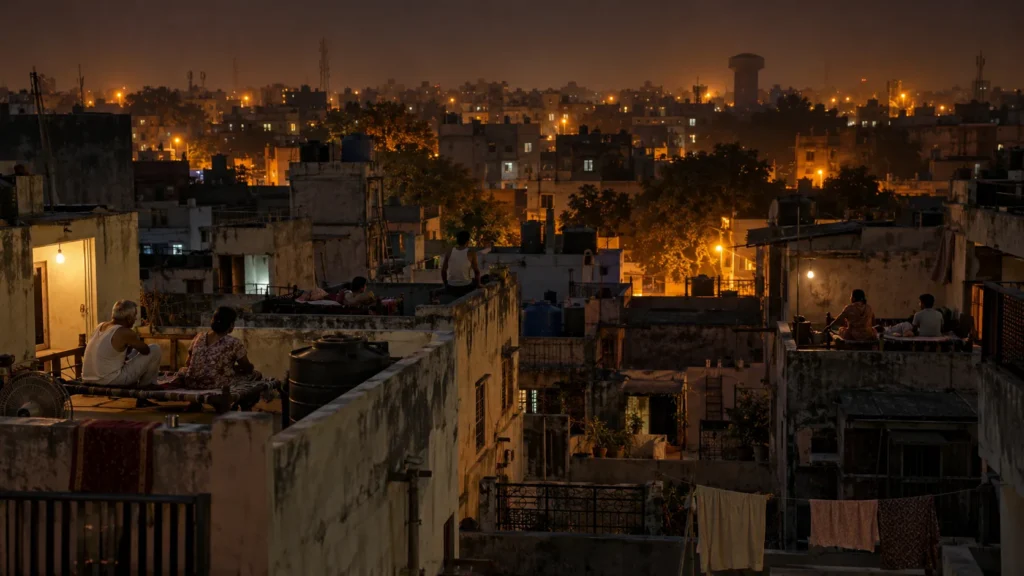
A power cut. A terrace. A neighbour screaming that something black had landed on the next roof. In May 2001 that sequence ran through Ghaziabad, East Delhi and adjoining pockets until the capital had a name for the dark: Monkey Man, kala bandar, the face-scratcher. The honest question is narrow. Did a single creature hunt the city, or did heat, rumour and fear assemble one?
The public record points one way. Police never produced the animal or the costumed attacker that matched the wildest sketches. Injuries and deaths were real. The mechanism, in the official June 2001 reading and in a 2003 medical paper on the examined cases, was panic, ordinary wounds, and a story that copied itself faster than any patrol could run.
What Delhi reported that May
Early April complaints at Vijaynagar police station in Ghaziabad look, in later reconstructions, like ordinary nocturnal monkey trouble on terraces — a normal summer habit in a city that already shares roofs with real macaques. By late April a complaint described a dark, shadow-like monkey figure. By the second week of May the tale had crossed the Yamuna and filled poorer eastern neighbourhoods.
Callers used different names and different anatomies. Police announced a reward of 50,000 rupees and flooded affected stretches with extra officers; contemporary wires spoke of deployments in the thousands. Neighbourhood men walked with lathis. What did not appear was stable physical proof: no consistent trackway, no hide, no blood pattern tying hundreds of nights to one body.
S.K. Verma and D.K. Srivastava, writing in the Indian Journal of Medical Sciences in 2003, counted about 397 police calls claiming attacks between 10 and 25 May, of which 51 files were detailed enough for medical review. A June 2001 police briefing quoted by Rediff put the load near 379 calls, 303 of them dismissed as baseless. Viral round numbers that freeze a single “attack count” are shakier than these sourced ranges. The durable fact is volume without a specimen.
Too many faces for one animal
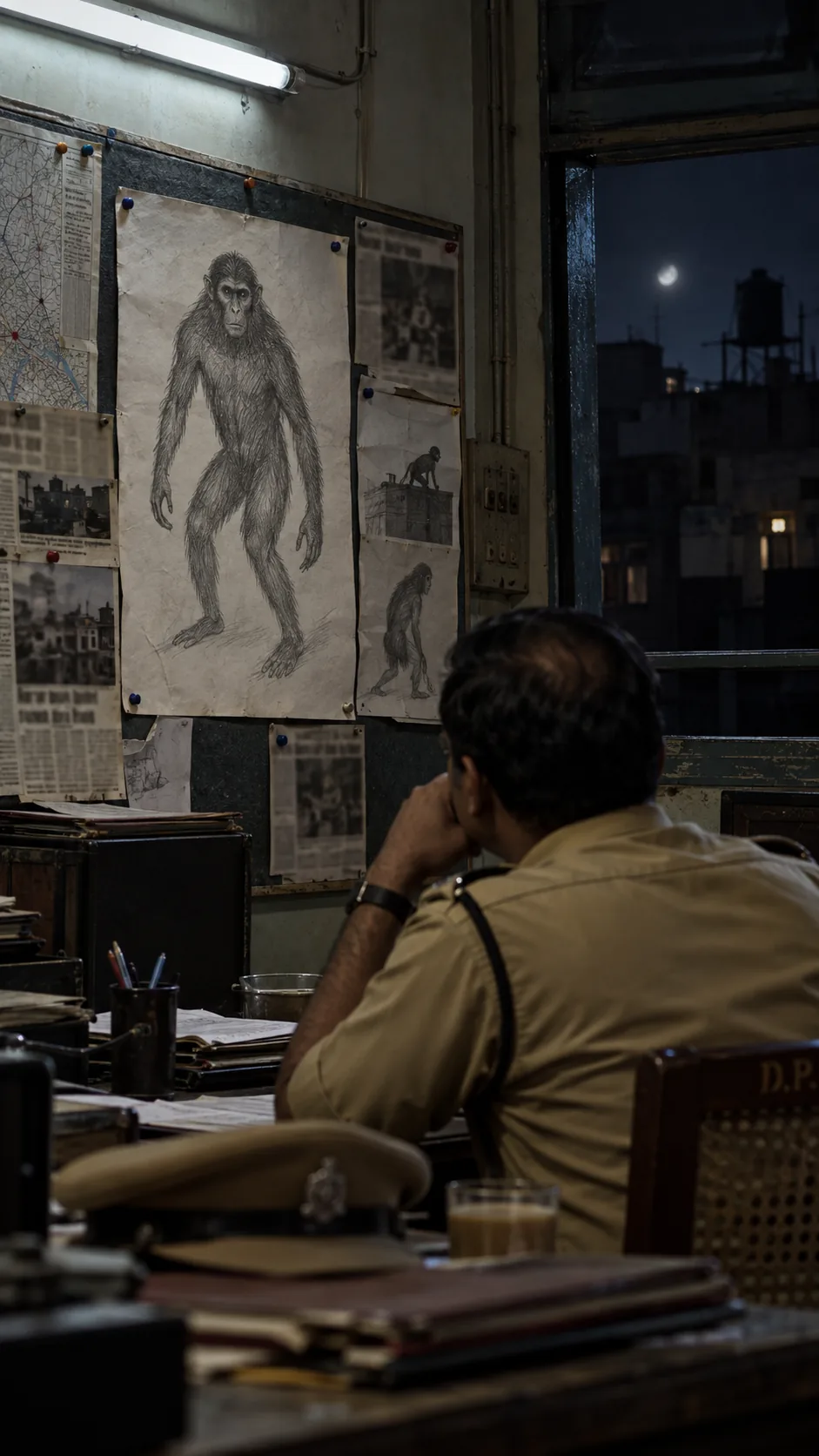
Witnesses did not agree on height. Four feet of black hair in one telling; eight feet and muscular in another. Metal helmet, metal claws, three chest buttons, glowing red eyes, springs or roller skates on the feet, a flying belt, a robot, “like Shaktimaan.” Calls were ohu-ohu, she-she or ho-ho depending on who spoke. Compiled IHBAS-linked interviews produced the same scatter: iron-like legs, black sneakers, a masked “terrible face,” even one daytime claim at 10:15 a.m.
Artist sketches released to the press looked like comic pages because the inputs fought each other. A single escaped animal or a single man in a suit should have collapsed toward one silhouette. This silhouette multiplied. Delhi’s real monkeys already leap ledges. A scratch from a rat, a cat, a macaque, a nail in sleep, or a shove in a feud can be retold as steel claws once the whole lane is repeating the same noun.
The deaths were from flight, not a claw
Contemporary outlets — among them the Independent, CNN, the Statesman and the Times of India — reported two or three deaths. Details shift slightly by desk. The pattern does not. A pregnant woman fell down stairs after neighbours shouted that the creature had arrived. A man jumped from a roof crying that the monkey had come. Some tallies add a third fall. No autopsy narrative in the mainstream 2001 coverage describes a body opened by a non-human predator.
Fear also turned on living people. A short wandering ascetic was beaten after a crowd decided he was the Monkey Man. Around 18 May a van driver was dragged out and badly injured in another case of mistaken identity. Those wounds reached hospital. The beast did not.
That distinction matters. An urban legend is folklore until someone misses a step in the dark. In 2001 people missed the step. Treating the episode as a joke erases those falls. Treating it as proof of a cyborg erases the police file.
FACT
In June 2001 a Delhi Police expert panel that included forensic examiners and mental-health specialists concluded there was no monkey or other animal behind the scare. Most injuries were too superficial to identify an assailant; several statements changed across interviews; the episode was framed as mass hysteria. The reward went unclaimed. Gang and foreign-conspiracy angles were rejected in that briefing.
What the medical board actually saw
Among cases Verma and Srivastava could examine, about two-thirds of alleged victims were men, most aged twenty to thirty. Ninety-four percent came from the poorest eastern belts; eighty-nine percent were of low socioeconomic status. Two-thirds of incidents were placed between midnight and 6 a.m. Roughly ninety-five percent showed abrasions blamed on the Monkey Man; about eighty-eight percent had multiple linear marks. The doctors noted those marks were compatible with a blunt or pointed object. A mythical claw was not required.
The June police-medical reading was blunter: wounds often too shallow for conclusions; many consistent with self-inflicted or household injury; several witnesses unreliable under psychiatric review. Heat-terrace life already produces rat bites, macaque scratches and collisions with masonry. Repeating the same label on television does the rest of the binding.
Preliminary psychological notes associated with IHBAS spoke of stress, sleep loss, eviction anxiety and high suggestibility. That is not a claim that patients were faking. Panic is a bodily event. Breath, flight, a fall, a mark on skin — those are not theatre. What never materialised is the single creature that would explain every mark with one anatomy.
How mass fear colonises a city
Mass sociogenic illness is not a synonym for lying. It describes a loop: one rumour, one visible scratch, one scream, then a thousand minds filling in the same outline. Delhi in May 2001 had the fuel — a heat wave, rolling cuts, dense working-class housing, open-air sleep, pre-existing monkeys, and newsrooms hungry for a creature headline.
In a lane, information moves by mouth. A shout becomes ten households standing up. A police jeep looks like confirmation. A printed sketch turns every dark shape into a match. Then come pranks: a monkey mask, a dyed glove tossed from a balcony, and, in 2002, a separate costume stunt in an affluent colony that was not the original wave.
The family resemblance is international. Victorian London had Spring-heeled Jack — another night attacker whose face changed with each telling. The sequence repeats: darkness, inconsistent witnesses, press heat, vigilantes, an official cold shower, silence. Monkey Man is that sequence in a north-Indian summer.
Monkeys, blackouts, and the headline machine
Rhesus monkeys in Delhi are not folklore. They use roofs and cables and sometimes bite. Keeping April’s ordinary animal complaints separate from mid-May’s helmet-and-button stories is the first honest edit. Two nights of rumour can recode a macaque scratch as metal.
When the fan dies, families move to the terrace. Darkness does half the work. Sensational front pages and looping television took a cluster of eastern calls and sold a capital-wide reign of terror. Senior officers later said unsubstantiated reports invited ever stranger testimony even though nobody held a stable sighting.
Rakesh Omprakash Mehra’s 2009 film Delhi-6 reused “kala bandar” as a metaphor for communal rumour. Cinema is not a case diary. The metaphor sticks because the city already knows how a name travels farther than a body.
An unsolved monster is the weaker reading
No sealed report produced a captured robot or a lab escapee. Police checked the zoo-escape idea; it did not hold. The June committee shut the gang-and-ISI door. The reward stayed on the table. Calls dropped after the third week of May as patrols thickened, rumour-mongers were warned, and cameras looked away.
Could a prankster have clawed a few people on a few nights? Officers floated a “mischief-monger” early on. Could one person account for hundreds of contradictory calls? The scatter of height, costume and timetable makes that the expensive theory. The cheap theory is the one written in June 2001: stress, suggestion, dark terraces, and media repetition assembling a creature that is complete only in speech.
Clips still title the story “unsolved.” Unsolved is a fair word when evidence is thin and rivals remain open. Here the rivals closed: no carcass, no hide, no single photograph, a wound pattern of ordinary abrasions, deaths by falling. Mystery packaging wins clicks. The file on the desk was already a social diagnosis.
FAQ
Did the Monkey Man exist?
No creature was secured or forensically demonstrated. The official 2001 reading was mass hysteria. Marks and fatalities were real; the proposed animal was not.
How many people died?
Period newsrooms wrote two or three deaths, all from falling off roofs or down stairs while fleeing a shout — not from a documented non-human attack. Treat exact tallies as report-dependent.
What caused the scratches?
Examined injuries were mostly superficial abrasions compatible with flight, household accidents, rats, cats or ordinary monkeys. A metal-claw lab confirmation was not published.
Why offer a reward if nothing was there?
Complaint volume forced an operational response; some officers also suspected pranksters. A bounty is not a specimen. Nobody collected it.
Is this the same story as Delhi-6?
The film borrowed the black-monkey rumour as allegory. It is not the police dossier.
Disclaimer: This article interprets public 2001 police briefings, contemporary news and a published medical paper. It is not a hunt guide or proof of the paranormal. Use sourced figures; viral robot-capture claims are not documents. Nothing here asks anyone to attack a suspected “creature.”