 Vista
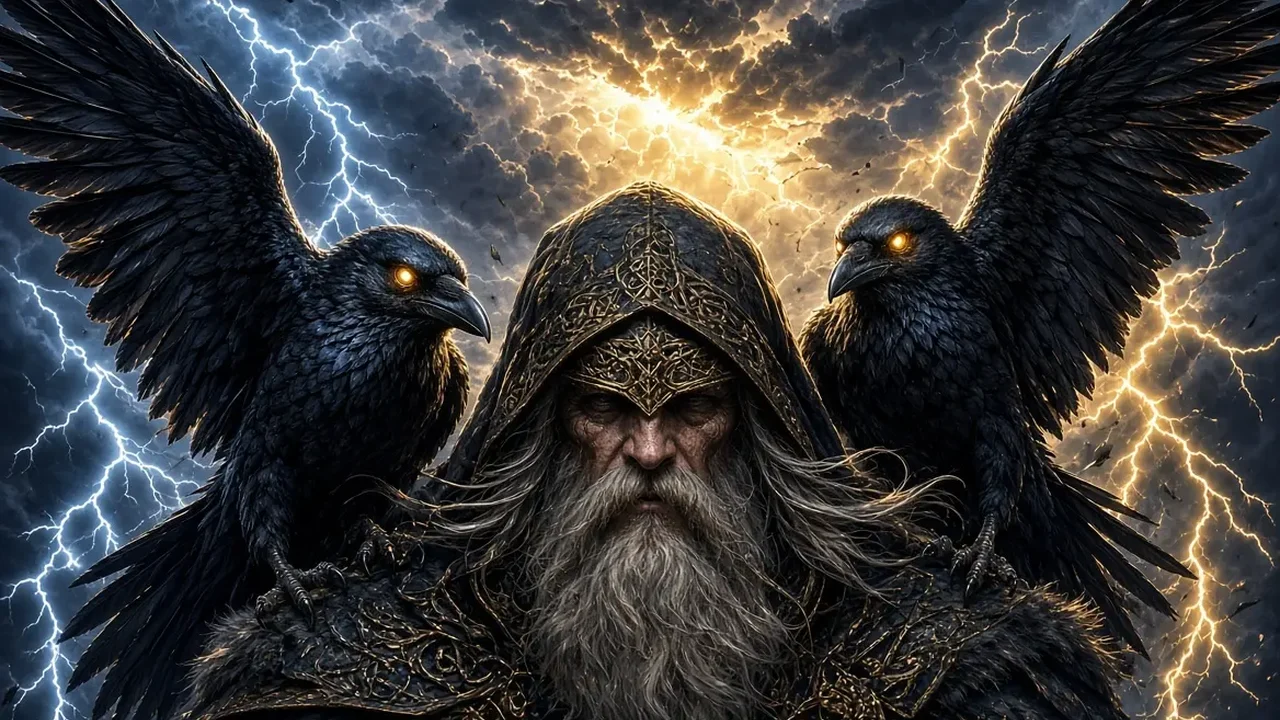
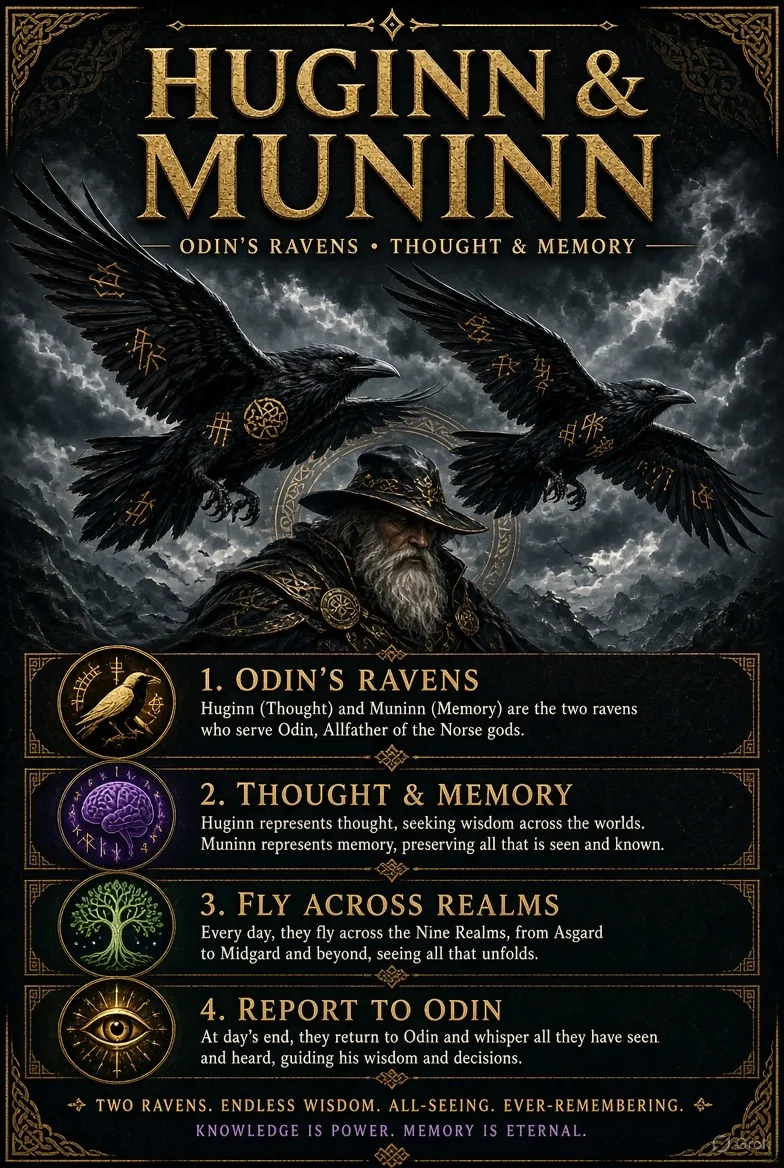
Huginn and Muninn are the two ravens associated with Odin in Norse mythology. Their names are commonly translated as Thought and Memory, though the nuance of Muninn also includes mind or remembrance. In Grímnismál, Odin describes how they fly across the world each day and confesses that he fears they may not return, especially Muninn. The Prose Edda adds that the birds sit on his shoulders, fly out at dawn and report what they have seen and heard. That makes them powerful symbols of awareness and knowledge, but not evidence of real supernatural surveillance birds.
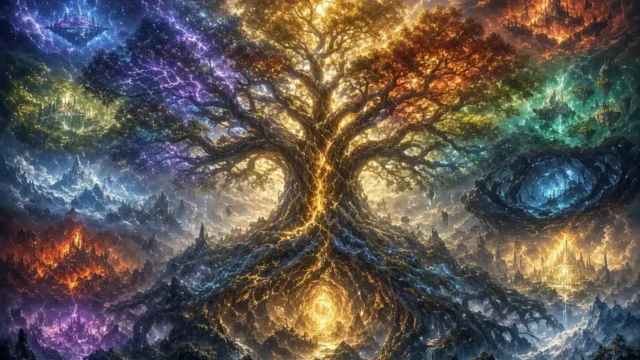
This article answers Huginn and Muninn Norse mythology, Odin’s ravens’ names, Thought and Memory meanings, what the birds tell Odin, why he fears their loss, how they differ from his wolves Geri and Freki, and whether a pair of raven tattoos is a historically fixed Viking symbol. The gallery artwork is creative mythology imagery, not a documentary photograph.
Who Are Huginn and Muninn?
The two ravens are among Odin’s most recognizable animal companions. Old Norse poems and later prose place them close to the god associated with wisdom, poetry, battle, wandering and dangerous knowledge. Their names occur as Huginn and Muninn, with alternative spellings Hugin, Munin, Hugin and Munin in different English adaptations. A raven perched on each shoulder is a familiar modern portrait, but the poetic and prose contexts should be distinguished. Grímnismál names the birds and describes their flight, while Snorri’s Gylfaginning supplies a fuller account of the shoulder-perching and whispered information. A single dark raven in a modern wallpaper is not automatically either named character. Unless an illustration identifies the birds, the caption should use ‘Odin-inspired raven artwork’ rather than confidently assign the name of one bird by its position. Correct character identification is the foundation of a useful image-search guide.
What Do Huginn and Muninn Mean?
Huginn is usually glossed as Thought. Muninn is frequently called Memory, but the Old Norse meaning also concerns the mind, thought or remembering. The names invite interpretation because thinking and remembering are central to Odin’s pursuit of knowledge. Yet translating them as modern scientific terms for two distinct parts of a brain would go far beyond the poem. The medieval source does not say Huginn stores short-term information while Muninn works as a separate cognitive computer. That distinction is a metaphor invented by contemporary explainers. A careful poster can label the names ‘Thought’ and ‘Memory/Mind’, which communicates the familiar association while acknowledging nuance. The names themselves are historically grounded in the poem; a particular geometric raven rune guaranteeing wisdom is a different, much more doubtful claim. A modern tattoo may be personally meaningful without being a proven ancient spell.
What Does Grímnismál Say About Odin’s Ravens?
In stanza 20 of Grímnismál, Odin says the two ravens fly every day over the vast world. He worries that Huginn may not return and expresses still greater concern for Muninn. That compact poetic passage is the strongest early textual foundation of their fame. It does not explain the complete practical routine of how many kilometers they fly, how they identify enemies or what language they speak to every human being. Those details are elaborated differently by later prose and by modern imagination. The fact that Odin worries about the birds is especially interesting because it gives vulnerability to a figure often presented as nearly all-knowing. If Thought and Memory leave him, he risks losing access to things he values. That is an interpretation of the imagery rather than a scientific theory about divine brains. A well-written article can show both the poetry’s words and why they remain compelling without fabricating additional verses.
What Does Snorri’s Prose Edda Add?
Gylfaginning describes two ravens sitting on Odin’s shoulders and reporting the things they see and hear. Odin sends them out at daybreak to fly over the world, and they return by his morning meal. This prose explanation gives readers a clear narrative scene: an old god awaiting birds that bring him news from far away. It also helps explain the title ‘Raven-God’ sometimes connected with Odin. One online account may say the birds return at sunset, another at breakfast. The more careful approach is to identify which source version the summary follows and avoid pretending a single daily schedule appears in every early poem. This is mythology, so there is no actual tracking log of the birds’ flights. In a featured illustration, dark ravens against the northern sky can convey the scene; the exact landscape and feather pattern are artistic choices.
Why Is Odin Afraid Muninn May Not Return?
Odin’s particular anxiety for Muninn is one of the most thought-provoking details in the poem. Many readers understand the names as suggesting the possibility of losing thought or memory when the god sends out aspects of his awareness. Scholars have discussed whether the ravens are animal messengers, personified faculties or something linked with wider ritual imagination. The source itself does not settle all of these theories, and it is better to present them as interpretations. It would also be wrong to assert that the poem proves Odin has a medical memory disorder or that the birds are literal fragments of his brain. The emotional point is that even a god seeking all knowledge fears losing something precious. That theme helps explain why a simple two-raven symbol continues to resonate with readers interested in wisdom, risk and remembrance. A caption can mention the poetic worry without inventing a supernatural cure for forgetting.
Huginn and Muninn Versus Geri and Freki
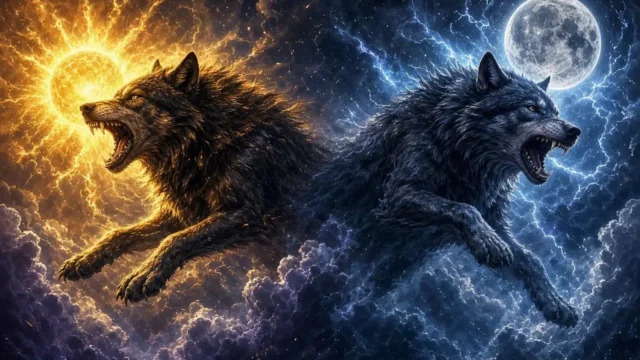
Odin is also associated with two wolves named Geri and Freki, mentioned in the stanza immediately before the ravens in Grímnismál. The wolves are linked with his eating arrangements in the hall, whereas the ravens are associated with daily flights and intelligence or news. The animal pairs are easy to mix up in group portraits of Odin. Huginn and Muninn are birds, not wolves; Geri and Freki are wolves, not the celestial wolves Sköll and Hati. The latter chase the sun and moon in the familiar Prose Edda account and have a different role. A strong infographic can distinguish three pairs: Odin’s ravens, Odin’s wolves and the celestial wolves, each with the correct names. That simple comparison prevents a surprising number of inaccurate Pinterest charts. The old texts provide enough separate character traits that one need not invent special colors or magical power rankings to make the animals recognizable.
Ravens, Battlefields and Viking Age Symbolism
Ravens are intelligent real birds, and they also have a striking cultural association with battlefields in Norse poetry. Odin’s relationship to warfare and the slain makes the two birds especially effective symbols in art. Raven motifs and banners appear in wider Viking Age discussion, but identifying every archaeological bird ornament as Huginn or Muninn would be unwarranted without specific evidence. An image of a historical brooch may show a bird without telling us exactly which mythological character the wearer intended. Similarly, a black raven over a shield is a popular modern Norse design, but no universal tattoo system survives proving every Viking carried that exact mark for battle victory. A responsible article distinguishes the archaeological object, the Eddic poem and the new artwork. Readers can appreciate the bird’s symbolic appeal while recognizing what can and cannot be established from the past.
Are Huginn and Muninn Odin’s Literal Eyes?
Popular headlines describe the ravens as Odin’s ‘eyes and ears’. That is useful metaphorical language because they bring reports about what they have seen and heard. However, the medieval sources do not require that Odin’s physical eyesight literally depends on two birds in the way a modern remote camera system would. Odin famously has one eye in his wisdom-well story, but that does not mean the missing eye becomes a raven or that each bird represents one physical eyeball. Those are modern fictional extrapolations unless a particular retelling explicitly says so. An educational paragraph should explain that the ravens extend the god’s knowledge of distant events. Some comics turn them into magical drones or give them speech with detailed personalities; those are creative adaptations. The old text’s powerful image is much simpler: ravens flying through the world, returning to whisper news and causing their owner anxiety about losing them.
Huginn and Muninn Tattoo, Wallpapers and Search-Ready Images
A pair of ravens over Odin’s shoulders, one on each side of Yggdrasil, or circling a northern mountain is a natural subject for fantasy art. Related searches include ‘Huginn Muninn meaning’, ‘Odin ravens names’, ‘Hugin Munin tattoo’, ‘thought memory Norse symbol’ and ‘Odin raven wallpaper’. A modern tattoo may symbolize intelligence, remembrance or partnership. That personal symbolism can be meaningful without becoming a fixed ancient magical promise. For a visual post, use a readable illustration and a factual poster with the names, the poetic source and the difference from Geri and Freki. ALT text should reflect what the actual illustration shows; if only one black bird appears, do not claim the image depicts both named ravens and Odin unless those subjects are visible. The best reader experience combines attractive artwork with a reliable explanation of the old poem and prose account.
Frequently Asked Questions
What are Odin’s ravens called?
Huginn and Muninn, also written Hugin and Munin in English.
What does Huginn mean?
Thought is the common English interpretation of the name.
What does Muninn mean?
Memory or Mind are common glosses, with some linguistic nuance.
Why does Odin send the ravens away?
Snorri says they fly over the world and return with news of things seen and heard.
Why does Odin fear for Muninn?
Grímnismál says he worries more for Muninn; the symbolic meaning is open to interpretation.
Are Geri and Freki Odin’s ravens?
No. Geri and Freki are Odin’s wolves; Huginn and Muninn are his ravens.
Conclusion
Huginn and Muninn are compelling because two simple birds capture Odin’s hunger for knowledge and fear of loss. The poem gives their names and the god’s worry, while later prose explains their daily reports. Accurate captions can preserve both the imagery and the difference between source and fantasy invention.
Sources and illustration note
Grímnismál, stanza 20 and the two ravens; Snorri’s Gylfaginning: Odin’s ravens and wolves; Research on myth, mind and Odin’s ravens.
Reviewed 15 November 2026. Images are modern fantasy interpretations, not historical photographs.














Share Your Opinion
Comments are closed on this post.