 Vista
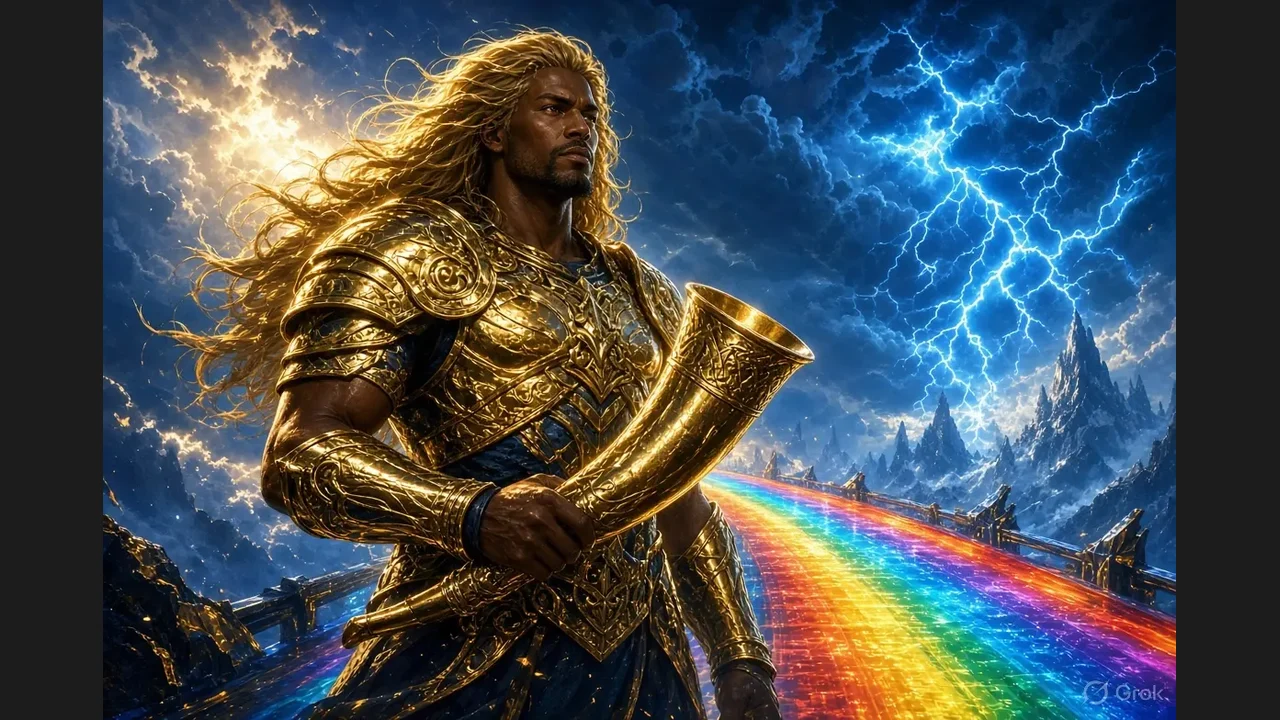
Heimdall (Heimdallr) is the watchman of the Norse gods and the guardian associated with Bifröst, the bridge between the human world and the gods. In Snorri Sturluson’s Prose Edda he lives at Himinbjörg, needs extraordinarily little sleep, sees great distances in darkness and daylight, and can hear remarkably faint sounds. His horn, Gjallarhorn, announces the crisis of Ragnarök. In a familiar account, he and Loki kill one another during the final battle.
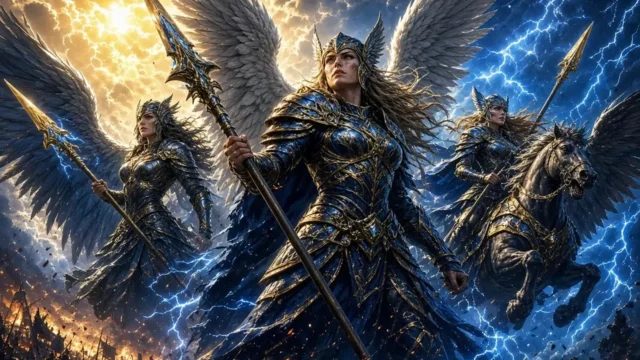
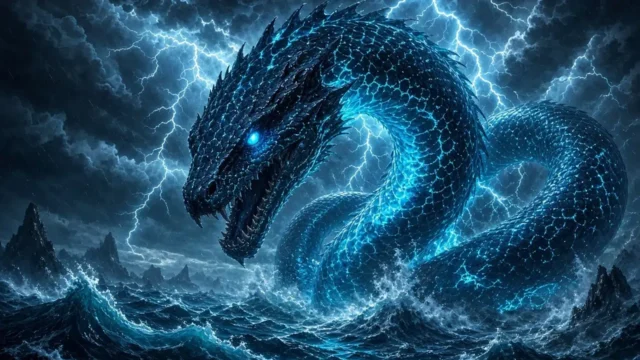
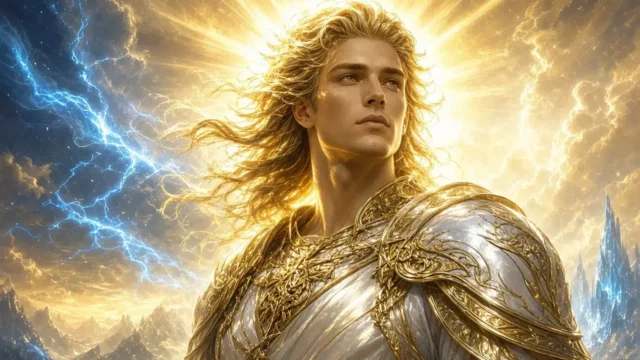
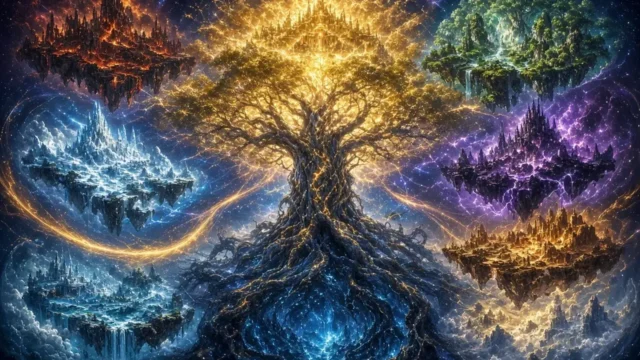
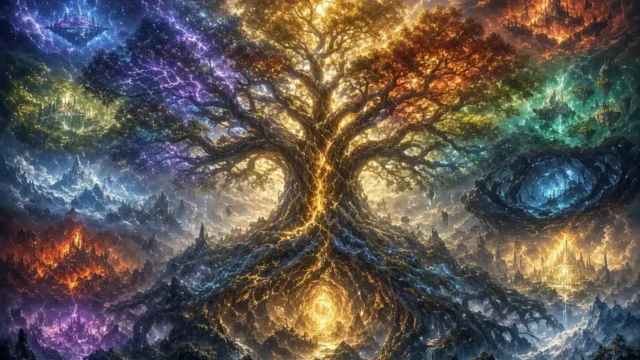
If you searched for Heimdall Norse mythology, Bifrost guardian, Gjallarhorn meaning, Heimdall’s powers or Heimdall fantasy images, this guide explains the actual mythological episodes, his unusual parentage, major symbols and differences from modern screen adaptations. The illustrations are artistic interpretations, not documentary pictures of a god.
Who Is Heimdall? The Watchman of the Æsir
Heimdallr belongs among the important Æsir figures in the medieval accounts. His defining responsibility is vigilance: he watches approaches to the gods and guards a crossing that could be used by dangerous enemies. That role makes him different from Odin, whose myths emphasize knowledge and war, or Thor, whose narratives showcase journeys and physical combat. In an illustrated family of gods, his horn and position near the bridge offer the clearest visual identity. Snorri also calls him a holy figure and uses the name ‘White God’, which should be understood within the medieval literary setting rather than turned into a modern racial claim. His importance is not measured by the number of enemies he personally defeats. Being a sentinel is central to the safety of Asgard, and his final horn blast connects small acts of watchfulness to a cosmic threat. A good beginner’s article starts with that duty before listing magical senses or cinematic weapons.
Himinbjörg: Where Does Heimdall Live?
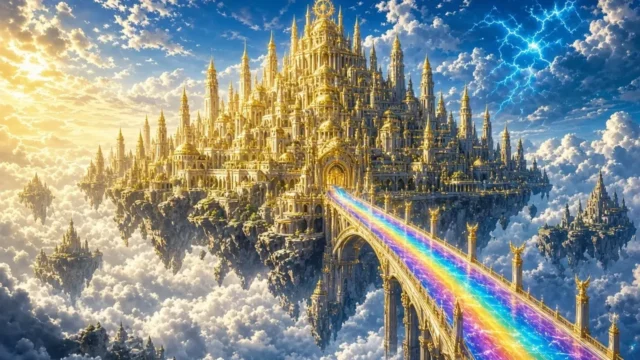
Himinbjörg is Heimdall’s residence, described as lying by the point where Bifröst reaches heaven. A stanza quoted in the Prose Edda associates the place with his enjoyment of mead while he keeps watch. The name has been understood in relation to heavenly heights or a mountain of the sky. Modern artists often create an enormous watchtower, stone fortress or palace hanging above a rainbow bridge. Those settings communicate his job effectively, yet no surviving medieval text gives an architect’s exact floor plan of Himinbjörg. The old description is about a location near the crossing and the god who guards it. When a page promises a ‘real photograph of Heimdall’s palace’, it confuses a fantasy scene with a physical site. For SEO image captions, ‘Heimdall keeping watch at Himinbjörg above Bifrost’ is a more useful and truthful label than an invented geographic address.
What Is Gjallarhorn? The Horn Heard Across Worlds
Gjallarhorn is the sounding horn associated with Heimdall. The Prose Edda describes its blast as heard through the worlds, making it a fitting warning device for the gods’ watchman. During the events leading to Ragnarök, the sound signals that the final crisis has arrived. Its name appears with different English spellings, including Gjallarhorn and Gjallar-Horn; those variants need not be treated as separate objects. The medieval stories do not give a verified precise length, alloy, decibel level or a modern mechanical operating system. Fantasy images may make it an enormous golden trumpet emitting blue light, but that is a design choice. The source-grounded facts are who possesses the horn and when it is sounded. This also helps distinguish Gjallarhorn from Gungnir, Odin’s spear, and from Mjölnir, Thor’s hammer. A good educational poster labels each object under the correct owner instead of treating all three as the same weapon.
Heimdall’s Extraordinary Sight, Hearing and Sleep
Snorri’s description says that Heimdall needs less sleep than a bird, sees far by day or night and hears the grass growing and wool growing on sheep. Such wonderfully impossible hearing is a literary way to describe vigilance at a cosmic level. No evidence suggests that a human with the same name literally possessed these abilities. Some modern comics add new powers, equipment or a universal ability to teleport, none of which should automatically be presented as part of the Prose Edda. For a visual guide, sharp eyes, an elevated vantage point and the horn can represent his senses without filling the artwork with fake numerical specifications. A careful explanation also separates a metaphorical ability to watch over worlds from an established technology. Heimdall’s gift is that the smallest movement can matter: a distant threat that others would miss may be noticed by him in time to warn the gods.
Why Does Heimdall Have Nine Mothers?
A fragment known through Snorri has Heimdall declaring himself the son of nine mothers, described as sisters. That statement is one of the most intriguing puzzles in Norse mythology. Scholars have discussed possible connections with groups of waves or other figures, but an exact, universally accepted family tree identifying all nine mothers is not established by the brief surviving reference alone. Some websites confidently assign him a conventional mother and father, then supply the names of nine ocean daughters as though every text said the same thing. Such simplification is risky. If an educational infographic needs a family note, it should say ‘associated in a medieval fragment with nine mothers’ and explain that their identities are debated. The mystery is interesting precisely because the evidence is incomplete. A character profile can remain accurate without resolving every genealogical puzzle through invented relationships.
Golden Teeth, Gullintanni and the Sword Called Hǫfuð
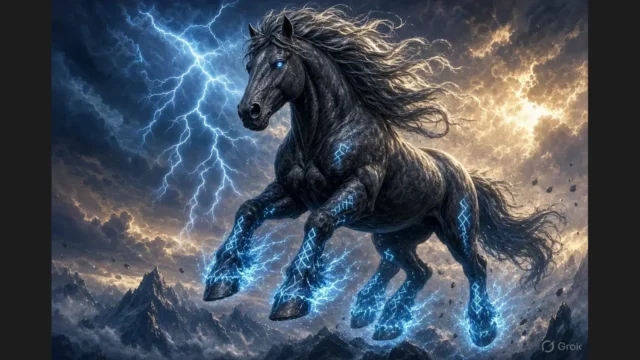
Other distinctive attributes of Heimdall include golden teeth and the alternative name Gullintanni, commonly interpreted in relation to gold teeth. Snorri also mentions a horse called Gulltoppr, or Gold-top, and the sword Hǫfuð, whose name means ‘head’. The exact spellings vary in modern English writing. These details enrich artwork, but a mythic name should not become a fabricated blueprint with exact dimensions or magical damage ratings. When designing a Norse god comparison chart, a horn remains the strongest recognizable symbol, while golden teeth, horse and sword can be noted as additional source-connected motifs. Some adaptations turn the sword into a machine for opening gates between worlds. That can work within fictional science-fantasy, but the medieval description does not provide the same engineered portal mechanism. Source-based article captions should identify the object without implying that modern game mechanics are older than the game itself.
The Poem Rígsþula: Did Heimdall Create Social Classes?
The unusual poem Rígsþula tells of a wandering figure called Rígr visiting different households and contributing to the origins of social categories. Its introductory framing identifies Rígr with Heimdall, though the relationship and the poem’s literary setting have been discussed by scholars. This is an important but sensitive episode: it reflects historical social categories within a particular tradition, not a valid modern biological theory about people. A beginner article should describe the text and its interpretive uncertainty rather than presenting it as a complete scientific account of how society began. Its place alongside Heimdall’s watchman role shows how Norse mythic figures can appear in very different kinds of storytelling. If a visitor asks ‘What did Heimdall do besides guard Bifrost?’, the poem is worth mentioning—with its name, context and limitations—instead of inventing an unrelated conquest story.
Heimdall and Loki: Their Conflict at Ragnarök
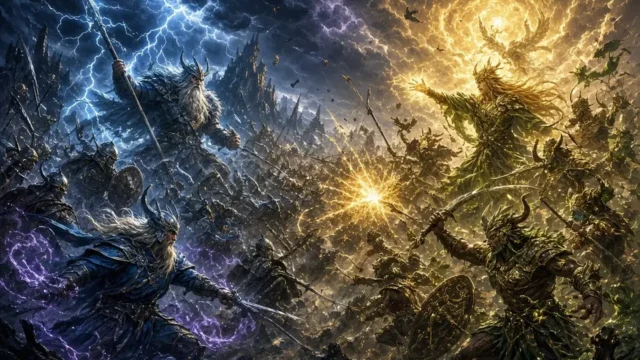
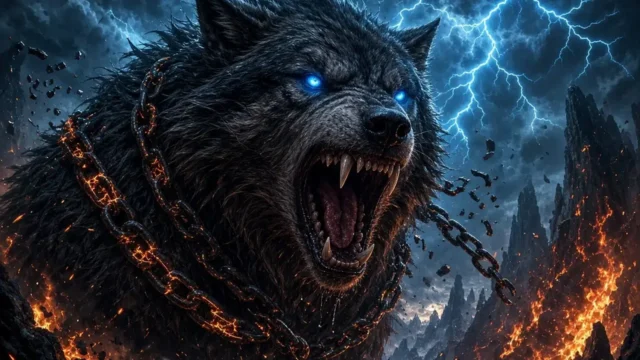
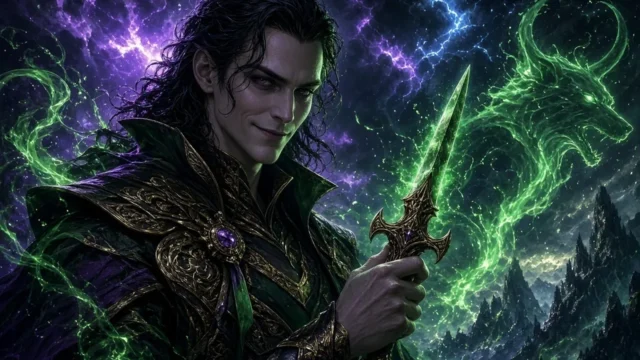
The Prose Edda’s Ragnarök narrative associates Heimdall with sounding Gjallarhorn when the gods’ enemies approach. The alarm calls attention to a crisis involving Fenrir, Jörmungandr, Surtr and other threats. In Snorri’s final-battle account, Heimdall and Loki confront each other and kill one another. This should not be confused with Odin’s struggle against Fenrir or Thor’s fatal encounter with the world serpent. Each god has a different fated adversary. The importance of the Heimdall-Loki duel lies partly in the opposition between vigilant protection and disruptive cunning: one guards the boundary while the other repeatedly crosses and challenges it. That thematic reading is an interpretation; the battle outcome is the source-based claim. A dramatic image of the bridge guardian facing Loki can be used as modern art, but it should not silently substitute a movie plot for the medieval narrative.
Marvel Heimdall vs Mythology Heimdall: Reading the Images
Modern adaptations make Heimdall the keeper of a cosmic transportation system, often with a shining sword and spectacular portal effects. They use the Norse names as inspiration for their own story and visual universe. In the medieval accounts, Bifröst is identified with a rainbow-like bridge, and Heimdall is a sentinel with extraordinary hearing, sight and a warning horn. A film costume, actor’s likeness or invented technical mechanism does not become an ancient Viking image simply because the character has the same name. For an SEO-rich visual article, natural searches include ‘Heimdallr Norse mythology’, ‘Bifrost guardian’, ‘Gjallarhorn horn’, ‘Heimdall nine mothers’ and ‘who kills Heimdall at Ragnarok’. The best captions answer one of these intents accurately. Since the actual mythology is well supported by textual sources, there is no need for misleading ‘real footage’ or unverifiable quotes.
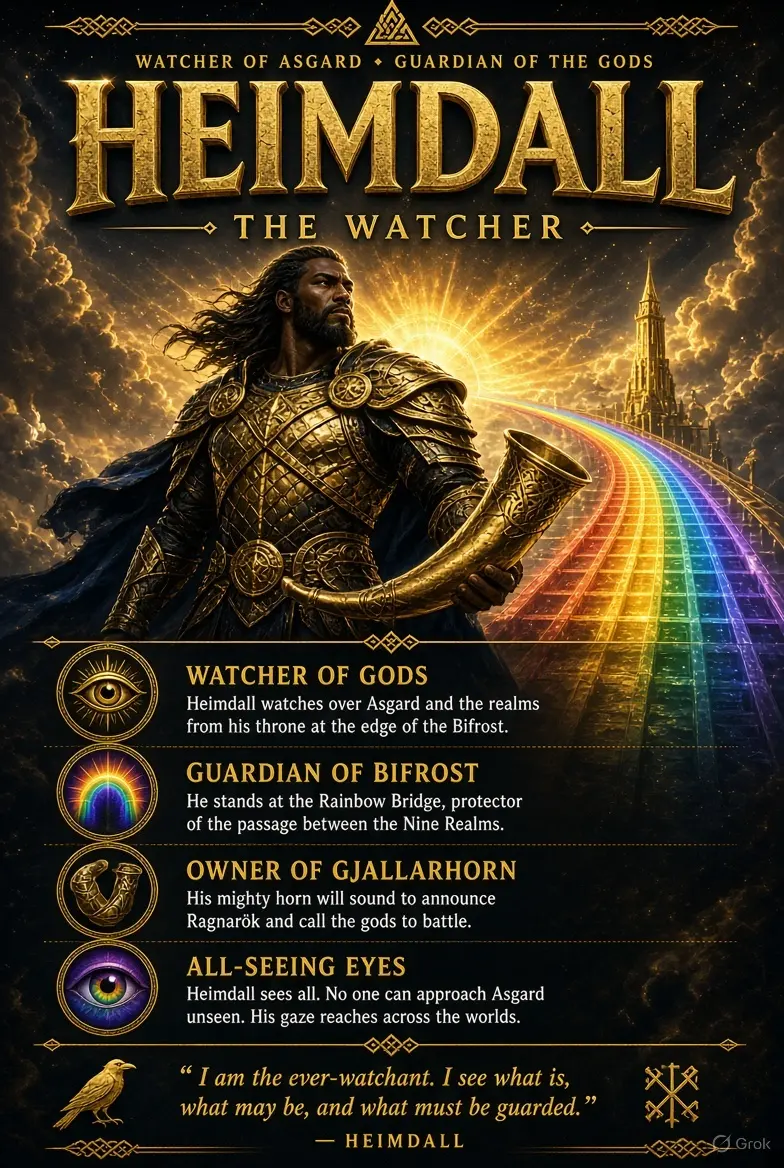
Artwork and source The first-person line on the poster is modern artwork copy. In Gylfaginning, Heimdall guards the bridge from Himinbjörg and sounds Gjallarhorn at Ragnarök.
Frequently Asked Questions
Who guards the Bifrost bridge?
Heimdall is the watchman associated with the gods’ rainbow-like bridge in Snorri’s Prose Edda.
What is Heimdall’s horn called?
Gjallarhorn, the warning horn he sounds at the approach of Ragnarök.
Why does Heimdall have nine mothers?
A medieval fragment calls him the son of nine sisters; their precise identities and meaning remain debated.
Can Heimdall hear grass grow?
The Prose Edda describes his supernatural hearing in just this way; it is mythological storytelling.
Who kills Heimdall at Ragnarok?
In Snorri’s account Heimdall and Loki kill one another.
Is Heimdall the same as Marvel’s character?
The modern character is an adaptation; its costume and invented mechanics do not define the older mythology.
Conclusion
Heimdall’s horn, watchtower and extraordinary senses make him a natural subject for mythology artwork, but the older stories also reveal uncertainties about his family and a fated conflict with Loki. Treat the visuals as creative interpretations and use the Eddic sources to identify which details are actually described.
Sources and image note
Prose Edda — Gylfaginning (Heimdall and Ragnarok); Poetic Edda source context; Viking Society for Northern Research, Edda edition.
Updated 15 November 2026. Images are artistic interpretations of mythology, not historical photographs.








Share Your Opinion
Comments are closed on this post.