 Vista
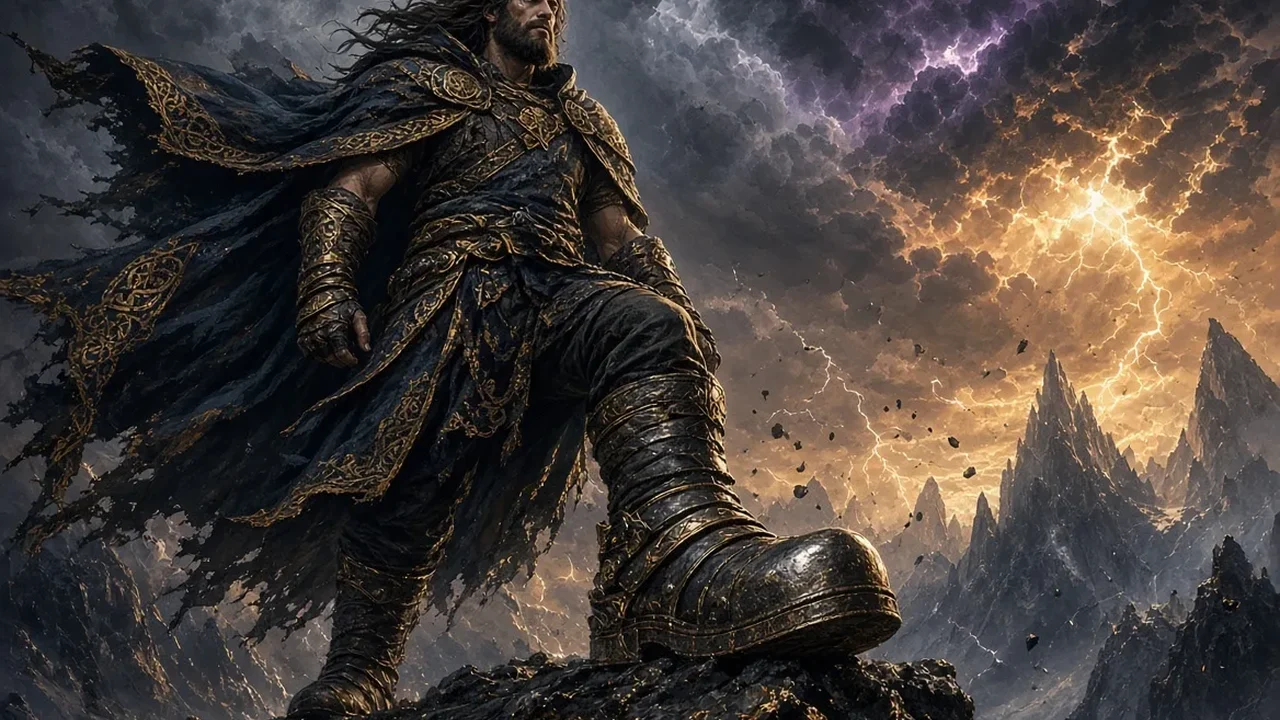
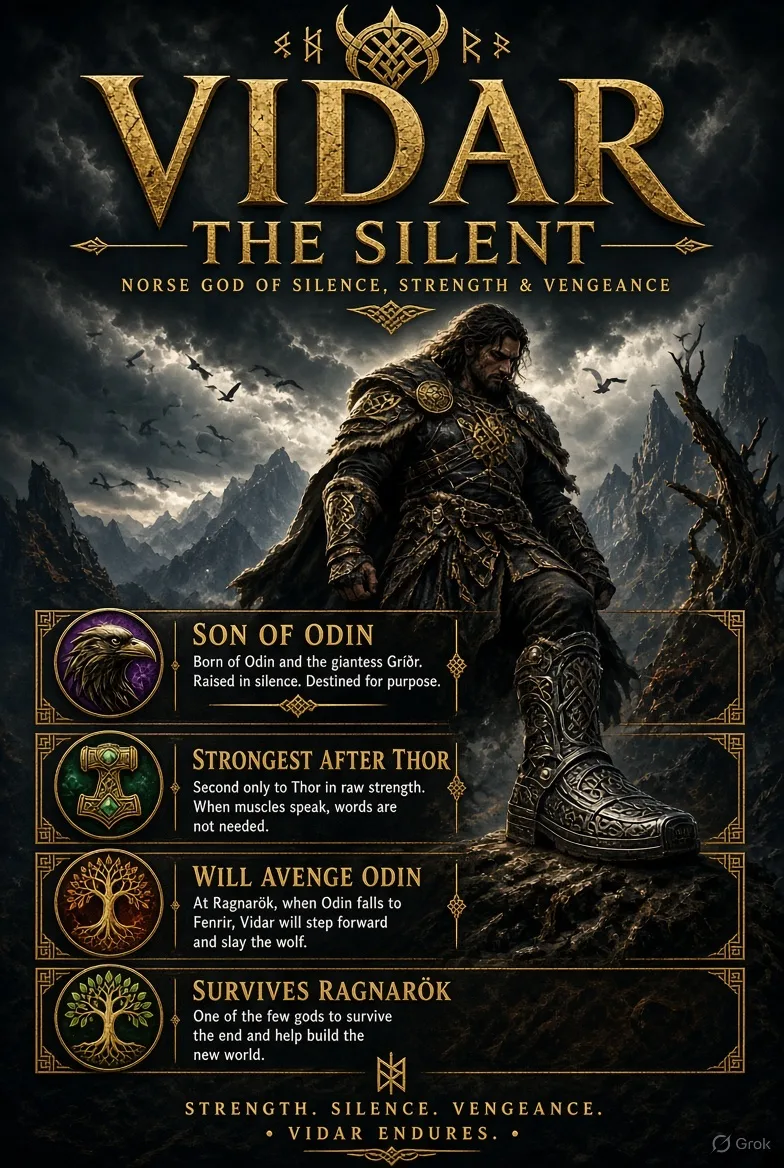
Víðarr (Vidar) is Odin’s son who avenges him by killing the wolf Fenrir at Ragnarök in Norse mythology. Snorri’s Prose Edda calls him the silent god, describes his great strength and gives him an extraordinary thick shoe. After Fenrir swallows Odin, Víðarr steps onto the wolf’s lower jaw and tears its mouth apart. The poem Völuspá preserves a different image: he drives a sword into the wolf’s heart. The two descriptions should not be silently merged into one supposedly exact ancient action scene.
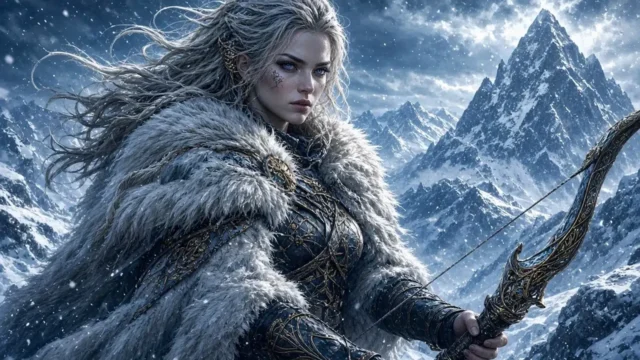
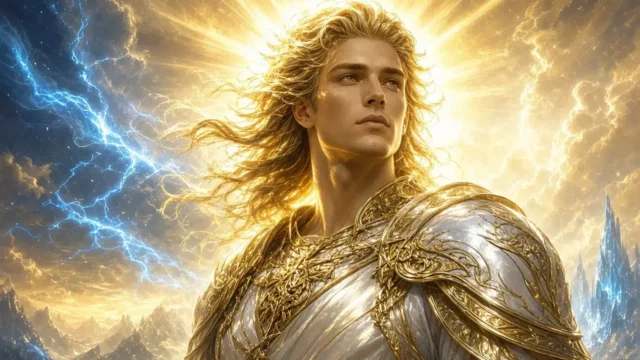
Here we explain Vidar Norse mythology, who his mother Gríðr is, why he is called silent, the strange shoe made from leather scraps, the death of Fenrir, the differing accounts and Víðarr’s role in the world after Ragnarök. Images are modern fantasy interpretations of medieval texts.
Who Is Víðarr, Odin’s Silent Son?
The Old Norse name Víðarr is usually written Vidar or Vidarr in English. He belongs among the Æsir and is identified as a son of Odin. Snorri introduces him as a silent god with exceptional strength, sometimes described as second only to Thor. Silence here is a distinctive title, not proof that the deity lacked speech, a tongue, hearing or normal communication. The old source does not give a detailed reason for the silence. Some modern books invent a vow never to speak until Odin dies; that may be an appealing story, but it should not be advertised as an explicit statement in every medieval account. Nor does Víðarr appear as a full-time guard of Valhalla or as Odin’s adopted son. A reliable character profile starts with his relationship to Odin and his particular action at Ragnarök. An image of a quiet warrior in a shadowy forest can evoke his persona, but the accurate identity is established by his name and story rather than the artist’s chosen facial expression.
Who Is Vidar’s Mother, Gríðr?
Snorri’s material identifies the jötunn Gríðr as Víðarr’s mother. That family connection is worth preserving because popular simplified myth charts often put every son of Odin under Frigg. In the traditional sources, the mothers of Odin’s sons vary. Gríðr has her own important appearance in the story of Thor’s journey to Geirröðr, where she lends him protective equipment including a belt, iron gloves and a staff. Thus she is more than an unnamed monstrous parent in a footnote. Not every medieval passage lists the entire family together, and spelling can vary across translations. A useful infographic can show Odin, Gríðr and Víðarr, while explicitly identifying Gríðr as a jötunn rather than repeating a tidy cinematic royal family. Being related to a jötunn is not a contradiction for an Æsir figure: divine and jötunn kinship frequently overlap in Norse mythology. This makes Víðarr’s lineage an instructive example of the complexity of the surviving genealogies.
Why Is Vidar Associated with a Thick Shoe?
One of the strangest details in the Prose Edda is Víðarr’s extraordinarily thick shoe. Snorri explains that leather offcuts from the toes and heels of shoes, removed during shoemaking, are gathered for it over the ages. The resulting footwear plays a vital part when the god confronts Fenrir. This is an example of ordinary craftwork being imagined as a contribution to a cosmic event. Modern retellings sometimes call the shoe an iron boot or a technological weapon. Yet the central prose image concerns leather pieces, not a mechanical device or a metal rocket shoe. Some manuscripts and interpretations describe the protective footwear with slight differences, so a caption should name the particular version it follows. The source does not specify an exact modern shoe size, manufacturer or number of layers. A poster can explain the offcuts in one sentence, then show a substantial boot braced against the wolf. That communicates the story without inventing production statistics.
How Does Fenrir Kill Odin at Ragnarök?
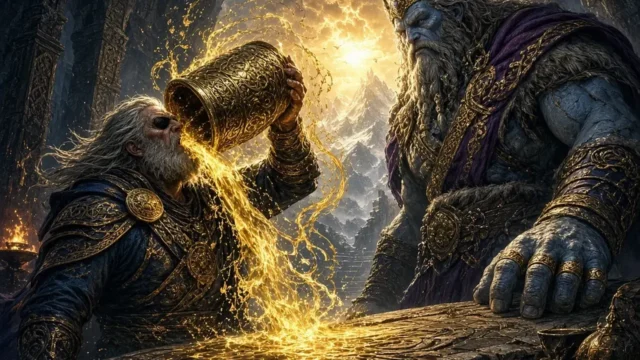
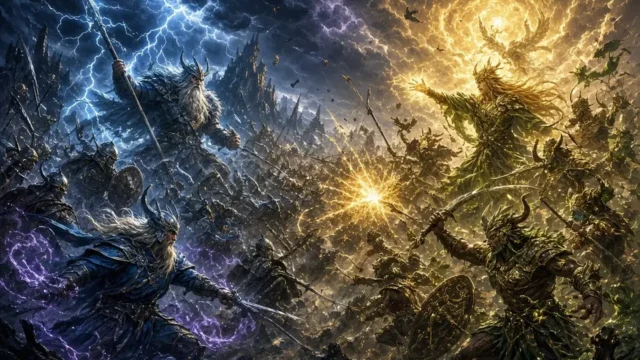
Fenrir is one of the three famous children of Loki and Angrboða, together with Jörmungandr and Hel. In the Prose Edda he grows increasingly dangerous, is bound by Gleipnir after biting off Týr’s right hand, and breaks loose during the events of Ragnarök. Odin meets the wolf and is swallowed. This defeat is one of the great tragedies of the Norse final battle: even the Allfather who pursues knowledge and tries to prepare for the future cannot escape his predicted fate. The battle is not the same as Thor’s fatal confrontation with Jörmungandr. Thor kills the world serpent and dies from its venom, while Odin is swallowed by Fenrir. Víðarr’s appearance directly after his father’s death gives the next scene its emotional force. Correctly ordering the episodes also helps readers who arrived after seeing confusing game art in which several gods fight the wrong monsters. The literary account is a sequence of named encounters rather than one undifferentiated monster battle.
How Vidar Kills Fenrir in the Prose Edda
Snorri describes Víðarr rushing forward after Odin is swallowed. He plants the thick shoe on Fenrir’s lower jaw, takes the upper jaw in his hand and pulls until the mouth tears apart, killing the giant wolf. The scene is brutal and supernatural, not a real method for handling dangerous wildlife. The magical scale of Fenrir makes the action possible within the myth; it should not be turned into physical instruction. Some artwork shows Víðarr leaping into the wolf’s mouth with a sword and a shield, which may combine multiple versions of the encounter. For a source-faithful caption of the prose account, the thick shoe and both jaws are the identifying elements. This also distinguishes Víðarr from Týr, whose hand Fenrir bites earlier, and from Odin, whom the wolf swallows. A dramatic image can show the same scene without asserting a verifiable historical battlefield or an exact date for Ragnarök.
What Does Völuspá Say About Fenrir’s Death?
The poetic tradition preserves a notably different description. In Völuspá, Víðarr avenges Odin by driving a weapon into the wolf’s heart. Some translations emphasize the sword’s thrust rather than the jaw-ripping movement made famous by Snorri. The two descriptions agree on the central relation—Víðarr takes vengeance on Fenrir for Odin—but differ in how the enemy is killed. A careful article should tell readers this rather than falsely presenting every modern image as a photograph of one uniform ancient script. It is possible for artists to choose the poetic sword scene or the prose shoe scene; either can be presented honestly with a label. This is a good example of why Norse myths are best approached through surviving texts, not only through social media lists of powers. An infographic with two small scenes and source names can explain the distinction more clearly than a fantasy ranking table.
Why Is Víðarr Called a God of Vengeance?
Because Víðarr avenges Odin at Ragnarök, modern summaries often call him the Norse god of vengeance. That label captures a major dramatic function but should not be mistaken for a universal office overseeing every act of revenge in ancient northern Europe. The source describes a particular event: a son responds to his father’s death by killing a monstrous enemy. Whether the act represents duty, restoration, fate or violence has invited interpretation. The Prose Edda also emphasizes Víðarr’s usefulness to the gods in difficult situations. Thus his story is more than a one-word emotional category. An educational page can discuss vengeance as a theme while explaining that the evidence for a complete legal or ritual system administered by Víðarr is much thinner. A modern tattoo featuring the silent god may symbolize persistence, loyalty or revenge to its wearer, but personal meaning should not be advertised as an unchanged Viking Age rule.
Víðarr’s Home and His Place in Mythic Geography
The poem Grímnismál mentions a land associated with Víðarr, described in connection with tall grass or brushwood. Later writers and artists sometimes imagine a quiet wooded hall, which fits the god’s title as silent. Yet the poetry does not provide a measured route, map coordinates or detailed architectural plan. Asgard and the wider divine territories are mythic locations described through poems and prose episodes. A visual showing a solitary warrior among trees may express the mood of Víðarr’s dwelling but does not establish that this exact building existed in Viking Age Scandinavia. For image SEO, a caption can use ‘Víðarr, the silent son of Odin, in a forest-inspired fantasy landscape’ if that is visibly what the illustration shows. There is no need to assign his hall the name of another god’s residence or invent an unevidenced throne. Readers benefit from knowing the sparse original description and the limits of artistic reconstruction.
Does Vidar Survive Ragnarök?
Yes. In the familiar renewal narrative, Víðarr is among the divine figures who survive the destruction of Ragnarök and appear in the emerging world. This is an important contrast with the fate of Odin, Thor and many others. Some accounts also mention Váli, Baldr, Höðr and the sons of Thor in relation to the new order, though their precise roles differ by source. Víðarr’s survival means he is not merely a final-battle cameo: he connects the destruction of the old order with the possibility of life afterward. A modern interpretation may see endurance or restoration in that role, but no medieval text supplies a detailed plan of his later reign or a schedule of new battles. An informational poster should say that he kills Fenrir and survives Ragnarök rather than invent an entirely new mythic empire. The strongest imagery is the contrast between a devastated battlefield and a fresh, quiet landscape.
Frequently Asked Questions
Who is Vidar in Norse mythology?
Víðarr is Odin’s son and a powerful Æsir figure known as the silent god.
Who is Vidar’s mother?
Gríðr, a jötunn in the medieval prose tradition.
Why is Vidar’s shoe special?
Snorri says it is made from leather shoe-trimmings gathered across the ages.
Who kills Fenrir at Ragnarok?
Víðarr kills Fenrir to avenge Odin.
Does Vidar tear Fenrir’s mouth or stab him?
Snorri describes tearing its jaws apart; Völuspá gives a different sword-vengeance image.
Does Vidar survive Ragnarok?
Yes, he is among figures connected with the renewed world after the catastrophe.
Conclusion
Víðarr’s quiet identity, giant-wolf confrontation and survival give his story unusual weight. The thick shoe belongs especially to Snorri’s account, while Völuspá pictures revenge with a sword. Presenting the versions separately makes dramatic Vidar artwork more accurate and more interesting.
Primary sources and artwork note
Prose Edda: Víðarr, the thick shoe and Ragnarök; Völuspá, Víðarr’s revenge; Grímnismál and Víðarr’s realm.
Reviewed 15 November 2026. Illustrations are interpretations of old stories.















Share Your Opinion
Comments are closed on this post.