 Vista

Frigg is a leading goddess among the Æsir in Norse mythology, closely associated with Odin and the tragic story of their son Baldr. In the Prose Edda, her residence is called Fensalir. When Baldr dreams of his death, Frigg tries to protect him by securing promises from living beings and objects not to harm him. But mistletoe is left outside the arrangement, and Loki exploits this weakness. Her role in the story is central: it is a mother’s attempt to defeat fate, not simply an image of a serene queen beside Odin.
This guide explores Frigg Norse mythology, Frigg’s family, how Baldr dies, Fensalir, her attendant Fulla, and the often-confused comparison Frigg vs Freyja. Along the way, we distinguish the medieval evidence from modern fantasy illustrations, invented symbols and films.
Who Is Frigg? Queenly Figure Among the Æsir
Frigg appears in medieval Icelandic sources as a prominent goddess and the wife of Odin. Snorri’s Gylfaginning introduces her as the foremost of the goddesses and names her dwelling Fensalir. She is often described in quick guides as the goddess of marriage, motherhood, foresight or domestic life. Some of these labels reflect interpretations and wider Germanic comparisons rather than a fixed Old Norse job description. Her strongest narrative role in the familiar source is her relationship with Baldr and the grief following his death. This already gives her a more complex identity than the quiet, decorative queen common in fantasy portraits. A clear visual representation can use symbols of a hall, a protective gesture and Baldr’s name, but it should not invent a single official crown worn throughout Scandinavian history. The surviving texts include multiple layers of storytelling, so asking what Frigg does in a particular episode is often more useful than ranking her alongside other goddesses by an imaginary score.
Odin and Frigg: Their Relationship in Norse Mythology
Odin is closely connected with knowledge, warfare, poetry and the dead, while Frigg appears as his wife and a powerful participant in the divine family. Their relationship is not a direct copy of a modern film’s royal marriage. In Gylfaginning, Odin’s knowledge and Frigg’s desperate precautions form two contrasting responses to the ominous future of Baldr. The myth does not offer a complete domestic diary recording every conversation between them. More broadly, the historical relationship between names of Germanic goddesses and divine spouses is a subject of scholarship. It should not be simplified into a claim that every people in northern Europe imagined precisely the same character with the same family history. For SEO images, describing Frigg as ‘Odin’s wife in Norse mythology’ is reasonable. Adding that she is ‘the mother of every Norse god’ would be misleading. The original stories name other mothers, including Jörð as Thor’s mother.
Fensalir: What Do We Know About Frigg’s Hall?
Fensalir is the named dwelling of Frigg in the Prose Edda and poetic references. The name is commonly understood in relation to marsh or fen halls. That suggests a distinctive atmosphere for artwork: a quiet hall among water, reeds, pale mist and northern trees. But a popular painting with a white marble palace and shining lakes should be treated as a creative scene, not an excavated structure. The old narratives do not preserve measured floor plans, exact GPS coordinates or a single official exterior portrait. Fensalir is part of the mythic geography surrounding Asgard and the other divine places. For an informational poster, the accurate label is simply ‘Fensalir — Frigg’s dwelling’. There is no need to assign it a fixed elevation among the Nine Realms or claim that its door is located at a particular Scandinavian site. A source-aware caption adds value for readers arriving from searches for Norse goddess wallpapers.
Baldr’s Dreams and Frigg’s Protective Oaths
Baldr suffers disturbing dreams that suggest his approaching death. In the familiar Prose Edda account, Frigg tries to prevent disaster by asking nearly everything in creation not to injure him. Fire, water, metals, stones, trees, animals and other elements are included in the protective promises. The gods then discover that thrown objects do not harm him, and they turn this into a strange game. The problem is that the security arrangement depends on a promise that was not collected from one small plant. This is a mythic story about the limits of prevention rather than a rule for making a person physically invulnerable. A picture of Frigg gathering promises can evoke the scene, but it should not be presented as a real historical ritual performed in a specific year. The unusual fact worth preserving is that Frigg actively attempts to protect Baldr and seems to have succeeded until an overlooked exception is discovered.
Mistletoe and Loki: Why Frigg’s Plan Fails
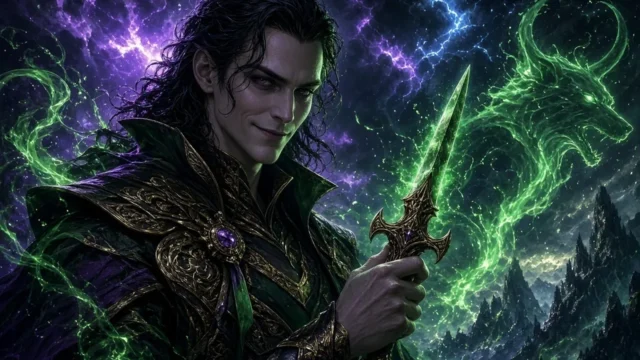
Frigg does not secure an oath from mistletoe because she considers it too young or insignificant. Loki learns this after speaking to her in disguise. He then makes use of the plant to arrange Baldr’s death. In Snorri’s version, the blind Höðr throws the fatal object after Loki guides him. Thus a precise answer to ‘Who killed Baldr?’ involves both figures: Höðr delivers the strike and Loki deliberately enables it. The story should not be rewritten as Frigg personally choosing to kill her son or Loki firing a conventional arrow in every medieval version. Modern art often gives the weapon a green glow and treats mistletoe as a universal poison, neither of which is needed for the source-based explanation. Baldr’s tragedy reveals the fragility of even extraordinary protective efforts, and Frigg’s attempt to resist fate is one of the main emotional centers of the myth.
Hermóðr and Hel: Frigg Tries Again to Save Baldr
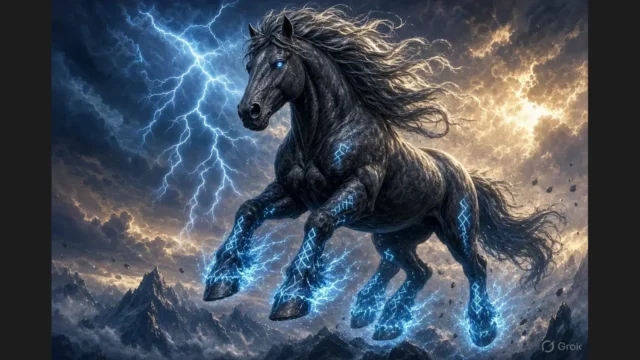
After Baldr’s death, Frigg asks whether anyone will make the dangerous journey to the world of the dead and negotiate for his return. Hermóðr volunteers and rides Odin’s extraordinary eight-legged horse Sleipnir toward Hel. In Snorri’s account, the ruler of the dead agrees to release Baldr if all things weep for him. The gods’ messengers seek tears from everywhere, but the figure Þökk refuses. The condition is not fulfilled, and Baldr remains in Hel. This second effort shows that Frigg is not absent from the story after her first plan fails; her grief produces further action. The narrative is not proof that such a supernatural underworld journey happened in history. It is a myth that also links Frigg to Loki, Hel, Odin’s horse and the unfolding fate of Asgard. These connected topics make useful internal links once the related pages are publicly available.
Fulla, Hlín and Frigg’s Attendants
Snorri names Fulla as an attendant closely connected with Frigg. Fulla keeps Frigg’s box and footwear and knows her private counsel. Other female divine figures, such as Hlín, appear in descriptions that associate them with protection or service to Frigg. Their relationships can be complicated by poetic usage and by the uncertain boundaries between different goddess names. A modern ‘Norse goddess hierarchy’ chart may present an invented roster of servants, each with an exact rank and elemental power. The source does not provide that kind of organized bureaucracy. A better guide names the attested figure, gives the specific action or relationship and admits when a wider association is debated. If a poster depicts a woman carrying Frigg’s chest, the caption can mention Fulla. However, a generic portrait should not confidently identify every secondary character unless a reliable visual context supports it.
Frigg vs Freyja: Same Goddess or Different?
Frigg and Freyja are distinct named figures in surviving narratives. Frigg is Odin’s wife and the mother of Baldr in the familiar accounts. Freyja is associated with the Vanir, is Njörðr’s daughter and Freyr’s sister, and is known for Brísingamen, cats and Fólkvangr. Similarities in their names or spheres have led scholars to debate historical connections and possible transformations of traditions. But that scholarly question cannot be reduced to ‘the two are definitely identical’ or ‘no relationship could ever have existed’. For practical reader guidance, use their distinct medieval stories and family relationships. A family-tree infographic should not show Freyja replacing Frigg beside Odin, nor identify Loki as Frigg’s child simply because Marvel has a different royal family. Carefully labeling the sources is a more reliable approach than dramatic ‘secret goddess revealed’ claims.
Frigg Images, Symbols and Modern Interpretations
Modern Frigg tattoos and wallpapers often feature a regal goddess, spinning tools, keys, clouds or runic designs. Such symbols may be inspired by associations with domesticity and fate, but they should not automatically be called verified Viking Age sacred marks. The medieval texts are not an illustrated costume manual, and no authenticated photograph of a supernatural goddess exists. For a featured image, a composed woman in a northern hall is a sensible creative direction. For an informational poster, use Frigg’s name, Odin, Baldr, Fensalir, the oath story and Fulla. Avoid made-up spell instructions, scientifically impossible claims or a specific rune that supposedly guarantees protection. ALT text should describe what the picture actually shows; if the image depicts a mother holding a child, it should not be labeled as Frigg’s encounter with mistletoe unless that is the identifiable subject. Visual quality and factual care can reinforce each other.
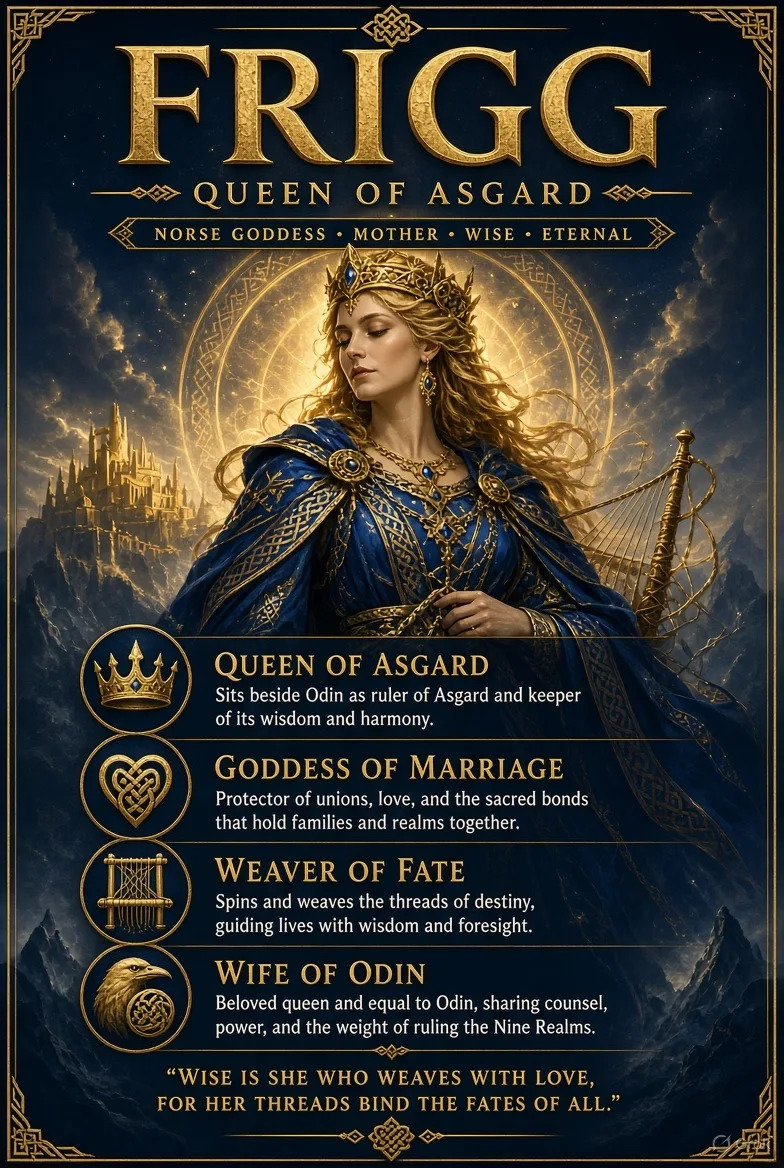
Artwork and source The line in quotation marks is modern poster copy. The Eddic depiction of Frigg includes foreknowledge and her efforts to protect Baldr.
Frequently Asked Questions
Who is Frigg in Norse mythology?
Frigg is a prominent goddess associated with Odin, Fensalir and the story of Baldr.
Is Frigg Odin’s wife?
Yes, the familiar Prose Edda accounts describe Frigg as Odin’s wife.
Who is Frigg’s son?
Baldr is her son in the well-known death tradition.
Where does Frigg live?
Her dwelling is called Fensalir.
Why did Baldr die despite Frigg’s protection?
Frigg overlooked mistletoe; Loki exploited the omission and guided Höðr into the fatal act.
Are Frigg and Freyja identical?
The surviving myths give them distinct names and roles, although possible historical connections are debated.
Conclusion
Frigg is more than Odin’s companion in a group portrait. Her attempt to protect Baldr, grief after his death and connection with Fensalir and Fulla give her a substantial place in Norse storytelling. Distinguishing her from Freyja and marking later artistic invention keeps an illustrated guide useful.
Sources and image note
Snorri Sturluson, Gylfaginning (Frigg and Baldr); Skaldskaparmal: goddess names and stories; Viking Society scholarly Gylfaginning edition.
Reviewed 15 November 2026. Images are artistic depictions, not historical photographs.













Share Your Opinion
Comments are closed on this post.