 Vista
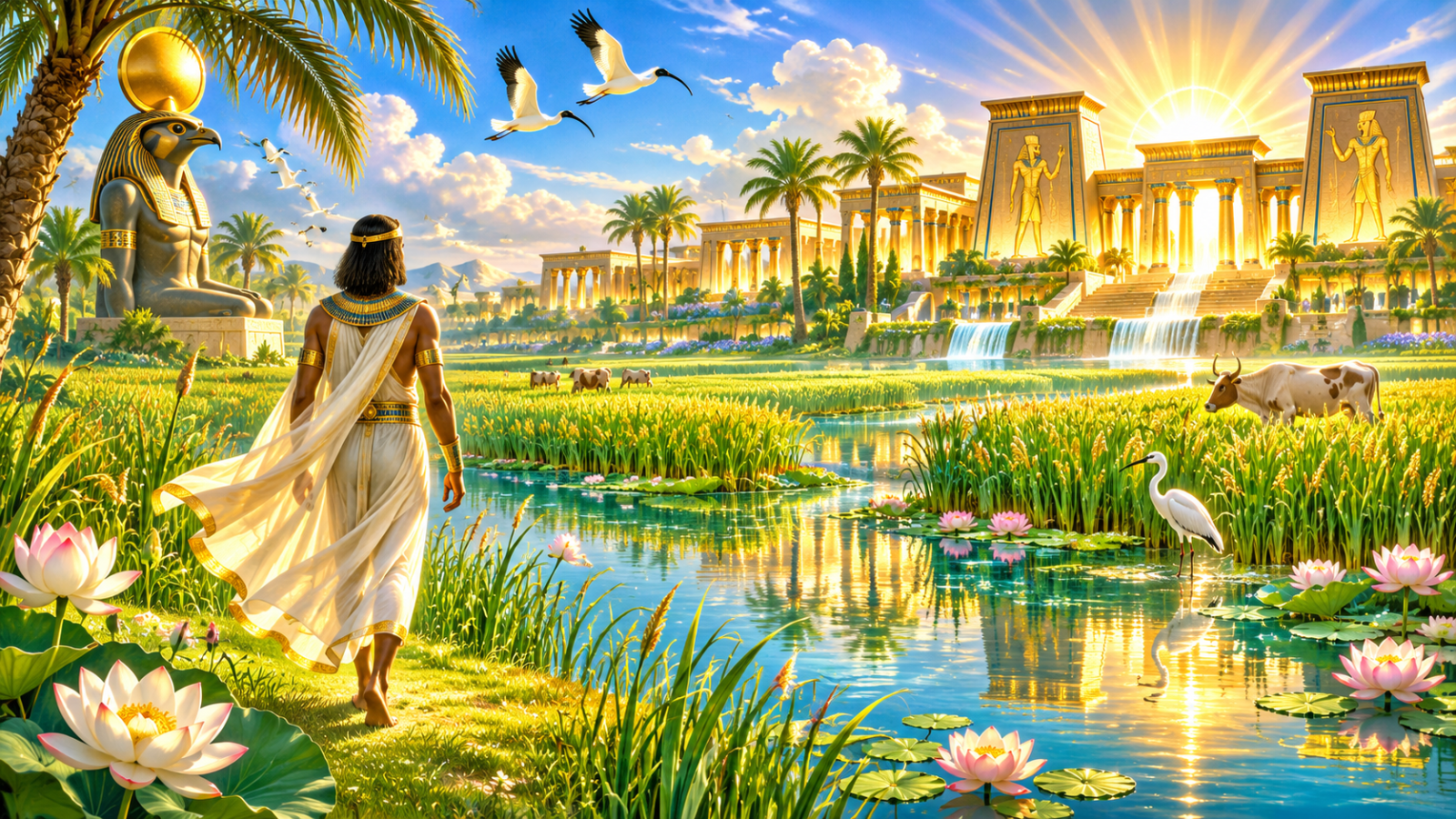
Aaru (also written Iaru or Yaru), usually called the Field of Reeds, was the ancient Egyptian idea of a blessed afterlife: a green, fertile land of rivers, fields and harvests where justified dead people lived on under the rule of Osiris. It was reached only after passing through the dangers of the Duat and the judgment in the Hall of the Two Truths. Aaru is often called the “Egyptian heaven”, but the comparison is loose. It looks like an ideal version of Egypt, not a place beyond the physical world.
This guide explains what texts say about Aaru, how the dead reached it, why farming appears in paradise, what shabtis were for, and what remains uncertain.
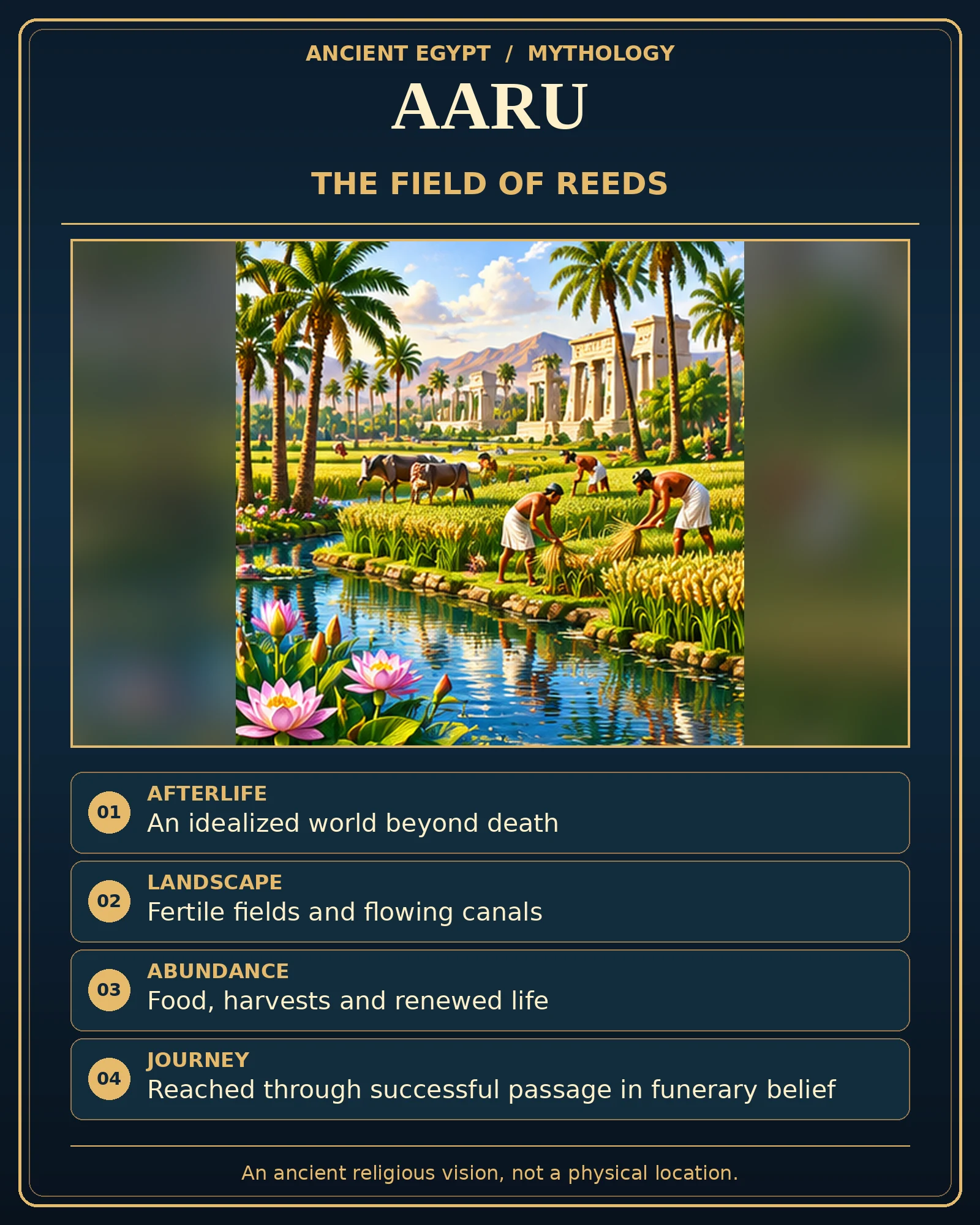
Aaru Quick Facts
| Item | Detail |
|---|---|
| Names | Field of Reeds (Sekhet-Iaru); also linked with the Field of Offerings (Sekhet-Hotep) |
| Ruler | Osiris |
| Access | Only after passing the Duat and a successful judgment |
| Landscape | Fields, canals, islands, grain, reeds |
| Key texts | Coffin Texts, Book of the Dead (including Spells 109, 110 and 125) |
| Helpers | Shabti figures to do work (Spell 6) |
What Was Aaru?
The Book of the Dead describes fields where the blessed dead could eat, drink, farm and meet their loved ones. The setting is linked to the east, where the sun rises, and some texts describe islands and canals. The Egyptians’ own descriptions are not a single consistent map, since they come from different periods and traditions. The core idea is simple: a continuation of the best of earthly life, free from hunger, illness and injustice. For the wider picture, see our guides to the Egyptian afterlife and the Duat.
How the Dead Reached Aaru
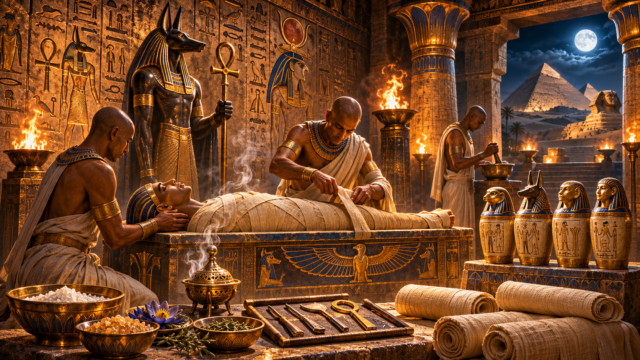
- The body is preserved and buried with the proper rites.
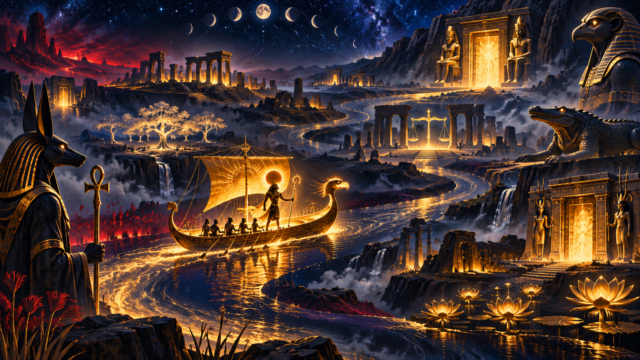
- The ba and ka travel through the Duat, using spells to pass gates and guardians.
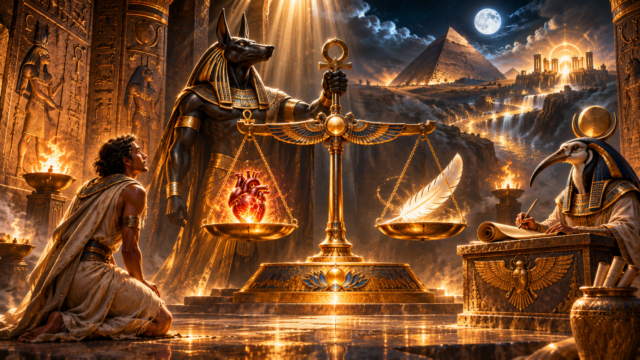
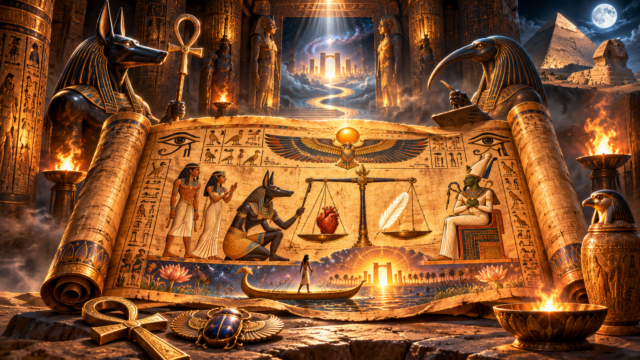
- The heart is weighed against the feather of Ma’at.
- If justified, the dead person is presented to Osiris.
- The person enters the fields and lives as a blessed spirit.
Story box (retold from funerary texts): After the judgment, a woman is led through a last gate. The air is warm. Before her stretch green fields, bending reeds and a slow river. People harvest grain in the distance, and a small boat crosses a canal. She hears her name spoken by someone she loved. This is an imagined scene based on how the afterlife fields are described in the Book of the Dead.
Farming in Paradise and the Shabti
Texts and tomb paintings show the dead ploughing, sowing and harvesting in Aaru. Because the Egyptians did not want to labour in paradise, they placed small figures called shabtis (or ushabtis) in tombs. Spell 6 of the Book of the Dead tells the figure to answer when the dead person is called to work and to say “Here I am”. Rich tombs could hold hundreds of shabtis, in some cases one for each day of the year with overseers, though numbers differ between burials.
Is Aaru the Same as Heaven?
Not really. Aaru is physical, like a perfect Egypt, and the dead still eat, drink and work (or have helpers work for them). It is also not the only vision of the afterlife. Royal texts describe joining the sun god on his boat or becoming a star, and the Duat shows another path. Egyptians often held several images at once without trying to unify them.
History, Mythology and Speculation
| Category | What belongs here |
|---|---|
| History | Tomb paintings of harvests; shabti figures; Book of the Dead papyri |
| Mythology | The fields ruled by Osiris; the blessed dead; the gates and judgment before it |
| Speculation | Exact location; links with real places in the Delta; claims that it proves a universal “heaven” idea |
Myth vs Fact
| Popular claim | Reality |
|---|---|
| Aaru is exactly the Egyptian heaven. | It is one vision of the afterlife and differs from later ideas of heaven. |
| Everyone went to Aaru. | Only those who passed the judgment did. |
| The dead had to do hard labour forever. | Shabtis were meant to do the work in their place. |
| Aaru was a real place on Earth. | It was a religious concept, though it was modelled on the Nile landscape. |
| There was only one afterlife idea. | Several co-existed, such as the sun boat and the stars. |
Frequently Asked Questions About Aaru
What is Aaru?
The Egyptian paradise known as the Field of Reeds, ruled by Osiris.
How did someone reach Aaru?
By passing the Duat and being judged true in the weighing of the heart.
What is a shabti?
A small figure placed in the tomb to do work for the dead in the afterlife.
Who ruled Aaru?
Osiris, lord of the dead.
Is Aaru the same as the Field of Offerings?
They are closely linked in the texts, though the names and details vary by source.
Is Aaru like heaven in other religions?
There are similarities, but Aaru is a physical, Egypt-like land and the comparison is only partial.
Did Egyptians also believe in a sky afterlife?
Yes. Royal texts describe joining the sun god or the stars.
Is there evidence that Aaru exists?
No. It is a religious belief documented in texts and tomb art.
Reliable Sources
- World History Encyclopedia: Egyptian Mythology
- Egypt Exploration Society: Gods of Egypt
- The Metropolitan Museum of Art: Divine Egypt
Last updated: 25 November 2026. Related reading on Vista Hub: our guides to the Egyptian afterlife, the Duat, Osiris, the weighing of the heart and the Book of the Dead.
Related guides: Egyptian Afterlife Explained: Ka, Ba, Akh, the Field of Reeds and the Journey of the Dead · Ancient Egyptian Temples, Rituals and Worship Explained: Priests, Offerings and Sacred Architecture












Share Your Opinion
Comments are closed on this post.