 Vista
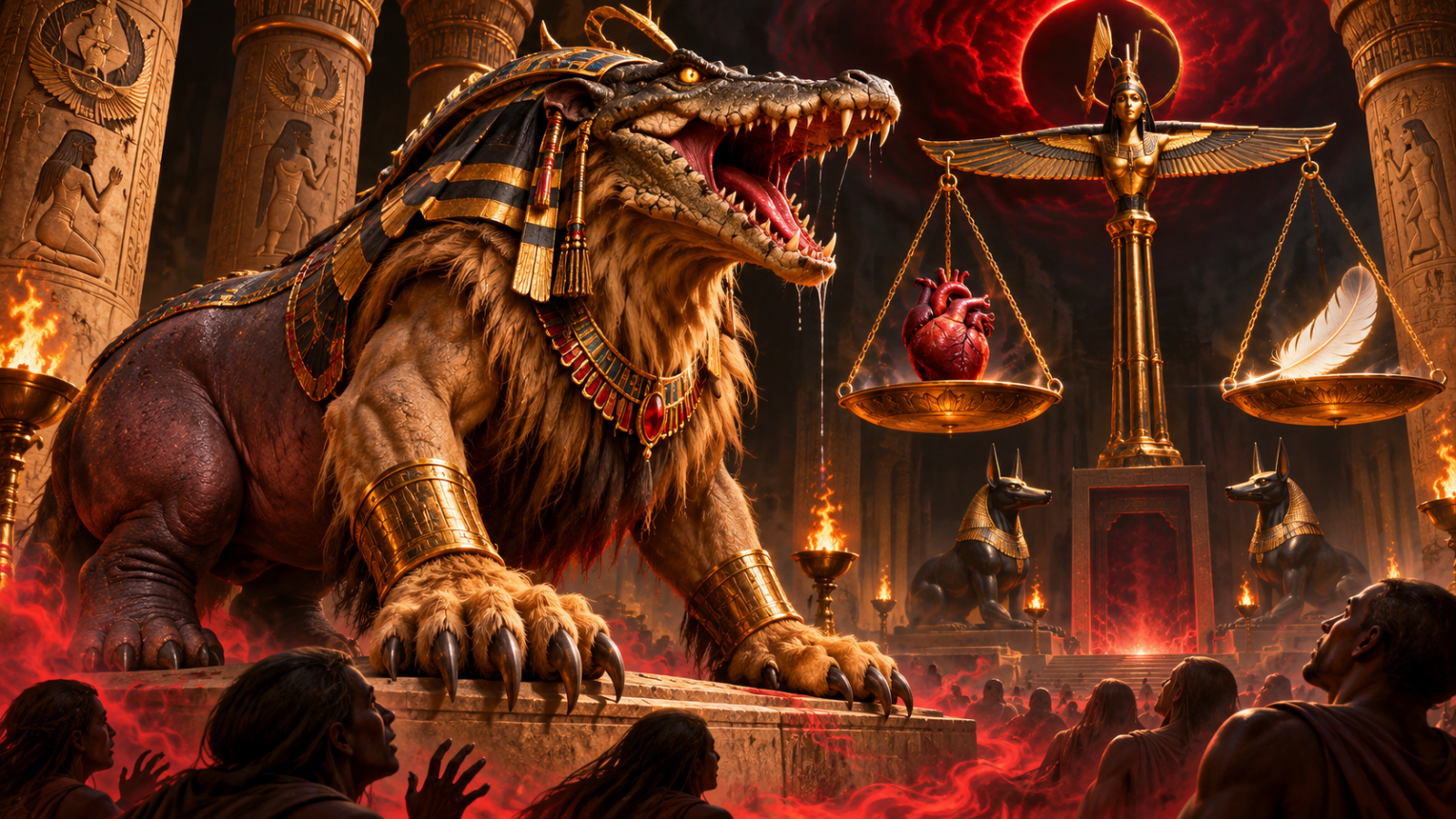
Ammit (also spelled Ammut or Ammemet) was a fearsome creature of ancient Egyptian funerary belief, known as the “Devourer of the Dead”. She had the head of a crocodile, the front of a lion or leopard, and the back legs of a hippopotamus, a mix of the three most dangerous man-eating animals the Egyptians knew. In the judgment scene of the Book of the Dead, Ammit waits beside the scales. If a dead person’s heart is found heavy with wrongdoing, she eats it, and the person suffers what texts call a “second death”, an end to existence in the afterlife. Importantly, Ammit is not the judge and not a god who decides who is guilty. She is the consequence of a failed judgment.
This guide explains her appearance, her exact role in the weighing of the heart, how she differs from other judgment figures, what the sources do and do not tell us, and how she is shown in modern media.
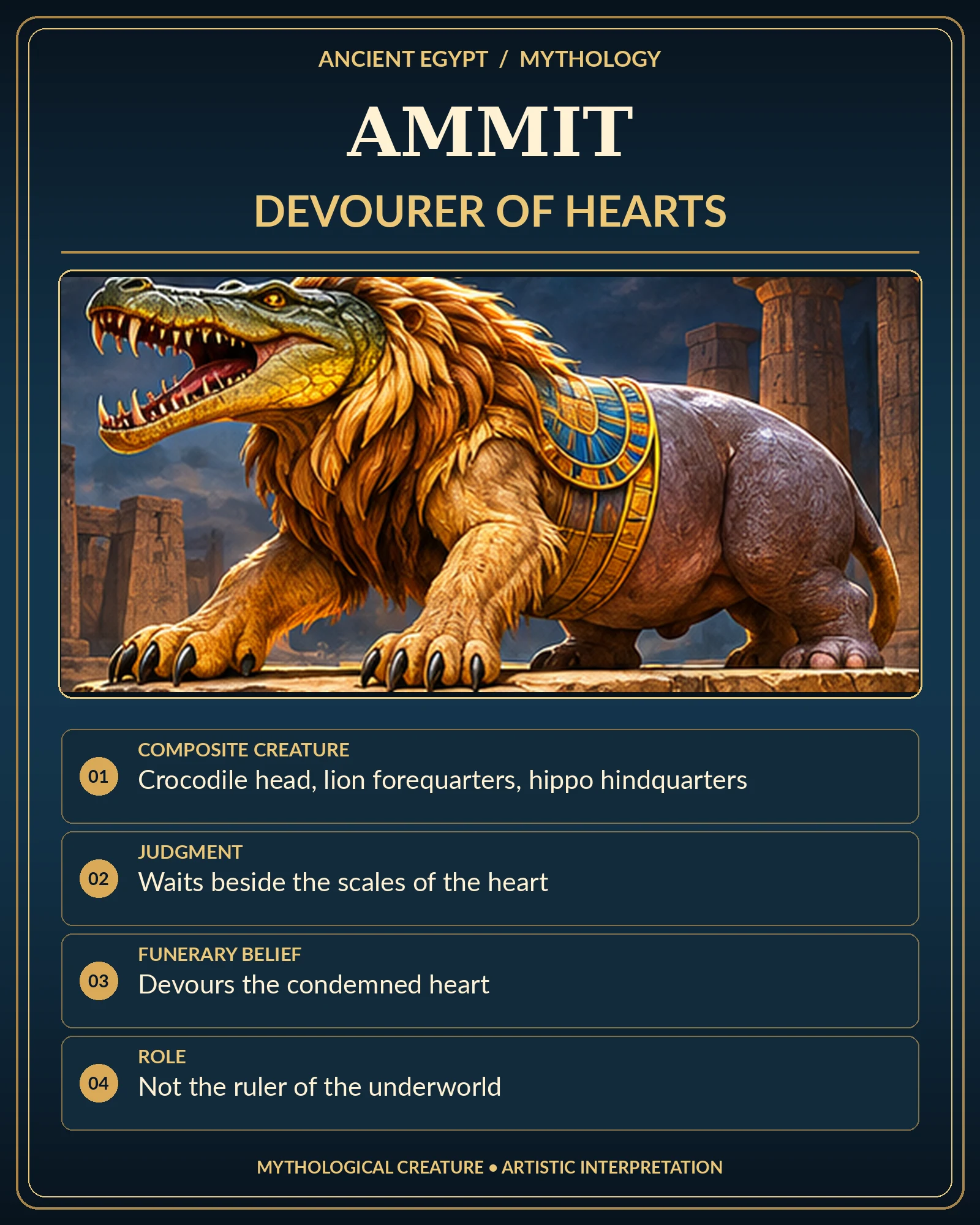
Ammit Quick Facts
| Item | Detail |
|---|---|
| Name | Ammit, usually understood as “devourer” or “eater of the dead” |
| Form | Crocodile head, lion or leopard forequarters, hippo hindquarters |
| Role | Eats the hearts of those who fail the judgment |
| Where she appears | Book of the Dead judgment scenes, mainly New Kingdom and later |
| Worship | No known temples or cult; she was a feared part of the afterlife system |
| Not to be confused with | Osiris (judge), Anubis (guide and weigher), Thoth (recorder), Ma’at (truth) |
Who Was Ammit?
Ammit is best described as a guardian of the afterlife’s moral order, not as a deity with followers. Egyptian religion believed that a dead person had to pass a judgment before reaching a blessed existence. The judgment scene needed both a reward and a risk, and Ammit represents the risk. She sits near the scales, often crouched or standing on a small base, watching the result.
Because she is part of a funerary painting and spell collection rather than of a myth with a plot, we have no story of Ammit’s birth or adventures. Her character is defined by function: she is the terrible end waiting for those who fail. Some ancient texts give her titles that stress her fearsome nature, such as a being who is “great of death”, but these titles come from the funerary tradition and do not form a life story.
Why Crocodile, Lion and Hippo?
| Body part | Animal | Why it frightened Egyptians |
|---|---|---|
| Head and jaws | Nile crocodile | A powerful ambush predator of the river |
| Front body and mane | Lion or leopard | The great land predator |
| Hind body | Hippopotamus | One of the most dangerous animals along the Nile |
The combination is a symbolic way of saying “the most deadly creature imaginable”. This is a modern reading based on how Egyptians made composite beings, since no text lists the reason for each part. It is consistent with the way other guardians, such as the hippo-lion-crocodile form of Taweret, were built from dangerous animals, though in Taweret’s case the same strength is used to protect.
Ammit in the Weighing of the Heart
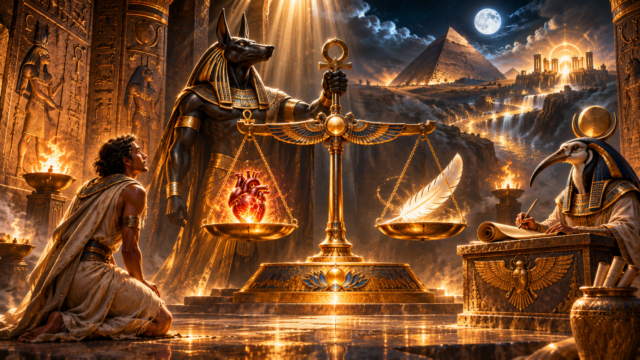
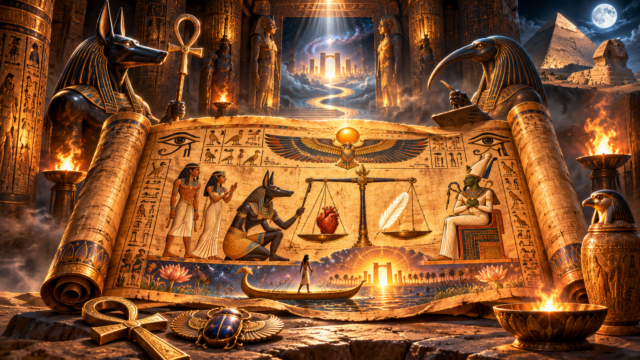
The best-known setting for Ammit is the vignette that goes with Spell 125 of the Book of the Dead. In the typical picture, the dead person is led into the Hall of the Two Truths. The god Anubis brings the heart to a balance scale. On one pan sits the heart, which Egyptians believed recorded a person’s moral life. On the other pan is the feather of Ma’at, the symbol of truth and order. Thoth, the god of writing, records the result. Ammit crouches nearby. The god Osiris, enthroned, presides over the verdict. Our separate guide to the weighing of the heart ceremony explains the full procedure.
Story box (retold from judgment scenes): A scribe called Ani has crossed the dark halls of the Duat and now stands before the scales. His heart sits on one side, and the feather on the other. Anubis watches the pointer. Thoth holds his reed pen, ready to write. In the shadow, Ammit waits with her jaws slightly open. Ani has recited that he has not lied, stolen or harmed others. The scales balance. Thoth writes the verdict, Ammit turns away, and Ani is led to Osiris. The scene is based on the famous papyrus that carries Ani’s name, and it shows the hopeful version of the story: most surviving papyri show a successful judgment.
What Is the “Second Death”?
Egyptians believed the dead person’s survival depended on keeping together several parts of the self, including the ka (life force), the ba (personality), the name and the heart. If the heart was destroyed by Ammit, the person could not continue. Scholars often call this the “second death”, a final end that is different from physical death. It was not described as an eternal torture chamber like later hell ideas in some religions. It is better read as annihilation, the loss of any future existence. Some later underworld books describe punishments for enemies of Ra and Osiris, but those belong to separate texts and traditions.
Did Everyone Fear Ammit?
Ammit does not appear in every judgment scene. Some papyri show the scales without her, and the surviving scenes mostly show positive outcomes. This tells us something about Egyptian expectations. Funerary papyri were prepared for people who hoped to succeed, and the spells included protection, such as Spell 30B, which asks the heart not to testify against its owner. In other words, Egyptians prepared for the judgment with both good behaviour and magical insurance, which is a human mix of morality and anxiety.
History, Mythology and Speculation
| Category | What belongs here |
|---|---|
| History | Ammit in Book of the Dead papyri and some tomb or coffin art; the Spell 125 tradition |
| Mythology | Her role as devourer of failed hearts and the idea of a second death |
| Speculation | Whether Egyptians feared her as a real threat or as a moral symbol; modern claims that she is a “goddess of justice”; any detailed biography |
Ammit in Modern Media
Ammit has become popular in fantasy books, games and shows, often as a monster or as a goddess of justice. For example, she appears as a major character in Marvel’s Moon Knight series (2022), where she is presented in a way that differs from the ancient sources. Such versions are creative adaptations. If you want to understand the original figure, remember that Egyptian texts show her as a silent part of the judgment scene, not as a speaking character with plans.
Myth vs Fact
| Popular claim | Reality |
|---|---|
| Ammit was the goddess who judged the dead. | She was the devourer who ate failed hearts. Osiris presided and Thoth recorded the verdict. |
| Egyptians worshipped Ammit in temples. | There is no evidence of a temple cult for her. |
| Ammit tortured souls forever. | Her action is usually read as annihilation, not eternal torture. |
| Every judgment scene includes Ammit. | Many do, but some papyri show the scales without her. |
| Ammit proves that Egyptians had a hell. | The Egyptian underworld included dangers and punishments in some texts, but it is not the same as later ideas of hell. |
Frequently Asked Questions About Ammit
What does Ammit look like?
She has a crocodile head, a lion or leopard front body, and a hippo back body.
What does Ammit do?
She eats the hearts of the dead who fail the judgment, which ends their afterlife.
Is Ammit a goddess?
She is usually described as a divine or supernatural being, but she did not have a known temple cult like major goddesses.
Who judges the dead, Ammit or Osiris?
Osiris presides over the judgment. Ammit only carries out the consequence if the heart fails.
What is the second death?
It is the final end of a person’s existence in the afterlife when the heart is destroyed.
Why does Ammit have three animals in her body?
The combination of crocodile, lion and hippo stands for the most dangerous animals that Egyptians knew.
Is Ammit the same as Taweret?
No. Both use hippo, lion and crocodile traits, but Taweret is a protective birth goddess and Ammit is a devourer of failed hearts.
Is the Marvel version of Ammit accurate?
No. It is a fictional adaptation. In the ancient sources she does not speak or plan; she is part of the judgment scene.
Reliable Sources
- World History Encyclopedia: Egyptian Mythology
- Egypt Exploration Society: Gods of Egypt
- The Metropolitan Museum of Art: Divine Egypt
Last updated: 25 November 2026. Related reading on Vista Hub: our guides to the weighing of the heart, Anubis, Ma’at, Osiris and Egyptian monsters and creatures.
Related guides: Weighing of the Heart: Egyptian Judgment of the Dead — Feather of Ma'at, Anubis, Thoth and Ammit · Sobek: Egyptian Crocodile God of the Nile — Kom Ombo, Sacred Crocodiles and Myths












Share Your Opinion
Comments are closed on this post.