 Vista
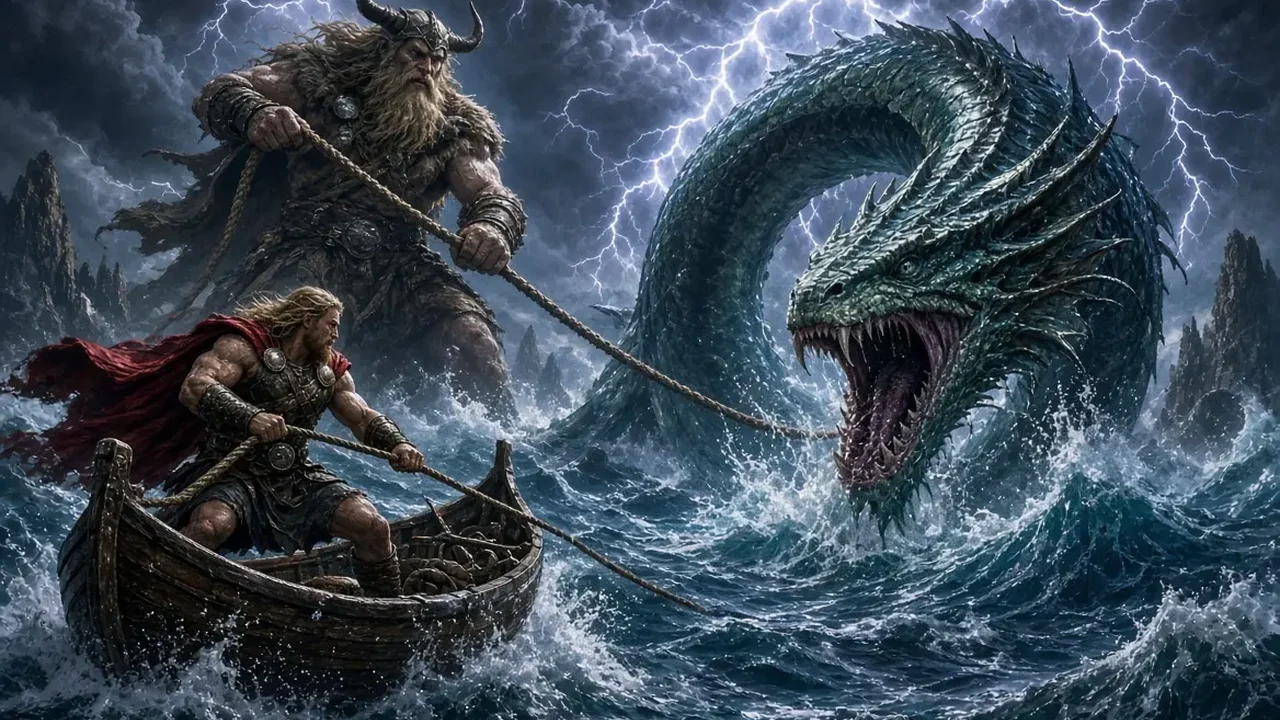
Thor once hooked Jörmungandr, the Midgard Serpent, while fishing at sea with the jötunn Hymir. He used an ox head as bait and pulled the enormous creature toward a small boat. In Snorri’s Gylfaginning, Hymir panics and cuts the fishing line, letting the serpent escape. The older poem Hymiskviða presents a related scene with different poetic details, including Thor striking toward the serpent. These episodes should not be confused with Ragnarök, when Thor finally kills the World Serpent but dies from its venom after taking nine steps.
This is a source-aware explanation of Thor fishing for Jormungandr, who Hymir is, why a bull’s head was needed, why the boat was in danger and how the fishing episode fits with the famous last battle. The dramatic ocean images are modern mythological interpretations, not historical photographs.
Who Is Jörmungandr, the Midgard Serpent?
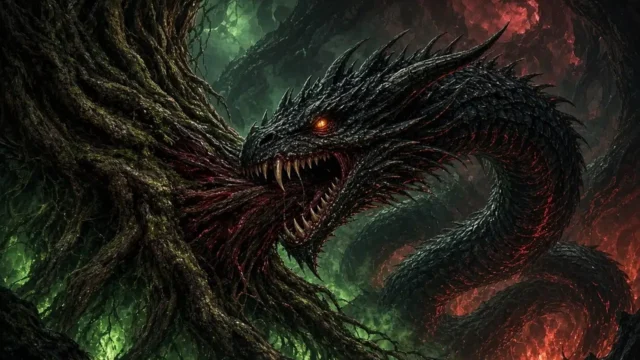
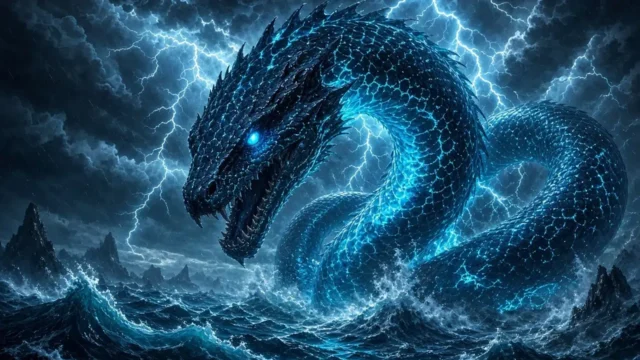
Jörmungandr is the monstrous serpent associated with encircling Midgard in the sea. Snorri identifies it as a child of Loki and Angrboða, alongside Fenrir and Hel. The creature is not the same as Níðhöggr, which is associated with Yggdrasil’s roots and with other ominous scenes. Its immense size is what makes the fishing episode so extraordinary: the bait on a line from a small boat reaches a being that circles the human world. The common English names World Serpent and Midgard Serpent refer to the same figure. Illustrators often show it with a dragon-like head, fins and glowing eyes. Those details can be artistic additions, while the textual foundation is a dangerous serpent of cosmic scale. A trustworthy image caption should identify the creature as Jörmungandr when it rises from the sea, rather than calling every large water dragon in Nordic fantasy the same being. The family connection also explains why it is sometimes called a brother of Fenrir.
Who Is Hymir, and Why Is Thor Fishing with Him?
Hymir is the jötunn who becomes Thor’s fishing companion. In Hymiskviða, the larger story involves the gods’ need for a vast cauldron that Hymir possesses and that Thor is sent to obtain. Týr is linked with the expedition in the poem, though prose summaries do not always recount every stage in exactly the same order. The fishing trip is therefore more than a random leisure activity. It takes place during an encounter between a powerful god and a jötunn whose household includes a remarkable object. In Gylfaginning, the emphasis is on Thor seeking an opportunity to meet the serpent. Hymir’s reluctance and fear help show how extraordinary the encounter is. Modern adventure paintings may show a long Viking ship packed with warriors, but the famous narrative centres on the two figures in a comparatively small fishing boat. Recognizing the source and the cauldron context makes the story more informative than a generic Thor-versus-sea-monster image.
The Ox-Head Bait: How Did Thor Lure the Serpent?
Thor takes the head of one of Hymir’s oxen as bait for an unusually strong hook. In the poem and Snorri’s prose, this is the remarkable object that draws the Midgard Serpent toward the boat. This detail is crucial for an educational poster: the bait is an ox head, not a magical golden fish or a piece of Mjölnir. The use of such a large object emphasizes that Thor is not pursuing an ordinary fish. Hymir, meanwhile, fishes in more conventional waters and fears that the boat has been rowed too far into danger. Some modern illustrations show Thor carrying a fishing pole with a tiny lure, as though the scene were a sport-fishing competition. That misses the contrast between ordinary angling and a mythic confrontation with a creature of world-spanning scale. The poem’s language is highly figurative, so images should be described as interpretations rather than documentary reconstructions of how the hook was built.
Why Does Thor Row Beyond the Safe Fishing Grounds?
In Snorri’s account, Hymir first wants to stop at familiar fishing grounds, but Thor insists on rowing farther out. Hymir warns about the dangerous region where the Midgard Serpent lies. Thor continues, seemingly determined to test his strength against the monster. That escalating risk drives the suspense. The boat travels from a zone of ordinary human-scale fishing into a dangerous mythic sea. The story does not provide geographic coordinates or a verified coastline where tourists can repeat the journey. It also does not say that the serpent was caught in a lake beside Asgard. The World Serpent is associated with the ocean around the human realm. A featured illustration can use a vast stormy sea, dark water and a distant serpent shadow. Yet the central factual sequence is the decision to row beyond Hymir’s safe limit. This helps explain why the giant’s fear becomes so intense when the line finally pulls tight.
Thor Hooks the Serpent and Brings It to the Surface
The serpent takes the ox-head bait and the immense force on the fishing line becomes apparent. Thor pulls with supernatural strength; in Snorri’s version he braces so hard that his feet go through the boat’s planking and reach the sea floor. This physical detail is fantastical and expresses his power rather than a plausible instruction about fishing gear. When the monster rises, Thor and the serpent face one another, making a striking scene for artists. Some accounts emphasize the serpent’s venom and terrifying gaze. Readers should not assume that a precise modern photograph could capture how far above the boat its head rose. The surviving sources do not give a universally fixed number of meters for the creature. The strongest visual is the contrast between a tiny boat, a strained line, the powerful thunder god and a cosmic serpent. The myth turns an everyday practice into a dangerous encounter with the world’s boundary.
Why Does Hymir Cut the Fishing Line?
In the prose account, Hymir is terrified when the creature emerges. He cuts the line so the serpent sinks back beneath the water rather than destroying the boat. Thor is furious, and the prose describes a rough confrontation with Hymir as the encounter ends. The line-cutting provides a direct answer to why Thor does not finish killing Jörmungandr during this expedition. However, the older Hymiskviða poem is not simply a line-by-line copy of Snorri’s prose. Its surviving stanzas are compressed and include Thor striking at the serpent, while the escape is phrased differently. A good explanation should say ‘in Snorri’s version’ before identifying Hymir’s knife. An artist may choose the cut-line scene or the raised-hammer scene, but captions should be source-specific. It would be misleading to claim all manuscripts agree that Hymir secretly owns a magical sword that alone can sever a giant serpent’s chain. The well-attested device in the prose telling is the fishing line.
Does Thor Kill Jörmungandr on This Fishing Trip?
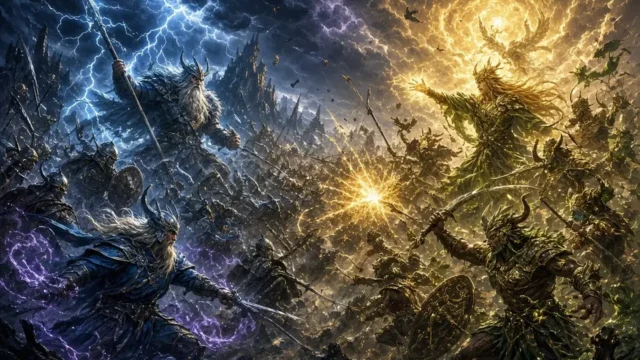
The important distinction is between the fishing encounter and Ragnarök. The familiar mythic cycle gives Thor a final confrontation with Jörmungandr at the end of the world, where the god strikes the serpent down but is fatally affected by its venom. The fishing episode earlier establishes them as dangerous opponents. Some interpretations of Hymiskviða have discussed how strongly the poem suggests a successful blow during the fishing scene, but Snorri’s account clearly lets the serpent escape. A source-aware article can acknowledge that poetic variation without flattening the myth into two identical battles. If a search result promises ‘Thor kills the World Serpent with a fishing hook,’ it probably confuses events. The myth does not make the hook the final killing weapon at Ragnarök. That final battle is a different episode, involving many gods and monsters. An image gallery benefits from separating the ocean fishing scene from the apocalyptic battlefield instead of combining them under one inaccurate caption.
What Does Hymiskviða Add Beyond the Famous Picture?
Hymiskviða contains a broader story about the immense vessel needed for the gods’ gathering. Týr points Thor toward Hymir’s giant cauldron, and the journey includes unsettling members of Hymir’s household, the fishing episode, tests of strength and the eventual return with the cauldron. This helps explain why many old translations title the poem ‘The Lay of Hymir’ rather than ‘Thor Fishing’. The fishing confrontation is one powerful scene within a larger narrative. A useful long-form article should outline that frame instead of treating the ox-head bait as an isolated viral image. Some details of Týr’s family and the poem’s household figures are difficult to reconcile with other sources, so an accurate account should identify the poem rather than force every relationship into one tidy gods-and-giants family tree. The larger journey shows Thor’s physical might, Hymir’s mixed response and the mythic importance of a seemingly ordinary object such as a cauldron.
Thor vs Jormungandr Wallpaper, Tattoo and Image Captions
The fishing scene is visually dramatic: a tiny boat, stormy sea, strong fishing line and serpent rising into the sky. Searches include ‘Thor fishing for Jormungandr’, ‘Thor and Hymir fishing’, ‘Midgard Serpent ox head’, ‘Thor fishing mythology painting’ and ‘Jormungandr Ragnarok’. These queries overlap but do not all request the same event. A featured image can emphasize the serpent emerging from the ocean. The inside poster should label Hymir, the ox-head bait, the frightening catch, the line-cutting in Snorri’s version and the later Ragnarök encounter. A caption should be accurate to the artwork: if there is no visible Hymir in the boat, do not claim the image clearly portrays both characters. A tattoo can symbolize confrontation with overwhelming danger, but no specific modern design is proven to have been a universally recognized Viking Age ritual mark. The images are creative depictions of a literary myth.
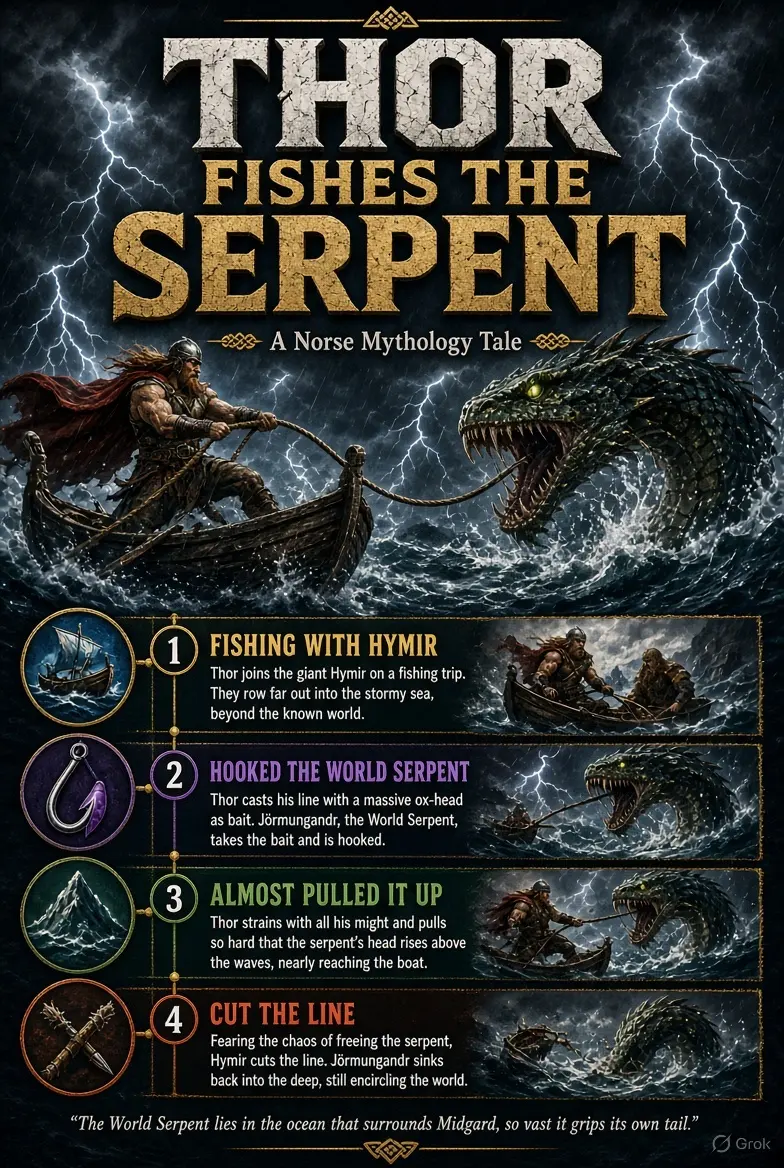
Artwork and source Snorri tells the version in which Hymir cuts the line. The surviving poetic account does not give the same ending. The footer is a modern paraphrase.
Frequently Asked Questions
Who went fishing with Thor?
The jötunn Hymir accompanies him in the famous story.
What bait did Thor use?
The head of an ox from Hymir’s herd.
What did Thor catch?
Jörmungandr, the Midgard or World Serpent.
Why did the serpent escape?
In Snorri’s prose, Hymir cuts the line in fear; the poetic account differs in detail.
Did Thor kill the serpent while fishing?
The familiar prose account says it escaped; the fatal final confrontation takes place at Ragnarök.
Where is the story told?
Especially in Hymiskviða and Gylfaginning.
Conclusion
Thor’s fishing trip turns a boat and ox-head bait into a confrontation with a cosmic serpent. Hymir’s fear, the extraordinary catch and the variation between poetry and prose are central. Keeping the fishing trip separate from Ragnarök makes the scene more accurate and more useful for readers exploring Norse mythology images.
Sources and art disclaimer
Hymiskviða, The Lay of Hymir — Poetic Edda; Gylfaginning: Thor’s fishing expedition; Völuspá: Thor’s final meeting with the World Serpent.
Reviewed 15 November 2026. Illustrations are fantasy interpretations, not historical evidence.
















Share Your Opinion
Comments are closed on this post.