 Vista
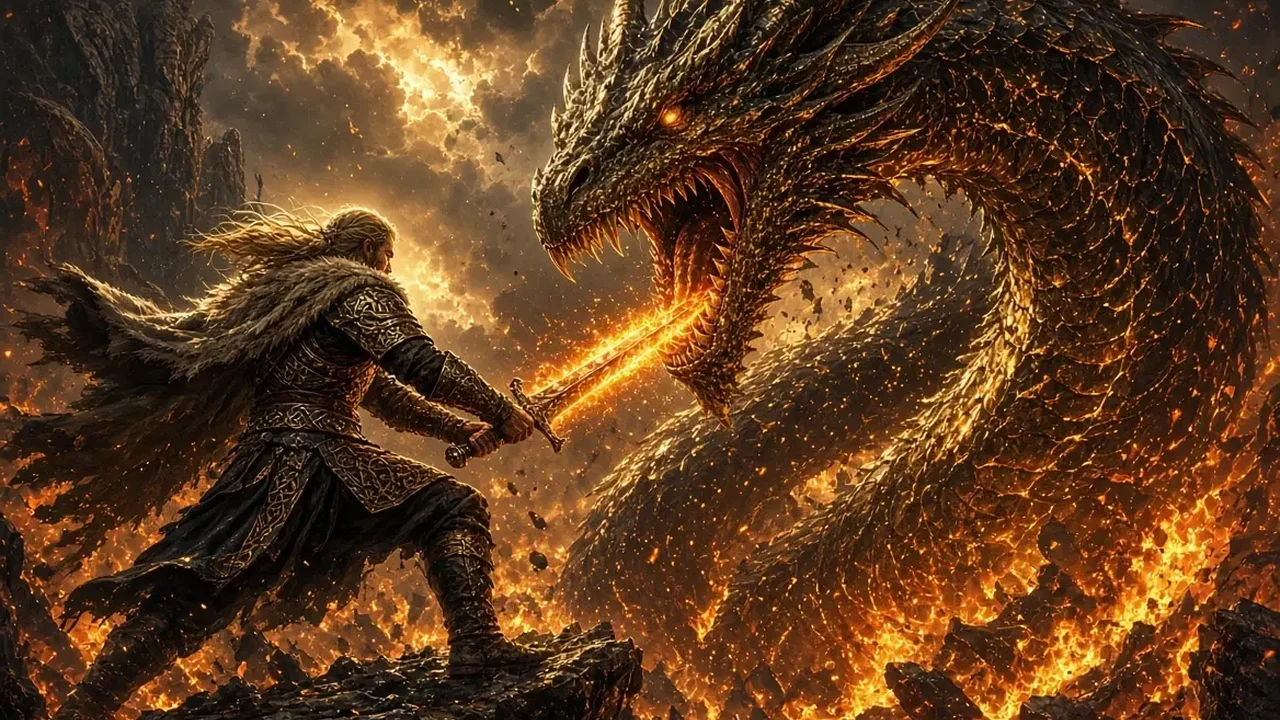
Sigurðr (Sigurd) kills the dragon Fáfnir in a famous heroic story preserved in the Old Norse Poetic Edda and Völsunga saga. Guided by the smith Regin, he prepares the sword Gram and ambushes the dragon by digging a trench across its path to water. When Fáfnir crosses over the hiding place, Sigurd strikes upward with the blade. Later, while cooking the dragon’s heart, he tastes its blood and understands the speech of birds, which warn him about Regin’s plans. The dangerous treasure behind the dragon is tied to a curse and to the gold associated with Andvari.
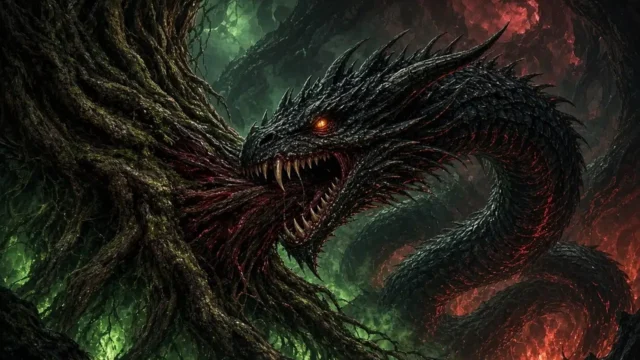
This guide explains Sigurd vs Fafnir dragon, who the hero is, why Fáfnir became a dragon, how the sword Gram enters the story, what the birds say and how Sigurd relates to the German hero Siegfried. The heroic scenes are artistic illustrations, not real photographs of dragons or ancient battles.
Who Is Sigurd in Norse Mythology and Heroic Legend?
Sigurðr, commonly written Sigurd or Sigurth in English, belongs to the legendary Völsung cycle of heroic tales. His father is Sigmund, and the narrative surrounds his youth with questions of royal ancestry, vengeance and extraordinary destiny. Sigurd is not one of the Æsir gods, even though Odin appears in stories connected with his family. He is a mortal or heroic human figure whose exploits become larger than life through mythic poetry. That distinction matters for readers searching for ‘Norse dragon slayer god’. Calling him Thor’s son, Loki’s brother or an immortal ruler of Asgard would confuse different parts of Old Norse literature. The hero’s most recognizable deed is killing Fáfnir, but his wider story also includes the fate of the Völsungs, the ring and treasure, and his eventual involvement with Brynhild and the Burgundian heroes. A useful featured image can show a warrior with a sword facing an enormous serpent or dragon. Its exact armor, hair and age remain modern interpretations rather than archaeological evidence.
Who Was Fáfnir Before Becoming a Dragon?
Fáfnir’s background is crucial to the story’s meaning. In the heroic cycle, he is a son of Hreiðmarr and brother of Regin and Ótr. The family’s tragedy begins when Loki kills Ótr, who has taken the shape of an otter. The gods are forced to provide compensation in gold. That gold comes from the dwarf Andvari and is associated with a curse. Fáfnir then murders his father to keep the wealth for himself, eventually taking dragon-like form to guard the treasure. Modern fantasy summaries often say Fáfnir was born as an ordinary dragon whose only ambition was to burn villages. The literary tradition is more disturbing: greed changes relationships and drives betrayal within a family. Dragon imagery makes the hoarded gold memorable, but the story is not simply about a monster existing to be killed. The cursed treasure affects human actions long after Fáfnir dies. Accurate captions should identify that moral complication rather than invent a detailed species chart of dragon biology.
Regin, the Smith Who Raised and Guided Sigurd
Regin is Sigurd’s foster father or mentor in the familiar heroic account and an accomplished smith. He tells the young hero about Fáfnir and the treasure, pressing him to seek the dragon. But Regin is also Fáfnir’s brother, so his involvement is deeply personal. Modern game art sometimes treats Regin as a random dwarf shopkeeper selling a powerful blade for coins. The surviving poems present a relationship full of instruction, ambition and risk. Regin’s demands also must be balanced against Sigurd’s duty to avenge his own father. In Reginsmál the hero is concerned that his father’s death be addressed before pursuing the gold. This interplay makes the action more meaningful than a simple fetch quest. A historically careful introduction can identify Regin as a smith and a member of Fáfnir’s family without claiming all supernatural metalworking in Norse mythology was performed by the same craftsman. Brokkr and Sindri, associated with Mjölnir, belong to a different treasure-making episode.
The Sword Gram: How Does Sigurd Obtain His Weapon?
The sword Gram is one of the key objects of the Völsung narrative. It is associated with Sigmund’s earlier sword and with Sigurd receiving a weapon powerful enough to face Fáfnir after work by Regin. In Reginsmál, Gram is described through tests emphasizing extraordinary sharpness, including cutting a strand of wool in flowing water and splitting Regin’s anvil. Versions of the sword’s making and reforging vary across heroic poetry and prose, so an article should identify the source of a particular detail. A common error is to call Gram Thor’s hammer or claim Odin uses it against Fenrir at Ragnarök. Gram belongs to Sigurd’s heroic legend. Its visual design, rune engravings and precise dimensions in current illustrations are not uniformly specified. A featured picture can show a strong sword and dragon without pretending the exact blade has been recovered from an archaeological site. The important narrative role is that this weapon makes Sigurd’s planned attack possible.
How Sigurd Kills Fáfnir from a Trench
The most recognizable scene comes from Fáfnismál. Sigurd and Regin find the route Fáfnir takes when crawling to water. Sigurd digs a trench or pit across that path and waits below the ground. When Fáfnir moves over the hiding place, Sigurd thrusts Gram upward into his body, reaching the heart. The serpent writhes, and hero and monster then speak. This is quite different from the common cinematic image of Sigurd riding a flying horse into a high-altitude battle against a fire-breathing beast. The source-grounded tactic is an ambush from below, not a conventional duel fought face-to-face in an open field. The story is supernatural literature and does not provide real instructions for approaching dangerous animals. Illustrators may adapt the angle for drama, but a factual poster should label the trench, the path to water and the decisive sword thrust. Those details give the event its distinctive character and help distinguish it from other famous dragon fights.
What Does Fáfnir Say Before He Dies?
Fáfnir is not merely a silent creature that vanishes after being struck. The poem gives him speech and allows a conversation with Sigurd. He asks who the young man is, and they discuss identity, danger and the terrible consequences connected with the gold. The dragon’s speech contributes to a larger theme: acquiring treasure through violence can bring ruin rather than simple happiness. Some fantasy summaries invent a final curse spoken by the dragon in modern English and treat it as a literal medieval quotation. A source-aware article instead refers to the actual poem and summarizes the warning without attributing invented lines. The conversation also makes Fáfnir’s monstrous shape less simple than a stock enemy in a video game. His greed and knowledge of the treasure matter as much as his physical strength. The hero’s victory is not the end of the story because the gold and Regin remain a threat.
Why Does Sigurd Understand the Language of Birds?
After Fáfnir’s death, Regin cuts out the dragon’s heart and asks Sigurd to cook it for him. While checking whether it is ready, Sigurd burns a finger and puts it in his mouth. A touch of the dragon’s heart blood reaches his tongue, after which he understands the speech of birds nearby. The birds warn that Regin plans to betray or kill him for the treasure, and they advise him how to protect himself. This is a major turning point in the narrative: the hero gains knowledge unexpectedly through the very creature he defeated. It is not a historical claim that blood from any real reptile grants human beings the ability to understand animal language. No one should imitate the scene in life. Some modern retellings swap the birds for Odin’s ravens Huginn and Muninn. Those named ravens are not the specified birds of this passage. A careful infographic can use a generic small bird and the label ‘birds warn Sigurd’, avoiding a false character identification.
What Happens to Regin and the Cursed Treasure?
Once Sigurd understands the birds, he becomes aware of Regin’s dangerous intentions. In the familiar heroic sequence he kills Regin and takes Fáfnir’s treasure. The wealth is associated with Andvari’s curse and becomes an important force in later tragedies. The famous ring Andvaranaut belongs to that treasure tradition, but its exact later ownership and significance differ across texts and modern adaptations. Some films turn the story into a simple moral where every coin is made from dragon scales, while others make the cursed ring identical to the single ring in a later fantasy novel. The Old Norse narrative has its own chain of ownership and wrongdoing. Loki’s taking of Andvari’s gold, Hreiðmarr’s family conflict, and Sigurd’s victory link different episodes. A reader searching for ‘Fafnir gold curse’ should see that continuity. The treasure brings power and danger rather than an uncomplicated happy ending.
Sigurd, Brynhild and the Road to Later Tragedy
After the dragon episode, the story turns toward the shield-maiden Brynhild or Sigrdrífa tradition and the larger Völsung saga. In Fáfnismál the birds direct Sigurd toward a sleeping warrior-maiden, which creates a bridge to later poems. The exact relationship between Brynhild, Sigrdrífa and different southern traditions is complex, so it is misleading to write that every surviving version presents one identical biography. Sigurd’s future includes love, oaths, deception and death, making the dragon’s treasure part of a wider tragic cycle. A school-friendly article can outline that direction without trying to compress the entire Volsung family history into one paragraph. The dragon victory is a turning point, not the complete end of Sigurd’s life. Modern art showing a sword-bearing rider, a sleeping warrior and glittering gold may combine several episodes; captions should indicate when an image is a montage rather than one exact scene from the poem.
Sigurd vs Siegfried, Fafnir Tattoo and Dragon Images
Sigurd is closely related to the German legendary figure Siegfried, made famous through different medieval and later adaptations. The names and core dragon-slaying theme overlap, but details change across the Norse Völsung material, the Nibelungenlied and Wagner’s operas. A useful comparison does not claim that every version describes the trench, sword and bird episode identically. Search queries include ‘Sigurd killing Fafnir dragon’, ‘Gram sword Norse mythology’, ‘Fafnir cursed treasure’, ‘Sigurd dragon blood birds’ and ‘Sigurd vs Siegfried difference’. A wide image with a warrior and dragon can work as a featured visual; the vertical poster can identify Regin, Gram, the pit, the heart and the bird warning. ALT text should describe what is actually visible, not force a false claim that the illustration shows an authentic historical dragon. Dragon tattoos can represent victory over greed or fear today, but the chosen design is modern symbolism rather than a guaranteed original Viking charm.
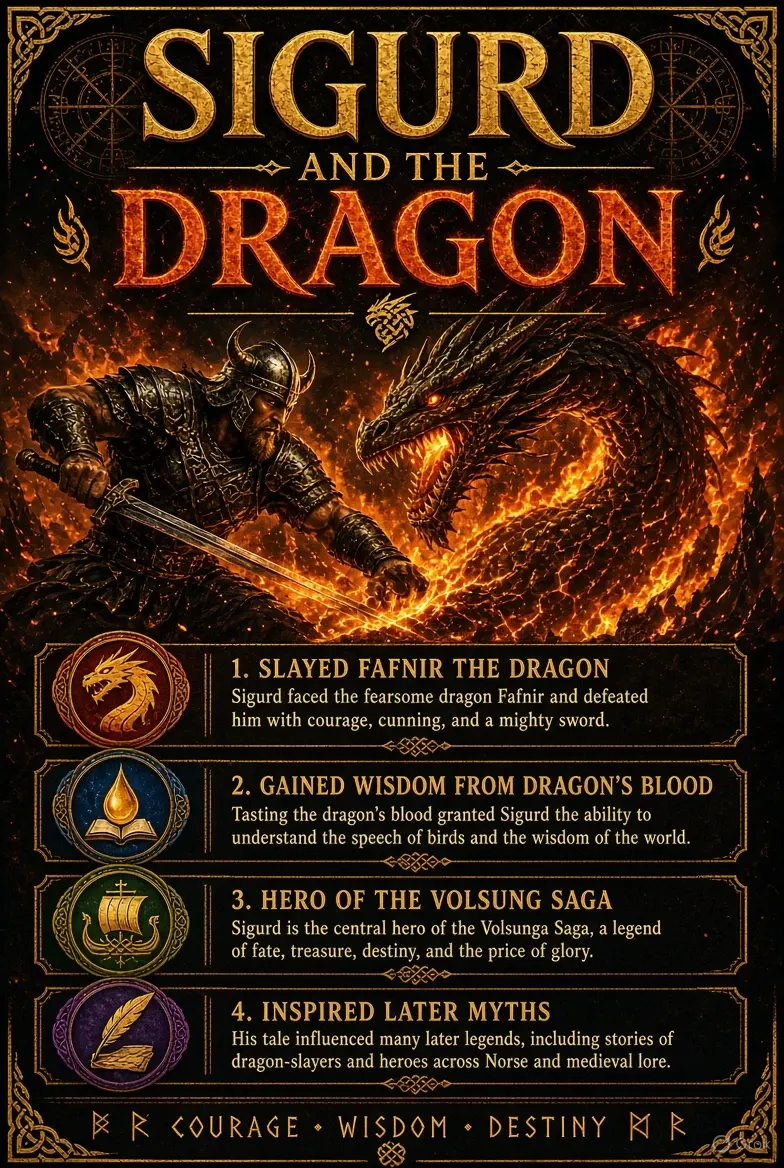
Artwork and source In the story Sigurd touches Fáfnir’s blood to his tongue while roasting the heart and comes to understand the birds. The tale does not claim that he learned all the world’s wisdom.
Frequently Asked Questions
Who kills Fáfnir in Norse mythology?
Sigurðr (Sigurd), the Völsung hero.
Was Fáfnir always a dragon?
No. In the story he is a member of Hreiðmarr’s family who becomes a treasure-guarding dragon.
What was Sigurd’s sword called?
Gram.
How did Sigurd kill Fáfnir?
He hid in a trench on the dragon’s route to water and thrust upward into its heart.
Why could Sigurd understand birds?
He tasted blood from Fáfnir’s heart while cooking it.
Are Sigurd and Siegfried identical in every source?
They are related legendary figures, but Norse and German versions differ in details.
Conclusion
Sigurd’s victory over Fáfnir is a story about strategy, a remarkable sword and the moral danger of hoarded wealth. Regin’s motives, the enchanted understanding of birds and the cursed gold make it more than a simple monster hunt. Keeping the old poem and later adaptations distinct makes the dragon artwork more accurate and useful.
Original sources and image note
Fáfnismál: Sigurd’s trench, Fáfnir and birds; Reginsmál: Regin, Gram, Andvari and the treasure; Völsunga saga: prose parallels to Sigurd and the dragon.
Reviewed 15 November 2026. Dragon imagery depicts legend and is not evidence of real creatures.


















Share Your Opinion
Comments are closed on this post.