 Vista
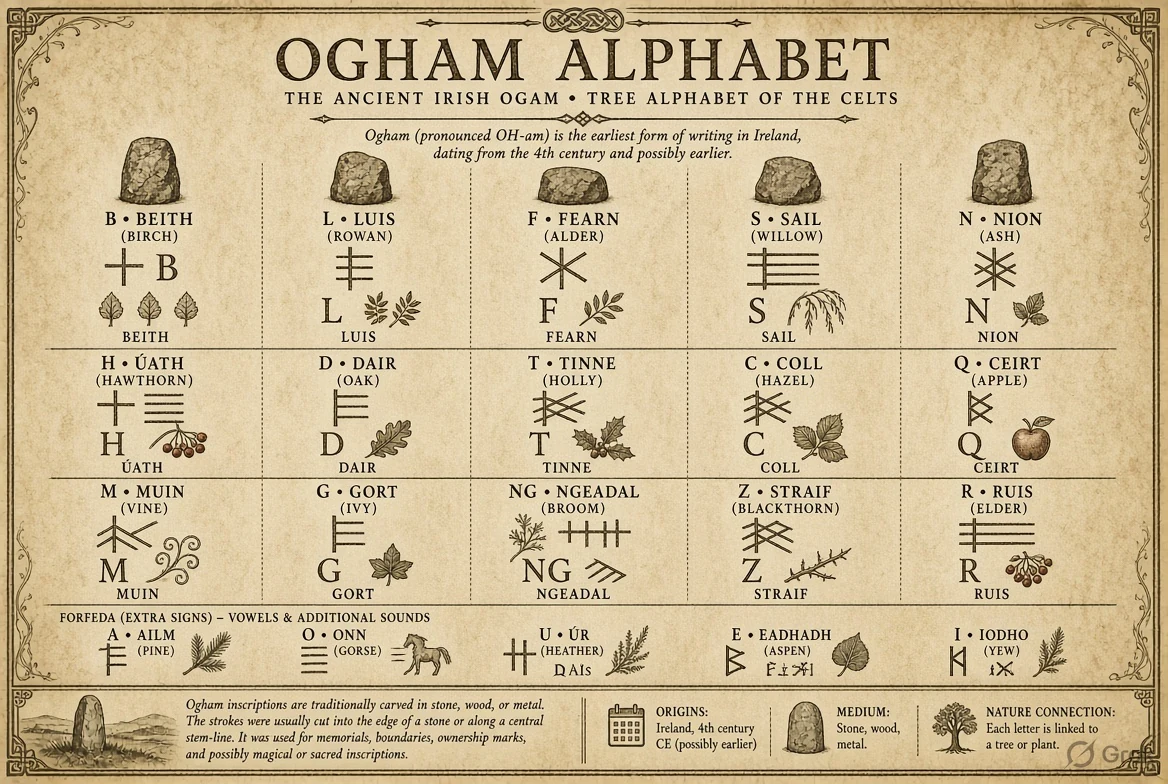
Direct answer: The Ogham alphabet chart shows an early Irish writing system with 20 primary characters made from strokes and notches around a stemline. Most stone inscriptions are read upward along an edge, while later supplementary signs are called forfeda. Use these three charts to understand real Ogham letters, reading direction and why English A–Z converters can be misleading.
Updated 20 November 2026. Chart is an educational transcription guide, not a reading of any particular archaeological inscription.
Ogham alphabet chart pictures: letters, stones and forfeda


Ogham alphabet chart: what the strokes really represent
Ogham is an early medieval alphabet associated especially with early Irish inscriptions. Instead of the familiar rounded letters of the Latin alphabet, its signs are built from short strokes or notches arranged in relation to a line. On a standing stone, the stone’s edge may act as that stemline. The number, placement and direction of marks distinguish letters. This visual structure is why a clear Ogham alphabet chart should show both the signs and the baseline orientation, not merely English letters printed beside random scratches.
Although it is frequently described as an “ancient Celtic tree alphabet”, surviving inscriptions principally record names and linguistic material. Medieval traditions connect many letter names to trees and poetic interpretations, but those later associations should not be mistaken for a universal instruction manual for ancient divination. To read an inscription accurately, first consider its writing direction, word divisions and historical language. A modern jewellery design that spells a person’s name may be a contemporary transliteration rather than a period-authentic inscription.
The 20 primary Ogham letters and their traditional groups
The classical system comprises twenty principal letters, arranged in four groups of five. Traditional group names include the aicmí associated with Beith, Huath, Muin and Ailm. In practical introductory charts, the groups are often shown as five consonants on one side of a stemline, five on the other, five crossing it and five vowel notches. Seeing these four structural families side by side helps a learner identify a letter without trying to memorise twenty isolated silhouettes.
Broad modern-letter approximations for the four groups are B–L–F–S–N, H–D–T–C–Q, M–G–NG–Z/R-related historical values, and A–O–U–E–I, but historical sound values are not always identical to modern English conventions. Different scholarly displays may use conventional transliterations rather than exact phonetic equivalents. The third group in particular should not be simplified into a confidently labelled English A-to-Z chart. Use a specialist table when reading Old Irish personal names or studying the original sound system.
How to read Ogham on a standing stone
A characteristic Ogham inscription follows an edge of a stone. In many examples the reading proceeds from the bottom upwards along one edge. Longer inscriptions may continue over the top and down another side. That direction is crucial: if you start at the wrong end or reverse the stemline, letters and names can become nonsensical. Horizontal manuscript Ogham and computer-font displays may instead run left to right, reflecting the conventions of later writing and modern text layout.
The image below separates a letter chart from an inscription-direction guide for precisely this reason. Before transcribing, find the stemline or edge, note which strokes sit to its left and right, and count the groups carefully. Surface damage, lichen and irregular carving can obscure short notches. Do not infer a missing mark solely because a modern English word seems plausible. Archaeologists and epigraphers use photographs, site context, comparative readings and established corpora for uncertain inscriptions.
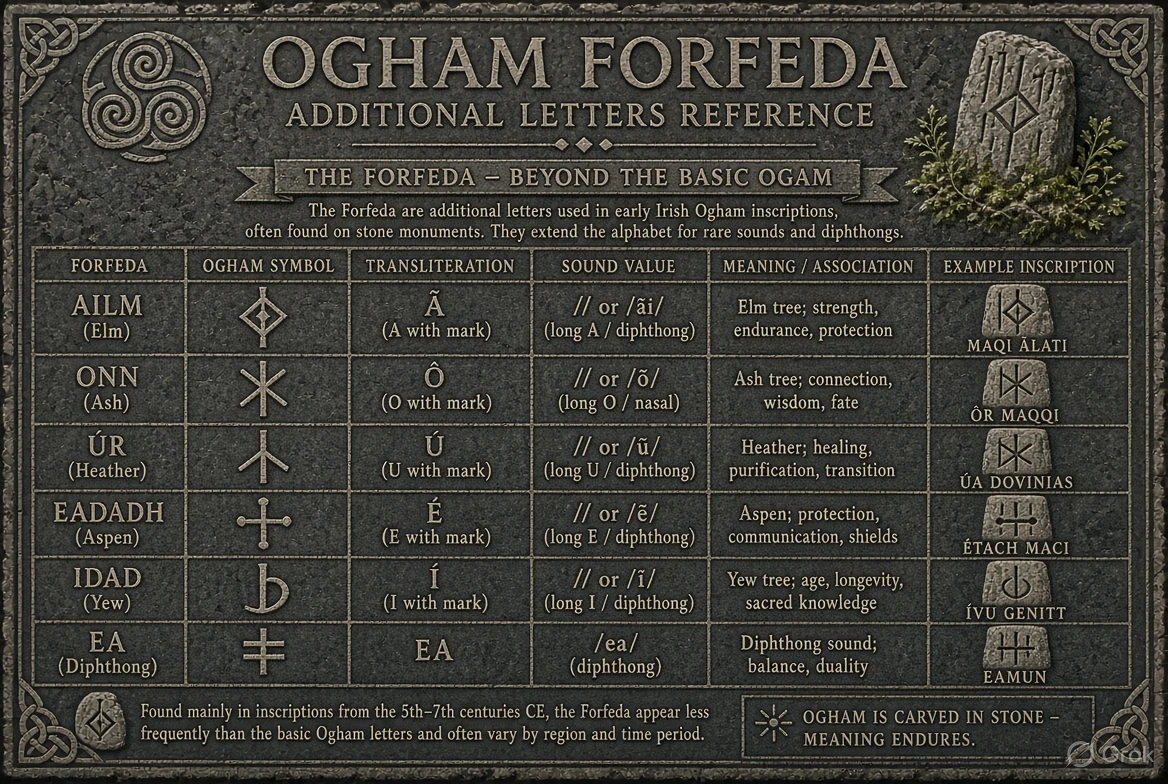
What are forfeda? Supplementary Ogham characters explained
Forfeda are additional characters known from later Ogham traditions. They are usually distinguished from the twenty primary letters taught to beginners. Some popular charts present five supplementary signs, while the Unicode character repertoire describes 26 Ogham letters in all, with six supplementary entries in its encoded set. The difference reflects how various manuscripts, scholarly conventions and digital inventories are counted, not a reason to dismiss primary inscriptions.
For a reliable reference chart, label the main twenty separately from the forfeda. Do not assume every supplementary sign occurs on early memorial stones or that all periods used the same spelling conventions. Unicode provides character encoding for digital text, but an encoded repertoire does not itself prove that a particular historical community carved every displayed character on a dated monument. That is a distinct archaeological question. Where a chart uses later forms, indicate that openly.
Ogham to English translator: what online converters can and cannot do
People searching for an Ogham alphabet translator usually want to render a modern name, date, motto or short sentence. A converter can replace Roman letters with a selected set of Ogham characters, but that is a transliteration, not automatically a translation into Old Irish. The names James, Aisha or London written in Ogham-style signs remain modern names; their historical linguistic and grammatical status does not change because their shape resembles a stone inscription.
English contains letter combinations and sounds that do not map neatly to the original Ogham system. Q, V, W, X and Y can require conventions or approximations depending on what exactly is being encoded. Gaelic orthography has changed across centuries as well. For serious heritage projects, decide first whether you want modern Irish spelling, a historical Old Irish form or a purely decorative modern spelling. Label the resulting artwork accordingly and consider asking a competent language specialist to review permanent inscriptions.
Ogham tattoos, jewellery and name engravings: accuracy checklist
An Ogham name tattoo can be visually striking, but one reversed stroke may change the intended reading. Confirm the precise name spelling before converting it. Compare at least two independent tables rather than trusting an anonymous screenshot. Verify whether your artist has placed the letters on a vertical stemline, a horizontal baseline or around an ornamental motif. If the design is meant to resemble a memorial stone, carefully check bottom-to-top orientation.
Be sceptical of claims that an Ogham pendant automatically grants a specific mystical power. Such assertions are modern belief claims, not evidence supplied by the script’s archaeological record. Also separate tree-name lore from the literal letters: a symbol associated with a tree in later commentary may still be functioning as a consonant in an actual inscription. For a classroom display, annotate the graphic with the words “historical alphabet”, “traditional letter name” and “modern transliteration” where needed.
Ogham vs runes, Latin letters and Adinkra symbols
Ogham and runes are sometimes shown together in “Celtic symbols charts”, but they are different scripts with different letterforms, histories and language relationships. Ogham is especially associated with the Irish linguistic sphere; the Germanic runic alphabets are a different tradition. Latin letters later became dominant for writing Irish and are used in its modern standard script. They may spell the same language, but visually they operate in a very different way.
Adinkra, in contrast, is a symbolic system expressing named ideas rather than an ordinary phonetic alphabet. This distinction matters in search results because “symbol” can refer to a character, a value-based motif or a decorative image. Ask whether the chart teaches how to spell a word, how to interpret a proverb or simply how to recognise a design. An honest Ogham guide should focus on encoding, letter groups, reading direction and attested historical usage.
Frequently asked questions: Ogham letters and translation
How many letters are in the Ogham alphabet?
The basic alphabet has twenty primary letters. The Unicode repertoire additionally includes six supplementary letters, while some historical presentations group the additions differently.
Is Ogham the same as a Celtic tree alphabet?
Ogham is a real writing system. Tree-based letter associations survive in medieval lore, but not every interpretation advertised online is a historical fact.
How do you read Ogham from bottom to top?
On many stones, begin at the lower end of an inscribed edge, follow the stemline upwards and count strokes relative to the edge.
Can I write my name in Ogham?
Yes, as a modern transliteration. That does not automatically turn the name into an authentic Old Irish word.
Is an Ogham alphabet A–Z chart historically exact?
No. English’s 26-letter arrangement is not the same as the structure or historical sound values of primary Ogham letters.
Conclusion: the right Ogham chart starts with the stemline
Ogham is best approached as a historical script, not a mystical font with effortless English equivalents. The twenty-letter table explains how marks differ; a stone-reading diagram explains orientation; and a supplementary chart shows why not every letter belongs to the original set. Use Unicode and epigraphic resources to validate spellings before committing them to jewellery, prints or tattoos.
Sources
Unicode Standard, Chapter 8: Ogham script and reading direction; Unicode Ogham block character chart. Study specific inscriptions with archaeological catalogues rather than inferring them from decorative artwork.



Share Your Opinion
Comments are closed on this post.